Recognition: no theorem link
Effective null geodesics and black hole images in Kruglov nonlinear electrodynamics
Pith reviewed 2026-05-11 01:04 UTC · model grok-4.3
The pith
Kruglov nonlinear electrodynamics produces stable photon orbits outside black hole horizons for small positive q, changing the appearance of relativistic images.
A machine-rendered reading of the paper's core claim, the machinery that carries it, and where it could break.
Core claim
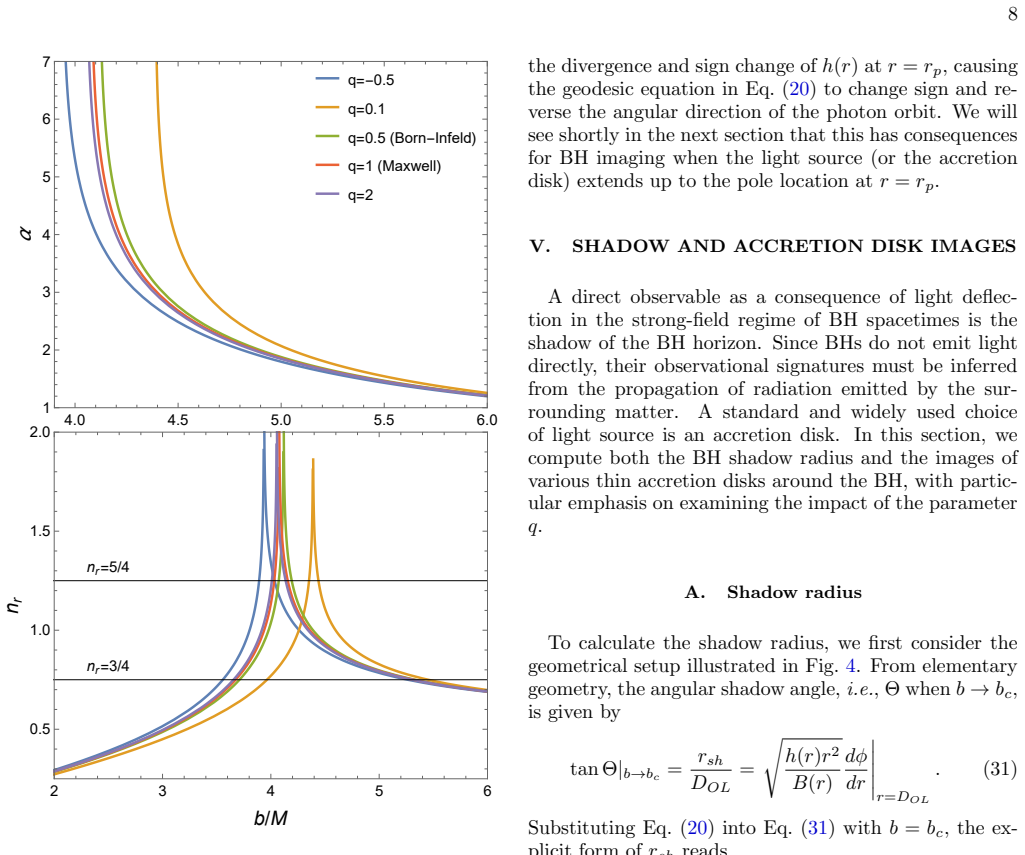
In the Kruglov model the effective null geodesics are set by a geometry extracted from the nonlinear electrodynamics Lagrangian. For sufficiently small positive q this geometry admits stable photon orbits outside the event horizon, modifies the interval of impact parameters that permit multiple photon trajectories, and therefore produces observable shifts in the relativistic images and in the black-hole shadow, all while the underlying spacetime metric remains close to the Reissner-Nordström case.
What carries the argument
The effective geometry for null geodesics obtained from the Kruglov nonlinear electrodynamics Lagrangian, which dictates photon trajectories independently of the spacetime metric.
If this is right
- Stable photon orbits appear outside the event horizon when q is small and positive.
- The range of impact parameters supporting multiple photon trajectories changes noticeably.
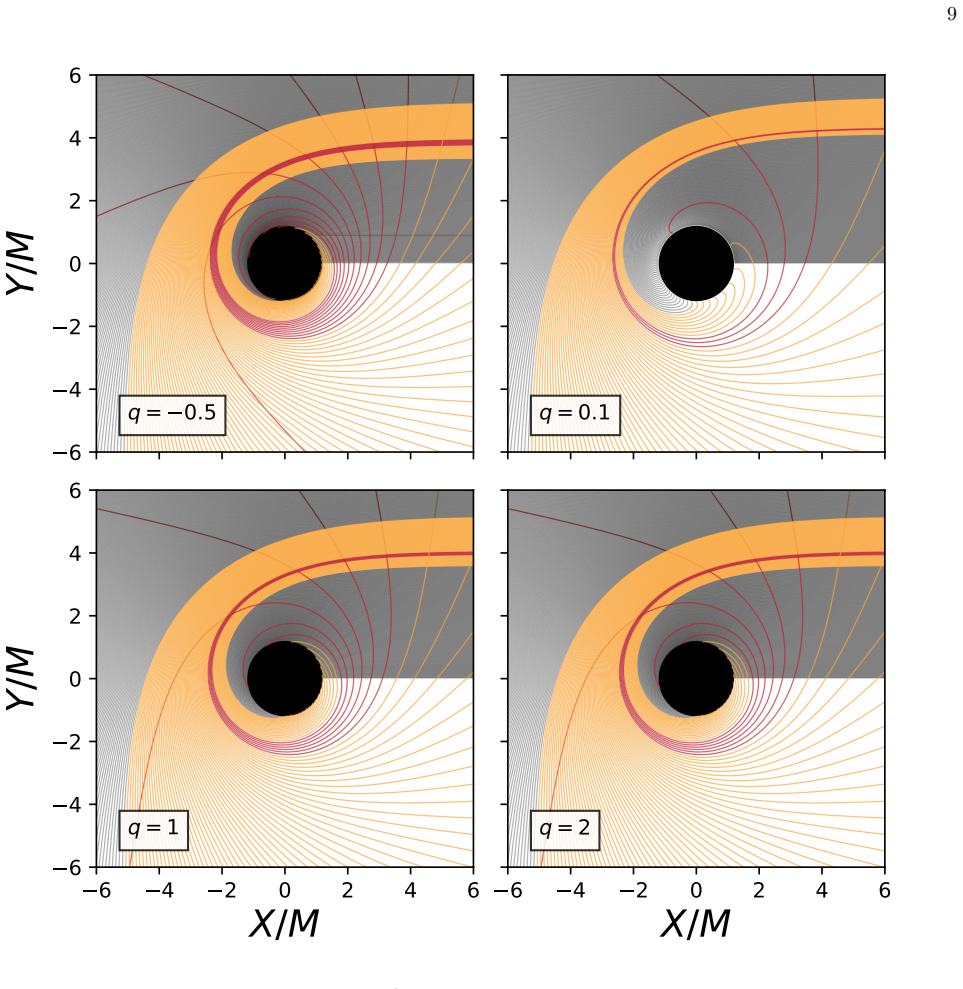
- Accretion-disk images and relativistic rings exhibit systematic brightness and position variations.
- Black-hole shadow sizes and shapes deviate from pure Reissner-Nordström predictions in ways testable with current horizon-scale data.
Where Pith is reading between the lines
- Observations of black-hole images could constrain the Kruglov parameter independently of tests that rely only on the spacetime metric.
- The same mechanism may operate in other nonlinear electrodynamics models, offering a general route to separate electromagnetic nonlinearity from gravitational modifications.
- Extending the numerical geodesic integrations to rotating black holes would reveal whether spin strengthens or weakens the stability of these extra photon orbits.
Load-bearing premise
The effective metric derived from the Kruglov Lagrangian is assumed to govern photon propagation correctly and without hidden instabilities that would change the reported stable orbits.
What would settle it
High-resolution images of Sgr A* or M87* that show no stable-orbit signatures or no corresponding shift in shadow size and ring structure for the relevant range of q would contradict the predicted modifications to photon trajectories.
Figures




read the original abstract
We investigate the effective photon geometry associated with black holes in Kruglov nonlinear electrodynamics and its consequences for strong-field optical phenomena. This model constitutes a one-parameter generalization of Born-Infeld electrodynamics, interpolating between Maxwell theory and exponential electrodynamics through the parameter $q$. For a wide range of $q$, the spacetime geometry outside the event horizon remains close to the Reissner-Nordstr\"om solution, while photon propagation is governed by an effective geometry that depends sensitively on the nonlinear electrodynamics sector. We study the corresponding null geodesic structure through fully numerical calculations, focusing on photon spheres, light deflection, black hole shadows, and accretion-disk images. The effective geometry shows qualitatively distinct features depending on $q$. In particular, sufficiently small positive values of $q$ generate stable photon orbits outside the event horizon, together with significant modifications to the range of impact parameters supporting multiple photon trajectories. These effects produce observable modifications in the relativistic images, including systematic variations in the effective geometry. We also analyze the black hole shadow in relation to current horizon-scale constraints on Sgr~A*. Our results demonstrate that nonlinear electrodynamics can substantially modify photon propagation and relativistic image formation even when the underlying spacetime gometry remains close to the Maxwell electrodynamics case.
Editorial analysis
A structured set of objections, weighed in public.
Referee Report
Summary. The manuscript examines the effective null geometry for black holes in Kruglov nonlinear electrodynamics, a one-parameter generalization of Born-Infeld theory parameterized by q. It performs fully numerical integrations of null geodesics in the derived effective metric (while the background spacetime remains close to Reissner-Nordström) and claims that sufficiently small positive q produces stable photon orbits outside the event horizon, modifies the range of impact parameters admitting multiple photon trajectories, and yields observable changes in relativistic images, light deflection, and black-hole shadows, with comparisons to Sgr A* constraints.
Significance. If the reported stability and image modifications hold under scrutiny, the work demonstrates that nonlinear electrodynamics can induce qualitatively new strong-field lensing features even when the metric is perturbatively close to the Maxwell case, offering a concrete example of how the photon sector decouples from the background geometry. The emphasis on fully numerical geodesic calculations is a methodological strength that could be strengthened by reproducibility details.
major comments (2)
- [§4] §4 (photon-sphere and stability analysis): The central claim that small positive q generates stable photon orbits outside the horizon rests on forward numerical integration of the geodesic equations with initial conditions tuned to circular orbits. No effective radial potential is constructed, no second-derivative test for stability is performed, and no suite of perturbed trajectories is shown. In the q=0 Reissner-Nordström limit these orbits are known to be unstable; without such tests the reported stability and consequent changes in multiple-image impact-parameter ranges cannot be distinguished from numerical artifacts or marginal cases.
- [Numerical methods (near §3–4)] Numerical methods paragraph (near §3–4): The abstract and text state that “fully numerical calculations” were performed, yet no integration scheme, adaptive step-size control, convergence tests, or error estimates on the reported orbit radii or impact-parameter boundaries are supplied. This absence directly affects in the qualitative distinctions claimed for small positive q.
minor comments (2)
- [§3] The definition of the effective metric tensor components (Eq. (X) in §3) should explicitly state the relation to the Kruglov Lagrangian invariants to avoid ambiguity when readers compare with other NED models.
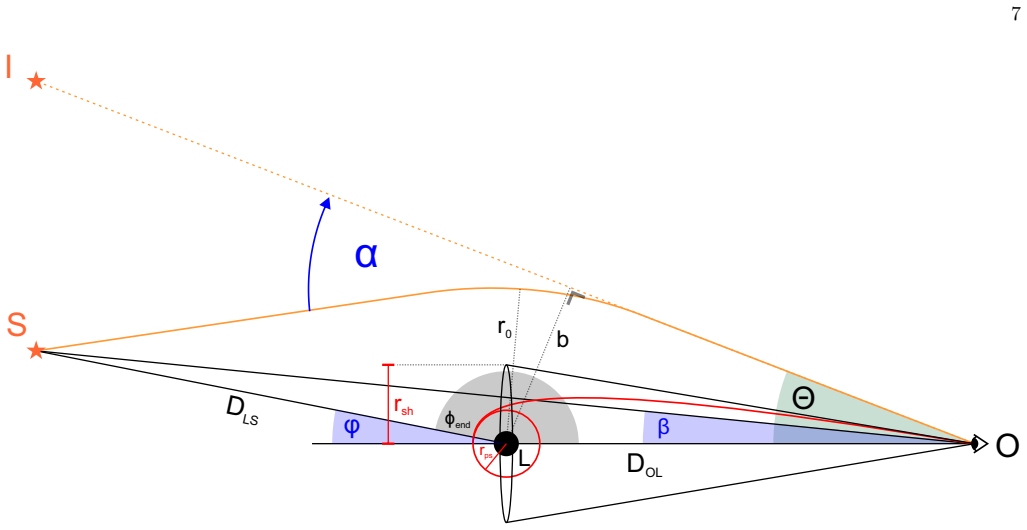
- [Figures 4–6] Figure captions for the shadow and accretion-disk images lack quantitative labels for the impact-parameter ranges shown; adding these would improve clarity of the claimed modifications.
Simulated Author's Rebuttal
We thank the referee for the careful reading of our manuscript and for the constructive comments, which help clarify the presentation of our numerical results on photon orbits in the effective geometry of Kruglov nonlinear electrodynamics. We address each major comment below and will incorporate revisions to strengthen the stability analysis and numerical methodology.
read point-by-point responses
-
Referee: [§4] §4 (photon-sphere and stability analysis): The central claim that small positive q generates stable photon orbits outside the horizon rests on forward numerical integration of the geodesic equations with initial conditions tuned to circular orbits. No effective radial potential is constructed, no second-derivative test for stability is performed, and no suite of perturbed trajectories is shown. In the q=0 Reissner-Nordström limit these orbits are known to be unstable; without such tests the reported stability and consequent changes in multiple-image impact-parameter ranges cannot be distinguished from numerical artifacts or marginal cases.
Authors: We agree that the stability claim would be more robust with an explicit effective potential and analytical stability test. Our numerical integrations of the geodesic equations in the effective metric, initialized at candidate circular-orbit radii, show long-term bounded motion for small positive q (in contrast to the q=0 case), but we did not construct the radial potential or perform the second-derivative test in the submitted version. In the revised manuscript we will derive the effective radial potential for null geodesics, evaluate the second derivative at the circular-orbit radius to confirm stability, and add representative plots of slightly perturbed trajectories to demonstrate that the orbits remain bound rather than exhibiting secular drift. This will also clarify the impact-parameter ranges for multiple images. revision: yes
-
Referee: [Numerical methods (near §3–4)] Numerical methods paragraph (near §3–4): The abstract and text state that “fully numerical calculations” were performed, yet no integration scheme, adaptive step-size control, convergence tests, or error estimates on the reported orbit radii or impact-parameter boundaries are supplied. This absence directly affects in the qualitative distinctions claimed for small positive q.
Authors: We acknowledge that the numerical-methods description was insufficient. The integrations were carried out with a fourth-order Runge-Kutta integrator employing adaptive step-size control based on local truncation error, together with convergence checks by varying the tolerance parameter and verifying that orbit radii and impact-parameter boundaries stabilize to within 0.1 percent. These details were omitted from the original text. In the revised manuscript we will insert a dedicated numerical-methods subsection specifying the integrator, adaptive-step algorithm, convergence criteria, and error estimates on the photon-sphere radii and critical impact parameters, thereby supporting the reported distinctions for small positive q. revision: yes
Circularity Check
No circularity: numerical geodesics in independently derived effective metric
full rationale
The paper starts from the Kruglov NED Lagrangian, derives the effective null geometry via standard methods for nonlinear electrodynamics, and then performs forward numerical integration of the geodesic equations in that fixed metric. No quantities are fitted to the computed orbits or images, no self-referential definitions equate inputs to outputs, and no load-bearing steps reduce to self-citations or ansatzes imported from the authors' prior work. The reported features of photon spheres and images are direct consequences of the numerical solutions rather than tautological restatements of the initial Lagrangian or metric choice. This matches the default expectation of a self-contained computation.
Axiom & Free-Parameter Ledger
free parameters (1)
- q
axioms (1)
- domain assumption Einstein gravity sourced by Kruglov nonlinear electrodynamics
Reference graph
Works this paper leans on
-
[1]
On the deflection of a light ray from its rectilinear motion, by the attraction of a celestial body at which it nearly passes by
J. G. v. Soldner, “On the deflection of a light ray from its rectilinear motion, by the attraction of a celestial body at which it nearly passes by”,Berliner Astronomisches Jahrbuch, 161 (1801-1804)
-
[2]
Gravitational Lenses,
P. Schneider, J. Ehlers and E. E. Falco, “Gravitational Lenses,” Springer, 1992
1992
-
[3]
In- troduction to gravitational lensing and cosmology,
P. Schneider, C. S. Kochanek, and J. Wambsganss, “In- troduction to gravitational lensing and cosmology,” in Gravitational Lensing: Strong, Weak and Micro (2006)
2006
-
[4]
A Determination of the Deflection of Light by the Sun’s Gravitational Field, from Observations Made at the To- tal Eclipse of May 29, 1919,
F. W. Dyson, A. S. Eddington and C. Davidson, “A Determination of the Deflection of Light by the Sun’s Gravitational Field, from Observations Made at the To- tal Eclipse of May 29, 1919,” Phil. Trans. Roy. Soc. Lond. A220, 291 (1920)
1919
-
[5]
Gravitation and Light,
O. J. Lodge, “Gravitation and Light,” Nature104, 354 (1919)
1919
-
[6]
Gravitational Lenses,
S. Liebes, “Gravitational Lenses,” Phys. Rev.133, B835 (1964)
1964
-
[7]
The gravitational lens effect,
S. Refsdal, “The gravitational lens effect,” Mon. Not. Roy. Astron. Soc.128, 295 (1964)
1964
-
[8]
Cosmological appli- cations of gravitational lensing,
R. D. Blandford and R. Narayan, “Cosmological appli- cations of gravitational lensing,” Ann. Rev. Astron. As- trophys.30, 311 (1992)
1992
-
[9]
Gravitational lensing from a spacetime per- spective,
V. Perlick, “Gravitational lensing from a spacetime per- spective,” Living Rev. Rel.7, 9 (2004)
2004
-
[10]
The gravity field of a particle I,
C. Darwin, “The gravity field of a particle I,” Proc. Roy. Soc. Lond.A249, p. 180 (1959)
1959
-
[11]
Gravitational Lensing by Black Holes,
V. Bozza, “Gravitational Lensing by Black Holes,” Gen. Rel. Grav.42, 2269 (2010), arXiv:0911.2187
-
[12]
Image of a spherical black hole with thin accretion disk,
J. P. Luminet, “Image of a spherical black hole with thin accretion disk,” Astron. Astrophys.75(1979), 228-235
1979
- [13]
-
[14]
First M87 Event Horizon Telescope Results. I. The Shadow of the Supermassive Black Hole
K. Akiyamaet al.[Event Horizon Telescope], “First M87 Event Horizon Telescope Results. I. The Shadow of the 15 Supermassive Black Hole,” Astrophys. J. Lett.875, L1 (2019), arXiv:1906.11238
work page internal anchor Pith review arXiv 2019
-
[15]
First M87 Event Horizon Telescope Results. II. Array and Instrumentation,
K. Akiyamaet al.[Event Horizon Telescope], “First M87 Event Horizon Telescope Results. II. Array and Instrumentation,” Astrophys. J. Lett.875, L2 (2019), arXiv:1906.11239
-
[16]
First M87 Event Horizon Telescope Results. III. Data Processing and Calibration,
K. Akiyamaet al.[Event Horizon Telescope], “First M87 Event Horizon Telescope Results. III. Data Processing and Calibration,” Astrophys. J. Lett.875, L3 (2019), arXiv:1906.11240
-
[17]
Akiyama et al., First M87 Event Horizon Telescope Results
K. Akiyamaet al.[Event Horizon Telescope], “First M87 Event Horizon Telescope Results. IV. Imaging the Cen- tral Supermassive Black Hole,” Astrophys. J. Lett.875, L4 (2019), arXiv:1906.11241
-
[18]
First M87 Event Horizon Telescope Results. V. Physical Origin of the Asymmetric Ring
K. Akiyamaet al.[Event Horizon Telescope], “First M87 Event Horizon Telescope Results. V. Physical Origin of the Asymmetric Ring,” Astrophys. J. Lett.875, L5 (2019), arXiv:1906.11242
work page Pith review arXiv 2019
-
[19]
First M87 Event Horizon Telescope Results. VI. The Shadow and Mass of the Central Black Hole
K. Akiyamaet al.[Event Horizon Telescope], “First M87 Event Horizon Telescope Results. VI. The Shadow and Mass of the Central Black Hole,” Astrophys. J. Lett.875, L6 (2019), arXiv:1906.11243
work page Pith review arXiv 2019
-
[20]
First M87 Event Horizon Telescope Results. VII. Polariza- tion of the Ring,
K. Akiyamaet al.[Event Horizon Telescope], “First M87 Event Horizon Telescope Results. VII. Polariza- tion of the Ring,” Astrophys. J. Lett.910, L12 (2021), arXiv:2105.01169
-
[21]
First M87 Event Horizon Telescope Results. VIII. Magnetic Field Structure near The Event Horizon,
K. Akiyamaet al.[Event Horizon Telescope], “First M87 Event Horizon Telescope Results. VIII. Magnetic Field Structure near The Event Horizon,” Astrophys. J. Lett. 910, L13 (2021), arXiv:2105.01173
-
[22]
First M87 Event Horizon Telescope Results. IX. Detection of Near-horizon Circular Polarization,
K. Akiyamaet al.[Event Horizon Telescope], “First M87 Event Horizon Telescope Results. IX. Detection of Near- horizon Circular Polarization,” Astrophys. J. Lett.957, L20 (2023), arXiv:2311.10976
-
[23]
K. Akiyamaet al.[Event Horizon Telescope], “First Sagittarius A* Event Horizon Telescope Results. I. The Shadow of the Supermassive Black Hole in the Center of the Milky Way,” Astrophys. J. Lett.930, L12 (2022) arXiv:2311.08680
work page internal anchor Pith review arXiv 2022
-
[24]
K. Akiyamaet al.[Event Horizon Telescope], “First Sagittarius A* Event Horizon Telescope Results. II. EHT and Multiwavelength Observations, Data Processing, and Calibration,” Astrophys. J. Lett.930, L13 (2022), arXiv:2311.08679
-
[25]
K. Akiyamaet al.[Event Horizon Telescope], “First Sagittarius A* Event Horizon Telescope Results. III. Imaging of the Galactic Center Supermassive Black Hole,” Astrophys. J. Lett.930, L14 (2022), arXiv:2311.09479
-
[26]
K. Akiyamaet al.[Event Horizon Telescope], “First Sagittarius A* Event Horizon Telescope Results. IV. Variability, Morphology, and Black Hole Mass,” Astro- phys. J. Lett.930, L15 (2022), arXiv:2311.08697
-
[27]
K. Akiyamaet al.[Event Horizon Telescope], “First Sagittarius A* Event Horizon Telescope Results. V. Testing Astrophysical Models of the Galactic Center Black Hole,” Astrophys. J. Lett.930, L16 (2022), arXiv:2311.09478
-
[28]
First Sagittarius A* Event Horizon Telescope Results. VI. Testing the Black Hole Metric,
K. Akiyamaet al.[Event Horizon Telescope], “First Sagittarius A* Event Horizon Telescope Results. VI. Testing the Black Hole Metric,” Astrophys. J. Lett.930, L17 (2022), arXiv:2311.09484
-
[29]
First Sagittarius A* Event Horizon Telescope Results. VII. Polarization of the Ring,
K. Akiyamaet al.[Event Horizon Telescope], “First Sagittarius A* Event Horizon Telescope Results. VII. Polarization of the Ring,” Astrophys. J. Lett.964, L25 (2024)
2024
-
[30]
First Sagittarius A* Event Horizon Telescope Results. VIII. Physical Interpretation of the Polarized Ring,
K. Akiyamaet al.[Event Horizon Telescope], “First Sagittarius A* Event Horizon Telescope Results. VIII. Physical Interpretation of the Polarized Ring,” Astro- phys. J. Lett.964, L26 (2024)
2024
-
[31]
Non-singular general-relativistic gravita- tional collapse,
J. Bardeen, “Non-singular general-relativistic gravita- tional collapse,”Proc. Int. Conf. GR5,Tbilisi174, 1968
1968
-
[32]
The Bardeen Model as a Nonlinear Magnetic Monopole
E. Ayon-Beato and A. Garcia, “The Bardeen model as a nonlinear magnetic monopole,” Phys. Lett. B493, 149 (2000), arXiv:gr-qc/0009077
work page Pith review arXiv 2000
-
[33]
Foundations of the new field theory,
M. Born and L. Infeld, “Foundations of the new field theory,” Nature132, 1004.1 (1933)
1933
-
[34]
Nonlinear electrody- namics and general relativity,
R. Pellicer and R. J. Torrence, “Nonlinear electrody- namics and general relativity,” J. Math. Phys.10, 1718 (1969)
1969
-
[35]
Duality Rota- tions and TypeDSolutions to Einstein Equations With Nonlinear Electromagnetic Sources,
I. H. Salazar, A. Garcia and J. Plebanski, “Duality Rota- tions and TypeDSolutions to Einstein Equations With Nonlinear Electromagnetic Sources,” J. Math. Phys.28, 2171 (1987)
1987
-
[36]
Nonlinear Electrody- namics and black holes,
N. Breton and R. Garcia-Salcedo, “Nonlinear Electrody- namics and black holes,” arXiv:hep-th/0702008
-
[37]
Detecting photon-photon scattering in vacuum at exawatt lasers,
D. Tommasini, A. Ferrando, H. Michinel and M. Seco, “Detecting photon-photon scattering in vacuum at exawatt lasers,” Phys. Rev. A77, 042101 (2008), arXiv:0802.0101
-
[38]
A photon–photon collider in a vacuum hohlraum,
O. J. Pike, F. Mackenroth, E. G. Hill and S. J. Rose, “A photon–photon collider in a vacuum hohlraum,” Nature Photon8, 434 (2014)
2014
-
[39]
Remarks on nonlinear Electrodynamics,
P. Gaete and J. Helay¨ el-Neto, “Remarks on nonlinear Electrodynamics,” Eur. Phys. J. C74, 3182 (2014), arXiv:1408.3363
-
[40]
Vacuum mate- rial properties and Cherenkov radiation in logarith- mic electrodynamics,
P. Gaete and J. A. Helay¨ el-Neto, “Vacuum mate- rial properties and Cherenkov radiation in logarith- mic electrodynamics,” Eur. Phys. J. C83, 128 (2023), arXiv:2205.03252
-
[41]
Photon-photon scattering in Born-Infeld electrodynamics,
H. Kadlecova, “Photon-photon scattering in Born-Infeld electrodynamics,” Proc. SPIE Int. Soc. Opt. Eng.12580, 1258007 (2023)
2023
-
[42]
Notes on Born–Infeld-type electrody- namics,
S. I. Kruglov, “Notes on Born–Infeld-type electrody- namics,” Mod. Phys. Lett. A32, 1750201 (2017), arXiv:1612.04195
-
[43]
Born–Infeld-type electrodynamics and magnetic black holes,
S. I. Kruglov, “Born–Infeld-type electrodynamics and magnetic black holes,” Annals Phys.383, 550 (2017), arXiv:1707.04495
-
[44]
Geometrical aspects of light propagation in nonlinear electrodynamics
M. Novello, V. A. De Lorenci, J. M. Salim and R. Klip- pert, “Geometrical aspects of light propagation in non- linear electrodynamics,” Phys. Rev. D61, 045001 (2000), arXiv:gr-qc/9911085
work page Pith review arXiv 2000
-
[45]
Geodesic of non- linear electrodynamics and stable photon orbits,
A. S. Habibina and H. S. Ramadhan, “Geodesic of non- linear electrodynamics and stable photon orbits,” Phys. Rev. D101, 124036 (2020), arXiv:2007.03211
-
[46]
Strong lensing and shadow of Ayon-Beato–Garcia (ABG) nonsingular black hole,
H. S. Ramadhan, M. F. Ishlah, F. P. Pratama and I. Al- fredo, “Strong lensing and shadow of Ayon-Beato–Garcia (ABG) nonsingular black hole,” Eur. Phys. J. C83, 465 (2023), arXiv:2303.10921
-
[47]
Comment on “Strong lensing and shadow of Ayon-Beato–Garcia (ABG) nonsingular black hole
M. F. Fauzi, “Comment on “Strong lensing and shadow of Ayon-Beato–Garcia (ABG) nonsingular black hole”,” Eur. Phys. J. C85, 1246 (2025), arXiv:2509.24777
-
[48]
Effect of nonlinear electrodynamics on polarization distribution around black holes,
A. Tlemissov, B. Toshmatov and J. Kov´ aˇ r, “Effect of nonlinear electrodynamics on polarization distribution around black holes,” Phys. Rev. D111, 064084 (2025), arXiv:2503.08294. 16
-
[49]
R. Kumar Walia, “Exploring nonlinear electrodynamics theories: Shadows of regular black holes and horizonless ultracompact objects,” Phys. Rev. D110, 064058 (2024), arXiv:2409.13290
-
[50]
E. Guzman-Herrera, A. Montiel and N. Breton, “Com- parative of light propagation in Born-Infeld, Euler- Heisenberg and ModMax nonlinear electrodynamics,” JCAP11, 002 (2024), arXiv:2407.21326
-
[51]
S. Murk and I. Soranidis, “Light rings and causality for nonsingular ultracompact objects sourced by nonlin- ear electrodynamics,” Phys. Rev. D110, 044064 (2024), arXiv:2406.07957
-
[52]
Regular Magnetic Black Holes and Monopoles from Nonlinear Electrodynamics
K. A. Bronnikov, “Regular magnetic black holes and monopoles from nonlinear electrodynamics,” Phys. Rev. D63, 044005 (2001), arXiv:gr-qc/0006014
work page Pith review arXiv 2001
-
[53]
Nonlinear electrodynamics, regular black holes and wormholes,
K. A. Bronnikov, “Nonlinear electrodynamics, regular black holes and wormholes,” Int. J. Mod. Phys. D27, 1841005 (2018), arXiv:1711.00087
-
[54]
D. Flores-Alfonso, B. A. Gonz´ alez-Morales, R. Linares and M. Maceda, “Black holes and gravitational waves sourced by non-linear duality rotation-invariant confor- mal electromagnetic matter,” Phys. Lett. B812, 136011 (2021), arXiv:2011.10836
-
[55]
Charged rotating black string in gravitating nonlinear electromagnetic fields,
S. H. Hendi and A. Sheykhi, “Charged rotating black string in gravitating nonlinear electromagnetic fields,” Phys. Rev. D88(2013) no.4, 044044, arXiv:1405.6998
-
[56]
C. M. Claudel, K. S. Virbhadra and G. F. R. Ellis, “The Geometry of photon surfaces,” J. Math. Phys.42, 818 (2001), arXiv:gr-qc/0005050
-
[57]
Geodesic stability, Lyapunov exponents and quasinormal modes,
V. Cardoso, A. S. Miranda, E. Berti, H. Witek and V. T. Zanchin, “Geodesic stability, Lyapunov exponents and quasinormal modes,” Phys. Rev. D79, 064016 (2009), arXiv:0812.1806
-
[58]
The Escape of Photons from Gravitation- ally Intense Stars,
J. L. Synge, “The Escape of Photons from Gravitation- ally Intense Stars,” Mon. Not. Roy. Astron. Soc.131, 463 (1966)
1966
-
[59]
Timelike and null geodesics in the Kerr metric,
J. M. Bardeen, “Timelike and null geodesics in the Kerr metric,” Proceedings, Ecole d’Et´ e de Physique Th´ eorique: Les Astres Occlus : Les Houches, France, August, 1972, 215-240 (1973), 215-240
1972
-
[60]
Upper bound on the radii of black-hole photonspheres,
S. Hod, “Upper bound on the radii of black-hole photonspheres,” Phys. Lett. B727, 345 (2013), arXiv:1701.06587
-
[61]
V. Bozza, “Gravitational lensing in the strong field limit,” Phys. Rev. D66, 103001 (2002), arXiv:gr- qc/0208075
-
[62]
N. Tsukamoto, “Deflection angle in the strong deflection limit in a general asymptotically flat, static, spherically symmetric spacetime,” Phys. Rev. D95, 064035 (2017), arXiv:1612.08251
-
[63]
Light deflection and gravitational lensing effects in acoustic black- bounce spacetime,
C. F. S. Pereira, A. R. Soares, M. V. d. S. Silva, R. L. L. Vit´ oria and H. Belich, “Light deflection and gravitational lensing effects in acoustic black- bounce spacetime,” Phys. Rev. D112, 064012 (2025), arXiv:2505.12577
-
[64]
Strong gravitational lensing effects of black holes with quantum hair,
S. Cheong and W. Kim, “Strong gravitational lensing effects of black holes with quantum hair,” Phys. Rev. D 112, 124041 (2025), arXiv:2508.07565
-
[65]
Strong lensing by GUP-improved black holes,
B. Rodr´ ıguez, I. D´ ıaz-Salda˜ na, W. Yunpanqui and J. Chagoya, “Strong lensing by GUP-improved black holes,” Class. Quant. Grav.43, 035006 (2026), arXiv:2509.22880
-
[66]
Strong gravitational lensing by black holes with a cloud of strings and constraints from EHT observations of M87* and Sgr A*,
A. Kumar and S. G. Ghosh, “Strong gravitational lensing by black holes with a cloud of strings and constraints from EHT observations of M87* and Sgr A*,” Annals Phys.484, 170291 (2026)
2026
-
[67]
Mul- tiprobe analysis of strong-field effects in f(Q) gravity,
M. Khodadi, B. Pourhassan and E. N. Saridakis, “Mul- tiprobe analysis of strong-field effects in f(Q) gravity,” Phys. Rev. D113, 064020 (2026), arXiv:2512.03529
-
[68]
Gravitation and Cosmology: Principles and Applications of the General Theory of Relativity,
S. Weinberg, “Gravitation and Cosmology: Principles and Applications of the General Theory of Relativity,” John Wiley and Sons, 1972
1972
-
[69]
S. E. Gralla, D. E. Holz and R. M. Wald, “Black Hole Shadows, Photon Rings, and Lensing Rings,” Phys. Rev. D100, 024018 (2019), arXiv:1906.00873
-
[70]
Anisotropic gravastar as horizonless regular black hole spacetime and its images illuminated by thin accretion disk,
M. F. Fauzi, H. S. Ramadhan and A. Sulaksono, “Anisotropic gravastar as horizonless regular black hole spacetime and its images illuminated by thin accretion disk,” Eur. Phys. J. C84, 1145 (2024)
2024
-
[71]
Accretion disk for regular black holes with sub- Planckian curvature,
W. Zeng, Y. Ling, Q. Q. Jiang and G. P. Li, “Accretion disk for regular black holes with sub- Planckian curvature,” Phys. Rev. D108, 104072 (2023), arXiv:2308.00976
-
[72]
Y. Meng, X. M. Kuang, X. J. Wang, B. Wang and J. P. Wu, “Images from disk and spherical accretions of hairy Schwarzschild black holes,” Phys. Rev. D108, 064013 (2023), arXiv:2306.10459
-
[73]
Op- tical appearance of black holes surrounded by a dark mat- ter halo,
C. F. B. Macedo, J. L. Rosa and D. Rubiera-Garcia, “Op- tical appearance of black holes surrounded by a dark mat- ter halo,” JCAP07, 046 (2024), arXiv:2402.13047
-
[74]
S. Vagnozzi, R. Roy, Y. D. Tsai, L. Visinelli, M. Afrin, A. Allahyari, P. Bambhaniya, D. Dey, S. G. Ghosh and P. S. Joshi,et al.“Horizon-scale tests of gravity theories and fundamental physics from the Event Horizon Tele- scope image of Sagittarius A,” Class. Quant. Grav.40, 165007 (2023), arXiv:2205.07787
-
[75]
The shape of the black hole photon ring: A precise test of strong-field general relativity,
S. E. Gralla, A. Lupsasca and D. P. Marrone, “The shape of the black hole photon ring: A precise test of strong-field general relativity,” Phys. Rev. D102, 124004 (2020), arXiv:2008.03879
-
[76]
Optical appearance of a thin-shell wormhole with a Hayward profile,
S. Guo, G. R. Li and E. W. Liang, “Optical appearance of a thin-shell wormhole with a Hayward profile,” Eur. Phys. J. C83, 663 (2023), arXiv:2210.03010
-
[77]
Images and Photon Ring Signatures of Thick Disks Around Black Holes,
F. H. Vincent, S. E. Gralla, A. Lupsasca and M. Wiel- gus, “Images and photon ring signatures of thick disks around black holes,” Astron. Astrophys.667, A170 (2022), arXiv:2206.12066
-
[78]
Observational properties of relativistic fluid spheres with thin accretion disks,
J. L. Rosa, “Observational properties of relativistic fluid spheres with thin accretion disks,” Phys. Rev. D107, 084048 (2023), arXiv:2302.11915
-
[79]
Observational imprints of gravastars from accretion disks and hot spots,
J. L. Rosa, D. S. J. Cordeiro, C. F. B. Macedo and F. S. N. Lobo, “Observational imprints of gravastars from accretion disks and hot spots,” Phys. Rev. D109, 084002 (2024), arXiv:2401.07766
-
[80]
L. F. D. da Silva, F. S. N. Lobo, G. J. Olmo and D. Rubiera-Garcia, “Photon rings as tests for alter- native spherically symmetric geometries with thin ac- cretion disks,” Phys. Rev. D108, 084055 (2023), arXiv:2307.06778
discussion (0)
Sign in with ORCID, Apple, or X to comment. Anyone can read and Pith papers without signing in.