Recognition: unknown
Fundamental Theorems on Controllability in Wave-domain Processing for Holographic MIMO
Pith reviewed 2026-05-08 10:31 UTC · model grok-4.3
The pith
Reconfigurable EM devices for holographic MIMO achieve controllability when geometry and mutual coupling satisfy derived necessary and sufficient conditions.
A machine-rendered reading of the paper's core claim, the machinery that carries it, and where it could break.
Core claim
The paper establishes fundamental theorems on controllability of generic reconfigurable EM devices for wave processing through dynamic configuration of passive scatterers. It derives necessary and sufficient conditions for controllability expressed as functions of geometry and mutual coupling between elements, providing a basis for design in holographic MIMO systems.
What carries the argument
The controllability conditions for reconfigurable EM devices, which determine whether dynamic configuration of passive scatterers can achieve arbitrary wave transformations based on geometry and mutual coupling.
Load-bearing premise
Controllability of the reconfigurable EM devices depends only on geometry and mutual coupling, with ideal passive scatterers free of losses, nonlinear effects, or other real-world imperfections.
What would settle it
A physical experiment showing a device whose geometry and coupling satisfy the derived conditions but cannot achieve the predicted wave transformations due to unaccounted losses or nonlinearities would disprove the theorems.
Figures



read the original abstract
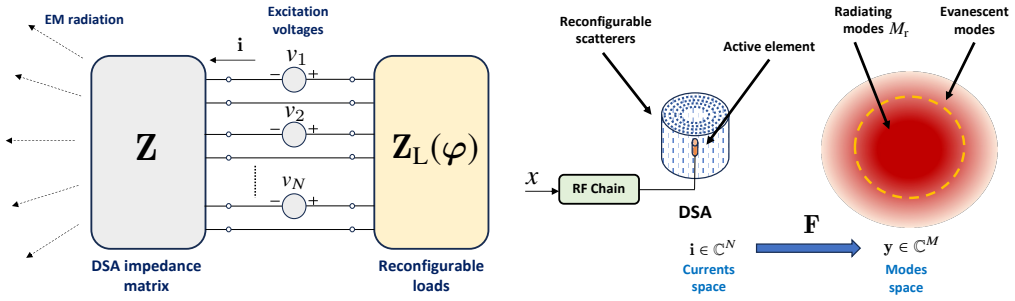
Wave-domain processing is an emerging paradigm where signal processing operations are partially shifted from the digital to the electromagnetic (EM) domain. Leveraging reconfigurable EM devices, this approach aims to reduce complexity, energy consumption, and latency in next-generation wireless systems employing holographic MIMO. This paper establishes fundamental theorems on the controllability of generic reconfigurable EM devices, where wave processing is achieved through the dynamic configuration of passive scatterers. Specifically, we derive necessary and sufficient conditions for controllability as a function of geometry and mutual coupling between elements. Finally, we provide a detailed discussion and numerical results characterizing the interplay between the number of elements, physical size, degrees of freedom, and directivity.
Editorial analysis
A structured set of objections, weighed in public.
Referee Report
Summary. The paper derives necessary and sufficient conditions for controllability of generic reconfigurable EM devices used in wave-domain processing for holographic MIMO. Controllability is characterized as a function of geometry and mutual coupling between passive scatterers. The work includes a discussion and numerical results on the interplay among the number of elements, physical size, degrees of freedom, and directivity.
Significance. If the controllability theorems hold under the paper's modeling assumptions, they supply a theoretical foundation for shifting signal processing into the EM domain, which could reduce digital complexity, energy use, and latency in holographic MIMO systems. The geometry-and-coupling conditions and the numerical trade-off characterization are potentially useful for system design. The idealized lossless linear scatterer model, however, restricts immediate applicability; real devices with dissipation or nonlinearities would require additional validation.
major comments (1)
- [Model and Theorems sections] The necessary-and-sufficient controllability conditions rest on an idealized model of passive scatterers that are lossless, linear, and frequency-independent. This assumption is load-bearing for the central claim because the controllability matrix rank analysis and DoF count are derived directly from the resulting wave-domain operator; any material loss, dispersion, or weak nonlinearity alters that operator and can invalidate the rank conditions. The numerical results inherit the same idealization and therefore do not test robustness against omitted physics.
minor comments (2)
- [Numerical results] Clarify whether the mutual-coupling matrix is assumed frequency-flat or whether the controllability conditions must be re-derived at each frequency of interest.
- [Discussion] Add a brief statement on how the derived conditions reduce to known results for the special case of zero mutual coupling.
Simulated Author's Rebuttal
We thank the referee for the constructive comments. We address the major comment below and indicate planned revisions.
read point-by-point responses
-
Referee: [Model and Theorems sections] The necessary-and-sufficient controllability conditions rest on an idealized model of passive scatterers that are lossless, linear, and frequency-independent. This assumption is load-bearing for the central claim because the controllability matrix rank analysis and DoF count are derived directly from the resulting wave-domain operator; any material loss, dispersion, or weak nonlinearity alters that operator and can invalidate the rank conditions. The numerical results inherit the same idealization and therefore do not test robustness against omitted physics.
Authors: We agree that the controllability theorems rely on the idealized model of lossless, linear, and frequency-independent scatterers, as defined in the Model section. This modeling choice enables the closed-form derivation of the necessary and sufficient rank conditions on the wave-domain operator. The paper's scope is the fundamental characterization under these standard assumptions for theoretical analysis of wave-domain processing. We acknowledge that material losses, dispersion, or nonlinearities would modify the operator and potentially the rank results. In the revised version we will add a dedicated paragraph in the Discussion section that explicitly states the modeling assumptions, notes their implications for real devices, and outlines possible extensions to non-ideal cases. The numerical results are intended to illustrate the theoretical trade-offs (element count, size, DoF, directivity) within the stated model rather than to demonstrate robustness to omitted physics. revision: partial
Circularity Check
No circularity: controllability conditions derived from standard rank analysis on explicit EM model
full rationale
The paper derives necessary and sufficient controllability conditions directly from the wave-domain scattering model parameterized by geometry and mutual coupling. This follows the standard linear-systems controllability test (rank of the controllability matrix) applied to the idealized passive-scatterer operator. No step reduces a claimed result to a fitted parameter, self-definition, or self-citation chain; the theorems are obtained by algebraic manipulation of the given interaction matrix under the stated lossless linear assumptions. The idealization is an explicit modeling choice, not a hidden tautology.
Axiom & Free-Parameter Ledger
Reference graph
Works this paper leans on
-
[1]
E. Bj ¨ornson, C.-B. Chae, J. Heath, Robert W., T. L. Marzetta, A. Mezghani, L. Sanguinetti, F. Rusek, M. R. Castellanos, D. Jun, and ¨O. Tugfe Demir, “Towards 6G MIMO: Massive Spatial Multiplexing, Dense Arrays, and Interplay Between Electromagnetics and Processing,” arXiv e-prints, p. arXiv:2401.02844, Jan. 2024
-
[2]
The integrated sensing and communication revolution for 6G: Vision, techniques, and applications,
N. Gonz ´alez-Prelcic, M. Furkan Keskin, O. Kaltiokallio, M. Valkama, D. Dardari, X. Shen, Y . Shen, M. Bayraktar, and H. Wymeersch, “The integrated sensing and communication revolution for 6G: Vision, techniques, and applications,”Proceedings of the IEEE, vol. 112, no. 7, pp. 676–723, July 2024
2024
-
[3]
Twenty-five years of signal processing advances for multiantenna communications: From theory to mainstream technology,
E. Bj ¨ornson, Y . C. Eldar, E. G. Larsson, A. Lozano, and H. V . Poor, “Twenty-five years of signal processing advances for multiantenna communications: From theory to mainstream technology,”IEEE Signal Processing Magazine, vol. 40, no. 4, pp. 107–117, 2023
2023
-
[4]
Next generation advanced transceiver tech- nologies for 6G and beyond,
C. You, Y . Cai, Y . Liu, M. D. Renzo, T. M. Duman, A. Yener, and A. Lee Swindlehurst, “Next generation advanced transceiver tech- nologies for 6G and beyond,”IEEE Journal on Selected Areas in Communications, vol. 43, no. 3, pp. 582–627, 2025
2025
-
[5]
Communicating with large intelligent surfaces: Fundamen- tal limits and models,
D. Dardari, “Communicating with large intelligent surfaces: Fundamen- tal limits and models,”IEEE Journal on Selected Areas in Communica- tions, vol. 38, no. 11, pp. 2526–2537, Nov 2020
2020
-
[6]
6G wireless communications: From far-field beam steering to near-field beam focusing,
H. Zhang, N. Shlezinger, F. Guidi, D. Dardari, and Y . C. Eldar, “6G wireless communications: From far-field beam steering to near-field beam focusing,”IEEE Communications Magazine, vol. 61, no. 4, pp. 72–77, April 2023
2023
-
[7]
Channel estimation and hybrid precoding for millimeter wave cellular systems,
A. Alkhateeb, O. El Ayach, G. Leus, and R. W. Heath, “Channel estimation and hybrid precoding for millimeter wave cellular systems,” IEEE Journal of Selected Topics in Signal Processing, vol. 8, no. 5, pp. 831–846, 2014
2014
-
[8]
The tri-hybrid MIMO architecture,
R. W. Heath, J. Carlson, N. V . Deshpande, M. R. Castellanos, M. Akrout, and C.-B. Chae, “The tri-hybrid MIMO architecture,”IEEE Wireless Communications, vol. 33, no. 1, pp. 199–206, 2026
2026
-
[9]
Embracing reconfigurable antennas in the tri-hybrid MIMO architecture for 6G and beyond,
M. R. Castellanos, S. Yang, C.-B. Chae, and R. W. Heath, “Embracing reconfigurable antennas in the tri-hybrid MIMO architecture for 6G and beyond,”IEEE Transactions on Communications, vol. 74, pp. 381–401, 2026
2026
-
[10]
Analog computing for signal processing and communications - part I: Computing with microwave networks,
M. Nerini and B. Clerckx, “Analog computing for signal processing and communications - part I: Computing with microwave networks,”IEEE Transactions on Signal Processing, vol. 73, pp. 5183–5197, 2025
2025
-
[11]
Over-the- air electromagnetic signal processing: From fundamentals to emerging paradigms,
D. Dardari, G. Torcolacci, G. Pasolini, and N. Decarli, “Over-the- air electromagnetic signal processing: From fundamentals to emerging paradigms,”IEEE Signal Processing Magazine, vol. 43, no. 1, pp. 6–28, Jan 2026
2026
-
[12]
Electromagnetic information theory: Fundamentals, modeling, applications, and open problems,
J. Zhu, Z. Wan, L. Dai, M. Debbah, and H. V . Poor, “Electromagnetic information theory: Fundamentals, modeling, applications, and open problems,”IEEE Wireless Communications, vol. 31, no. 3, pp. 156–162, 2024
2024
-
[13]
Reactively controlled directive arrays,
R. Harrington, “Reactively controlled directive arrays,”IEEE Trans. Antennas Propag., vol. 26, no. 3, pp. 390–395, May 1978
1978
-
[14]
Kalis, A
A. Kalis, A. G. Kanatas, and C. B. Papadias,Parasitic Antenna Arrays for Wireless MIMO Systems. Springer New York, NY , 2013
2013
-
[15]
Low-complexity adaptive spatial processing of ESPAR antenna systems,
J. C. Bucheli Garcia, M. Kamoun, and A. Sibille, “Low-complexity adaptive spatial processing of ESPAR antenna systems,”IEEE Trans. Wireless Commun. ”, vol. 19, no. 6, pp. 3700–3711, Feb. 2020
2020
-
[16]
Charac- teristic mode analysis of ESPAR for single-RF MIMO systems,
Z. Han, Y . Zhang, S. Shen, Y . Li, C.-Y . Chiu, and R. Murch, “Charac- teristic mode analysis of ESPAR for single-RF MIMO systems,”IEEE Transactions on Wireless Communications, vol. 20, no. 4, pp. 2353– 2367, 2021
2021
-
[17]
Multi-Functional Programmable Metasurfaces for 6G and Beyond,
X. Gan, X. Mu, Y . Liu, M. Di Renzo, J. M. Jornet, N. Gonz ´alez Prelcic, A. Shojaeifard, and T. J. Cui, “Multi-Functional Programmable Metasurfaces for 6G and Beyond,”arXiv e-prints, p. arXiv:2512.06693, Dec. 2025
-
[18]
Holographic MIMO communications: Theoretical foundations, enabling technologies, and future directions,
T. Gong, P. Gavriilidis, R. Ji, C. Huang, G. C. Alexandropoulos, L. Wei, Z. Zhang, M. Debbah, H. V . Poor, and C. Yuen, “Holographic MIMO communications: Theoretical foundations, enabling technologies, and future directions,”IEEE Communications Surveys & Tutorials, vol. 26, no. 1, pp. 196–257, 2024
2024
-
[19]
Holographic communication using intel- ligent surfaces,
D. Dardari and N. Decarli, “Holographic communication using intel- ligent surfaces,”IEEE Communications Magazine, vol. 59, no. 6, pp. 35–41, June 2021
2021
-
[20]
Fluid antenna system - Part I: Preliminaries,
K.-K. Wong, W. K. New, X. Hao, K.-F. Tong, and C.-B. Chae, “Fluid antenna system - Part I: Preliminaries,”IEEE Communications Letters, vol. 27, no. 8, pp. 1919–1923, 2023
1919
-
[21]
A reconfigurable aperture antenna based on switched links between electrically small metallic patches,
L. Pringle, P. Harms, S. Blalock, G. Kiesel, E. Kuster, P. Friederich, R. Prado, J. Morris, and G. Smith, “A reconfigurable aperture antenna based on switched links between electrically small metallic patches,” IEEE Transactions on Antennas and Propagation, vol. 52, no. 6, pp. 1434–1445, 2004
2004
-
[22]
Frequency, radiation pattern and polarization reconfigurable antenna using a parasitic pixel layer,
D. Rodrigo, B. A. Cetiner, and L. Jofre, “Frequency, radiation pattern and polarization reconfigurable antenna using a parasitic pixel layer,” IEEE Transactions on Antennas and Propagation, vol. 62, no. 6, pp. 3422–3427, 2014
2014
-
[23]
A reconfigurable MuPAR antenna system employing a hybrid beam-forming technique,
D. K. Rongas, L. Marantis, and A. G. Kanatas, “A reconfigurable MuPAR antenna system employing a hybrid beam-forming technique,” in2022 16th European Conference on Antennas and Propagation (EuCAP), 2022, pp. 1–5
2022
-
[24]
A Pixel-based Reconfigurable Antenna Design for Fluid Antenna Systems,
J. Zhang, J. Rao, Z. Ming, Z. Li, C.-Y . Chiu, K.-K. Wong, K.-F. Tong, and R. Murch, “A Pixel-based Reconfigurable Antenna Design for Fluid Antenna Systems,”arXiv e-prints, p. arXiv:2406.05499, Jun. 2024
-
[25]
Dynamic metasurface antennas for 6G extreme massive MIMO communications,
N. Shlezinger, G. C. Alexandropoulos, M. F. Imani, Y . C. Eldar, and D. R. Smith, “Dynamic metasurface antennas for 6G extreme massive MIMO communications,”IEEE Wireless Communications, vol. 28, no. 2, pp. 106–113, 2021
2021
-
[26]
Classification of metal handwritten digits based on microwave diffractive deep neural network,
Z. Gu, Q. Ma, X. Gao, J. W. You, and T. J. Cui, “Classification of metal handwritten digits based on microwave diffractive deep neural network,”Advanced Optical Materials, vol. 12, no. 7, p. 2301938, 2024. [Online]. Available: https://onlinelibrary.wiley.com/doi/ abs/10.1002/adom.202301938
-
[27]
Two-dimensional direction-of-arrival estimation using stacked intelligent metasurfaces,
J. An, C. Yuen, Y . L. Guan, M. D. Renzo, M. Debbah, H. V . Poor, and L. Hanzo, “Two-dimensional direction-of-arrival estimation using stacked intelligent metasurfaces,”IEEE Journal on Selected Areas in Communications, vol. 42, no. 10, pp. 2786–2802, 2024
2024
-
[28]
Efficient beamforming and radiation pattern control using stacked intelligent metasurfaces,
N. U. Hassan, J. An, M. Di Renzo, M. Debbah, and C. Yuen, “Efficient beamforming and radiation pattern control using stacked intelligent metasurfaces,”IEEE Open Journal of the Communications Society, vol. 5, pp. 599–611, 2024
2024
-
[29]
Stacked intelligent metasurfaces for multiuser downlink beamforming in the wave domain,
J. An, M. Di Renzo, M. Debbah, H. Vincent Poor, and C. Yuen, “Stacked intelligent metasurfaces for multiuser downlink beamforming in the wave domain,”IEEE Transactions on Wireless Communications, vol. 24, no. 7, pp. 5525–5538, 2025
2025
-
[30]
A Survey on Stacked Intelligent Metasurfaces: Fundamentals, Recent Advances, and Challenges,
C. K. Sheemar, W. Ullah Khan, S. Solanki, G. C. Alexandropoulos, and S. Chatzinotas, “A Survey on Stacked Intelligent Metasurfaces: Fundamentals, Recent Advances, and Challenges,”arXiv e-prints, p. arXiv:2603.05633, Mar. 2026
-
[31]
J. An, C. Yuen, M. Di Renzo, M. Bennis, M. Debbah, and L. Hanzo, “Stacked Intelligent Metasurface-Aided Wave-Domain Signal Process- ing: From Communications to Sensing and Computing,”arXiv e-prints, p. arXiv:2601.16030, Jan. 2026
-
[32]
Nonlinear EM-based signal processing,
M. Fabiani, G. Torcolacci, and D. Dardari, “Nonlinear EM-based signal processing,” inProc. Asilomar Conf. on Signals, Systems and Comput- ers, Oct 2025
2025
-
[33]
Stacked intelligent metasurfaces for efficient holographic MIMO communications in 6G,
J. An, C. Xu, D. W. K. Ng, G. C. Alexandropoulos, C. Huang, C. Yuen, and L. Hanzo, “Stacked intelligent metasurfaces for efficient holographic MIMO communications in 6G,”IEEE Journal on Selected Areas in Communications, vol. 41, no. 8, pp. 2380–2396, 2023
2023
-
[34]
A universal framework for multiport network analysis of reconfigurable intelligent surfaces,
M. Nerini, S. Shen, H. Li, M. Di Renzo, and B. Clerckx, “A universal framework for multiport network analysis of reconfigurable intelligent surfaces,”IEEE Transactions on Wireless Communications, vol. 23, no. 10, pp. 14 575–14 590, 2024
2024
-
[35]
A novel comprehensive multiport network model for stacked intelligent metasurfaces (SIM) characterization and optimization,
A. Abrardo, G. Bartoli, and A. Toccafondi, “A novel comprehensive multiport network model for stacked intelligent metasurfaces (SIM) characterization and optimization,”IEEE Transactions on Communica- tions, vol. 73, no. 11, pp. 11 559–11 573, 2025
2025
-
[36]
Beamforming with hybrid re- configurable parasitic antenna arrays,
N. V . Deshpande, M. R. Castellanos, S. R. Khosravirad, J. Du, H. Viswanathan, and R. W. Heath, “Beamforming with hybrid re- configurable parasitic antenna arrays,”IEEE Transactions on Wireless Communications, vol. 25, pp. 7048–7064, 2026
2026
-
[37]
3D electromagnetic signal processing,
D. Dardari, “3D electromagnetic signal processing,” in2024 58th Asilomar Conference on Signals, Systems, and Computers, 2024, pp. 596–601
2024
-
[38]
Over-the-air multifunctional wideband electromagnetic signal processing using dynamic scattering arrays,
——, “Over-the-air multifunctional wideband electromagnetic signal processing using dynamic scattering arrays,”IEEE Transactions on Wireless Communications, vol. 25, pp. 5016–5028, 2026
2026
-
[39]
P. del Hougne, “Electromagnetic Bounds on Realizing Targeted MIMO Transfer Functions in Real-World Systems with Wave-Domain Pro- grammability,”arXiv e-prints, p. arXiv:2602.14152, Feb. 2026
-
[40]
Reconfigurable electromagnetic environments: A general framework,
D. Dardari, “Reconfigurable electromagnetic environments: A general framework,”IEEE Journal on Selected Areas in Communications, vol. 42, no. 6, pp. 1479–1493, June 2024
2024
-
[41]
C. A. Balanis,Antenna Theory: Analysis and Design. New Jersey, USA: Wiley, 2016
2016
-
[42]
J. M. Lee,Introduction to Smooth Manifolds, 2nd ed., ser. Graduate Texts in Mathematics. New York, NY: Springer, 2012, vol. 218. [Online]. Available: https://doi.org/10.1007/978-1-4419-9982-5
-
[43]
Lang,Fundamentals of Differential Geometry, 1st ed., ser
S. Lang,Fundamentals of Differential Geometry, 1st ed., ser. Graduate Texts in Mathematics. New York, NY: Springer, 1999, vol. 191. [Online]. Available: https://doi.org/10.1007/978-1-4612-0541-8
-
[44]
The measure of the critical values of differentiable maps,
A. Sard, “The measure of the critical values of differentiable maps,” Bull. Amer. Math. Soc., vol. 48, pp. 883–890, 1942
1942
-
[45]
R. F. Harrington,Time-Harmonic Electromagnetic Fields. New York, USA: IEEE Press - Wiley, 2001
2001
-
[46]
Unified theory of characteristic modes - part I: Fundamentals,
M. Gustafsson, L. Jelinek, K. Schab, and M. Capek, “Unified theory of characteristic modes - part I: Fundamentals,”IEEE Transactions on Antennas and Propagation, vol. 70, no. 12, pp. 11 801–11 813, 2022
2022
-
[47]
Toward a circuit theory of communi- cation,
M. T. Ivrlac and J. A. Nossek, “Toward a circuit theory of communi- cation,”IEEE Transactions on Circuits and Systems I: Regular Papers, vol. 57, no. 7, pp. 1663–1683, 2010
2010
-
[48]
On the gain and beamwidth of directional antennas,
R. Harrington, “On the gain and beamwidth of directional antennas,” IRE Transactions on Antennas and Propagation, vol. 6, no. 3, pp. 219– 225, 1958
1958
-
[49]
Degrees of freedom and maximum directivity of antennas: A bound on maximum directivity of nonsuper- reactive antennas,
P.-S. Kildal, E. Martini, and S. Maci, “Degrees of freedom and maximum directivity of antennas: A bound on maximum directivity of nonsuper- reactive antennas,”IEEE Antennas and Propagation Magazine, vol. 59, no. 4, pp. 16–25, 2017
2017
-
[50]
Efficient and accurate EM-based design of large dynamic scattering ar- rays,
F. Benassi, S. Trovarello, D. Masotti, A. Costanzo, and D. Dardari, “Efficient and accurate EM-based design of large dynamic scattering ar- rays,” inProc. 20th European Conference on Antennas and Propagation (EuCAP 2026), Apr 2026, pp. 1–5
2026
discussion (0)
Sign in with ORCID, Apple, or X to comment. Anyone can read and Pith papers without signing in.