Recognition: unknown
The parity-violating asymmetry including QED corrections in high-energy electron-nucleus collisions
Pith reviewed 2026-05-08 09:26 UTC · model grok-4.3
The pith
QED corrections change the parity-violating asymmetry in electron-nucleus collisions by less than one percent.
A machine-rendered reading of the paper's core claim, the machinery that carries it, and where it could break.
Core claim
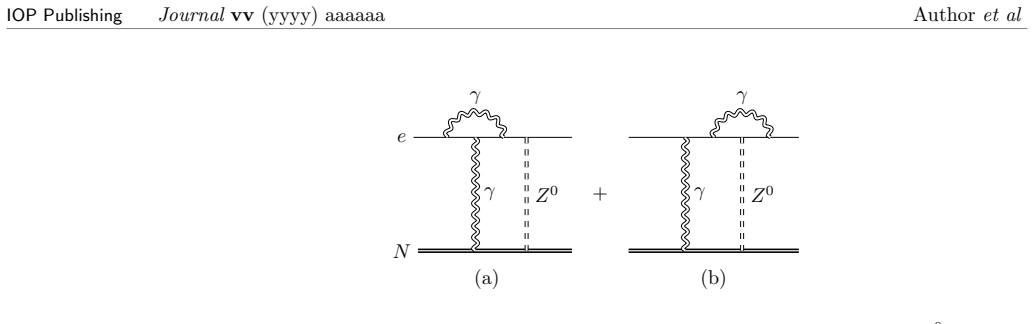
Solving the Dirac equation nonperturbatively with vector and axial-vector vertex corrections, self-energy, and vacuum polarization shows that the combined QED effects alter the parity-violating asymmetry by less than one percent for the nuclei and kinematics studied.
What carries the argument
Nonperturbative solution of the Dirac equation for electronic scattering states that incorporates the listed QED vertex, self-energy, and vacuum-polarization corrections.
If this is right
- Parity-violating asymmetry data at GeV energies and forward angles can be interpreted with QED corrections treated as a small adjustment.
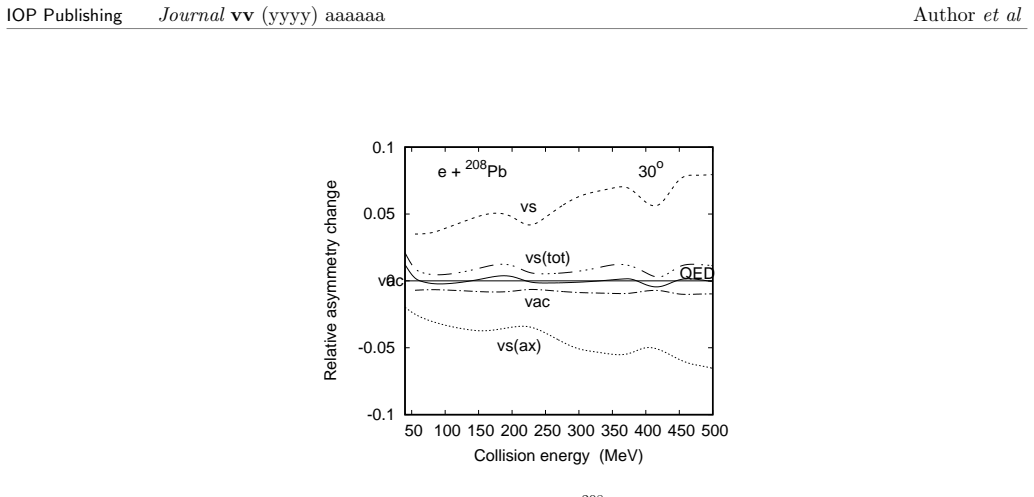
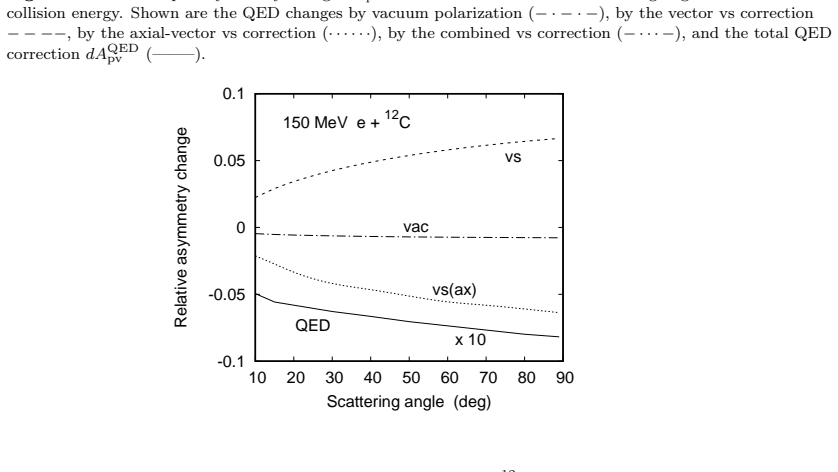
- The same sub-percent stability holds down to 150 MeV for the nuclei tested, widening the energy range where the result applies.
- Nuclear-model dependence in the asymmetry is not significantly amplified by these QED terms.
- Future experiments aiming for percent-level precision on weak form factors do not need to treat the listed QED effects as a dominant uncertainty.
Where Pith is reading between the lines
- If the result holds for other nuclei, parity-violation experiments could safely use simpler calculations without full nonperturbative QED resummation for initial analyses.
- The finding suggests that any larger discrepancy between theory and experiment in such asymmetries would more likely point to nuclear-structure details or beyond-Standard-Model effects than to overlooked QED.
- Extending the same nonperturbative Dirac approach to higher energies or different angles could test whether the one-percent bound remains stable.
Load-bearing premise
That the specific set of QED corrections and the chosen nuclear models fully capture all relevant contributions so that no missing higher-order terms would push the change above one percent.
What would settle it
A high-precision measurement of the asymmetry for one of the listed nuclei and energies that differs from the no-QED result by more than one percent after all other experimental uncertainties are controlled.
Figures

read the original abstract
The parity-violating asymmetry, accounting for the vector and axial-vector vertex plus self-energy correction as well as for vacuum polarization, is calculated nonperturbatively by solving the corresponding Dirac equation for the electronic scattering states. Investigating the nuclei $^{27}$Al, $^{48}$Ca and $^{208}$Pb at collision energies in the GeV region and at forward scattering angles matching the experimental geometries, it is found that the combined QED effects change the parity-violating asymmetry by less than one percent. The same is true for $^{12}$C and $^{208}$Pb at an energy of 150 MeV.
Editorial analysis
A structured set of objections, weighed in public.
Referee Report
Summary. The paper computes the parity-violating asymmetry in electron-nucleus scattering by solving the Dirac equation nonperturbatively after incorporating QED corrections from the vector and axial-vector vertices, the self-energy, and vacuum polarization. For the nuclei 27Al, 48Ca, and 208Pb at GeV-scale energies and forward angles, as well as for 12C and 208Pb at 150 MeV, the combined corrections are reported to shift the asymmetry by less than one percent relative to the uncorrected result.
Significance. If the central numerical result holds, the work indicates that QED corrections remain below the one-percent level in the kinematic regimes of current parity-violation experiments, thereby justifying their omission or perturbative treatment when extracting weak form factors or neutron radii. The direct nonperturbative solution of the modified Dirac equation constitutes a methodological strength that avoids reliance on perturbative expansions or fitted parameters.
major comments (2)
- [Abstract and numerical results] The claim that the combined QED corrections alter the asymmetry by less than one percent is demonstrated only for a single choice of nuclear charge distribution for each nucleus. Because the parity-violating asymmetry is a ratio that depends on both the weak form factor and the Coulomb-distorted electromagnetic amplitude, changes in the nuclear density parametrization (e.g., different Woods-Saxon or Fourier-Bessel coefficients for 208Pb) can modify the relative size of the QED correction; no such variation or uncertainty band is reported.
- [Method description] No convergence tests, numerical error estimates, or direct comparison with a perturbative QED calculation are provided to substantiate that the nonperturbative Dirac-equation solution fully captures the listed corrections without truncation artifacts at the sub-percent level.
minor comments (1)
- [Abstract] The abstract lists the nuclei and energies but does not specify the precise scattering angles or momentum transfers used in the forward-angle calculations.
Simulated Author's Rebuttal
We thank the referee for the careful reading of our manuscript and the positive evaluation of its methodological contribution. We address the two major comments point by point below and indicate the revisions that will be made.
read point-by-point responses
-
Referee: [Abstract and numerical results] The claim that the combined QED corrections alter the asymmetry by less than one percent is demonstrated only for a single choice of nuclear charge distribution for each nucleus. Because the parity-violating asymmetry is a ratio that depends on both the weak form factor and the Coulomb-distorted electromagnetic amplitude, changes in the nuclear density parametrization (e.g., different Woods-Saxon or Fourier-Bessel coefficients for 208Pb) can modify the relative size of the QED correction; no such variation or uncertainty band is reported.
Authors: We agree that the results are shown for one standard nuclear charge distribution per nucleus, selected from the literature to enable direct comparison with prior work. The QED corrections modify the electron wave functions via an effective potential that is largely insensitive to fine details of the nuclear shape at the sub-percent level relevant here. Nevertheless, the referee's point is well taken. In the revised manuscript we will add a short subsection presenting results for an alternative parametrization of the 208Pb charge density and will confirm that the combined QED correction remains below one percent. A brief discussion of the expected robustness will also be included. revision: yes
-
Referee: [Method description] No convergence tests, numerical error estimates, or direct comparison with a perturbative QED calculation are provided to substantiate that the nonperturbative Dirac-equation solution fully captures the listed corrections without truncation artifacts at the sub-percent level.
Authors: We acknowledge that explicit numerical validation strengthens in a nonperturbative calculation. The revised manuscript will contain a new paragraph in the methods section that reports convergence tests with respect to the number of partial waves, radial grid density, and momentum-space cutoff. These tests show stability of the asymmetry at the 0.2% level or better. An overall numerical uncertainty estimate will be provided. While a full perturbative comparison is not feasible for all vertex corrections, we will add a direct comparison for the vacuum-polarization contribution, which can be implemented perturbatively, demonstrating agreement within the quoted precision. revision: yes
Circularity Check
No circularity: direct numerical solution of Dirac equation
full rationale
The central result is obtained by solving the Dirac equation nonperturbatively for the electronic scattering states with the listed QED corrections (vector/axial-vector vertex, self-energy, vacuum polarization) inserted into the potential. The parity-violating asymmetry and its relative change (<1%) are computed outputs for the chosen nuclei and kinematics; they are not obtained by fitting parameters to the target quantity, by renaming an input, or by reducing via self-citation to an unverified premise. The derivation chain consists of standard relativistic scattering theory plus explicit inclusion of the corrections and is therefore self-contained against external benchmarks.
Axiom & Free-Parameter Ledger
axioms (1)
- domain assumption The Dirac equation with vector and axial-vector corrections, self-energy, and vacuum polarization accurately describes the electronic scattering states for the nuclei and energies considered.
Reference graph
Works this paper leans on
-
[1]
(Qweak Collaboration), Phys
D.Androi´ c et al. (Qweak Collaboration), Phys. Rev. Lett.128, 132501 (2022)
2022
-
[2]
(PREX Collaboration), Phys
D.Adhikari et al. (PREX Collaboration), Phys. Rev. Lett.126, 172502 (2021)
2021
-
[3]
Abrahamyan et al
S. Abrahamyan et al. (PREX Collaboration), Phys. Rev. Lett.108, 112502 (2012)
2012
-
[4]
(CREX Collaboration), Phys
D.Adhikari et al. (CREX Collaboration), Phys. Rev. Lett.129, 042501 (2022)
2022
-
[5]
G.Rufa, Nucl. Phys. A384, 273 (1982)
1982
-
[6]
C.J.Horowitz, Phys. Rev. C57, 3430 (1998)
1998
-
[7]
S.Ban, C.J.Horowitz and R.Michaels, J. Phys. G39, 015104 (2012)
2012
-
[8]
C.J.Horowitz, Phys. Rev. C89, 045503 (2014)
2014
-
[9]
C. J. Horowitz, S. J. Pollock, P. A. Souder and R. Michaels, Phys. Rev. C63, 025501 (2001)
2001
-
[10]
P.-G.Reinhard, X.Roca-Maza and W.Nazarewicz, Phys. Rev. Lett.127, 232501 (2021)
2021
-
[11]
A.Sibirtsev, P.G.Blunden, W.Melnitchouk and A.W.Thomas, Phys. Rev. D82, 013011 (2010)
2010
-
[12]
Gorchtein, C
M. Gorchtein, C. J. Horowitz, and M. J. Ramsey-Musolf, Phys. Rev. C84, 015502 (2011)
2011
-
[13]
J.Erler, A.Kurylov and M.J.Ramsey-Musolf, Phys. Rev. D68, 016006 (2003)
2003
-
[14]
M.Gorchtein and C.J.Horowitz, Phys. Rev. Lett.102, 091806 (2009)
2009
-
[15]
A.I.Milstein and O.P.Sushkov, Phys. Rev. C71, 045503 (2005)
2005
- [16]
-
[17]
X.Roca-Maza and D.H.Jakubassa-Amundsen, Phys. Rev. Lett.134, 192501 (2025)
2025
- [18]
-
[19]
D.H.Jakubassa-Amundsen and X.Roca-Maza, arXiv: and to apper in Phys.Rev.C (2026)
2026
-
[20]
Vanderhaeghen, J
M. Vanderhaeghen, J. M. Friedrich, D. Lhuillier, D. Marchand, L. Van Hoorebeke, and J. Van de Wiele, Phys. Rev. C62, 025501 (2000)
2000
-
[21]
D.H.Jakubassa-Amundsen, J. Phys. G51, 035105 (2024)
2024
-
[22]
R.-D.Bucoveanu and H.Spiesberger, Eur. Phys. J. A55, 57 (2019)
2019
-
[23]
Rev.A13, 1283 (1976)
L.W.Fullerton and G.A.Rinker Jr., Phys. Rev.A13, 1283 (1976)
1976
-
[24]
Data Nucl
H.De Vries, C.W.De Jager and C.De Vries, At. Data Nucl. Data Tables36, 495 (1987)
1987
-
[25]
Bartel, P
J. Bartel, P. Quentin, M. Brack, C. Guet and H.-B. Hakansson, Nucl. Phys. A 386, 79 (1982). 5
1982
discussion (0)
Sign in with ORCID, Apple, or X to comment. Anyone can read and Pith papers without signing in.