Recognition: unknown
Four-dimensional QCD equation of state from a quasi-parton model with physics-informed neural networks
Pith reviewed 2026-05-08 09:22 UTC · model grok-4.3
The pith
A physics-informed neural network quasi-parton model constructs a four-dimensional QCD equation of state from zero-density lattice data.
A machine-rendered reading of the paper's core claim, the machinery that carries it, and where it could break.
Core claim
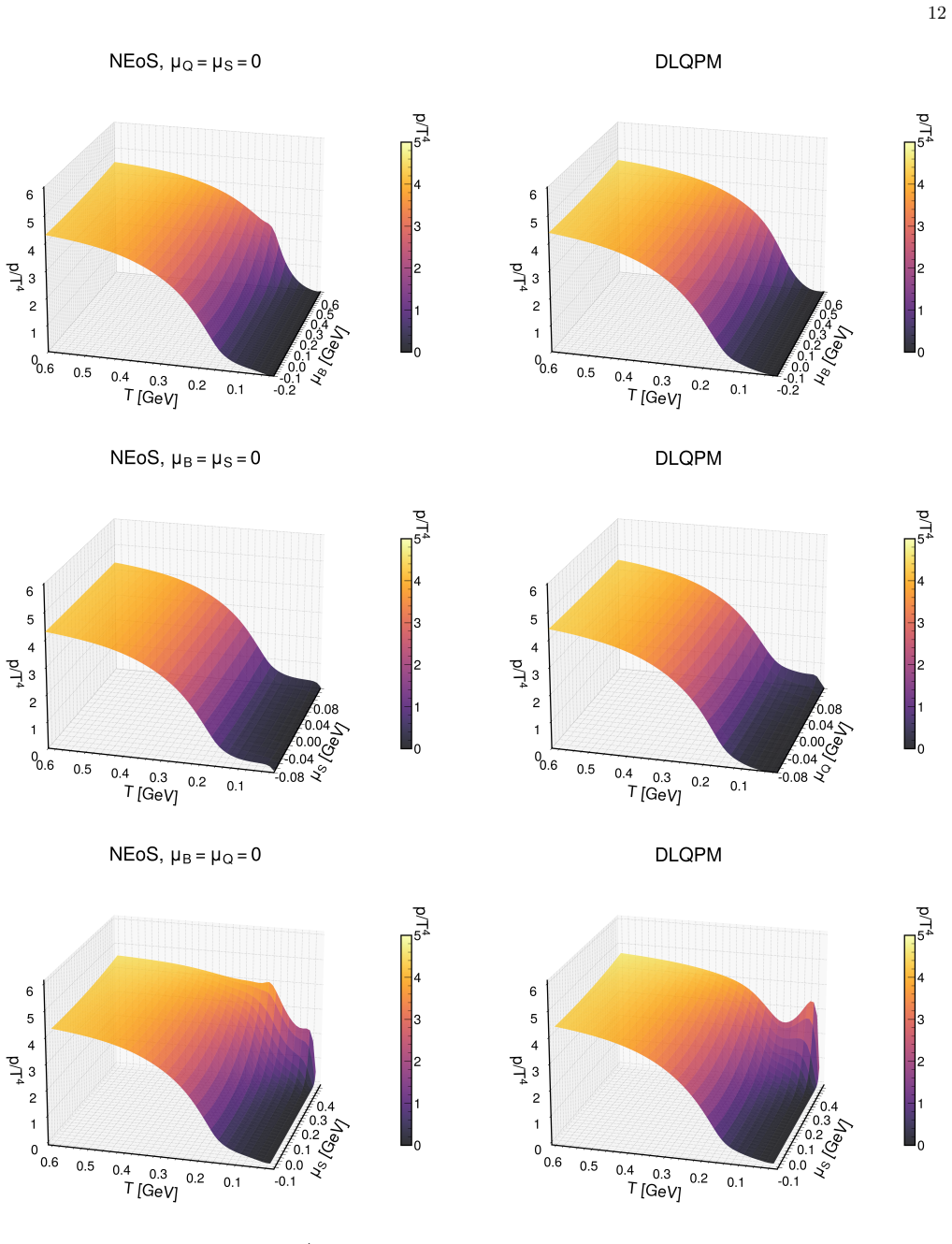
The DLQPM accurately reproduces the lattice-calculated cumulants χ^{B,Q,S}_{i,j,k} at μ_{B,Q,S}=0, and its predicted EoS at various chemical potentials agrees well with results from the generalized T'-expansion method in lattice QCD. The calculated baryon-strangeness correlation C_{BS} is consistent, within uncertainties, with preliminary STAR data.
What carries the argument
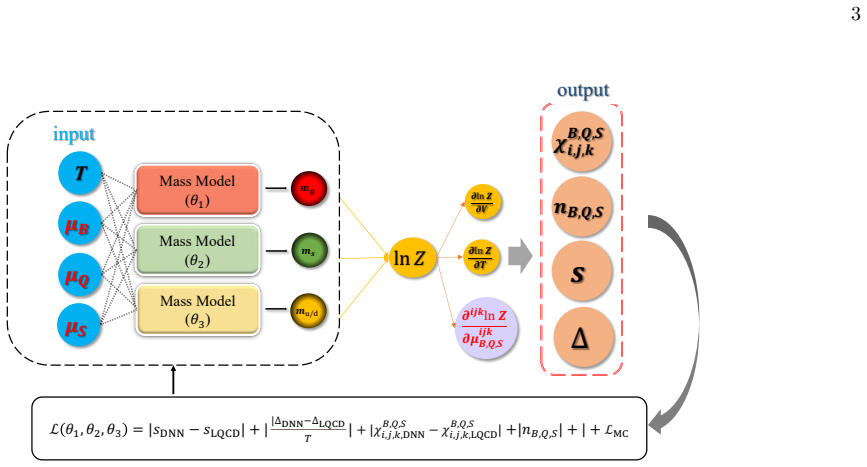
The deep-learning-assisted quasi-particle model (DLQPM) inside a physics-informed neural network, where the masses of light quarks, strange quarks, and gluons are parameterized as functions of T, μ_B, μ_Q, and μ_S.
Load-bearing premise
Quasi-particle masses can be written as functions of temperature and the three chemical potentials and trained solely on zero-chemical-potential lattice data to give thermodynamically consistent results at finite densities.
What would settle it
Lattice QCD calculations of pressure, energy density, or cumulants at small but nonzero chemical potentials that differ markedly from the DLQPM predictions would show the extrapolation has failed.
Figures


read the original abstract
The equation of state (EoS) of strongly interacting matter at finite temperature and chemical potentials (baryon, charge, and strangeness) is a crucial input for hydrodynamic simulations of relativistic heavy-ion collisions. We construct a four-dimensional EoS using a deep-learning-assisted quasi-particle model (DLQPM) within a physics-informed neural network (PINN) framework, in which the masses of light quarks, strange quarks, and gluons are parameterized as functions of temperature and chemical potentials ($T, \mu_B, \mu_Q, \mu_S$). The model is constrained by lattice QCD data at vanishing chemical potentials and provides a thermodynamically consistent extrapolation to finite $\mu_{B,Q,S}$. The DLQPM accurately reproduces the lattice-calculated cumulants $\chi^{B,Q,S}_{i,j,k}$ at $\mu_{B,Q,S}=0$, and its predicted EoS at various chemical potentials agrees well with results from the generalized $T'$-expansion method in lattice QCD. Furthermore, the calculated baryon-strangeness correlation $C_{BS}$ is consistent, within uncertainties, with preliminary STAR data. This work offers a reliable EoS for exploring the QCD phase structure in the beam energy scan region.
Editorial analysis
A structured set of objections, weighed in public.
Referee Report
Summary. The manuscript introduces a deep-learning-assisted quasi-particle model (DLQPM) using physics-informed neural networks (PINNs) to parameterize the masses of light quarks, strange quarks, and gluons as functions of temperature T and chemical potentials μ_B, μ_Q, μ_S. The model is trained exclusively on lattice QCD data at vanishing chemical potentials to enforce thermodynamic consistency via the PINN loss and generates a four-dimensional EoS. It claims accurate reproduction of lattice cumulants χ^{B,Q,S}_{i,j,k} at μ=0, good agreement of the finite-μ EoS with the generalized T'-expansion method, and consistency (within uncertainties) of the baryon-strangeness correlation C_BS with preliminary STAR data.
Significance. If the finite-μ extrapolation proves reliable, the DLQPM EoS would supply a practical, thermodynamically consistent input for hydrodynamic simulations of heavy-ion collisions in the beam-energy-scan regime. The PINN framework's enforcement of thermodynamic relations by construction is a methodological strength that could be extended to other quasi-particle approaches.
major comments (3)
- [Abstract] Abstract: The central claim that the DLQPM 'accurately reproduces' the lattice cumulants χ^{B,Q,S}_{i,j,k} at μ_{B,Q,S}=0 is presented without any quantitative metrics (e.g., relative errors, χ² values, or error bands on the reproduced quantities), details on the PINN architecture, loss-function weights, or fitting procedure. This absence directly undermines assessment of the model's fidelity to the training data.
- [Model and results] Model construction and results: The mass functions m_q(T, μ_B, μ_Q, μ_S), m_s, and m_g are parameterized and fitted solely to μ=0 lattice pressure, energy density, and cumulants; the finite-μ EoS is then generated by the same functional form. Because no independent lattice data at finite μ are used for validation, the reported agreement with the generalized T'-expansion method compares two extrapolations rather than testing against direct data, leaving the physical correctness of the μ-dependence unverified.
- [Methodology] Thermodynamic consistency: While the PINN loss enforces thermodynamic relations by construction, this does not constrain the functional form of the mass parameterization itself. Consequently, thermodynamic consistency alone cannot guarantee that the extrapolated EoS at finite μ is free of systematic bias inherited from the chosen mass ansatz.
minor comments (1)
- [Abstract] Notation for the cumulants χ^{B,Q,S}_{i,j,k} and the correlation C_BS should be defined explicitly on first use, including the precise definitions of the indices.
Simulated Author's Rebuttal
We thank the referee for the thorough and constructive review. We address each major comment below and indicate planned revisions to strengthen the manuscript.
read point-by-point responses
-
Referee: [Abstract] Abstract: The central claim that the DLQPM 'accurately reproduces' the lattice cumulants χ^{B,Q,S}_{i,j,k} at μ_{B,Q,S}=0 is presented without any quantitative metrics (e.g., relative errors, χ² values, or error bands on the reproduced quantities), details on the PINN architecture, loss-function weights, or fitting procedure. This absence directly undermines assessment of the model's fidelity to the training data.
Authors: We agree that the abstract would be strengthened by quantitative support for the reproduction claim. In the revised manuscript we will add explicit metrics (maximum relative deviations and χ² per degree of freedom for the cumulants) and will include concise statements on the PINN architecture, loss-function weighting, and training procedure. These details already appear in Section II; we will ensure they are also summarized at the beginning of the paper for immediate accessibility. revision: yes
-
Referee: [Model and results] Model construction and results: The mass functions m_q(T, μ_B, μ_Q, μ_S), m_s, and m_g are parameterized and fitted solely to μ=0 lattice pressure, energy density, and cumulants; the finite-μ EoS is then generated by the same functional form. Because no independent lattice data at finite μ are used for validation, the reported agreement with the generalized T'-expansion method compares two extrapolations rather than testing against direct data, leaving the physical correctness of the μ-dependence unverified.
Authors: We acknowledge that no direct lattice data at finite chemical potentials exist for independent validation, owing to the sign problem. The comparison with the T'-expansion method is therefore between two extrapolation procedures. We will revise the text to state this limitation explicitly, to frame the agreement as a cross-check between independent methods rather than a direct test, and to quantify the spread between the two approaches as an estimate of extrapolation uncertainty. revision: partial
-
Referee: [Methodology] Thermodynamic consistency: While the PINN loss enforces thermodynamic relations by construction, this does not constrain the functional form of the mass parameterization itself. Consequently, thermodynamic consistency alone cannot guarantee that the extrapolated EoS at finite μ is free of systematic bias inherited from the chosen mass ansatz.
Authors: The referee correctly notes that thermodynamic consistency enforced by the loss function does not remove possible systematic bias from the quasi-particle mass ansatz. In the revised manuscript we will add an explicit discussion of this model dependence, including sensitivity tests to neural-network depth/width and alternative mass functional forms, together with a statement on the remaining extrapolation uncertainty. revision: yes
Circularity Check
No significant circularity; model fit and extrapolation are independent of target outputs
full rationale
The derivation trains a PINN-parameterized quasi-particle mass function exclusively on lattice data at μ=0 (pressure, energy density, and cumulants), with thermodynamic relations enforced by construction in the loss. The four-dimensional EoS at finite μ is then obtained by direct evaluation of the trained integrals. This is a standard extrapolation whose finite-μ values are not equivalent to the μ=0 inputs by construction, nor are they statistically forced to match any particular form; the μ-dependence remains an unconstrained output of the network architecture. No load-bearing self-citations, uniqueness theorems, or ansatz smuggling appear in the provided text, and the comparison to the T'-expansion method is an external cross-check rather than an internal reduction. The central claim therefore retains independent content beyond its training data.
Axiom & Free-Parameter Ledger
free parameters (1)
- Parameters of the mass functions m_q(T, μ_B, μ_Q, μ_S), m_s(T, μ_B, μ_Q, μ_S), m_g(T, μ_B, μ_Q, μ_S)
axioms (2)
- domain assumption Quasi-particle description remains valid at finite chemical potentials
- domain assumption Physics-informed neural network architecture guarantees thermodynamic consistency
Reference graph
Works this paper leans on
- [1]
- [2]
- [3]
-
[4]
J. E. Bernhard, J. S. Moreland, and S. A. Bass, Nature Phys.15, 1113 (2019)
2019
-
[5]
P. Achenbachet al., Nucl. Phys. A1047, 122874 (2024), arXiv:2303.02579 [hep-ph]
- [6]
-
[7]
Properties of hot and dense matter from relativistic heavy ion collisions,
P. Braun-Munzinger, V. Koch, T. Sch¨ afer, and J. Stachel, Phys. Rept.621, 76 (2016), arXiv:1510.00442 [nucl-th]
-
[8]
H. Elfner and B. M¨ uller, J. Phys. G50, 103001 (2023), arXiv:2210.12056 [nucl-th]
- [9]
- [10]
- [11]
-
[12]
Sorensen et al., Dense nuclear matter equation of state from heavy-ion collisions, Prog
A. Sorensenet al., Prog. Part. Nucl. Phys.134, 104080 (2024), arXiv:2301.13253 [nucl-th]
-
[13]
X. Anet al., Nucl. Phys. A1017, 122343 (2022), arXiv:2108.13867 [nucl-th]
-
[14]
Kumaret al.(MUSES), Living Rev
R. Kumaret al.(MUSES), Living Rev. Rel.27, 3 (2024), arXiv:2303.17021 [nucl-th]
- [15]
-
[16]
S. Borsanyi, Z. Fodor, C. Hoelbling, S. D. Katz, S. Krieg, and K. K. Szabo, Phys. Lett. B730, 99 (2014), arXiv:1309.5258 [hep-lat]
-
[17]
A. Bazavovet al.(HotQCD), Phys. Lett. B795, 15 (2019), arXiv:1812.08235 [hep-lat]
-
[18]
A. Bazavovet al.(HotQCD), Phys. Rev. D86, 034509 (2012), arXiv:1203.0784 [hep-lat]
-
[19]
A. Bazavovet al.(HotQCD), Phys. Rev. D90, 094503 (2014), arXiv:1407.6387 [hep-lat]
-
[20]
D. Bollweg, J. Goswami, O. Kaczmarek, F. Karsch, S. Mukherjee, P. Petreczky, C. Schmidt, and P. Scior (HotQCD), Phys. Rev. D105, 074511 (2022), 7 arXiv:2202.09184 [hep-lat]
-
[21]
D. Bollweg, J. Goswami, O. Kaczmarek, F. Karsch, S. Mukherjee, P. Petreczky, C. Schmidt, and P. Scior (HotQCD), Phys. Rev. D104(2021), 10.1103/Phys- RevD.104.074512, arXiv:2107.10011 [hep-lat]
- [22]
-
[23]
S. Bors´ anyi, Z. Fodor, J. N. Guenther, R. Kara, S. D. Katz, P. Parotto, A. P´ asztor, C. Ratti, and K. K. Szab´ o, Phys. Rev. Lett.126, 232001 (2021), arXiv:2102.06660 [hep-lat]
-
[24]
S. Borsanyi, J. N. Guenther, R. Kara, Z. Fodor, P. Parotto, A. Pasztor, C. Ratti, and K. K. Szabo, Phys. Rev. D105, 114504 (2022), arXiv:2202.05574 [hep-lat]
- [25]
- [26]
-
[27]
O. Soloveva, A. Palermo, and E. Bratkovskaya, Phys. Rev. C110, 034908 (2024), arXiv:2311.15984 [hep-ph]
- [28]
-
[29]
Peshier, B
A. Peshier, B. Kampfer, O. P. Pavlenko, and G. Soff, Phys. Rev. D54, 2399 (1996)
1996
-
[30]
M. Alqahtani, M. Nopoush, and M. Strickland, Phys. Rev. C92, 054910 (2015), arXiv:1509.02913 [hep-ph]
- [31]
-
[32]
O. Soloveva, J. Aichelin, and E. Bratkovskaya, Phys. Rev. D105, 054011 (2022), arXiv:2108.08561 [hep-ph]
-
[33]
S. Plumari, W. M. Alberico, V. Greco, and C. Ratti, Phys. Rev. D84, 094004 (2011), arXiv:1103.5611 [hep- ph]
- [34]
- [35]
-
[36]
V. Mykhaylova and C. Sasaki, Phys. Rev. D103, 014007 (2021), arXiv:2007.06846 [hep-ph]
-
[37]
P. Romatschke, Phys. Rev. D85, 065012 (2012), arXiv:1108.5561 [gr-qc]
-
[38]
Mykhaylova,Transport Properties of Hot QCD Matter in the Quasiparticle Approach, Ph.D
V. Mykhaylova,Transport Properties of Hot QCD Matter in the Quasiparticle Approach, Ph.D. thesis
-
[39]
Thuerey, P
N. Thuerey, P. Holl, M. Mueller, P. Schnell, F. Trost, and K. Um,Physics-based Deep Learning(WWW, 2021)
2021
-
[40]
Paszke, S
A. Paszke, S. Gross, F. Massa, A. Lerer, J. Bradbury, G. Chanan, T. Killeen, Z. Lin, N. Gimelshein, L. Antiga, A. Desmaison, A. Kopf, E. Yang, Z. DeVito, M. Rai- son, A. Tejani, S. Chilamkurthy, B. Steiner, L. Fang, J. Bai, and S. Chintala, inAdvances in Neural Informa- tion Processing Systems, Vol. 32, edited by H. Wallach, H. Larochelle, A. Beygelzimer,...
2019
-
[41]
A. G. Baydin, B. A. Pearlmutter, A. A. Radul, and J. M. Siskind, Journal of Machine Learning Research18, 1 (2018)
2018
-
[42]
Hornik, M
K. Hornik, M. B. Stinchcombe, and H. L. White, Neural Networks2, 359 (1989)
1989
-
[43]
Mattuck, Osborne McGraw-Hill (1976)
R. Mattuck, Osborne McGraw-Hill (1976)
1976
-
[44]
J. I. Kapusta and C. Gale,Finite-temperature field theory: Principles and applications, Cambridge Mono- graphs on Mathematical Physics (Cambridge University Press, 2011)
2011
-
[45]
P. P. M. Raissi and G. Karniadakis, Journal of Compu- tational Physics378, 686 (2019)
2019
-
[46]
Raissi, P
M. Raissi, P. Perdikaris, and G. E. Karniadakis, Journal of Computational Physics378, 686 (2019)
2019
- [47]
-
[48]
S. Soma, L. Wang, S. Shi, H. St¨ ocker, and K. Zhou, EPJ Web Conf.276, 06007 (2023)
2023
-
[49]
Pang, Int
L.-G. Pang, Int. J. Mod. Phys. E33, 2430009 (2024)
2024
- [50]
- [51]
-
[52]
Aarts, K
G. Aarts, K. Fukushima, T. Hatsuda, A. Ipp, S. Shi, L. Wang, and K. Zhou, Nature Reviews Physics7, 1 (2025)
2025
- [53]
-
[54]
V. Koch, A. Majumder, and J. Randrup, Nucl. Phys. A 774, 841 (2006)
2006
-
[55]
Baryon- Strangeness Correlations in Au+Au Collisions at RHIC-STAR, XXXI International Conference on Ultra- relativistic Nucleus-Nucleus Collisions, Frankfurt, Apr.6- 12, 2025,
H. Feng (for the STAR Collaboration), “Baryon- Strangeness Correlations in Au+Au Collisions at RHIC-STAR, XXXI International Conference on Ultra- relativistic Nucleus-Nucleus Collisions, Frankfurt, Apr.6- 12, 2025,”
2025
- [56]
-
[57]
M. Chenget al., Phys. Rev. D79, 074505 (2009), arXiv:0811.1006 [hep-lat]
-
[58]
A. Bazavovet al., Phys. Rev. Lett.113, 072001 (2014), arXiv:1404.6511 [hep-lat]
-
[59]
A. Bazavovet al., Phys. Rev. Lett.111, 082301 (2013), arXiv:1304.7220 [hep-lat]
-
[60]
D. Bollweg, H. T. Ding, J. Goswami, F. Karsch, S. Mukherjee, P. Petreczky, and C. Schmidt, Phys. Rev. D110, 054519 (2024), arXiv:2407.09335 [hep-lat]
-
[61]
Hadronic Fluctuations and Correlations,
V. Koch, “Hadronic Fluctuations and Correlations,” in Relativistic Heavy Ion Physics, edited by R. Stock (2010) pp. 626–652, arXiv:0810.2520 [nucl-th]
- [62]
-
[63]
Searching for Activation Functions
P. Ramachandran, B. Zoph, and Q. V. Le, “Searching for activation functions,” (2017), arXiv:1710.05941 [cs.NE]
work page internal anchor Pith review arXiv 2017
-
[64]
N. Haque and M. G. Mustafa, Prog. Part. Nucl. Phys. 140, 104136 (2025), arXiv:2404.08734 [hep-ph]
-
[65]
P. Levai and U. W. Heinz, Phys. Rev. C57, 1879 (1998), arXiv:hep-ph/9710463
-
[66]
L. Adamczyket al.(STAR), Phys. Rev. C96, 044904 (2017), arXiv:1701.07065 [nucl-ex]
- [67]
-
[68]
A. Kumar, H.-T. Ding, J.-B. Gu, and S.-T. Li, PoS LA TTICE2024, 175 (2025), arXiv:2502.03152 [hep-lat]. Appendix A: The training results Fig. 5 illustrates the temperature dependence of both the trace anomaly ∆ and the entropy densitys/T 3 at µB = 0. The results indicate that the DLQPM can ac- 8 curately reproduce the QCD EoS. As temperature in- creases, ...
discussion (0)
Sign in with ORCID, Apple, or X to comment. Anyone can read and Pith papers without signing in.