Recognition: unknown
QCD vacuum pressure and its influence on the equation of state of non-strange quark stars
Pith reviewed 2026-05-08 11:10 UTC · model grok-4.3
The pith
A modified Nambu-Jona-Lasinio model finds that low vacuum pressure from condensate feedback enables first-order chiral transitions that support massive pulsars while high pressure crossovers are ruled out.
A machine-rendered reading of the paper's core claim, the machinery that carries it, and where it could break.
Core claim
Within the modified Nambu-Jona-Lasinio model with G = G1 + G2 ⟨ψ̄ψ⟩, the vacuum pressure obtained from the gap equation leads to distinct behaviors depending on the ratio G1/G. A ratio of 0.74 to 0.75 results in low vacuum pressure and a first-order chiral phase transition, producing an equation of state that accommodates the existence of massive pulsars. A ratio greater than 0.96 yields high vacuum pressure and a crossover transition, but this equation of state is inconsistent with recent pulsar observations. The allowed parameter range gives a current quark mass of 4.08 to 4.13 MeV where the condensate feedback contributes about 25 percent, and the model permits the GW170817 merger to be a
What carries the argument
The modified coupling constant G = G1 + G2 times the quark condensate, which introduces feedback from the condensate into the gluon propagator and thereby sets the vacuum pressure that governs the order of the chiral phase transition and the stiffness of the quark matter equation of state.
If this is right
- Only first-order chiral phase transitions with low vacuum pressure produce equations of state stiff enough to support observed massive pulsars.
- Equations of state with crossover chiral transitions due to high vacuum pressure are incompatible with pulsar mass-radius constraints.
- The tidal deformability of a 1.4 solar mass non-strange quark star is limited to at most 646.
- The compact binary merger observed in GW170817 is compatible with consisting of non-strange quark stars.
- Model parameters are restricted to current quark masses between 4.08 and 4.13 MeV with approximately 25% condensate feedback.
Where Pith is reading between the lines
- Confirmation of a pulsar mass-radius point that fits only the low-pressure first-order case would validate the condensate feedback model for the EOS.
- The upper bound on tidal deformability for 1.4 solar mass stars provides a benchmark for distinguishing quark star models in upcoming observations.
- Extending the analysis to include temperature effects or strange quark degrees of freedom could reveal how the vacuum pressure influences the full QCD phase diagram at finite density.
Load-bearing premise
The load-bearing premise is that the ad-hoc dependence of the coupling on the quark condensate correctly represents the feedback on the gluon propagator and that the resulting difference in vacuum pressure between first-order and crossover transitions is what decides whether the equation of state can explain observed pulsar masses.
What would settle it
A high-precision mass and radius measurement of a pulsar exceeding 2 solar masses that cannot be fit by the low-vacuum-pressure first-order equation of state, or a confirmed crossover signature in dense matter that allows high vacuum pressure while still matching observations, would falsify the central claim.
Figures





read the original abstract
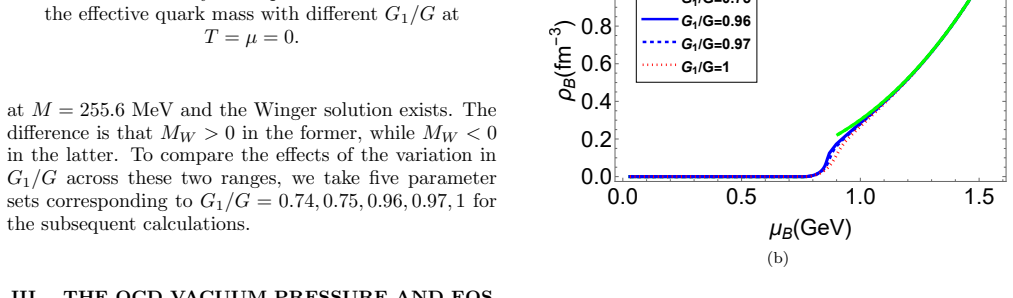
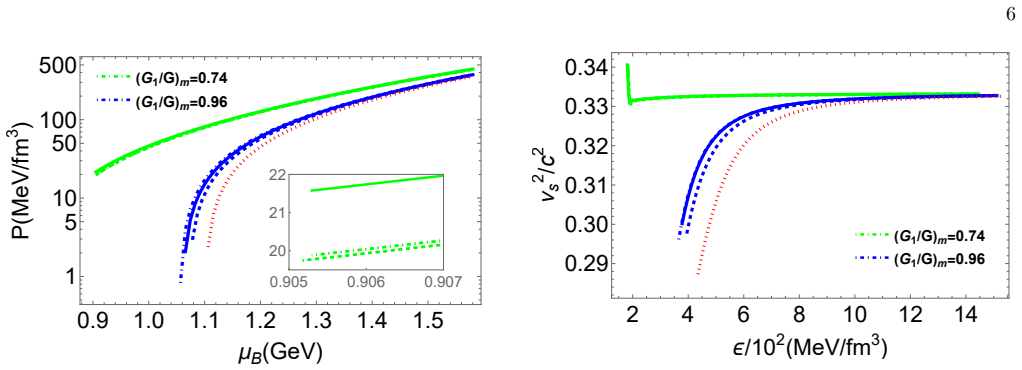
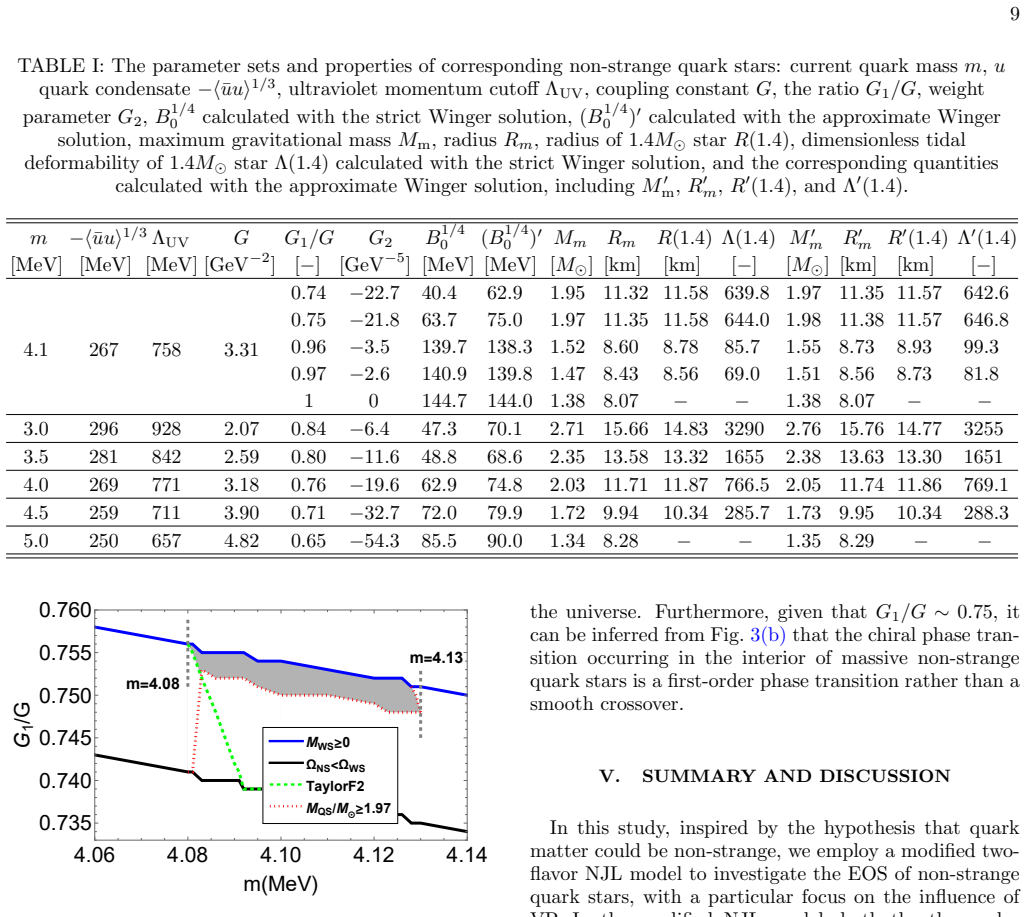
Solutions of the quark gap equation and the corresponding vacuum pressure are investigated within a modified Nambu-Jona-Lasinio model, which is a basic issue for studying the QCD equation of state (EOS) and the properties of hypothetical non-strange quark stars. In this study, the coupling strength $G$ is modified as $G=G_1+G_2\langle\bar{\psi}\psi\rangle$ to highlight the feedback effect of the quark condensate on the gluon propagator. Our analysis reveals that the influence of the vacuum pressure on EOS stiffness critically depends on whether the chiral phase transition is a first-order transition or a smooth crossover. A small ratio $G_1/G$ $(0.74\sim0.75)$ leads to a low vacuum pressure and a first-order chiral phase transition, a scenario favored by the existence of massive pulsars. Conversely, a large $G_1/G$ $(>0.96)$ leads to a high vacuum pressure and a crossover, but the corresponding EOS is ruled out by recent pulsar mass-radius observations. The model parameter space, restricted by four constraints, indicates the current quark mass is in the range $4.08\leq m\leq4.13$ MeV, with the quark condensate feedback contribution accounting for approximately 25\%. Furthermore, it is argued that the merging compact binary in GW170817 could be non-strange quark stars, and the tidal deformability is constrained to $\Lambda(1.4)\leq646$.
Editorial analysis
A structured set of objections, weighed in public.
Referee Report
Summary. The manuscript presents a modified Nambu-Jona-Lasinio (NJL) model in which the four-fermion coupling is made condensate-dependent, G = G1 + G2 ⟨ψ̄ψ⟩, to incorporate feedback on the gluon propagator. By solving the gap equation, the authors compute the vacuum pressure and construct the equation of state (EOS) for non-strange quark matter. They identify two regimes: for G1/G ≈ 0.74–0.75 the model yields a low vacuum pressure, a first-order chiral phase transition, and a sufficiently stiff EOS to support observed pulsar masses; for G1/G > 0.96 the vacuum pressure is higher, the transition is a crossover, and the EOS is too soft to be compatible with recent mass-radius data. The parameter space is restricted by four internal constraints, yielding a current quark mass m ≈ 4.1 MeV and a 25 % condensate-feedback contribution. The authors further argue that the GW170817 event could involve non-strange quark stars and derive an upper bound Λ(1.4) ≤ 646 on the tidal deformability.
Significance. If the central mapping from the order of the chiral transition to EOS stiffness survives scrutiny, the work would provide a concrete link between effective-model parameters and astrophysical observables, offering a potential explanation for the existence of massive pulsars within a quark-star scenario and a new constraint on the QCD vacuum structure. The explicit numerical results for the EOS and the tidal-deformability bound constitute falsifiable predictions that could be tested against future gravitational-wave or X-ray data. However, the significance is tempered by the ad-hoc nature of the coupling modification, which lacks independent QCD grounding.
major comments (3)
- [§2 (model section), Eq. (3)] §2 (model section), Eq. (3): The linear feedback form G = G1 + G2 ⟨ψ̄ψ⟩ is postulated without derivation from the gluon Dyson-Schwinger equation, lattice QCD input, or comparison to alternative functional forms. Because the first-order versus crossover distinction—and therefore the entire claim that only the small-ratio scenario is compatible with massive pulsars—rests directly on this specific dependence, an explicit justification or robustness test is required.
- [§3–4 (gap equation and EOS results)] §3–4 (gap equation and EOS results): The four constraints used to fix m ≈ 4.1 MeV and the 25 % feedback fraction are all internal to the same parametrization. The windows G1/G ≈ 0.74–0.75 and G1/G > 0.96 are chosen precisely to produce the desired transition order; the subsequent assertion that the small-ratio scenario is 'favored' by pulsar data therefore reduces to the initial parameter choice rather than an independent test.
- [§4 (EOS and mass-radius curves)] §4 (EOS and mass-radius curves): No error estimates, regularization-scheme dependence, or cutoff sensitivity are reported for the vacuum-pressure values or the resulting mass-radius relations. Given that the distinction between 'low' and 'high' vacuum pressure is load-bearing for the pulsar-mass argument, quantitative uncertainty bands on the EOS and on the tidal-deformability bound are needed.
minor comments (2)
- [Abstract] Abstract: The statement that the EOS for G1/G > 0.96 'is ruled out by recent pulsar mass-radius observations' is made without citing the specific data sets or providing the corresponding mass-radius plot in the main text.
- [Notation throughout] Notation throughout: The symbol G is used both for the full coupling and for its reference value; introducing a distinct symbol (e.g., G_ref) would improve clarity.
Simulated Author's Rebuttal
We thank the referee for the constructive and detailed report. We address each major comment below and indicate the revisions that will be made to strengthen the manuscript.
read point-by-point responses
-
Referee: The linear feedback form G = G1 + G2 ⟨ψ̄ψ⟩ is postulated without derivation from the gluon Dyson-Schwinger equation, lattice QCD input, or comparison to alternative functional forms. Because the first-order versus crossover distinction—and therefore the entire claim that only the small-ratio scenario is compatible with massive pulsars—rests directly on this specific dependence, an explicit justification or robustness test is required.
Authors: The linear form is a phenomenological ansatz introduced to model the feedback of the quark condensate onto the effective gluon propagator, motivated by qualitative features observed in Dyson-Schwinger studies of QCD. A complete derivation from the gluon DSE or lattice input is beyond the scope of the present effective-model analysis. In the revision we will expand the motivation in §2 with additional references to related DSE literature. We will also add a robustness test employing a quadratic feedback term and show that the qualitative separation between first-order and crossover regimes, together with the resulting EOS stiffness distinction, persists. These changes will appear as new text and a supplementary figure in the revised manuscript. revision: partial
-
Referee: The four constraints used to fix m ≈ 4.1 MeV and the 25 % feedback fraction are all internal to the same parametrization. The windows G1/G ≈ 0.74–0.75 and G1/G > 0.96 are chosen precisely to produce the desired transition order; the subsequent assertion that the small-ratio scenario is 'favored' by pulsar data therefore reduces to the initial parameter choice rather than an independent test.
Authors: The four constraints are the standard vacuum and meson observables employed in NJL models to determine the base parameters, including the current quark mass and the feedback coefficient G2. The ratio G1/G is subsequently varied to explore the two physically distinct regimes of the chiral transition. The pulsar mass-radius data constitute an external astrophysical constraint that selects only the low-ratio regime. We will revise §§3–4 to make this separation explicit, thereby clarifying that the preference for the small-ratio scenario is driven by the independent pulsar observations rather than by the choice of windows. revision: partial
-
Referee: No error estimates, regularization-scheme dependence, or cutoff sensitivity are reported for the vacuum-pressure values or the resulting mass-radius relations. Given that the distinction between 'low' and 'high' vacuum pressure is load-bearing for the pulsar-mass argument, quantitative uncertainty bands on the EOS and on the tidal-deformability bound are needed.
Authors: We agree that quantitative uncertainty estimates are required. In the revised manuscript we will introduce error bands on the vacuum pressure, EOS, mass-radius curves, and tidal deformability by varying the cutoff within the interval allowed by the model constraints. We will also discuss the sensitivity to the regularization scheme. Updated figures and accompanying text will be added to §4. revision: yes
Circularity Check
No significant circularity; derivation is self-contained against external benchmarks
full rationale
The paper introduces the ansatz G = G1 + G2⟨ψ̄ψ⟩ within a modified NJL model and solves the gap equation to obtain the vacuum pressure and chiral transition order as functions of the ratio G1/G. Four independent constraints (standard in NJL phenomenology, such as meson masses and decay constants) restrict the parameter space to m ≈ 4.1 MeV and ~25% feedback, which fixes G1/G ≈ 0.74–0.75 and yields a first-order transition with low vacuum pressure. The resulting EOS is then confronted with external data (pulsar mass-radius measurements and GW170817 tidal deformability), which favor this case while excluding the crossover regime for G1/G > 0.96. No step reduces the central claim to its inputs by construction, no self-citation is load-bearing for the uniqueness of the ansatz, and the comparison to pulsar observations is independent of the fitted values. The derivation therefore remains non-circular.
Axiom & Free-Parameter Ledger
free parameters (2)
- G1/G ratio =
0.74-0.75 or >0.96
- current quark mass m =
4.08-4.13 MeV
axioms (2)
- domain assumption The Nambu-Jona-Lasinio model with the given gap equation supplies a reliable effective description of the QCD vacuum and chiral symmetry breaking at the relevant densities.
- ad hoc to paper The linear feedback form G = G1 + G2⟨ψ̄ψ⟩ correctly encodes the back-reaction of the condensate on the gluon propagator.
invented entities (1)
-
Condensate-dependent coupling G = G1 + G2⟨ψ̄ψ⟩
no independent evidence
Reference graph
Works this paper leans on
-
[1]
Itoh, Prog
N. Itoh, Prog. Theor. Phys.44, 291 (1970)
1970
-
[2]
Terazawa, Tokyo University Report, page INS336 (1979)
H. Terazawa, Tokyo University Report, page INS336 (1979)
1979
-
[3]
A. R. Bodmer, Phys. Rev. D4, 1601 (1971)
1971
-
[4]
Witten, Phys
E. Witten, Phys. Rev. D30, 272 (1984)
1984
-
[5]
Holdom, J
B. Holdom, J. Ren, and C. Zhang, Phys. Rev. Lett.120, 222001 (2018)
2018
-
[6]
Li, S.-Y
C.-M. Li, S.-Y. Zuo, Y. Yan, Y.-P. Zhao, F. Wang, Y.- F. Huang, and H.-S. Zong, Phys. Rev. D101, 063023 (2020)
2020
-
[7]
J. Geng, B. Li, and Y. Huang, Innovation2, 100152 (2021)
2021
-
[8]
Zhang, Y
C. Zhang, Y. Gao, C.-J. Xia, and R. Xu, Phys. Rev. D 108, 123031 (2023)
2023
-
[9]
W.-L. Yuan, C. Huang, C. Zhang, E. Zhou, and R. Xu, Phys. Rev. D111, 063033 (2025)
2025
-
[10]
Xia, Y.-T
C.-J. Xia, Y.-T. Rong, and T.-T. Sun, Phys. Rev. C112, 064904 (2025)
2025
-
[11]
Zhang and R
C. Zhang and R. B. Mann, Phys. Rev. D103, 063018 (2021)
2021
-
[12]
Li, S.-Y
C.-M. Li, S.-Y. Zuo, Y.-P. Zhao, H.-J. Mu, and Y.-F. Huang, Phys. Rev. D106, 116009 (2022)
2022
-
[13]
L.-Q. Su, C. Shi, Y.-F. Huang, Y. Yan, C.-M. Li, and H. Zong, Phys. Rev. D103, 094037 (2021)
2021
-
[14]
Xia, H.-M
C.-J. Xia, H.-M. Jin, and T.-T. Sun, Phys. Rev. D108, 054013 (2023)
2023
-
[15]
H. Wang, Z.-F. Gao, H.-Y. Jia, N. Wang, and X.-D. Li, Universe6(2020), 10.3390/universe6050063
- [16]
- [17]
- [18]
-
[19]
L. McLerran and R. D. Pisarski, Nucl. Phys. A796, 83 (2007), arXiv:0706.2191 [hep-ph]
-
[20]
L. McLerran and S. Reddy, Phys. Rev. Lett.122, 122701 (2019), arXiv:1811.12503 [nucl-th]
-
[21]
Hosaka and H
A. Hosaka and H. Toki, Phys. Rep.277, 65 (1996)
1996
-
[22]
E.-P. Zhou, X. Zhou, and A. Li, Phys. Rev. D97, 083015 (2018)
2018
-
[23]
Miao, J.-L
Z. Miao, J.-L. Jiang, A. Li, and L.-W. Chen, Astrophys. J. Lett.917, L22 (2021)
2021
-
[24]
Z. Yang, T. Zeng, Y. Yan, W.-L. Yuan, C. Zhang, and E. Zhou, Phys. Rev. D113, 023021 (2026). 11
2026
-
[25]
Zhang, J
C. Zhang, J. M. Z. Pretel, and R. Xu, Phys. Rev. D113, 043006 (2026)
2026
-
[26]
S. P. Klevansky, Rev. Mod. Phys.64, 649 (1992)
1992
-
[27]
Buballa, Phys
M. Buballa, Phys. Rep.407, 205 (2005)
2005
-
[28]
Z. Li, K. Xu, X. Wang, and M. Huang, Eur. Phys. J. C 79, 245 (2019)
2019
-
[29]
Zhang, G.-Z
J.-L. Zhang, G.-Z. Kang, and J.-L. Ping, Phys. Rev. D 105, 094015 (2022)
2022
- [30]
-
[31]
Yang, D.-S
L.-K. Yang, D.-S. Fan, C.-M. Li, and Y.-L. Ma, Phys. Rev. D112, 094042 (2025)
2025
-
[32]
Zhao, S.-Y
Y.-P. Zhao, S.-Y. Zuo, and C.-M. Li, Chin. Phys. C45, 073105 (2021)
2021
-
[33]
Zhao, S.-Y
Y.-P. Zhao, S.-Y. Zuo, and C.-M. Li, Chin. Phys. C46, 103107 (2022)
2022
-
[34]
Zhao, C.-Y
Y.-P. Zhao, C.-Y. Wang, S.-Y. Zuo, and C.-M. Li, Chin. Phys. C47, 053103 (2023)
2023
-
[35]
C. D. Roberts and A. G. Williams, Prog. Part. Nucl. Phys.33, 477 (1994)
1994
-
[36]
Roberts and S
C. Roberts and S. Schmidt, Prog. Part. Nucl. Phys.45, Supplement 1, S1 (2000)
2000
-
[37]
Maris and C
P. Maris and C. D. Roberts, Int. J. Mod. Phys. E12, 297 (2003)
2003
-
[38]
Roberts, Prog
C. Roberts, Prog. Part. Nucl. Phys.61, 50 (2008), quarks in Hadrons and Nuclei29th CourseInternational Work- shop on Nuclear Physics
2008
-
[39]
I. C. Cl¨ oet and C. D. Roberts, Prog. Part. Nucl. Phys. 77, 1 (2014)
2014
-
[40]
Zong and W.-M
H.-S. Zong and W.-M. Sun, Int. J. Mod. Phys. A23, 3591 (2008)
2008
-
[41]
C.-M. Li, Y. Yan, J.-J. Geng, Y.-F. Huang, and H.-S. Zong, Phys. Rev. D98, 083013 (2018)
2018
-
[42]
Z.-F. Cui, C. Shi, W.-M. Sun, Y.-L. Wang, and H.-S. Zong, Eur. Phys. J. C74, 2782 (2014)
2014
-
[43]
Cui, S.-S
Z.-F. Cui, S.-S. Xu, B.-L. Li, A. Sun, J.-B. Zhang, and H.-S. Zong, Eur. Phys. J. C78, 770 (2018)
2018
-
[44]
Xu, Z.-F
S.-S. Xu, Z.-F. Cui, A. Sun, and H.-S. Zong, J. Phys. G: Nucl. Part. Phys.45, 105001 (2018)
2018
-
[45]
Li, P.-L
C.-M. Li, P.-L. Yin, and H.-S. Zong, Phys. Rev. D99, 076006 (2019)
2019
-
[46]
Antoniadis, P
J. Antoniadis, P. C. C. Freire, N. Wex, T. M. Tauris, R. S. Lynch, M. H. van Kerkwijk, M. Kramer, C. Bassa, V. S. Dhillon, T. Driebe, J. W. T. Hessels, V. M. Kaspi, V. I. Kondratiev, N. Langer, T. R. Marsh, M. A. McLaugh- lin, T. T. Pennucci, S. M. Ransom, I. H. Stairs, J. van Leeuwen, J. P. W. Verbiest, and D. G. Whelan, Science 340, 1233232 (2013)
2013
-
[47]
¨Ozel and P
F. ¨Ozel and P. Freire, Annu. Rev. Astron. Astr.54, 401 (2016)
2016
-
[48]
H. T. Cromartie, E. Fonseca, S. M. Ransom, P. B. De- morest, Z. Arzoumanian, H. Blumer, P. R. Brook, M. E. DeCesar, T. Dolch, J. A. Ellis, et al., Nat. Astron.4, 72 (2020)
2020
-
[49]
M. C. Miller, F. K. Lamb, A. J. Dittmann, S. Bogdanov, Z. Arzoumanian, K. C. Gendreau, S. Guillot, W. C. G. Ho, J. M. Lattimer, M. Loewenstein, S. M. Morsink, P. S. Ray, M. T. Wolff, C. L. Baker, T. Cazeau, S. Man- thripragada, C. B. Markwardt, T. Okajima, S. Pollard, I. Cognard, H. T. Cromartie, E. Fonseca, L. Guillemot, M. Kerr, A. Parthasarathy, T. T. ...
2021
-
[50]
T. E. Riley, A. L. Watts, P. S. Ray, S. Bogdanov, S. Guillot, S. M. Morsink, A. V. Bilous, Z. Arzouma- nian, D. Choudhury, J. S. Deneva, K. C. Gendreau, A. K. Harding, W. C. G. Ho, J. M. Lattimer, M. Loewen- stein, R. M. Ludlam, C. B. Markwardt, T. Okajima, C. Prescod-Weinstein, R. A. Remillard, M. T. Wolff, E. Fonseca, H. T. Cromartie, M. Kerr, T. T. Pen...
2021
-
[51]
M. C. Miller, F. K. Lamb, A. J. Dittmann, S. Bog- danov, Z. Arzoumanian, K. C. Gendreau, S. Guillot, A. K. Harding, W. C. G. Ho, J. M. Lattimer, R. M. Lud- lam, S. Mahmoodifar, S. M. Morsink, P. S. Ray, T. E. Strohmayer, K. S. Wood, T. Enoto, R. Foster, T. Oka- jima, G. Prigozhin, and Y. Soong, Astrophys. J. Lett. 887, L24 (2019)
2019
-
[52]
T. E. Riley, A. L. Watts, S. Bogdanov, P. S. Ray, R. M. Ludlam, S. Guillot, Z. Arzoumanian, C. L. Baker, A. V. Bilous, D. Chakrabarty, K. C. Gendreau, A. K. Harding, W. C. G. Ho, J. M. Lattimer, S. M. Morsink, and T. E. Strohmayer, Astrophys. J. Lett.887, L21 (2019)
2019
-
[53]
Doroshenko, V
V. Doroshenko, V. Suleimanov, G. P¨ uhlhofer, and A. Santangelo, Nat. Astron.6, 1444 (2022)
2022
-
[54]
L.-Q. Su, C. Shi, Y.-F. Huang, Y. Yan, C.-M. Li, W.-L. Yuan, and H.-S. Zong, Astrophys. Space Sci.369, 29 (2024)
2024
-
[55]
B. P. Abbott and et al. (LIGO Scientific Collaboration and Virgo Collaboration), Phys. Rev. Lett.119, 161101 (2017)
2017
-
[56]
B. P. Abbott and et al. (LIGO Scientific Collaboration and Virgo Collaboration), Phys. Rev. X9, 011001 (2019)
2019
-
[57]
Hong-Shi and S
Z. Hong-Shi and S. Wei-Min, Commun. Theor. Phys.46, 717 (2006)
2006
-
[58]
Reinders, H
L. Reinders, H. Rubinstein, and S. Yazaki, Phys. Rep. 127, 1 (1985)
1985
-
[59]
T. G. Steele, Z. Phys. C42, 499 (1989)
1989
-
[60]
Pascual and R
P. Pascual and R. Tarrach, QCD: Renormalization for the Practitioner (Springer, 1984)
1984
-
[61]
Jiang, H
Y. Jiang, H. Gong, W.-M. Sun, and H.-S. Zong, Phys. Rev. D85, 034031 (2012)
2012
-
[62]
Shi, Y.-L
C. Shi, Y.-L. Du, S.-S. Xu, X.-J. Liu, and H.-S. Zong, Phys. Rev. D93, 036006 (2016)
2016
-
[63]
Li, J.-L
C.-M. Li, J.-L. Zhang, Y. Yan, Y.-F. Huang, and H.-S. Zong, Phys. Rev. D97, 103013 (2018)
2018
-
[64]
Li, H.-R
C.-M. Li, H.-R. Zheng, S.-Y. Zuo, Y.-P. Zhao, F. Wang, and Y.-F. Huang, Astrophys. J980, 231 (2025)
2025
-
[65]
M. I. Gorenstein and S. N. Yang, Phys. Rev. D52, 5206 (1995)
1995
-
[66]
K. A. Olive, Chin. Phys. C38, 090001 (2014)
2014
-
[67]
Y. Yan, J. Cao, X.-L. Luo, W.-M. Sun, and H.-S. Zong, Phys. Rev. D86, 114028 (2012)
2012
-
[68]
O. G. Benvenuto and G. Lugones, Phys. Rev. D51, 1989 (1995)
1989
-
[69]
Hinderer, B
T. Hinderer, B. D. Lackey, R. N. Lang, and J. S. Read, Phys. Rev. D81, 123016 (2010)
2010
-
[70]
T. Zhao, W. Zheng, F. Wang, C.-M. Li, Y. Yan, Y.- F. Huang, and H.-S. Zong, Phys. Rev. D100, 043018 (2019)
2019
-
[71]
Zhang, Phys
C. Zhang, Phys. Rev. D101, 043003 (2020)
2020
-
[72]
Ren and C
J. Ren and C. Zhang, Phys. Rev. D102, 083003 (2020)
2020
-
[73]
B.-K. Sheng and Y.-L. Ma, Symmetry16, 718 (2024), arXiv:2304.14138 [nucl-th]. 12
-
[74]
G. E. Brown and M. Rho, Phys. Rev. Lett.66, 2720 (1991)
1991
discussion (0)
Sign in with ORCID, Apple, or X to comment. Anyone can read and Pith papers without signing in.