Recognition: unknown
Near-deterministic loading of optical tweezer arrays via repulsive barricade potentials
Pith reviewed 2026-05-08 09:07 UTC · model grok-4.3
The pith
Repulsive barricade potentials protect particles in optical tweezers to enable multiple loading cycles and reach 94 percent success for atoms.
A machine-rendered reading of the paper's core claim, the machinery that carries it, and where it could break.
Core claim
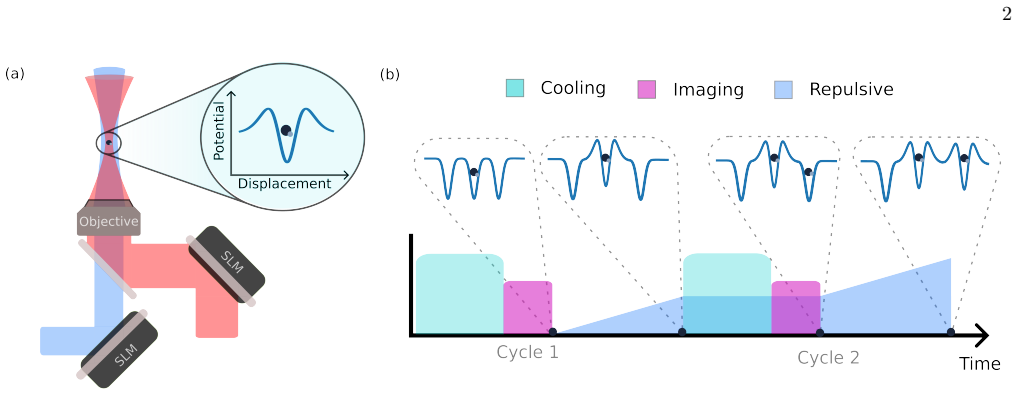
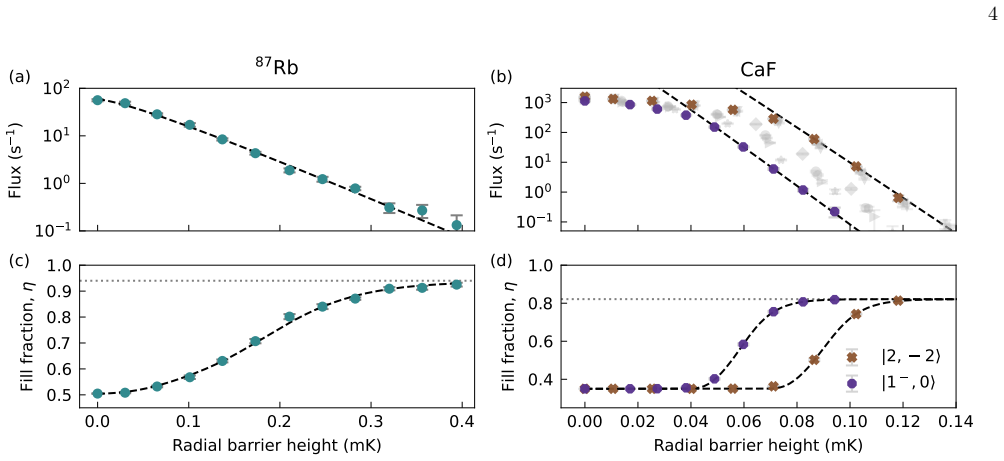
Repulsive barricade potentials can be added around occupied optical tweezers to repel incoming atoms or molecules, thereby protecting trapped particles from collisional loss and extending their lifetimes to hundreds of milliseconds. This protection supports repeated loading cycles that raise the probability of a filled site to 82 percent for molecules and 94 percent for atoms after four attempts, offering a scalable route to near-perfect arrays when combined with rearrangement techniques.
What carries the argument
Repulsive barricade potentials placed around occupied tweezers that repel incoming particles while preserving the primary trap for already loaded atoms or molecules.
If this is right
- Initial array filling fractions rise well above the single-cycle limit before any rearrangement is applied.
- Fewer rearrangement steps are needed to reach defect-free configurations.
- The method applies equally to atomic and molecular platforms.
- Larger-scale quantum arrays become feasible with less overhead in preparation time.
Where Pith is reading between the lines
- Overall array preparation time could drop if the extra loading cycles are faster than full rearrangement sequences.
- The approach might tolerate denser initial trap configurations where collision rates are higher.
- Optimizing barrier height versus loading efficiency offers a tunable parameter that could be tested directly in the lab.
- Integration with dynamic trap repositioning during loading might push filling probabilities even closer to unity.
Load-bearing premise
The repulsive barricades can be created without disturbing the main trapping potential or blocking new particles from entering empty tweezers, and the modeled collision rates truly allow the stated lifetimes of hundreds of milliseconds.
What would settle it
An experiment that loads one particle into a protected tweezer, activates the barricade, and then repeatedly attempts to load a nearby empty site while measuring how long the first particle survives before ejection.
Figures

read the original abstract
Optical tweezers are a powerful tool for creating defect-free arrays of atoms and molecules, enabling advances in quantum simulation, computation, and precision metrology. However, the achievable array size is limited by the initial loading fraction, typically $50\,\%$ for atoms and $35\,\%$ for molecules. Here, we propose a general scheme for enabling multiple loading cycles by protecting trapped particles using a repulsive barrier. We show that collision-limited lifetimes of particles in protected tweezers can reach hundreds of milliseconds, allowing loading probabilities of $82\,\%$ for molecules and $94\,\%$ for atoms after four loading cycles. Combined with existing rearrangement techniques, this approach enables efficient unity filling of tweezer arrays and provides a scalable pathway towards larger quantum technology platforms.
Editorial analysis
A structured set of objections, weighed in public.
Referee Report
Summary. The manuscript proposes a scheme to achieve near-deterministic filling of optical tweezer arrays for atoms and molecules by protecting occupied sites with repulsive barricade potentials during multiple loading cycles. It reports that collision-limited lifetimes in protected tweezers can reach hundreds of milliseconds, yielding calculated loading probabilities of 82% for molecules and 94% for atoms after four cycles; when combined with existing rearrangement techniques, this enables efficient unity filling.
Significance. If the modeling of lifetimes and loading dynamics holds, the approach offers a scalable route to larger defect-free arrays without requiring new hardware, which would advance quantum simulation, computation, and metrology platforms. The quantitative estimates of lifetimes and cycle probabilities provide a concrete, falsifiable prediction that can be tested experimentally.
major comments (3)
- [potential implementation and loading dynamics sections] The central claim depends on the repulsive barricade not disrupting the primary trap depth for occupied sites or raising the effective barrier for incoming particles into empty sites. The manuscript must provide an explicit potential model (e.g., in the section describing the superimposed potentials) with calculated trap depths, barrier heights, and loading-rate simulations confirming both conditions hold simultaneously; without this, the assumed collision rates and resulting lifetimes cannot be validated.
- [lifetime and probability calculations] The reported collision-limited lifetimes (hundreds of ms) and the derived probabilities (82% molecules, 94% atoms after four cycles) rest on unshown modeling. The manuscript should include the explicit equations for lifetime calculation from collision rates, the probabilistic model or Monte Carlo simulation for multi-cycle loading, and sensitivity analysis to the assumed rates; the abstract states the numbers but the full text must supply the supporting derivations and error estimates.
- [results for atoms vs. molecules] The distinction between atoms and molecules in the quoted probabilities requires justification of the differing collision rates and protection efficacy; if the barricade implementation is identical, the factor-of-two difference in final filling should be traced to specific parameters in the model.
minor comments (2)
- [figures] Ensure all figures showing potential landscapes include quantitative scales for depth and radial distance to allow direct assessment of trap integrity.
- [introduction or results] Add a brief comparison table of loading fractions with and without the barricade scheme to highlight the improvement over the stated baselines (50% atoms, 35% molecules).
Simulated Author's Rebuttal
We thank the referee for their thorough review and constructive feedback on our manuscript. We believe the proposed scheme offers a promising approach, and we have addressed the major comments by providing additional details and clarifications in the revised version. Our point-by-point responses are as follows.
read point-by-point responses
-
Referee: [potential implementation and loading dynamics sections] The central claim depends on the repulsive barricade not disrupting the primary trap depth for occupied sites or raising the effective barrier for incoming particles into empty sites. The manuscript must provide an explicit potential model (e.g., in the section describing the superimposed potentials) with calculated trap depths, barrier heights, and loading-rate simulations confirming both conditions hold simultaneously; without this, the assumed collision rates and resulting lifetimes cannot be validated.
Authors: We agree with the referee that an explicit potential model is essential for validating our claims. In the revised manuscript, we have expanded the section on potential implementation to include a detailed model of the superimposed repulsive barricade and primary trap potentials. This includes explicit calculations of the trap depths for occupied sites and barrier heights for empty sites. Furthermore, we have added simulations of the loading dynamics that confirm the barricade does not significantly alter the primary trap depth or impede loading into empty sites. These additions directly support the collision rates and lifetimes used in our analysis. revision: yes
-
Referee: [lifetime and probability calculations] The reported collision-limited lifetimes (hundreds of ms) and the derived probabilities (82% molecules, 94% atoms after four cycles) rest on unshown modeling. The manuscript should include the explicit equations for lifetime calculation from collision rates, the probabilistic model or Monte Carlo simulation for multi-cycle loading, and sensitivity analysis to the assumed rates; the abstract states the numbers but the full text must supply the supporting derivations and error estimates.
Authors: We have incorporated the requested details into the revised manuscript. Specifically, we now present the explicit equations relating collision rates to the collision-limited lifetimes. We describe the probabilistic model for the multi-cycle loading process and outline the Monte Carlo simulation approach used to derive the loading probabilities. A sensitivity analysis to variations in the assumed collision rates is included, along with error estimates on the final probabilities. These derivations are now fully detailed in the main text to support the numbers reported in the abstract. revision: yes
-
Referee: [results for atoms vs. molecules] The distinction between atoms and molecules in the quoted probabilities requires justification of the differing collision rates and protection efficacy; if the barricade implementation is identical, the factor-of-two difference in final filling should be traced to specific parameters in the model.
Authors: The difference in loading probabilities between atoms and molecules stems from their distinct physical properties, particularly the collision cross-sections and rates, as well as minor variations in how the barricade interacts with each species due to differences in mass and polarizability. In the revised manuscript, we have added a dedicated discussion in the results section that justifies these parameters and traces the factor-of-two difference explicitly to the model inputs, such as the higher collision rate for molecules arising from their larger effective size compared to atoms. This explains the lower lifetime and thus the reduced probability for molecules while maintaining the same barricade implementation. revision: yes
Circularity Check
No circularity: loading probabilities derived from independent lifetime estimates
full rationale
The paper proposes a repulsive-barricade scheme and derives collision-limited lifetimes (hundreds of ms) from physical assumptions about trap depths and collision rates, then computes multi-cycle loading probabilities (82% molecules, 94% atoms after four cycles) as direct consequences of those lifetimes. No step redefines a fitted parameter as a prediction, imports a uniqueness theorem from self-citation, or reduces the central claim to an ansatz or renaming; the calculations remain self-contained against external benchmarks of trap potentials and collision physics.
Axiom & Free-Parameter Ledger
axioms (2)
- domain assumption Repulsive barriers can be superimposed on optical traps without altering trap depths or loading dynamics
- domain assumption Collision rates in the protected configuration yield lifetimes of hundreds of milliseconds
Reference graph
Works this paper leans on
-
[1]
Browaeys and T
A. Browaeys and T. Lahaye, Nature Physics16, 132 (2020)
2020
-
[2]
A. M. Kaufman and K.-K. Ni, Nature Physics17, 1324 (2021)
2021
-
[3]
Endres, H
M. Endres, H. Bernien, A. Keesling, H. Levine, E. R. Anschuetz, A. Krajenbrink, C. Senko, V. Vuletic, M. Greiner, and M. D. Lukin, Science354, 1024 (2016)
2016
-
[4]
Barredo, S
D. Barredo, S. de L´ es´ eleuc, V. Lienhard, T. Lahaye, and A. Browaeys, Science354, 1021 (2016)
2016
-
[5]
W. Lee, H. Kim, and J. Ahn, Opt. Express24, 9816 (2016)
2016
-
[6]
M. A. Norcia, A. W. Young, and A. M. Kaufman, Phys. Rev. X8, 041054 (2018)
2018
-
[7]
Saskin, J
S. Saskin, J. T. Wilson, B. Grinkemeyer, and J. D. Thompson, Phys. Rev. Lett.122, 143002 (2019)
2019
-
[8]
N. C. Jackson, R. K. Hanley, M. Hill, F. Leroux, C. S. Adams, and M. P. A. Jones, SciPost Phys.8, 038 (2020)
2020
-
[9]
Sheng, J
C. Sheng, J. Hou, X. He, K. Wang, R. Guo, J. Zhuang, B. Mamat, P. Xu, M. Liu, J. Wang, and M. Zhan, Phys. Rev. Lett.128, 083202 (2022)
2022
-
[10]
Anderegg, L
L. Anderegg, L. W. Cheuk, Y. Bao, S. Burchesky, W. Ketterle, K.-K. Ni, and J. M. Doyle, Science365, 1156 (2019)
2019
-
[11]
Y. Bao, S. S. Yu, L. Anderegg, E. Chae, W. Ketterle, K.-K. Ni, and J. M. Doyle, Science382, 1138 (2023)
2023
-
[12]
C. M. Holland, Y. Lu, and L. W. Cheuk, Phys. Rev. Lett. 131, 053202 (2023)
2023
-
[13]
A. J. Park, L. R. B. Picard, G. E. Patenotte, J. T. Zhang, T. Rosenband, and K.-K. Ni, Phys. Rev. Lett. 131, 183401 (2023)
2023
-
[14]
N. B. Vilas, P. Robichaud, C. Hallas, G. K. Li, L. An- deregg, and J. M. Doyle, Nature628, 282 (2024)
2024
-
[15]
D. K. Ruttley, T. R. Hepworth, A. Guttridge, and S. L. Cornish, Nature637, 827 (2025)
2025
-
[16]
Nogrette, H
F. Nogrette, H. Labuhn, S. Ravets, D. Barredo, L. B´ eguin, A. Vernier, T. Lahaye, and A. Browaeys, Phys. Rev. X4, 021034 (2014)
2014
-
[17]
H. Kim, W. Lee, H. G. Lee, H. Jo, Y. Song, and J. Ahn, Nature Communications7, 10.1038/ncomms13317 (2016). 6
-
[18]
Schymik, V
K.-N. Schymik, V. Lienhard, D. Barredo, P. Scholl, H. Williams, A. Browaeys, and T. Lahaye, Phys. Rev. A102, 063107 (2020)
2020
-
[19]
Bluvstein, H
D. Bluvstein, H. Levine, G. Semeghini, T. T. Wang, S. Ebadi, M. Kalinowski, A. Keesling, N. Maskara, H. Pichler, M. Greiner, V. Vuleti´ c, and M. D. Lukin, Nature604, 451 (2022)
2022
-
[20]
C. M. Holland, Y. Lu, and L. W. Cheuk, Science382, 1143 (2023)
2023
-
[21]
H. J. Manetsch, G. Nomura, E. Bataille, X. Lv, K. H. Leung, and M. Endres, Nature647, 60 (2025)
2025
-
[22]
Pichard, D
G. Pichard, D. Lim, E. Bloch, J. Vaneecloo, L. Boura- chot, G.-J. Both, G. M´ eriaux, S. Dutartre, R. Hostein, J. Paris, B. Ximenez, A. Signoles, A. Browaeys, T. La- haye, and D. Dreon, Phys. Rev. Appl.22, 024073 (2024)
2024
-
[23]
N.-C. Chiu, E. C. Trapp, J. Guo, M. H. Abobeih, L. M. Stewart, S. Hollerith, P. L. Stroganov, M. Kalinowski, A. A. Geim, S. J. Evered, S. H. Li, X. Lyu, L. M. Peters, D. Bluvstein, T. T. Wang, M. Greiner, V. Vuleti´ c, and M. D. Lukin, Nature 10.1038/s41586-025-09596-6 (2025)
-
[24]
Ebadi, T
S. Ebadi, T. T. Wang, H. Levine, A. Keesling, G. Se- meghini, A. Omran, D. Bluvstein, R. Samajdar, H. Pich- ler, W. W. Ho, S. Choi, S. Sachdev, M. Greiner, V. Vuleti´ c, and M. D. Lukin, Nature595, 227 (2021)
2021
-
[25]
Scholl, M
P. Scholl, M. Schuler, H. J. Williams, A. A. Eberharter, D. Barredo, K.-N. Schymik, V. Lienhard, L.-P. Henry, T. C. Lang, A. M. L¨ auchli, T. Lahaye, and A. Browaeys, Nature595, 233 (2021)
2021
-
[26]
T. M. Graham, Y. Song, J. Scott,et al., Nature604, 457 (2022)
2022
-
[27]
S. J. Evered, D. Bluvstein, M. Kalinowski,et al., Nature 622, 268 (2023)
2023
-
[28]
Sales Rodriguez, J
P. Sales Rodriguez, J. M. Robinson, P. N. Jepsen,et al., Nature645, 620 (2025)
2025
-
[29]
A fault-tolerant neutral-atom architecture for universal quantum computation,
D. Bluvstein, A. A. Geim, S. H. Li, S. J. Evered, J. P. B. Ataides, G. Baranes, A. Gu, T. Manovitz, M. Xu, M. Kalinowski, S. Majidy, C. Kokail, N. Maskara, E. C. Trapp, L. M. Stewart, S. Hollerith, H. Zhou, M. J. Gul- lans, S. F. Yelin, M. Greiner, V. Vuleti´ c, M. Cain, and M. D. Lukin, Nature 10.1038/s41586-025-09848-5 (2025)
-
[30]
I. S. Madjarov, A. Cooper, A. L. Shaw, J. P. Covey, V. Schkolnik, T. H. Yoon, J. R. Williams, and M. En- dres, Phys. Rev. X9, 041052 (2019)
2019
-
[31]
A. W. Young, W. J. Eckner, W. R. Milner, D. Kedar, M. A. Norcia, E. Oelker, N. Schine, J. Ye, and A. M. Kaufman, Nature588, 408 (2020)
2020
-
[32]
Schlosser, G
N. Schlosser, G. Reymond, and P. Grangier, Phys. Rev. Lett.89, 023005 (2002)
2002
-
[33]
Schlosser, G
N. Schlosser, G. Reymond, I. Protsenko, and P. Grangier, Nature411, 1024 (2001)
2001
-
[34]
Gr¨ unzweig, A
T. Gr¨ unzweig, A. Hilliard, M. McGovern, and M. F. An- dersen, Nature Physics6, 951 (2010)
2010
-
[35]
B. J. Lester, N. Luick, A. M. Kaufman, C. M. Reynolds, and C. A. Regal, Phys. Rev. Lett.115, 073003 (2015)
2015
-
[36]
M. M. Aliyu, L. Zhao, X. Q. Quek, K. C. Yellapragada, and H. Loh, Phys. Rev. Res.3, 043059 (2021)
2021
-
[37]
M. O. Brown, T. Thiele, C. Kiehl, T.-W. Hsu, and C. A. Regal, Phys. Rev. X9, 011057 (2019)
2019
-
[38]
Ang’ong’a, C
J. Ang’ong’a, C. Huang, J. P. Covey, and B. Gadway, Phys. Rev. Res.4, 013240 (2022)
2022
-
[39]
Jenkins, J
A. Jenkins, J. W. Lis, A. Senoo, W. F. McGrew, and A. M. Kaufman, Phys. Rev. X12, 021027 (2022)
2022
-
[40]
E. F. Walraven, M. R. Tarbutt, and T. Karman, Physical Review Letters132, 183401 (2024)
2024
-
[41]
I. H. A. Knottnerus, Y. C. Tseng, A. Urech, R. J. C. Spreeuw, and F. Schreck, SciPost Phys.19, 118 (2025)
2025
-
[42]
A. L. Shaw, P. Scholl, R. Finklestein, and I. S. M. et al., Physical Review Letters130, 10.1103/Phys- RevLett.130.193402 (2023)
-
[43]
T. Vanackere, A. Hermans, I. Christen, C. Panuski, M. Dong, M. Zimmermann, H. Raniwala, A. J. Leen- heer, M. Eichenfield, G. Gilbert, and D. Englund, Nature Communications 10.1038/s41467-025-66718-4 (2025)
-
[44]
C. S. Adams and I. G. Hughes,Optics f2f: From Fourier to Fresnel(Oxford University Press, 2018)
2018
-
[45]
J. D. Miller, R. A. Cline, and D. J. Heinzen, Phys. Rev. A47, R4567 (1993)
1993
-
[46]
Y. H. Fung, P. Sompet, and M. F. Andersen, Technologies 4, 4 (2016)
2016
-
[47]
E. B. Norrgard, D. J. McCarron, M. H. Steinecker, M. R. Tarbutt, and D. DeMille, Phys. Rev. Lett.116, 063004 (2016)
2016
-
[48]
H. J. Williams, S. Truppe, M. Hambach, L. Caldwell, N. J. Fitch, E. A. Hinds, B. E. Sauer, and M. R. Tarbutt, New Journal of Physics19, 113035 (2017)
2017
-
[49]
Anderegg, B
L. Anderegg, B. L. Augenbraun, E. Chae, B. Hemmer- ling, N. R. Hutzler, A. Ravi, A. Collopy, J. Ye, W. Ket- terle, and J. M. Doyle, Phys. Rev. Lett.119, 103201 (2017)
2017
-
[50]
A. L. Collopy, S. Ding, Y. Wu, I. A. Finneran, L. An- deregg, B. L. Augenbraun, J. M. Doyle, and J. Ye, Phys. Rev. Lett.121, 213201 (2018)
2018
-
[51]
Humphreys, A
B. Humphreys, A. J. Matthies, and H. J. Williams, Com- puter Physics Communications316, 109813 (2025)
2025
-
[52]
Grimm, M
R. Grimm, M. Weidem¨ uller, and Y. B. Ovchinnikov, Ad- vances in Atomic, Molecular, and Optical Physics42, 95 (2000). Appendix: Fill F raction Model We derive the cumulative fill fractionηafterNload- ing cycles by considering the probabilityP N that a given tweezer site is occupied at the end of theN-th loading cycle. In the first cycle, no barricade is p...
2000
discussion (0)
Sign in with ORCID, Apple, or X to comment. Anyone can read and Pith papers without signing in.