Recognition: unknown
Exploring Cosmic Evolution in R\'enyi Entropic Cosmology with Constraints from DESI DR2 BAO and GW Data
Pith reviewed 2026-05-08 10:28 UTC · model grok-4.3
The pith
Rényi entropic corrections to the Friedmann equations receive a direct constraint on their parameter from late-time acceleration data.
A machine-rendered reading of the paper's core claim, the machinery that carries it, and where it could break.
Core claim
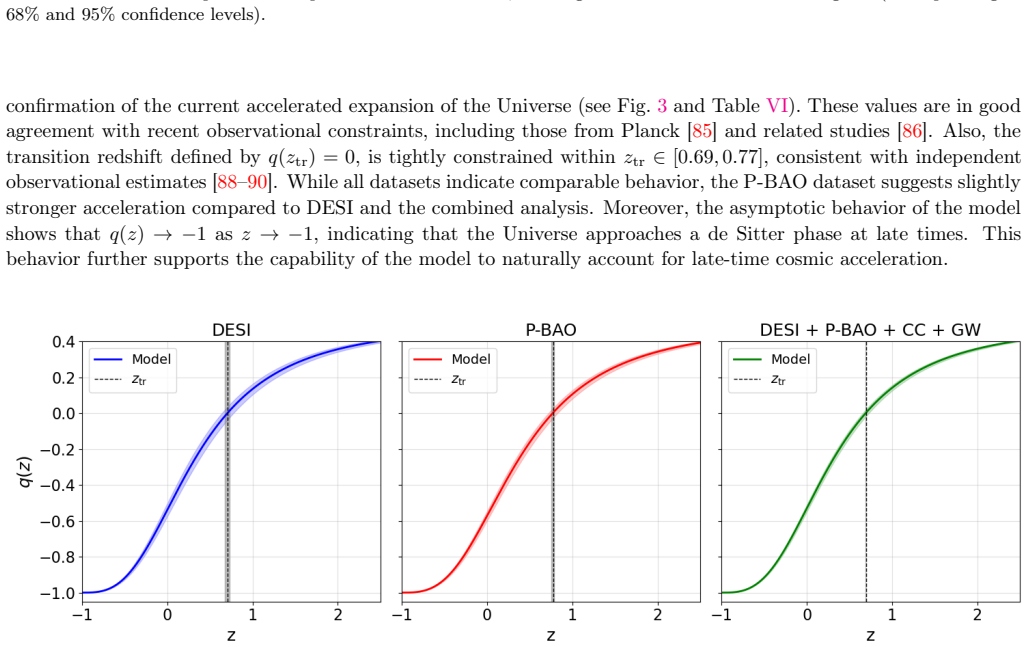
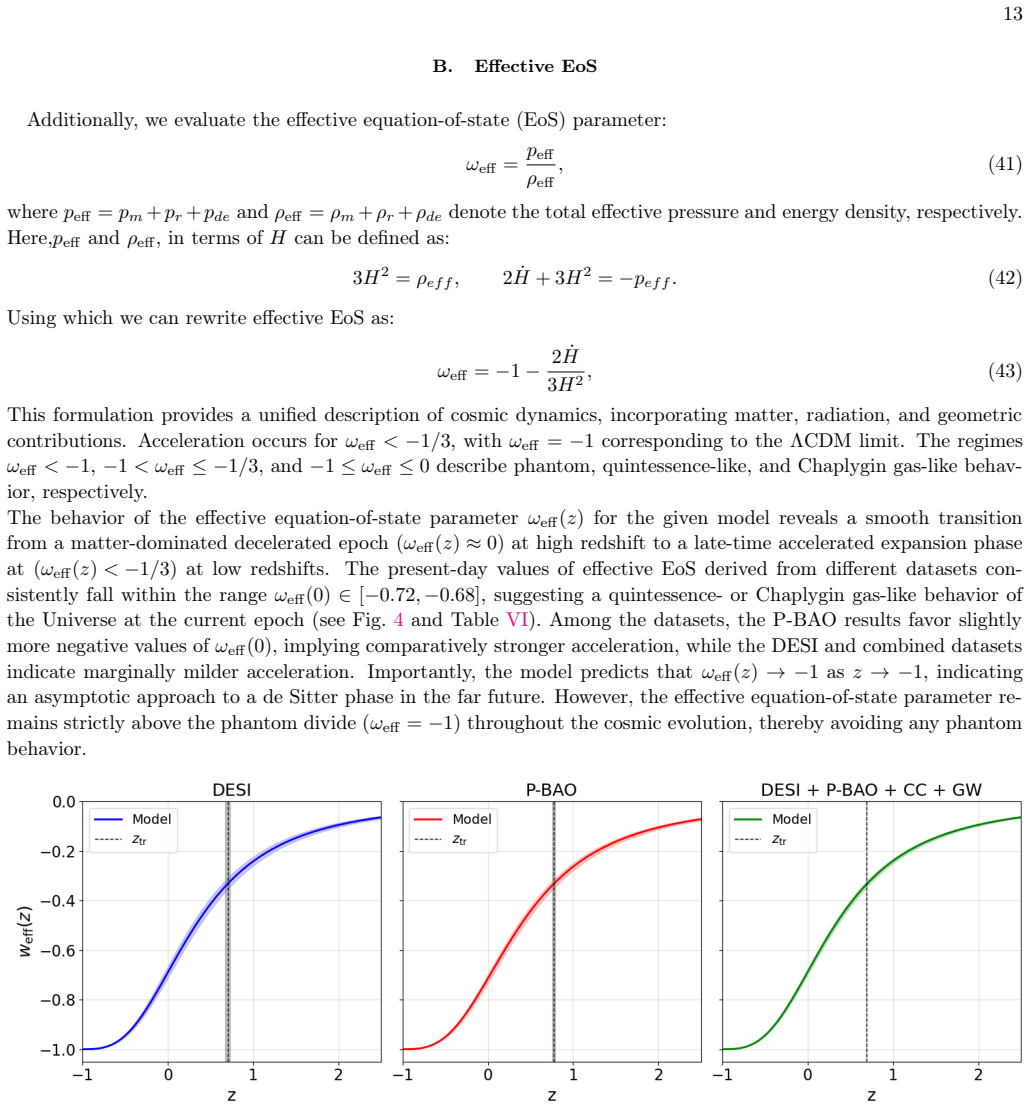
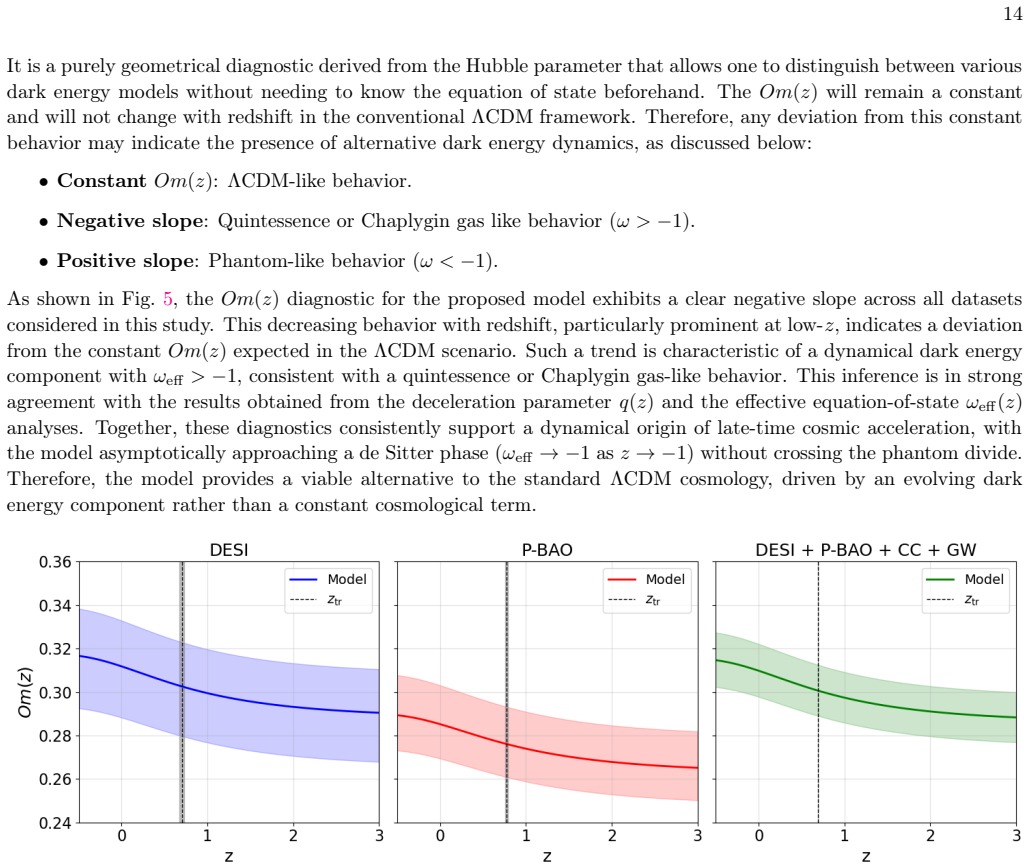
The Rényi entropic correction supplies a viable description of late-time cosmic acceleration, with the parameter λ tightly bounded by DESI DR2 BAO, P-BAO, CC, and GW data to values that also satisfy Big Bang Nucleosynthesis and baryogenesis limits; the resulting expansion history remains stable, obeys energy conditions, and transitions smoothly to the ΛCDM limit without phantom behavior.
What carries the argument
The Rényi entropic correction added to the Friedmann equations, which introduces the parameter λ that alters the effective energy density and pressure to drive acceleration at late times.
If this is right
- The model reproduces the observed late-time acceleration with a quintessence-like equation of state.
- Predicted values of the present Hubble constant and matter density fraction remain consistent with current measurements.
- The model satisfies standard energy conditions and remains stable against perturbations.
- Statistical comparisons favor the entropic model as a viable alternative to the standard cosmological constant picture.
- The derived λ satisfies independent bounds from Big Bang Nucleosynthesis and baryogenesis.
Where Pith is reading between the lines
- If the constraint holds, entropy-based modifications could link late-time acceleration to quantum-information effects without introducing new fields.
- Future surveys with tighter BAO or gravitational-wave standard-siren measurements could shrink the allowed range for λ further.
- The approach might be extended to early-universe epochs to test whether the same correction influences inflation or recombination.
Load-bearing premise
The Rényi entropic correction fully accounts for the observed late-time dynamics without hidden degeneracies or unmodeled systematics in the combined datasets.
What would settle it
A future high-precision measurement of the dark-energy equation-of-state parameter that falls below -1 at any redshift, or a Hubble-constant value lying well outside the model's predicted range from the same data combination.
Figures



read the original abstract
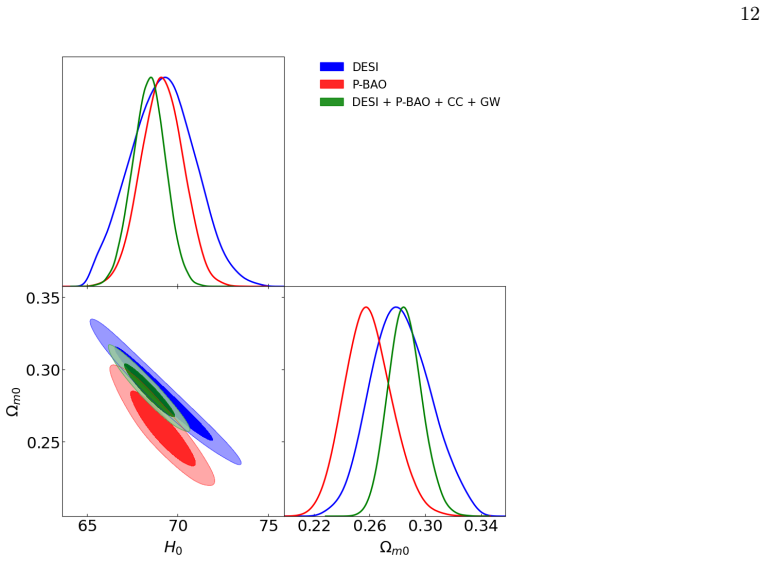
We explore a cosmological model based on R\'enyi entropic corrections to the Friedmann equations and constrain it using DESI, P-BAO, CC, and gravitational-wave observations. Unlike earlier works, we obtain a direct and stringent constraint on the R\'enyi parameter $\lambda$ from late-time cosmic acceleration, with the resulting value even satisfying recent Big Bang Nucleosynthesis and baryogenesis bounds. The model predicts values of $H_0$ and $\Omega_{m0}$ that are consistent with current observational data. It provides a successful description of late-time acceleration with a quintessence-like behavior, smoothly approaching the $\Lambda$CDM limit without crossing the phantom divide. Furthermore, the statical comparisons along with the evaluation of energy conditions and stability analyses reinforce its viability as a robust alternative to the standard cosmological model.
Editorial analysis
A structured set of objections, weighed in public.
Referee Report
Summary. The manuscript develops a cosmological model in which Rényi entropic corrections are added to the Friedmann equations, introducing a single free parameter λ. Using DESI DR2 BAO, P-BAO, cosmic chronometer, and gravitational-wave datasets, the authors perform a joint MCMC fit for λ, H0, and Ωm0, report a best-fit value of λ that satisfies BBN and baryogenesis bounds, and show that the resulting expansion history is quintessence-like, approaches the ΛCDM limit at late times, satisfies energy conditions, and passes statistical model-comparison tests.
Significance. If the reported bound on λ proves robust against parameter degeneracies, the work supplies one of the first direct late-time observational constraints on an entropic-gravity correction, together with explicit checks of energy conditions and stability that are not always performed in similar models. The approach of letting the data drive λ while recovering standard H0 and Ωm0 values is a concrete, falsifiable test of the framework.
major comments (2)
- [§4] §4 (MCMC results and posterior plots): the abstract asserts a 'direct and stringent constraint' on λ from late-time data, yet the fit simultaneously varies λ, H0, and Ωm0 on the same DESI DR2 + P-BAO + CC + GW datasets. No correlation matrix, degeneracy diagnostic (e.g., Δχ² when λ is fixed to zero), or conditional posterior is presented; without these the claim that the λ bound is independent rather than a projection along the H0–Ωm0 degeneracy direction cannot be verified.
- [§2.2] §2.2 (modified Friedmann equations): the entropic correction is introduced as an additive term to the effective dark-energy density. The paper does not quantify how this term correlates with the standard background parameters in the likelihood; a brief analytic or numerical degeneracy analysis (e.g., the derivative of the Hubble function with respect to λ at fixed H0, Ωm0) would be required to substantiate that the datasets can actually isolate λ.
minor comments (2)
- [Abstract] Abstract: 'statical comparisons' should read 'statistical comparisons'.
- [Figures/Tables] Figure captions and tables: axis labels and column headings should explicitly state the units and the 1σ/2σ confidence levels used for the reported intervals on λ, H0, and Ωm0.
Simulated Author's Rebuttal
We thank the referee for the constructive and detailed comments, which help clarify the presentation of our MCMC results and the independence of the λ constraint. We address each major point below and will revise the manuscript to incorporate the suggested analyses.
read point-by-point responses
-
Referee: [§4] §4 (MCMC results and posterior plots): the abstract asserts a 'direct and stringent constraint' on λ from late-time data, yet the fit simultaneously varies λ, H0, and Ωm0 on the same DESI DR2 + P-BAO + CC + GW datasets. No correlation matrix, degeneracy diagnostic (e.g., Δχ² when λ is fixed to zero), or conditional posterior is presented; without these the claim that the λ bound is independent rather than a projection along the H0–Ωm0 degeneracy direction cannot be verified.
Authors: We acknowledge that the manuscript does not present a correlation matrix or explicit degeneracy diagnostics such as Δχ² for λ fixed to zero. The joint MCMC posterior does show λ constrained away from zero while returning H0 and Ωm0 values consistent with independent data, and the inclusion of gravitational-wave standard sirens provides an additional handle on the expansion history. To substantiate the claim of an independent constraint, the revised version will include the full correlation matrix from the chains and a Δχ² comparison between the free-λ and λ=0 cases. If these diagnostics reveal significant degeneracy, we will also revise the abstract wording accordingly. revision: yes
-
Referee: [§2.2] §2.2 (modified Friedmann equations): the entropic correction is introduced as an additive term to the effective dark-energy density. The paper does not quantify how this term correlates with the standard background parameters in the likelihood; a brief analytic or numerical degeneracy analysis (e.g., the derivative of the Hubble function with respect to λ at fixed H0, Ωm0) would be required to substantiate that the datasets can actually isolate λ.
Authors: We agree that an explicit quantification of the correlation is needed. In the revised manuscript we will add both an analytic expression for ∂H(z)/∂λ evaluated at fixed H0 and Ωm0 (derived directly from the modified Friedmann equation) and a numerical evaluation of the likelihood response when λ is varied while holding the background parameters fixed. These additions will demonstrate the independent sensitivity of the late-time datasets to the Rényi term. revision: yes
Circularity Check
Fitted H0 and Ωm0 values presented as model predictions after joint fit with λ
specific steps
-
fitted input called prediction
[Abstract]
"The model predicts values of H0 and Ωm0 that are consistent with current observational data."
H0 and Ωm0 are fitted jointly with λ to the DESI DR2 BAO, P-BAO, CC, and GW data to obtain the constraint on λ; stating that the model 'predicts' these values therefore restates the best-fit results from the identical fit rather than providing an independent forecast.
full rationale
The paper constrains the Rényi parameter λ from late-time datasets and states that the model then predicts H0 and Ωm0 values consistent with observations. Because these parameters are varied jointly in the fit, the reported 'predictions' are direct outputs of the same parameter estimation rather than independent forecasts. The BBN/baryogenesis consistency check occurs after the fit and does not create circularity. The central constraint on λ retains independent content provided the entropic correction introduces dynamics not fully degenerate with standard parameters, but the presentation of fitted results as predictions constitutes partial circularity per the defined patterns.
Axiom & Free-Parameter Ledger
free parameters (1)
- λ (Rényi parameter)
axioms (2)
- domain assumption Rényi entropy supplies a correction term that modifies the Friedmann equations
- standard math FLRW metric and standard energy-momentum conservation hold
Reference graph
Works this paper leans on
-
[1]
Riess, A. G., et al. (1998). Observational Evidence from Supernovae for an Accelerating Universe and a Cosmological Constant. Astronomical Journal, 116(3), 1009–1038. https://doi.org/10.1086/300499
-
[2]
Perlmutter, S., et al. (1999). Measurements ofΩ and Λ from 42 High-Redshift Supernovae.Astrophysical Journal, 517(2), 565–586. https://doi.org/10.1086/307221 19
work page internal anchor Pith review doi:10.1086/307221 1999
-
[3]
L., Halpern, M., Hinshaw, G., et al
Bennett, C. L., et al. (2003). First-Year Wilkinson Microwave Anisotropy Probe (WMAP) Observations: Preliminary Maps and Basic Results.Astrophysical Journal Supplement Series , 148, 1–27. https://doi.org/10.1086/377253
-
[4]
Spergel, D. N., et al. (2003). First-Year Wilkinson Microwave Anisotropy Probe (WMAP) Observations: Determination of Cosmological Parameters.Astrophysical Journal Supplement Series , 148, 175–194. https://doi.org/10.1086/377226
-
[5]
Eisenstein, D. J., et al. (2005). Detection of the Baryon Acoustic Peak in the Large-Scale Correlation Function of SDSS Luminous Red Galaxies.Astrophysical Journal, 633(2), 560–574. https://doi.org/10.1086/466512
-
[6]
Percival, W. J., et al. (2010). Baryon Acoustic Oscillations in the Sloan Digital Sky Survey Data Release 7 Galaxy Sample. Monthly Notices of the Royal Astronomical Society , 401(4), 2148–2168. https://doi.org/10.1111/j.1365-2966.2009.15812.x
-
[7]
Weinberg, S. (1989). The Cosmological Constant Problem. Reviews of Modern Physics , 61(1), 1–23. https://doi.org/10.1103/RevModPhys.61.1
-
[8]
J. Martin, “Everything You Always Wanted To Know About The Cosmological Constant Problem (But Were Afraid To Ask),”Comptes Rendus Physique 13, 566 (2012), arXiv:1205.3365 [astro-ph.CO]
work page Pith review arXiv 2012
-
[9]
Carroll, S. M., Press, W. H., & Turner, E. L. (1992). The Cosmological Constant.Annual Review of Astronomy and Astrophysics, 30, 499–542. https://doi.org/10.1146/annurev.aa.30.090192.002435
-
[10]
Sahni, V., & Starobinsky, A. A. (2000). The Case for a Positive CosmologicalΛ-Term. International Journal of Modern Physics D, 9(4), 373–443. https://doi.org/10.1142/S0218271800000542
-
[11]
Armendariz-Picon, C., Mukhanov, V., & Steinhardt, P. J. (2000). Dynamical solution to the problem of a small cosmological constant and late-time cosmic acceleration. Phys. Rev. Lett. , 85(21), 4438–4441. https://doi.org/10.1103/PhysRevLett.85.4438
-
[12]
Sen, A. (2002). Rolling tachyon. Journal of High Energy Physics , 2002(04), 048. https://doi.org/10.1088/1126- 6708/2002/04/048
-
[13]
Khoury, J., & Weltman, A. (2004). Chameleon fields: Awaiting surprises for tests of gravity in space.Phys. Rev. Lett. , 93(17), 171104. https://doi.org/10.1103/PhysRevLett.93.171104
-
[14]
Kamenshchik, A., Moschella, U., & Pasquier, V. (2001). An alternative to quintessence.Physics Letters B , 511(2-4), 265–268. https://doi.org/10.1016/S0370-2693(01)00571-8
-
[15]
Bento, M. C., Bertolami, O., & Sen, A. A. (2002). Generalized Chaplygin gas, accelerated expansion, and dark energy- matter unification. Phys. Rev. D , 66(4), 043507. https://doi.org/10.1103/PhysRevD.66.043507
-
[16]
J. M. Bardeen, B. Carter and S. W. Hawking, The four laws of black hole mechanics,Commun. Math. Phys. 31, 161 (1973). https://doi.org/10.1007/BF01645742
-
[17]
J. D. Bekenstein, Black holes and entropy,Phys. Rev. D 7, 2333 (1973). https://doi.org/10.1103/PhysRevD.7.2333
-
[18]
S. W. Hawking, Particle creation by black holes, Commun. Math. Phys. 43, 199 (1975). https://doi.org/10.1007/BF02345020
-
[19]
Dimensional Reduction in Quantum Gravity
G. ’t Hooft, Dimensional reduction in quantum gravity, in Salamfestschrift, World Scientific (1993). https://arxiv.org/abs/gr-qc/9310026
work page Pith review arXiv 1993
-
[20]
L. Susskind, The world as a hologram,J. Math. Phys. 36, 6377 (1995). https://doi.org/10.1063/1.531249
-
[21]
J. M. Maldacena, The largeN limit of superconformal field theories and supergravity,Adv. Theor. Math. Phys. 2, 231 (1998). https://doi.org/10.1023/A:1026654312961
-
[22]
Black holes: complementarity vs. firewalls,
A. Almheiri, D. Marolf, J. Polchinski and J. Sully, Black holes: Complementarity or firewalls?,JHEP 02, 062 (2013). https://doi.org/10.1007/JHEP02(2013)062
-
[23]
T. Jacobson, Thermodynamics of spacetime: The Einstein equation of state, Phys. Rev. Lett. 75, 1260 (1995). https://doi.org/10.1103/PhysRevLett.75.1260
-
[24]
R. G. Cai and S. P. Kim, First law of thermodynamics and Friedmann equations of FRW universe,JHEP 02, 050 (2005). https://doi.org/10.1088/1126-6708/2005/02/050
-
[25]
M. Akbar and R. G. Cai, Thermodynamic behavior of Friedmann equations at apparent horizon,Phys. Rev. D 75, 084003 (2007). https://doi.org/10.1103/PhysRevD.75.084003
-
[26]
Sheykhi, Modified Friedmann equations from generalized entropy,Phys
A. Sheykhi, Modified Friedmann equations from generalized entropy, Phys. Lett. B 785, 118 (2018). https://doi.org/10.1016/j.physletb.2018.08.018
-
[27]
S. Nojiri, S. D. Odintsov and V. K. Oikonomou, Modified gravity theories on a nutshell,Phys. Rept. 692, 1 (2017). https://doi.org/10.1016/j.physrep.2017.06.001
-
[28]
Possible generalization of Boltzmann-Gibbs statistics,
C. Tsallis, Possible generalization of Boltzmann–Gibbs statistics, J. Stat. Phys. 52, 479 (1988). https://doi.org/10.1007/BF01016429
-
[29]
Rényi, On measures of entropy and information, inProceedings of the Fourth Berkeley Symposium on Mathematical Statistics and Probability (1961)
A. Rényi, On measures of entropy and information, inProceedings of the Fourth Berkeley Symposium on Mathematical Statistics and Probability (1961)
1961
-
[30]
J. D. Barrow, The area of a rough black hole, Phys. Lett. B 808, 135643 (2020). https://doi.org/10.1016/j.physletb.2020.135643
-
[31]
G. Kaniadakis, Statistical mechanics in the context of special relativity, Phys. Rev. E 66, 056125 (2002). https://doi.org/10.1103/PhysRevE.66.056125 20
-
[32]
B. D. Sharma and D. P. Mittal, New non-additive measures of entropy,J. Math. Sci. 10, 28 (1975)
1975
-
[33]
Rovelli, Black hole entropy from loop quantum gravity,Phys
C. Rovelli, Black hole entropy from loop quantum gravity, Phys. Rev. Lett. 77, 3288 (1996). https://doi.org/10.1103/PhysRevLett.77.3288
-
[34]
Das, S., S. Shankaranarayanan, & Sur, S. (2008). Power-law corrections to entanglement entropy of horizons. Physical Re- view. D. Particles, Fields, Gravitation, and Cosmology/Physical Review. D, Particles, Fields, Gravitation, and Cosmology, 77(6). doi:10.1103/physrevd.77.064013.
-
[35]
Radicella, N., & Pavón, D. (2010). The generalized second law in universes with quantum corrected entropy relations. Physics Letters B, 691(3), 121–126. doi:10.1016/j.physletb.2010.06.019
-
[36]
Mann, R. B., & Solodukhin, S. N. (1997). Quantum scalar field on a three-dimensional (BTZ) black hole instanton: Heat kernel, effective action, and thermodynamics. Physical Review. D. Particles, Fields, Gravitation, and Cosmology/Physical Review. D. Particles and Fields, 55(6), 3622–3632. doi:10.1103/physrevd.55.3622
-
[37]
Banerjee, R., & Majhi, B. R. (2008). Quantum tunneling and back reaction. Physics Letters B, 662(1), 62–65. doi:10.1016/j.physletb.2008.02.044
-
[38]
Shannon, C. E. (1948). A Mathematical Theory of Communication. Bell System Technical Journal, 27(3), 379–423. doi:10.1002/j.1538-7305.1948.tb01338.x
- [39]
-
[40]
Fazlollahi, H. R. (2023). Rényi entropy correction to expanding universe. The European Physical Journal C, 83(1). doi:10.1140/epjc/s10052-023-11183-w
-
[41]
Ghaffari, S., Ziaie, A. H., Bezerra, V. B., & Moradpour, H. (2019). Inflation in the Rényi cosmology. Modern Physics Letters A, 35(01), 1950341. doi:10.1142/s0217732319503413
- [42]
-
[43]
Pandey, B. (2021). Renyi entropy as a measure of cosmic homogeneity. Journal of Cosmology and Astroparticle Physics, 2021(02), 023–023. doi:10.1088/1475-7516/2021/02/023
-
[44]
Abdul Karim, M., Aguilar, J., Ahlen, S., Alam, S., Allen, L., Prieto, C. A., Brieden, S. (2025). DESI DR2 results. II. Measurements of baryon acoustic oscillations and cosmological constraints. Physical Review D, 112(8). https://doi.org/10.1103/tr6y-kpc6
- [45]
-
[46]
E. Chaussidon et al.. (2025). Early Time Solution as an Alternative to the Late Time Evolving Dark Energy with DESI DR2 BAO. [arXiv:2503.24343]
-
[47]
J., García-García, C., Anton, T., et al
Wolf, W. J., García-García, C., Anton, T., et al. (2025). Assessing Cosmological Evidence for Nonminimal Coupling.Phys. Rev. Lett., 135(8), 081001. https://doi.org/10.1103/jysf-k72m [arXiv:2504.07679]
-
[48]
A. Paliathanasis. (2025). Dark Energy within the Generalized Uncertainty Principle in Light of DESI DR2 . [arXiv:2503.20896]
-
[49]
Rich Abbott et. al. (2021). Open data from the first and second observing runs of Advanced LIGO and Advanced Virgo. SoftwareX, 13, 100658. doi:10.1016/j.softx.2021.100658
-
[50]
Rich Abbott et. al. GWTC-3: Compact Binary Coalescences Observed by LIGO and Virgo during the Second Part of the Third Observing Run. Physical Review X, 13(4). doi:10.1103/physrevx.13.041039.
- [51]
-
[52]
Oka, A., Saito, S., Nishimichi, T., Taruya, A., & Yamamoto, K. (2014). Simultaneous constraints on the growth of structure and cosmic expansion from the multipole power spectra of the SDSS DR7 LRG sample.Monthly Notices of the Royal Astronomical Society, 439, 2515–2530. arXiv:1310.2820
- [53]
-
[54]
Chuang, C.-H., & Wang, Y. (2013). Modeling the Anisotropic Two-Point Galaxy Correlation Function on Small Scales and Improved Measurements of H(z), DA(z), andβ(z) from the Sloan Digital Sky Survey DR7 Luminous Red Galaxies. Monthly Notices of the Royal Astronomical Society , 435, 255–262. arXiv:1209.0210
-
[55]
Anderson, L., et al. (2014). The clustering of galaxies in the SDSS-III Baryon Oscillation Spectroscopic Survey: baryon acoustic oscillations in the Data Releases 10 and 11 Galaxy samples.Monthly Notices of the Royal Astronomical Society , 441(1), 24–62. arXiv:1312.4877
work page Pith review arXiv 2014
-
[56]
Zhao, G.-B., et al. (2019). The clustering of the SDSS-IV extended Baryon Oscillation Spectroscopic Survey DR14 quasar sample: a tomographic measurement of cosmic structure growth and expansion rate based on optimal redshift weights. 21 Monthly Notices of the Royal Astronomical Society , 482(3), 3497–3513. arXiv:1801.03043
-
[57]
Baryon acoustic oscillations in the Ly α forest of BOSS quasars
Busca, N. G., et al. (2013). Baryon Acoustic Oscillations in the Ly-α forest of BOSS quasars.Astronomy & Astrophysics, 552, A96. arXiv:1211.2616
- [58]
- [59]
-
[60]
Alam, S., et al. (2017). The clustering of galaxies in the completed SDSS-III Baryon Oscillation Spectroscopic Survey: cosmological analysis of the DR12 galaxy sample.Monthly Notices of the Royal Astronomical Society , 470(3), 2617–2652. arXiv:1607.03155
work page Pith review arXiv 2017
-
[61]
Chuang, C.-H., et al. (2013). The clustering of galaxies in the SDSS-III Baryon Oscillation Spectroscopic Survey: single- probe measurements and the strong power of normalized growth rate on constraining dark energy.Monthly Notices of the Royal Astronomical Society, 433, 3559. arXiv:1303.4486
- [62]
-
[63]
Neveux, R., et al. (2020). The completed SDSS-IV extended Baryon Oscillation Spectroscopic Survey: BAO and RSD measurements from the anisotropic power spectrum of the quasar sample between redshift 0.8 and 2.2.Monthly Notices of the Royal Astronomical Society , 499(1), 210–229. arXiv:2007.08999
-
[64]
Jimenez, R., & Loeb, A. (2002). Constraining Cosmological Parameters Based on Relative Galaxy Ages. The Astrophysical Journal, 573(1), 37–42. https://doi.org/10.1086/340549
-
[65]
Brieden, S., Gil-Marín, H., & Verde, L. (2023). A tale of two (or more) h’s. Journal of Cosmology and Astroparticle Physics, 2023(04), 023. doi:10.1088/1475-7516/2023/04/023
-
[66]
Burnham, K. P., & Anderson, D. R. (2004). Multimodel inference: Understanding AIC and BIC in model selection. Sociological Methods & Research, 33(2), 261–304. https://doi.org/10.1177/0049124104268644
- [67]
-
[68]
Schwarz, G. (1978). Estimating the dimension of a model. The Annals of Statistics , 6(2), 461–464. https://doi.org/10.1214/aos/1176344136
-
[69]
Zhang, C., Zhang, H., Yuan, S., Liu, S., Zhang, T.-J., Sun, Y.: Four new observationalH(z) data from luminous red galaxies in the Sloan Digital Sky Survey data release seven.Res. Astron. Astrophys. 14, 1221 (2014).https://doi.org/ 10.1088/1674-4527/14/10/002
-
[70]
Simon, J., Verde, L., Jimenez, R.: Constraints on the redshift dependence of the dark energy potential.Phys. Rev. D 71, 123001 (2005). https://doi.org/10.1103/PhysRevD.71.123001
-
[71]
Moresco, M., Cimatti, A., Jimenez, R., Pozzetti, L., Zamorani, G., Bolzonella, M., Dunlop, J.C., Lamareille, F., Mignoli, M., Pearce, H., Rosati, P., Stern, D., Verde, L., Zucca, E., Carollo, C.M., Contini, T., Kneib, J.-P., Le Fèvre, O., Lilly, S.J., Mainieri, V.: Improved constraints on the expansion rate of the Universe up toz ∼ 1.1 from the spectrosco...
work page Pith review doi:10.1088/1475-7516/2012/08/006 2012
-
[72]
et al.: The clustering of galaxies in the completed SDSS-III Baryon Oscillation Spectroscopic Survey: cosmological analysis of the DR12 galaxy sample.Mon
Alam, S., Ata, M., Bailey, S.J., Beutler, F., Bizyaev, D., Blazek, J., Bolton, A.S., Brownstein, J.R., Burden, A., Chuang, C.-H., Comparat, J., Cuesta, A.J., Dawson, K.S., Eisenstein, D.J., Escoffier, S., Gil-Marín, H., Grieb, J.N., Hand, N., Ho, S., Kinemuchi, K. et al.: The clustering of galaxies in the completed SDSS-III Baryon Oscillation Spectroscopi...
2017
-
[73]
Moresco, M., Pozzetti, L., Cimatti, A., Jimenez, R., Maraston, C., Verde, L., Thomas, D., Citro, A., Tojeiro, R., Wilkinson, D.: A 6% measurement of the Hubble parameter atz ∼ 0.45: direct evidence of the epoch of cosmic re-acceleration.JCAP 2016, 014 (2016).https://doi.org/10.1088/1475-7516/2016/05/014
-
[74]
Monthly Notices of the Royal Astronomical Society , author =
Alam, S., Ata, M., Bailey, S. J., Beutler, F., Dmitry Bizyaev, Blazek, J., ... Kinemuchi, K. (2017). The clustering of galaxies in the completed SDSS-III Baryon Oscillation Spectroscopic Survey: cosmological analysis of the DR12 galaxy sample. Monthly Notices of the Royal Astronomical Society, 470(3), 2617–2652. https://doi.org/10.1093/mnras/stx721
-
[75]
Bautista, J. E., Romain Paviot, Mariana Vargas Magaña, Sylvain, S. Fromenteau, Héctor Gil-Marín, ... Chapman, M. (2020). The completed SDSS-IV extended Baryon Oscillation Spectroscopic Survey: measurement of the BAO and growth rate of structure of the luminous red galaxy sample from the anisotropic correlation function between redshifts 0.6 and 1. 500(1),...
-
[76]
Neveux, R., Burtin, E., Arnaud de Mattia, Smith, A., Ross, A. J., Hou, J., ... Rossi, G. (2020). The completed SDSS-IV extended Baryon Oscillation Spectroscopic Survey: BAO and RSD measurements from the anisotropic power spectrum of the quasar sample between redshift 0.8 and 2.2. Monthly Notices of the Royal Astronomical Society, 499(1), 210–229. https://...
-
[77]
Bautista, J. E., Busca, N. G., Guy, J., Rich, J., Blomqvist, M., du Mas des Bourboux, H., Noterdaeme, P. (2017). Measurementofbaryonacousticoscillationcorrelationsat z = 2.3withSDSSDR12Ly αforests. Astronomy & Astrophysics, 603, A12. https://doi.org/10.1051/0004-6361/201730533
-
[78]
G., Guy, J., Rich, J., Pieri, M
du Mas des Bourboux, H., Le Goff, J.-M., Blomqvist, M., Busca, N. G., Guy, J., Rich, J., Pieri, M. M. (2017). Baryon acous- tic oscillations from the complete SDSS-III Lyα-quasar cross-correlation function at z = 2.4. Astronomy & Astrophysics, 608, A130. https://doi.org/10.1051/0004-6361/201731731
-
[79]
and Samushia, Lado and Howlett, Cullan and Percival, Will J
Ross, A. E., Lado Samushia, Howlett, C., Percival, W. J., Burden, A., & Manera, M. (2015). The clustering of the SDSS DR7 main Galaxy sample – I. A 4 per cent distance measure at z = 0.15. Monthly Notices of the Royal Astronomical Society, 449(1), 835–847. doi:10.1093/mnras/stv154
-
[80]
Kazin, Jun Koda, Chris Blake, Nikhil Padmanabhan, Sarah Brough, et al
Eyal A. Kazin, Jun Koda, Chris Blake, Nikhil Padmanabhan, Sarah Brough, et al. (2014). The WiggleZ Dark Energy Survey: improved distance measurements to z = 1 with reconstruction of the baryonic acoustic feature, Monthly Notices of the Royal Astronomical Society, 441(4), 3524–3542. doi:10.1093/mnras/stu778
discussion (0)
Sign in with ORCID, Apple, or X to comment. Anyone can read and Pith papers without signing in.