Recognition: unknown
Boundary-Aware Stabilizer Scheduling for Distributed Quantum Error Correction
Pith reviewed 2026-05-08 12:08 UTC · model grok-4.3
The pith
By scheduling seam stabilizer measurements less frequently, distributed quantum error correction can achieve lower logical error rates than measuring all seams every round.
A machine-rendered reading of the paper's core claim, the machinery that carries it, and where it could break.
Core claim
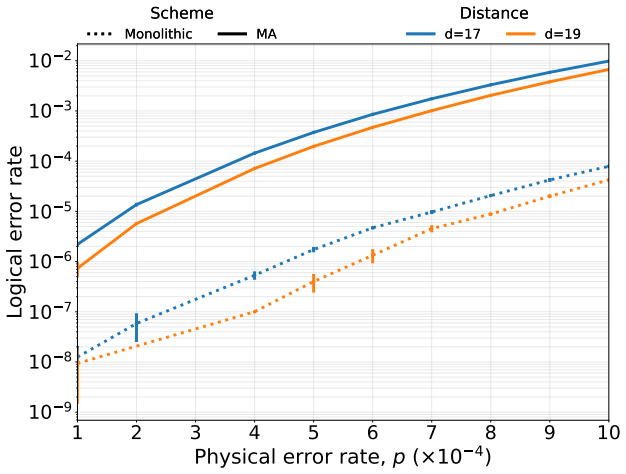
We develop SS-τ and AST policies that integrate directly into standard syndrome-extraction circuits for triangular color codes. Under circuit-level noise in Stim that includes idling errors from Bell-pair generation delays, both policies reduce remote-operation overhead and can lower the logical error rate relative to the Measure-All baseline. For physical error rate p = 10^{-3} we identify an entanglement-generation-rate regime in which SS-τ and AST exhibit fault-tolerant scaling, with logical error rate decreasing as code distance increases, and both policies outperform Measure-All across the tested regimes.
What carries the argument
Boundary-aware scheduling policies (SS-τ and AST) that decide how often to perform seam parity checks while copying the most recent syndrome in skipped rounds.
If this is right
- SS-τ and AST reduce remote-operation overhead relative to measuring every seam every round.
- Both policies can produce lower logical error rates than the Measure-All baseline.
- For physical error rate 10^{-3} and appropriate entanglement generation rates, logical error rate decreases as code distance increases under SS-τ and AST.
- SS-τ and AST outperform Measure-All across the simulated regimes.
Where Pith is reading between the lines
- The same skip-and-reuse idea could be applied to other topological codes that require remote operations at boundaries.
- Real hardware may need dynamic adjustment of the skip interval round-by-round if Bell-pair generation times fluctuate more than the model assumes.
- Combining the scheduler with improved decoder awareness of stale seam data might yield further reductions in logical error rate.
Load-bearing premise
The circuit-level noise model used in the simulations accurately captures the dominant error sources and timing in real distributed hardware with photonic interconnects.
What would settle it
An experiment on real photonic-interconnect hardware that measures logical error rates for triangular color codes under SS-τ or AST at physical error rate 10^{-3} and finds that the logical error rate does not decrease with increasing code distance in the claimed entanglement-generation-rate regime would falsify the fault-tolerant scaling result.
Figures






read the original abstract
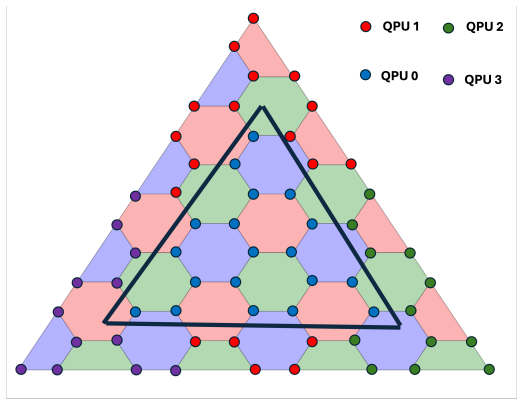
Future quantum architectures are expected to be modular, with quantum processors connecting multiple quantum processing units (QPUs) via photonic interconnects. In topological quantum error correction, such as color codes, this creates seam boundaries where parity checks require remote CNOT operations using heralded Bell pairs. These non-local checks are slower and noisier than bulk local checks because entanglement generation is probabilistic, causing data qubits to accumulate idle noise while waiting for remote operations. A natural way to reduce this overhead is to skip some seam measurements; however, doing so makes seam syndrome information stale and can degrade decoding. The central scheduling problem is therefore to determine how frequently seam checks should be measured so as to balance remote-operation and waiting noise against syndrome staleness. To address this trade-off, we develop a scheduling module that integrates directly into standard syndrome-extraction circuits. We consider two policies: Skip-Seam-$\tau$ (SS-$\tau$), which measures all bulk checks every round while measuring seam checks once every $\tau$ rounds and copying the most recent syndrome in skipped rounds, and Adaptive Skip-$\tau$ (AST), which selects $\tau$ as a function of code distance and entanglement generation rate (EGR). We evaluate these policies on triangular color codes under circuit-level noise in Stim, including idling errors induced by Bell-pair generation delays. Our simulations show that SS-tau and AST reduce remote-operation overhead and can lower the logical error rate (LER) relative to the Measure-All (MA) baseline. For physical error rate $p = 10^{-3}$, we identify an EGR regime in which both SS-$\tau$ and AST exhibit behavior consistent with fault-tolerant scaling, with LER decreasing as code distance increases. Across these regimes, SS-$\tau$ and AST outperform MA.
Editorial analysis
A structured set of objections, weighed in public.
Referee Report
Summary. The manuscript proposes two boundary-aware scheduling policies for stabilizer measurements in distributed color-code quantum error correction: Skip-Seam-τ (SS-τ), which measures seam checks every τ rounds while copying prior syndromes, and Adaptive Skip-τ (AST), which selects τ based on code distance and entanglement generation rate (EGR). These are integrated into standard syndrome-extraction circuits for triangular color codes. Under Stim simulations with circuit-level depolarizing noise augmented by idling errors from Bell-pair delays, the policies are shown to reduce remote-operation overhead and logical error rate (LER) relative to the Measure-All (MA) baseline. At physical error rate p=10^{-3}, an EGR regime is identified where both policies exhibit fault-tolerant scaling (LER decreasing with distance) and outperform MA.
Significance. If the simulation results hold, the work provides concrete, implementable scheduling strategies that could improve the practicality of modular quantum architectures connected by photonic interconnects. Credit is due for the direct embedding of scheduling into existing QEC circuits, the explicit trade-off analysis between remote overhead and syndrome staleness, and the use of Stim for circuit-level simulations that allow reproducible evaluation of the EGR window for scaling. The identification of regimes where skipping seam checks is beneficial is a useful contribution to distributed QEC design.
major comments (2)
- [§4.2] §4.2 and associated figures: the LER curves demonstrating outperformance of SS-τ and AST over MA, and the distance-dependent decrease at p=10^{-3}, are reported without error bars, Monte Carlo shot counts, or statistical tests; this undermines confidence in the claimed fault-tolerant scaling and relative gains, as small differences could be consistent with sampling noise.
- [§3.1] §3.1, noise model description: the circuit-level model includes deterministic idling proportional to entanglement generation time but does not incorporate or sensitivity-test against probabilistic heralding failures or photon-loss erasures typical of photonic links; if these channels dominate, the identified EGR regime for scaling and the LER advantage may not persist, making the central empirical claims model-dependent without further justification.
minor comments (2)
- [Abstract] Abstract: the phrase 'behavior consistent with fault-tolerant scaling' is used without a quantitative definition (e.g., LER scaling exponent or threshold crossing criterion), which should be stated explicitly for clarity.
- [§2.3] §2.3: the definition of the adaptive rule in AST could include an explicit pseudocode or equation showing how τ is computed from distance and EGR to improve reproducibility.
Simulated Author's Rebuttal
We thank the referee for the constructive feedback on our manuscript. We address each major comment below and indicate the revisions we will make to strengthen the work.
read point-by-point responses
-
Referee: [§4.2] §4.2 and associated figures: the LER curves demonstrating outperformance of SS-τ and AST over MA, and the distance-dependent decrease at p=10^{-3}, are reported without error bars, Monte Carlo shot counts, or statistical tests; this undermines confidence in the claimed fault-tolerant scaling and relative gains, as small differences could be consistent with sampling noise.
Authors: We agree that the lack of error bars, shot counts, and statistical tests in §4.2 reduces confidence in the reported LER differences and scaling claims. In the revised manuscript we will explicitly state the number of Monte Carlo shots used for each data point, add error bars (standard error of the mean) to all LER curves, and include a short discussion of statistical significance for the observed outperformance and distance-dependent trends. revision: yes
-
Referee: [§3.1] §3.1, noise model description: the circuit-level model includes deterministic idling proportional to entanglement generation time but does not incorporate or sensitivity-test against probabilistic heralding failures or photon-loss erasures typical of photonic links; if these channels dominate, the identified EGR regime for scaling and the LER advantage may not persist, making the central empirical claims model-dependent without further justification.
Authors: Our model in §3.1 focuses on idling noise from entanglement-generation delays under the assumption of successful heralding (with failed attempts retried), which is the dominant overhead in the photonic-link setting we consider. We will revise the noise-model section to state this assumption explicitly and add a qualitative discussion of how photon-loss erasures or heralding failures could shift the EGR window. A full quantitative sensitivity analysis incorporating erasure channels would require new simulations outside the current Stim framework and is planned for future work. revision: partial
Circularity Check
No load-bearing circularity; explicit policy definitions evaluated via independent Stim simulations
full rationale
The paper defines SS-τ and AST scheduling policies directly (measure seam checks every τ rounds or adaptively) and evaluates them by forward circuit-level simulation in Stim under a fixed noise model that includes idling from Bell-pair delays. The reported LER reductions and fault-tolerant scaling behavior are outputs of these simulations compared to the Measure-All baseline; no equations, fitted parameters, or self-citations reduce the performance claims to quantities constructed from the same data. The derivation chain consists of policy specification followed by independent Monte-Carlo evaluation and is therefore self-contained against external benchmarks.
Axiom & Free-Parameter Ledger
free parameters (1)
- τ (skip interval)
axioms (1)
- domain assumption Circuit-level noise model with idling errors during Bell-pair waits accurately represents distributed hardware
Reference graph
Works this paper leans on
-
[1]
Scheme for reducing decoherence in quantum computer memory,
P. W. Shor, “Scheme for reducing decoherence in quantum computer memory,”Physical review A, vol. 52, no. 4, p. R2493, 1995. 20 106 107 108 Entanglement generation rate (Hz) 10 4 10 3 10 2 10 1 Logical error rate Scheme MA AST Monolithic Distance d=9 d=15 d=17 d=21 Scheme MA AST Monolithic Distance d=9 d=15 d=17 d=21 Figure 9: Logical error rate (LER) vers...
1995
-
[2]
Error correcting codes in quantum theory,
A. M. Steane, “Error correcting codes in quantum theory,”Physical Review Letters, vol. 77, no. 5, p. 793, 1996
1996
-
[3]
Quantum error correction for quantum memories,
B. M. Terhal, “Quantum error correction for quantum memories,”Reviews of Modern Physics, vol. 87, no. 2, pp. 307–346, 2015
2015
-
[4]
M. A. Nielsen and I. L. Chuang,Quantum computation and quantum information. Cambridge university press, 2010
2010
-
[5]
Adaptive aborting schemes for quantum error correction decoding,
S. Bhambay, P. Murali, N. Walton, and T. Vasantam, “Adaptive aborting schemes for quantum error correction decoding,”arXiv preprint arXiv:2602.16929, 2026
-
[6]
An Introduction to Quantum Error Correction and Fault-Tolerant Quantum Computation
D. Gottesman, “An introduction to quantum error correction and fault-tolerant quan- tum computation,”arXiv preprint arXiv:0904.2557, 2009. 21
work page Pith review arXiv 2009
-
[7]
Reliable quantum computers,
J. Preskill, “Reliable quantum computers,”Proceedings of the Royal Society of London. Series A: Mathematical, Physical and Engineering Sciences, vol. 454, no. 1969, pp. 385–410, 1998
1969
-
[8]
Fault-tolerant quantum computation with constant error,
D. Aharonov and M. Ben-Or, “Fault-tolerant quantum computation with constant error,” inProceedings of the twenty-ninth annual ACM symposium on Theory of com- puting, 1997, pp. 176–188
1997
-
[9]
Topological quantum distillation,
H. Bombin and M. A. Martin-Delgado, “Topological quantum distillation,”Physical review letters, vol. 97, no. 18, p. 180501, 2006
2006
-
[10]
Two-dimensional color-code quantum computation,
A. G. Fowler, “Two-dimensional color-code quantum computation,”Physical Review A—Atomic, Molecular, and Optical Physics, vol. 83, no. 4, p. 042310, 2011
2011
-
[11]
A. J. Landahl, J. T. Anderson, and P. R. Rice, “Fault-tolerant quantum computing with color codes,”arXiv preprint arXiv:1108.5738, 2011
-
[12]
Fault-tolerant quantum computation by anyons,
A. Y. Kitaev, “Fault-tolerant quantum computation by anyons,”Annals of physics, vol. 303, no. 1, pp. 2–30, 2003
2003
-
[13]
Surface codes: Towards practical large-scale quantum computation,
A. G. Fowler, M. Mariantoni, J. M. Martinis, and A. N. Cleland, “Surface codes: Towards practical large-scale quantum computation,”Physical Review A—Atomic, Molecular, and Optical Physics, vol. 86, no. 3, p. 032324, 2012
2012
-
[14]
Gottesman,Stabilizer codes and quantum error correction
D. Gottesman,Stabilizer codes and quantum error correction. California Institute of Technology, 1997
1997
-
[15]
Suppressing quantum errors by scaling a surface code logical qubit,
“Suppressing quantum errors by scaling a surface code logical qubit,”Nature, vol. 614, no. 7949, pp. 676–681, 2023
2023
-
[16]
Tech- niques for combining fast local decoders with global decoders under circuit-level noise,
C. Chamberland, L. Goncalves, P. Sivarajah, E. Peterson, and S. Grimberg, “Tech- niques for combining fast local decoders with global decoders under circuit-level noise,” Quantum Science and Technology, vol. 8, no. 4, p. 045011, 2023
2023
-
[17]
Local predecoder to reduce the band- width and latency of quantum error correction,
S. C. Smith, B. J. Brown, and S. D. Bartlett, “Local predecoder to reduce the band- width and latency of quantum error correction,”Physical Review Applied, vol. 19, no. 3, p. 034050, 2023
2023
-
[18]
Promatch: Ex- tending the reach of real-time quantum error correction with adaptive predecoding,
N. Alavisamani, S. Vittal, R. Ayanzadeh, P. Das, and M. Qureshi, “Promatch: Ex- tending the reach of real-time quantum error correction with adaptive predecoding,” inProceedings of the 29th ACM International Conference on Architectural Support for Programming Languages and Operating Systems, Volume 3, 2024, pp. 818–833
2024
-
[19]
Better than worst-case decoding for quantum error correction,
G. S. Ravi, J. M. Baker, A. Fayyazi, S. F. Lin, A. Javadi-Abhari, M. Pedram, and F. T. Chong, “Better than worst-case decoding for quantum error correction,” inProceedings of the 28th ACM International Conference on Architectural Support for Programming Languages and Operating Systems, Volume 2, 2023, pp. 88–102. 22
2023
-
[20]
Lilliput: a lightweight low-latency lookup-table decoder for near-term quantum error correction,
P. Das, A. Locharla, and C. Jones, “Lilliput: a lightweight low-latency lookup-table decoder for near-term quantum error correction,” inProceedings of the 27th ACM International Conference on Architectural Support for Programming Languages and Operating Systems, 2022, pp. 541–553
2022
-
[21]
Quantum error correction near the coding theoretical bound,
D. Komoto and K. Kasai, “Quantum error correction near the coding theoretical bound,”npj Quantum Information, vol. 11, no. 1, p. 154, 2025
2025
-
[22]
IBM’s Vision for a Large-Scale Fault-Tolerant Quantum Computer by 2029,
P. Smith-Goodson, “IBM’s Vision for a Large-Scale Fault-Tolerant Quantum Computer by 2029,” Jun. 2025. [Online]. Available: https://www.forbes.com/sites/moorinsights/ 2025/06/10/ibms-vision-for-a-large-scale-fault-tolerant-quantum-computer-by-2029/
2029
-
[23]
Engineering fast high-fidelity quantum operations with constrained interactions,
T. Figueiredo Roque, A. A. Clerk, and H. Ribeiro, “Engineering fast high-fidelity quantum operations with constrained interactions,”npj Quantum Information, vol. 7, no. 1, p. 28, 2021
2021
-
[24]
High-fidelity parallel entangling gates on a neutral-atom quantum computer,
S. J. Evered, D. Bluvstein, M. Kalinowski, S. Ebadi, T. Manovitz, H. Zhou, S. H. Li, A. A. Geim, T. T. Wang, N. Maskaraet al., “High-fidelity parallel entangling gates on a neutral-atom quantum computer,”Nature, vol. 622, no. 7982, pp. 268–272, 2023
2023
-
[25]
Distributed quantum com- putation over noisy channels,
J. I. Cirac, A. Ekert, S. F. Huelga, and C. Macchiavello, “Distributed quantum com- putation over noisy channels,”Physical Review A, vol. 59, no. 6, p. 4249, 1999
1999
-
[26]
A blueprint for building a quantum computer,
R. Van Meter and D. Horsman, “A blueprint for building a quantum computer,”Com- munications of the ACM, vol. 56, no. 10, pp. 84–93, 2013
2013
-
[27]
Dis- tributed quantum error correction based on hyperbolic floquet codes,
E. Sutcliffe, B. Jonnadula, C. L. Gall, A. E. Moylett, and C. M. Westoby, “Dis- tributed quantum error correction based on hyperbolic floquet codes,”arXiv preprint arXiv:2501.14029, 2025
-
[28]
Distributed Realization of Color Codes for Quantum Error Correction
N. K. Chandra, D. Tipper, R. Nejabati, E. Kaur, and K. P. Seshadreesan, “Dis- tributed realization of color codes for quantum error correction,”arXiv preprint arXiv:2505.10693, 2025
work page internal anchor Pith review Pith/arXiv arXiv 2025
-
[29]
S. Singh, F. Gu, S. de Bone, E. Villase˜ nor, D. Elkouss, and J. Borregaard, “Modu- lar architectures and entanglement schemes for error-corrected distributed quantum computation,”arXiv preprint arXiv:2408.02837, 2024
-
[30]
Stim: a fast stabilizer circuit simulator,
C. Gidney, “Stim: a fast stabilizer circuit simulator,”Quantum, vol. 5, p. 497, 2021
2021
-
[31]
Color code decoder with improved scaling for correcting circuit-level noise,
S.-H. Lee, A. Li, and S. D. Bartlett, “Color code decoder with improved scaling for correcting circuit-level noise,”Quantum, vol. 9, p. 1609, 2025
2025
-
[32]
Review of distributed quantum computing: from single qpu to high performance quantum computing,
D. Barral, F. J. Cardama, G. Diaz-Camacho, D. Fa´ ılde, I. F. Llovo, M. Mussa-Juane, J. V´ azquez-P´ erez, J. Villasuso, C. Pi˜ neiro, N. Costaset al., “Review of distributed quantum computing: from single qpu to high performance quantum computing,”Com- puter Science Review, vol. 57, p. 100747, 2025. 23
2025
-
[33]
Optimal scheduling in a quantum switch: Capacity and throughput optimality,
S. Bhambay, T. Vasantam, and N. Walton, “Optimal scheduling in a quantum switch: Capacity and throughput optimality,” inAbstracts of the 2025 ACM SIGMETRICS International Conference on Measurement and Modeling of Computer Systems, 2025, pp. 139–141
2025
-
[34]
On the analysis of a multipartite entanglement distribution switch,
P. Nain, G. Vardoyan, S. Guha, and D. Towsley, “On the analysis of a multipartite entanglement distribution switch,”Proceedings of the ACM on Measurement and Anal- ysis of Computing Systems, vol. 4, no. 2, pp. 1–39, 2020
2020
-
[35]
A throughput optimal scheduling policy for a quan- tum switch,
T. Vasantam and D. Towsley, “A throughput optimal scheduling policy for a quan- tum switch,” inQuantum Computing, Communication, and Simulation II, vol. 12015. SPIE, 2022, pp. 14–23
2022
-
[36]
Quantum internet: Networking challenges in distributed quantum computing,
A. S. Cacciapuoti, M. Caleffi, F. Tafuri, F. S. Cataliotti, S. Gherardini, and G. Bianchi, “Quantum internet: Networking challenges in distributed quantum computing,”IEEE Network, vol. 34, no. 1, pp. 137–143, 2019
2019
-
[37]
Quantum internet: From communica- tion to distributed computing!
M. Caleffi, A. S. Cacciapuoti, and G. Bianchi, “Quantum internet: From communica- tion to distributed computing!” inProceedings of the 5th ACM international conference on nanoscale computing and communication, 2018, pp. 1–4
2018
-
[38]
Synchronization for fault-tolerant quantum computers,
S. Maurya and S. Tannu, “Synchronization for fault-tolerant quantum computers,” in Proceedings of the 52nd Annual International Symposium on Computer Architecture, 2025, pp. 1370–1385
2025
-
[39]
Surface code with decoherence: An analysis of three superconducting architectures,
J. Ghosh, A. G. Fowler, and M. R. Geller, “Surface code with decoherence: An analysis of three superconducting architectures,”Physical Review A—Atomic, Molecular, and Optical Physics, vol. 86, no. 6, p. 062318, 2012
2012
-
[40]
Efficient estimation of pauli channels,
S. T. Flammia and J. J. Wallman, “Efficient estimation of pauli channels,”ACM Transactions on Quantum Computing, vol. 1, no. 1, pp. 1–32, 2020
2020
-
[41]
(2024) Ibm brisbane 127-qubit quantum computer
IBM. (2024) Ibm brisbane 127-qubit quantum computer. Accessed: October 18, 2024. [Online]. Available: https://quantum.ibm.com/services/resources?system= ibm brisbane 24
2024
discussion (0)
Sign in with ORCID, Apple, or X to comment. Anyone can read and Pith papers without signing in.