Recognition: unknown
Programming long-range interactions in analog quantum simulators
Pith reviewed 2026-05-08 11:58 UTC · model grok-4.3
The pith
A hybrid classical-quantum method uses programmable long-range interactions to prepare high-fidelity many-body states in analog simulators for up to 1000 particles.
A machine-rendered reading of the paper's core claim, the machinery that carries it, and where it could break.
Core claim
We develop a hybrid classical-quantum toolbox that exploits this tunability to enhance many-body state preparation in analog simulators beyond fixed-connectivity architectures. Our approach is based on classical pre-compilation in homogeneous small systems, whose optimized parameters are extrapolated iteratively to larger system sizes, and then refined on the quantum hardware using noise-aware hybrid re-optimization and error-mitigation techniques. We benchmark this strategy across several fermionic, spin-1/2, and spin-1 models, demonstrating orders-of-magnitude improvements in fidelity and energy estimation for system sizes ranging from 100 to 1000 particles. Finally, we show that the high-
What carries the argument
The hybrid classical-quantum toolbox that pre-compiles optimized parameters in small homogeneous systems, extrapolates them iteratively to larger inhomogeneous systems, and refines them via noise-aware re-optimization on quantum hardware, using tunable long-range interactions.
If this is right
- Orders-of-magnitude gains in state preparation fidelity for fermionic, spin-1/2, and spin-1 models.
- More accurate energy estimation for systems containing 100 to 1000 particles.
- Controlled exploration of many-body thermalization using tunable-range out-of-equilibrium dynamics on existing platforms.
- State preparation that works beyond the limits of fixed-connectivity architectures in analog simulators.
Where Pith is reading between the lines
- The method may reduce the impact of preparation errors when analog simulators are used to model complex materials or molecules.
- Integration with multi-mode cavities or waveguides could further expand the range of controllable interaction patterns.
- Similar extrapolation-plus-refinement steps might be adapted to improve initial-state preparation in other quantum simulation platforms.
Load-bearing premise
Optimized parameters found in small homogeneous systems can be iteratively extrapolated to larger inhomogeneous systems while retaining high performance after quantum hardware refinement.
What would settle it
Direct measurement on an analog simulator showing that state fidelity or energy estimation accuracy fails to improve by orders of magnitude when scaling the extrapolated parameters from a 100-particle to a 500-particle system.
Figures




read the original abstract
Long-range interactions are the source of many equilibrium and out-of-equilibrium quantum many-body phenomena. Analog simulators based on ionic, atomic, superconducting, and molecular systems provide a natural platform to obtain these interactions using vibration- and photon-mediated processes. Recent experimental advances, such as their integration in multi-mode cavities and waveguides, or the use of Raman-assisted transitions, enable dynamical control over both the strength and the spatial range of these interactions, thereby rendering them programmable. Here, we develop a hybrid classical-quantum toolbox that exploits this tunability to enhance many-body state preparation in analog simulators beyond fixed-connectivity architectures. Our approach is based on classical pre-compilation in homogeneous small systems, whose optimized parameters are extrapolated iteratively to larger system sizes, and then refined on the quantum hardware using noise-aware hybrid re-optimization and error-mitigation techniques. We benchmark this strategy across several fermionic, spin-1/2, and spin-1 models, demonstrating orders-of-magnitude improvements in fidelity and energy estimation for system sizes ranging from 100 to 1000 particles. Finally, we show that the combination of such high-fidelity programmable state preparation techniques with tunable-range out-of-equilibrium dynamics enables controlled studies of many-body thermalization in regimes accessible to current experimental platforms. Our results establish programmable long-range interactions as a powerful resource for next-generation analog quantum simulators.
Editorial analysis
A structured set of objections, weighed in public.
Referee Report
Summary. The manuscript develops a hybrid classical-quantum method for programming tunable long-range interactions in analog simulators. Parameters are classically optimized on small homogeneous systems, iteratively extrapolated to larger inhomogeneous systems, and then refined via noise-aware hybrid optimization and error mitigation on quantum hardware. Benchmarks across fermionic, spin-1/2, and spin-1 models report orders-of-magnitude gains in state-preparation fidelity and energy estimation for N=100–1000, with an application to controlled many-body thermalization studies.
Significance. If the extrapolation procedure and reported gains are validated, the work would meaningfully advance analog quantum simulation by turning programmable long-range couplings into a practical resource for high-fidelity state preparation beyond fixed-connectivity limits, potentially enabling new out-of-equilibrium studies on near-term hardware.
major comments (3)
- [§4.3] §4.3 and Table II: For all N>50 benchmarks the reported fidelity and energy improvements are obtained exclusively from classical simulation of the extrapolated parameters; no direct quantum-hardware execution or noise-model refinement is possible at these sizes, so the headline scaling claim rests entirely on the untested assumption that the iterative extrapolation preserves optimization quality when the target Hamiltonian becomes inhomogeneous.
- [§3.2] §3.2, Eq. (12): The extrapolation ansatz is defined only for homogeneous systems and then applied to inhomogeneous cases without an accompanying error bound or cross-validation against exact diagonalization on intermediate-size inhomogeneous instances (e.g., N=20–30) where both exact and extrapolated results can be compared.
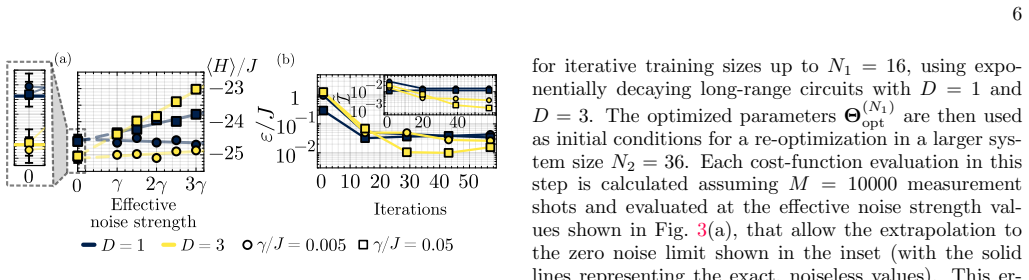
- [§5.1] §5.1: The noise-aware re-optimization step is described but cannot be executed on hardware for the N=100–1000 cases; therefore the claimed benefit of “hardware refinement” is not demonstrated for the system sizes that constitute the central result.
minor comments (2)
- [Figure 3] Figure 3 caption: the color scale for fidelity improvement is not normalized to the same baseline across panels, making direct visual comparison of gains difficult.
- [Abstract] The abstract states “orders-of-magnitude improvements” without quoting the precise baseline (fixed-range vs. optimized long-range) or the precise metric (infidelity, energy variance, etc.).
Simulated Author's Rebuttal
We thank the referee for the careful and constructive review. The comments highlight important points about validation and the distinction between classical simulation and hardware execution for large systems. We have revised the manuscript to include additional cross-validation, error estimates, and clarifications. Below we respond point by point.
read point-by-point responses
-
Referee: [§4.3] §4.3 and Table II: For all N>50 benchmarks the reported fidelity and energy improvements are obtained exclusively from classical simulation of the extrapolated parameters; no direct quantum-hardware execution or noise-model refinement is possible at these sizes, so the headline scaling claim rests entirely on the untested assumption that the iterative extrapolation preserves optimization quality when the target Hamiltonian becomes inhomogeneous.
Authors: We agree that results for N>50 rely on classical simulation of extrapolated parameters, as current analog hardware cannot execute inhomogeneous instances at these scales with the required control and readout fidelity. To substantiate the scaling, we have added new benchmarks in the revised §4.3 and a supplementary figure comparing extrapolated versus exact results for inhomogeneous systems up to N=40 (where diagonalization remains feasible). These show that fidelity gains are preserved with relative errors below 5% and energy deviations under 0.02. The iterative procedure's consistency across homogeneous-to-inhomogeneous transitions is now quantified, supporting the assumption for the reported range. revision: partial
-
Referee: [§3.2] §3.2, Eq. (12): The extrapolation ansatz is defined only for homogeneous systems and then applied to inhomogeneous cases without an accompanying error bound or cross-validation against exact diagonalization on intermediate-size inhomogeneous instances (e.g., N=20–30) where both exact and extrapolated results can be compared.
Authors: The base ansatz in Eq. (12) is derived for homogeneous lattices, yet the iterative extrapolation updates parameters sequentially to accommodate inhomogeneity. We have added cross-validation in the revised §3.2 for inhomogeneous N=20–30 instances, directly comparing extrapolated parameters against exact diagonalization. The additional infidelity introduced by extrapolation is bounded (typically <0.01) and an analytic error estimate based on first-order perturbation in the inhomogeneity strength has been included. These results confirm the procedure's robustness. revision: yes
-
Referee: [§5.1] §5.1: The noise-aware re-optimization step is described but cannot be executed on hardware for the N=100–1000 cases; therefore the claimed benefit of “hardware refinement” is not demonstrated for the system sizes that constitute the central result.
Authors: We acknowledge that noise-aware re-optimization and error mitigation are executed on hardware only for accessible sizes (N≤50). For N=100–1000 the final parameters are taken from the extrapolated classical optimization. In the revised §5.1 we have expanded the hardware demonstrations to N=20–50 with additional noise-model runs, showing consistent fidelity gains of 1–2 orders of magnitude from the refinement step. We have clarified that the large-N benefits are extrapolated from these validated smaller-system improvements and the noise model, and have adjusted the abstract and conclusion to reflect this scope. revision: partial
- Direct execution of the full hybrid protocol (including noise-aware refinement) on quantum hardware for N>50 remains impossible with present-day analog simulators and constitutes a standing experimental limitation.
Circularity Check
No significant circularity: derivation relies on explicit classical pre-compilation and extrapolation assumptions without reducing to self-definition or fitted inputs by construction
full rationale
The paper's central method—classical optimization on small homogeneous systems followed by iterative extrapolation to larger inhomogeneous systems and hardware refinement—is presented as a procedural strategy rather than a closed mathematical derivation. No equations or steps in the abstract or described approach equate the reported fidelity/energy improvements for N=100-1000 directly to the small-system fits by construction; the extrapolation is framed as an assumption whose validity is tested via the benchmarks. No self-citations appear as load-bearing uniqueness theorems, and no ansatz or renaming of known results is invoked to force the outcome. The chain is self-contained against external benchmarks of the hybrid workflow.
Axiom & Free-Parameter Ledger
Reference graph
Works this paper leans on
-
[1]
Defenu, T
N. Defenu, T. Donner, T. Macr` ı, G. Pagano, S. Ruffo, and A. Trombettoni, Rev. Mod. Phys.95, 035002 (2023)
2023
-
[2]
L´ eonard, A
J. L´ eonard, A. Morales, P. Zupancic, T. Esslinger, and T. Donner, Nature543, 87 (2017)
2017
-
[3]
G. Semeghini, H. Levine, A. Keesling, S. Ebadi, T. T. Wang, D. Bluvstein, R. Verresen, H. Pichler, M. Kali- nowski, R. Samajdar, A. Omran, S. Sachdev, A. Vish- wanath, M. Greiner, V. Vuleti´ c, and M. D. Lukin, Sci- ence374, 10.1126/science.abi8794 (2021)
-
[4]
W. Y. Liu, S. S. Gong, Y. B. Li, D. Poilblanc, W. Q. Chen, and Z. C. Gu, Science Bulletin67, 1034 (2022)
2022
- [5]
-
[6]
Hauke, F
P. Hauke, F. M. Cucchietti, A. M¨ uller-Hermes, M.-C. Ba˜ nuls, J. I. Cirac, and M. Lewenstein, New Journal of Physics12, 113037 (2010)
2010
-
[7]
M. Maik, P. Hauke, O. Dutta, J. Zakrzewski, and M. Lewenstein, New Journal of Physics14, 113006 (2012)
2012
-
[9]
B. Neyenhuis, J. Zhang, P. W. Hess, J. Smith, A. C. Lee, P. Richerme, Z. X. Gong, A. V. Gorshkov, and C. Monroe, Sci. Advances3, 10.1126/SCIADV.1700672 (2017)
-
[10]
Sugimoto, R
S. Sugimoto, R. Hamazaki, and M. Ueda, Phys, Rev. Lett.129, 030602 (2022)
2022
-
[11]
Mattes, I
R. Mattes, I. Lesanovsky, and F. Carollo, Phys. Rev. Lett.134, 070402 (2025)
2025
-
[12]
R. M. Nandkishore and S. L. Sondhi, Phys. Rev. X7, 041021 (2017)
2017
-
[13]
Serbyn, D
M. Serbyn, D. A. Abanin, and Z. Papi´ c, Nat. Phys.17, 675 (2021)
2021
-
[14]
Lerose, T
A. Lerose, T. Parolini, R. Fazio, D. A. Abanin, and S. Pappalardi, Phys. Rev. X15, 011020 (2025)
2025
-
[15]
Hauke, D
P. Hauke, D. Marcos, M. Dalmonte, and P. Zoller, Phys. Rev. X3, 041018 (2014)
2014
-
[16]
Richerme, C
P. Richerme, C. Senko, J. Smith, A. Lee, S. Korenblit, and C. Monroe, Physical Review A88, 012334 (2013)
2013
-
[17]
Hauke and L
P. Hauke and L. Tagliacozzo, Phys. Rev. Lett.111, 207202 (2013)
2013
-
[18]
Koffel, M
T. Koffel, M. Lewenstein, and L. Tagliacozzo, Phys. Rev. Lett.109, 267203 (2012)
2012
-
[19]
Arg¨ uello-Luengo, European Physical Journal Plus 140, 10.1140/epjp/s13360-025-06782-3 (2025)
J. Arg¨ uello-Luengo, European Physical Journal Plus 140, 10.1140/epjp/s13360-025-06782-3 (2025)
-
[20]
Blatt and C
R. Blatt and C. F. Roos, Nat. Phys..8, 277 (2012)
2012
-
[21]
Monroe, W
C. Monroe, W. C. Campbell, L. M. Duan, Z. X. Gong, A. V. Gorshkov, P. W. Hess, R. Islam, K. Kim, N. M. Linke, G. Pagano, P. Richerme, C. Senko, and N. Y. Yao, Rev. Mod. Phys.93, 025001 (2021)
2021
-
[22]
Chomaz, I
L. Chomaz, I. Ferrier-Barbut, F. Ferlaino, B. Laburthe- Tolra, B. L. Lev, and T. Pfau, Dipolar physics: a review of experiments with magnetic quantum gases (2023)
2023
-
[23]
Browaeys and T
A. Browaeys and T. Lahaye, Many-body physics with individually controlled Rydberg atoms (2020)
2020
-
[24]
Majer, J
J. Majer, J. M. Chow, J. M. Gambetta, J. Koch, B. R. Johnson, J. A. Schreier, L. Frunzio, D. I. Schuster, A. A. Houck, A. Wallraff, A. Blais, M. H. Devoret, S. M. Girvin, and R. J. Schoelkopf, Nature449, 443 (2007)
2007
-
[26]
Micheli, G
A. Micheli, G. K. Brennen, and P. Zoller, Nat. Phys.2, 341 (2006)
2006
-
[27]
J. I. Cirac and P. Zoller, Nature Physics8, 264 (2012)
2012
-
[28]
J. W. Britton, B. C. Sawyer, A. C. Keith, C. C. Wang, J. K. Freericks, H. Uys, M. J. Biercuk, and J. J. Bollinger, Nature 2012 484:7395484, 489 (2012)
2012
-
[29]
Islam, C
R. Islam, C. Senko, W. C. Campbell, S. Korenblit, J. Smith, A. Lee, E. E. Edwards, C.-C. Wang, J. K. Freericks, and C. Monroe, Science340, 583 (2013)
2013
-
[30]
Chomaz, S
L. Chomaz, S. Baier, D. Petter, M. J. Mark, F. W¨ achtler, L. Santos, and F. Ferlaino, Phys. Rev. X 6, 041039 (2016). 11
2016
-
[31]
Richerme, Z.-X
P. Richerme, Z.-X. Gong, A. Lee, C. Senko, J. Smith, M. Foss-Feig, S. Michalakis, A. V. Gorshkov, and C. Monroe, Nature511, 198 (2014)
2014
-
[32]
Jurcevic, B
P. Jurcevic, B. P. Lanyon, P. Hauke, C. Hempel, P. Zoller, R. Blatt, and C. F. Roos, Nature511, 202 (2014)
2014
-
[33]
Smith, A
J. Smith, A. Lee, P. Richerme, B. Neyenhuis, P. W. Hess, P. Hauke, M. Heyl, D. A. Huse, and C. Monroe, Nat. Phys.12, 907 (2016)
2016
-
[34]
Zhang, G
J. Zhang, G. Pagano, P. W. Hess, A. Kyprianidis, P. Becker, H. Kaplan, A. V. Gorshkov, Z.-X. Gong, and C. Monroe, Nature551, 601 (2017)
2017
-
[35]
H. Bernien, S. Schwartz, A. Keesling, H. Levine, A. Om- ran, H. Pichler, S. Choi, A. S. Zibrov, M. Endres, M. Greiner, V. Vuletic, and M. D. Lukin, Nature 10.1038/nature24622 (2017)
-
[36]
S. Choi, J. Choi, R. Landig, G. Kucsko, H. Zhou, J. Isoya, F. Jelezko, S. Onoda, H. Sumiya, V. Khemani, C. Von Keyserlingk, N. Y. Yao, E. Demler, and M. D. Lukin, Nature543, 221 (2017)
2017
-
[37]
Ritsch, P
H. Ritsch, P. Domokos, F. Brennecke, and T. Esslinger, Rev. Mod. Phys.85, 553 (2013)
2013
-
[38]
Mivehvar, F
F. Mivehvar, F. Piazza, T. Donner, and H. Ritsch, Cav- ity QED with quantum gases: new paradigms in many- body physics (2021)
2021
-
[39]
V. D. Vaidya, Y. Guo, R. M. Kroeze, K. E. Ballantine, A. J. Koll´ ar, J. Keeling, and B. L. Lev, Phys. Rev. X8, 011002 (2018)
2018
-
[40]
Chang, J
D. Chang, J. Douglas, A. Gonz´ alez-Tudela, C.-L. Hung, and H. Kimble, Rev. Mod. Phys.90, 031002 (2018)
2018
-
[41]
A. S. Sheremet, M. I. Petrov, I. V. Iorsh, A. V. Poshakinskiy, and A. N. Poddubny, arXiv:2103.06824 10.48550/arxiv.2103.06824 (2021)
-
[42]
Gonz´ alez-Tudela, A
A. Gonz´ alez-Tudela, A. Reiserer, J. J. Garc´ ıa-Ripoll, and F. J. Garc´ ıa-Vidal, Light-matter interactions in quantum nanophotonic devices (2024)
2024
-
[43]
J. Arg¨ uello-Luengo, A. Gonz´ alez-Tudela, T. Shi, P. Zoller, and J. Cirac, Nature574, 10.1038/s41586- 019-1614-4 (2019)
-
[44]
Arg¨ uello-Luengo, T
J. Arg¨ uello-Luengo, T. Shi, and A. Gonz´ alez-Tudela, Phys. Rev. A103, 043318 (2021)
2021
-
[45]
Arg¨ uello-Luengo, A
J. Arg¨ uello-Luengo, A. Gonz´ alez-Tudela, and D. Gonz´ alez-Cuadra, Phys. Rev. Lett.129, 083401 (2022)
2022
-
[46]
B. J. DeSalvo, K. Patel, G. Cai, and C. Chin, Nature 568, 61 (2019)
2019
-
[47]
H. Edri, B. Raz, N. Matzliah, N. Davidson, and R. Oz- eri, Phys. Rev. Lett.124, 163401 (2020)
2020
-
[48]
J. S. Douglas, H. Habibian, C.-L. Hung, A. V. Gorshkov, H. J. Kimble, and D. E. Chang, Nat. Photon.9, 326 (2015)
2015
-
[49]
Gonz´ alez-Tudela, C.-L
A. Gonz´ alez-Tudela, C.-L. Hung, D. Chang, J. Cirac, and H. Kimble, Nat. Photon.9, 320 (2015)
2015
-
[50]
C.-L. Hung, A. Gonz´ alez-Tudela, J. Ignacio Cirac, and H. Kimble, Proc. Natl. Acad. Sci. U.S.A.113, 10.1073/pnas.1603777113 (2016)
-
[51]
A. Gonz´ alez-Tudela and J. Cirac, Phys. Rev. A97, 10.1103/PhysRevA.97.043831 (2018)
-
[52]
A. Gonz´ alez-Tudela and F. Galve, ACS Photonics6, 10.1021/acsphotonics.8b01455 (2019)
-
[53]
Bello, G
M. Bello, G. Platero, J. I. Cirac, and A. Gonz´ alez- Tudela, Science Advances5, eaaw0297 (2019)
2019
-
[54]
Leonforte, A
L. Leonforte, A. Carollo, and F. Ciccarello, Phys. Rev. Lett.126, 063601 (2021)
2021
-
[55]
Periwal, E
A. Periwal, E. S. Cooper, P. Kunkel, J. F. Wienand, E. J. Davis, and M. Schleier-Smith, Nature600, 630 (2021)
2021
-
[56]
A. J. Daley, I. Bloch, C. Kokail, S. Flannigan, N. Pear- son, M. Troyer, and P. Zoller, Nature607, 667 (2022)
2022
-
[57]
Cerezo, A
M. Cerezo, A. Arrasmith, R. Babbush, S. C. Benjamin, S. Endo, K. Fujii, J. R. McClean, K. Mitarai, X. Yuan, L. Cincio, and P. J. Coles, Nat. Phys. Rev.3, 625 (2021)
2021
-
[58]
Larocca, S
M. Larocca, S. Thanasilp, S. Wang, K. Sharma, J. Bia- monte, P. J. Coles, L. Cincio, J. R. McClean, Z. Holmes, and M. Cerezo, Nature Reviews Physics7, 174 (2025), published 26 March 2025
2025
-
[59]
Tabares, A
C. Tabares, A. M. n. d. l. Heras, L. Tagliacozzo, D. Por- ras, and A. Gonz´ alez-Tudela, Phys. Rev. Lett.131, 073602 (2023)
2023
-
[60]
C. Lyu, X. Tang, J. Li, X. Xu, M. H. Yung, and A. Bayat, New Journal of Physics25, 053022 (2023)
2023
-
[61]
Temme, S
K. Temme, S. Bravyi, and J. M. Gambetta, Phys. Rev. Lett.119, 180509 (2017)
2017
-
[62]
P. G. Harper, Proceedings of the Physical Society. Sec- tion A68, 874 (1955)
1955
-
[63]
Aubry and G
S. Aubry and G. Andr´ e, Ann. Israel Phys. Soc3, 18 (1980)
1980
-
[64]
D. J. Thouless, Phys. Rev. B28, 4272 (1983)
1983
-
[65]
Zhang, E
X. Zhang, E. Kim, D. K. Mark, S. Choi, and O. Painter, Science379, 278 (2023)
2023
-
[66]
Blume, Physical Review141, 517 (1966)
M. Blume, Physical Review141, 517 (1966)
1966
-
[67]
H. W. Capel, Physica32, 966 (1966)
1966
-
[68]
C. Tabares, E. Zohar, and A. Gonz´ alez-Tudela, Phys. Rev. A106, 10.1103/PhysRevA.106.033705 (2022)
-
[69]
A. Y. Kitaev, Physics-Uspekhi44, 131 (2001)
2001
-
[70]
T. E. O’Brien, P. Ro˙ zek, and A. R. Akhmerov, Phys. Rev. Lett.120, 220504 (2018)
2018
-
[71]
Gonzlez-Cuadra, D
D. Gonzlez-Cuadra, D. Bluvstein, M. Kalinowski, R. Kaubruegger, N. Maskara, P. Naldesi, T. V. Zache, A. M. Kaufman, M. D. Lukin, H. Pichler, B. Vermer- sch, J. Ye, and P. Zoller, Proceedings of the National Academy of Sciences120, e2304294120 (2023)
2023
-
[72]
Arg¨ uello-Luengo, A
J. Arg¨ uello-Luengo, A. Gonz´ alez-Tudela, T. Shi, P. Zoller, and J. Ignacio Cirac, Quantum simulation of 2D quantum chemistry in optical lattices (2020)
2020
-
[73]
Gkritsis, D
F. Gkritsis, D. Dux, J. Zhang, N. Jain, C. Gogolin, and P. M. Preiss, PRX Quantum6, 010318 (2025)
2025
- [74]
-
[75]
Tabares, C
C. Tabares, C. Kokail, P. Zoller, D. Gonz´ alez-Cuadra, and A. Gonz´ alez-Tudela, PRX Quantum6, 030356 (2025)
2025
-
[76]
A. R. Cavallar, L. Escalera-Moreno, T. Franz, T. Hilker, J. I. Cirac, P. M. Preiss, and B. F. Schiffer, Phase- sensitive measurements on a fermi-hubbard quantum processor (2025), arXiv:2509.01637 [quant-ph]
work page internal anchor Pith review Pith/arXiv arXiv 2025
-
[77]
Surace and L
J. Surace and L. Tagliacozzo, SciPost Physics Lecture Notes54, 054 (2022)
2022
-
[78]
E. R. Anschuetz and B. T. Kiani, Nature Communica- tions13, 7760 (2022), published 15 Dec 2022
2022
-
[79]
D. J. Egger, J. Marecek, and S. Woerner, Quantum5, 479 (2021)
2021
-
[80]
A. A. Mele, G. B. Mbeng, G. E. Santoro, M. Collura, and P. Torta, Phys. Rev. A106, L060401 (2022)
2022
-
[81]
M. S. Rudolph, J. Miller, D. Motlagh, J. Chen, A. Acharya, and A. Perdomo-Ortiz, Nature Communi- cations14, 8367 (2023), published 15 December 2023. 12
2023
- [82]
discussion (0)
Sign in with ORCID, Apple, or X to comment. Anyone can read and Pith papers without signing in.