Recognition: unknown
Cryogenic pure CsI as a probe for neutrino electromagnetic interactions
Pith reviewed 2026-05-08 09:20 UTC · model grok-4.3
The pith
Cryogenic pure CsI can improve reactor limits on neutrino magnetic moment and millicharge by an order of magnitude.
A machine-rendered reading of the paper's core claim, the machinery that carries it, and where it could break.
Core claim
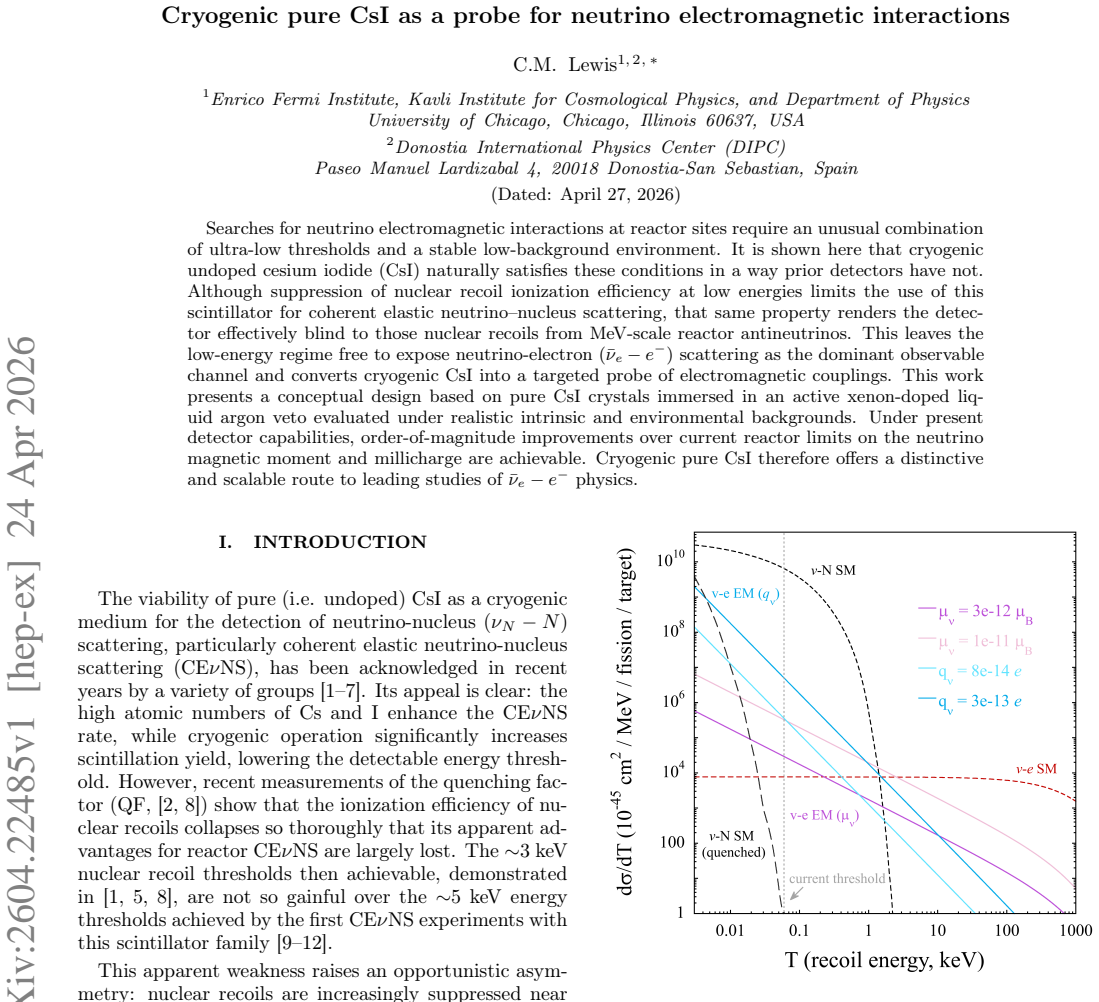
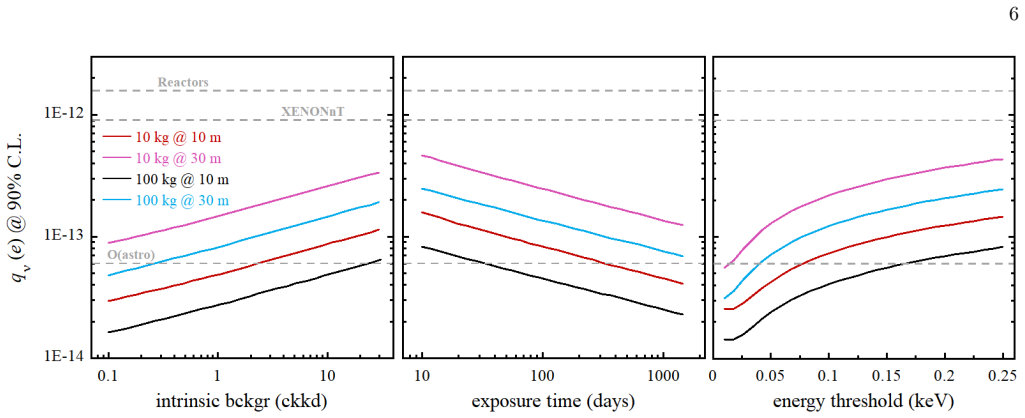
Cryogenic pure CsI immersed in an active xenon-doped liquid argon veto is effectively blind to coherent elastic neutrino-nucleus scattering from reactor antineutrinos because of suppressed nuclear recoil ionization efficiency at low energies, while retaining sensitivity to neutrino-electron scattering and thereby enabling order-of-magnitude improvements over existing reactor limits on the neutrino magnetic moment and millicharge.
What carries the argument
Suppression of nuclear recoil ionization efficiency at low energies in cryogenic CsI, which blinds the detector to nuclear recoils while preserving response to electron recoils from neutrino-electron scattering.
If this is right
- Order-of-magnitude improvements on current reactor limits for neutrino magnetic moment.
- Comparable gains on limits for neutrino millicharge.
- A scalable detector design that isolates neutrino-electron scattering as the primary observable channel.
- Targeted access to neutrino electromagnetic physics without requiring massive shielding against nuclear recoil backgrounds.
Where Pith is reading between the lines
- The same ionization-suppression property could be tested in other alkali halide scintillators to broaden the range of materials usable for electromagnetic neutrino searches.
- Success would reduce reliance on very large underground facilities for competitive neutrino magnetic moment measurements.
- The approach might be combined with directional sensitivity techniques to further separate signal from residual backgrounds.
Load-bearing premise
Nuclear recoil ionization efficiency in cryogenic CsI stays low enough at the energies of MeV-scale reactor antineutrinos to suppress coherent elastic neutrino-nucleus scattering while leaving neutrino-electron scattering observable.
What would settle it
Direct measurement showing that nuclear recoil ionization efficiency in cryogenic CsI at energies below a few keV is high enough to produce a detectable coherent elastic neutrino-nucleus scattering rate from reactor antineutrinos.
Figures



read the original abstract
Searches for neutrino electromagnetic interactions at reactor sites require an unusual combination of ultra-low thresholds and a stable low-background environment. It is shown here that cryogenic undoped cesium iodide (CsI) naturally satisfies these conditions in a way prior detectors have not. Although suppression of nuclear recoil ionization efficiency at low energies limits the use of this scintillator for coherent elastic neutrino-nucleus scattering, that same property renders the detector effectively blind to those nuclear recoils from MeV-scale reactor antineutrinos. This leaves the low-energy regime free to expose neutrino-electron ($\bar{\nu}_{e} -e^{-}$) scattering as the dominant observable channel and converts cryogenic CsI into a targeted probe of electromagnetic couplings. This work presents a conceptual design based on pure CsI crystals immersed in an active xenon-doped liquid argon veto evaluated under realistic intrinsic and environmental backgrounds. Under present detector capabilities, order-of-magnitude improvements over current reactor limits on the neutrino magnetic moment and millicharge are achievable. Cryogenic pure CsI therefore offers a distinctive and scalable route to leading studies of $\bar{\nu}_{e} -e^{-}$ physics.
Editorial analysis
A structured set of objections, weighed in public.
Referee Report
Summary. The paper claims that cryogenic undoped cesium iodide (CsI) naturally provides the ultra-low thresholds and low-background environment needed for reactor-based searches of neutrino electromagnetic interactions. It argues that the material's suppression of nuclear recoil ionization efficiency at low energies renders it effectively blind to coherent elastic neutrino-nucleus scattering (CEvNS) from MeV-scale reactor antineutrinos while remaining sensitive to neutrino-electron scattering; a conceptual design using pure CsI crystals in an active xenon-doped liquid argon veto is evaluated under realistic backgrounds and projects order-of-magnitude improvements over current reactor limits on the neutrino magnetic moment and millicharge.
Significance. If the key assumptions on nuclear recoil ionization hold, the proposal offers a distinctive and scalable route to neutrino-electron scattering studies that leverages a known scintillator property in a targeted way. The conceptual evaluation under realistic intrinsic and environmental backgrounds is a strength of the design presentation.
major comments (2)
- [Abstract] Abstract: The assertion that 'suppression of nuclear recoil ionization efficiency at low energies' renders cryogenic pure CsI 'effectively blind' to CEvNS from reactor antineutrinos is load-bearing for the background model and the claimed order-of-magnitude sensitivity gains, yet no quenching-factor measurements, cited data, or Monte Carlo results specific to cryogenic undoped CsI at the relevant recoil energies (~0.1–few keV) are provided.
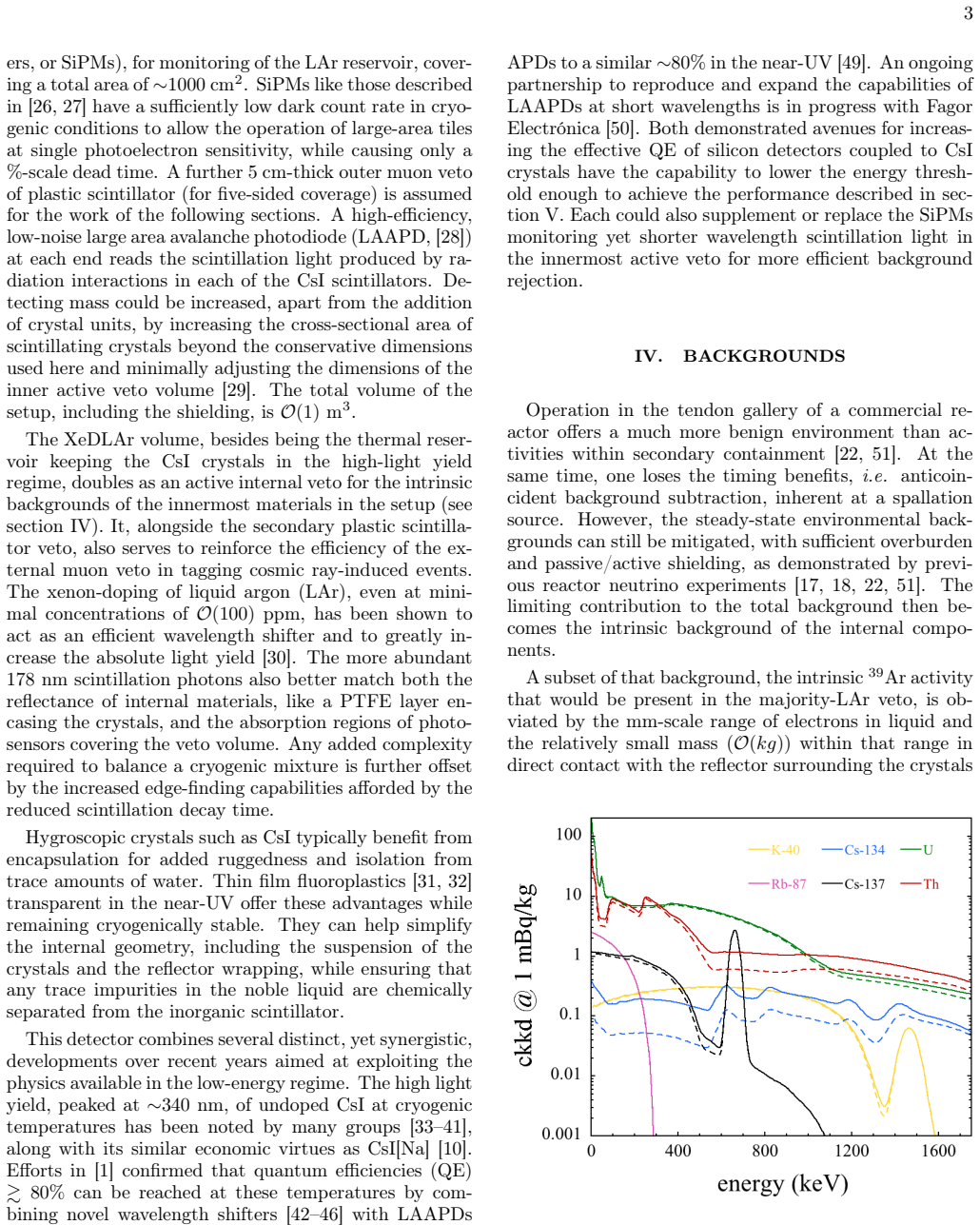
- [Abstract] Abstract: The quantitative projections for improvements on the neutrino magnetic moment and millicharge are stated to rest on an evaluation 'under realistic intrinsic and environmental backgrounds,' but the manuscript does not include the supporting background models, efficiency curves, or simulation results needed to assess the robustness of these claims.
minor comments (1)
- [Introduction] The manuscript would benefit from a short explicit comparison in the introduction to prior room-temperature CsI or similar detectors to clarify the claimed advantages of the cryogenic pure variant.
Simulated Author's Rebuttal
We thank the referee for their careful reading and for acknowledging the potential significance of the cryogenic pure CsI concept. We address the two major comments point by point below. Where the comments correctly identify missing supporting material, we have revised the manuscript to incorporate the requested details.
read point-by-point responses
-
Referee: [Abstract] Abstract: The assertion that 'suppression of nuclear recoil ionization efficiency at low energies' renders cryogenic pure CsI 'effectively blind' to CEvNS from reactor antineutrinos is load-bearing for the background model and the claimed order-of-magnitude sensitivity gains, yet no quenching-factor measurements, cited data, or Monte Carlo results specific to cryogenic undoped CsI at the relevant recoil energies (~0.1–few keV) are provided.
Authors: The referee is correct that this property is central to the background model. The manuscript draws on the well-established reduction in nuclear-recoil scintillation efficiency in CsI at low energies, a feature reported across multiple room-temperature and cryogenic CsI measurements in the dark-matter literature. We agree, however, that the original text did not cite these data explicitly or discuss their applicability to undoped cryogenic CsI at sub-keV recoil energies. In the revised manuscript we have added a dedicated paragraph in the introduction that (i) cites the relevant quenching-factor studies, (ii) notes the limited availability of dedicated sub-keV data for the exact undoped cryogenic configuration, and (iii) justifies the conservative extrapolation used for the conceptual design. These additions make the basis for the “effectively blind” statement transparent without altering the order-of-magnitude conclusions. revision: yes
-
Referee: [Abstract] Abstract: The quantitative projections for improvements on the neutrino magnetic moment and millicharge are stated to rest on an evaluation 'under realistic intrinsic and environmental backgrounds,' but the manuscript does not include the supporting background models, efficiency curves, or simulation results needed to assess the robustness of these claims.
Authors: We acknowledge that the original submission presented the sensitivity projections at a high conceptual level and omitted the detailed background model, efficiency curves, and simulation results. The revised manuscript now includes a new appendix that specifies (i) the assumed intrinsic radioactivity levels in pure CsI, (ii) the environmental and cosmogenic background rates appropriate to a shielded reactor-site deployment, (iii) the veto efficiency of the xenon-doped liquid-argon shield, and (iv) the resulting signal and background efficiency curves that underlie the quoted order-of-magnitude improvements. This material allows an independent assessment of the robustness of the projections. revision: yes
Circularity Check
No significant circularity; sensitivity projections are independent of fitted inputs
full rationale
The paper advances a conceptual detector design for probing neutrino electromagnetic interactions via cryogenic pure CsI, asserting that nuclear-recoil ionization suppression naturally blinds the detector to CEvNS while exposing neutrino-electron scattering. The order-of-magnitude improvement claims are presented as forward projections under realistic backgrounds rather than outputs of any internal fit, self-definition, or load-bearing self-citation chain. No equations, parameters, or uniqueness theorems are shown to reduce the central result to its own inputs by construction, and the derivation remains self-contained against external benchmarks such as prior reactor limits and detector capabilities.
Axiom & Free-Parameter Ledger
axioms (2)
- domain assumption Nuclear recoil ionization efficiency in cryogenic undoped CsI is strongly suppressed at energies relevant to MeV-scale reactor antineutrinos
- domain assumption Realistic intrinsic and environmental backgrounds can be controlled to the level needed for the electron-scattering channel to dominate
Reference graph
Works this paper leans on
-
[1]
Baxteret al., JHEP02, 123, arXiv:1911.00762 [physics.ins-det]
D. Baxter et al., JHEP02, 123 (2020), 1911.00762
- [2]
- [3]
- [4]
- [5]
- [6]
-
[7]
J. I. Collar et al., JHEP (2026), 2512.19788
work page internal anchor Pith review arXiv 2026
- [8]
-
[9]
Akimovet al.(COHERENT), Science357, 1123 (2017), arXiv:1708.01294 [nucl-ex]
D. Akimov et al., Science357, 1123 (2017), 1708.01294
- [10]
-
[11]
N. E. Fields, Ph.D. thesis, U. of Chicago (2014)
2014
-
[12]
B. Scholz,First Observation of Coherent Elastic Neutrino-Nucleus Scattering, Springer Theses (Springer Cham, 2018), 1904.01155
-
[13]
Agnolet et al., Nucl
G. Agnolet et al., Nucl. Instrum. Meth. A853, 53 (2017)
2017
-
[14]
Strauss et al., Eur
R. Strauss et al., Eur. Phys. J. C77(2017)
2017
-
[15]
Billard et al., J
J. Billard et al., J. Phys. G44, 105101 (2017)
2017
-
[16]
Buck et al., J
C. Buck et al., J. Phys (Conf. Ser.)1342, 012094 (2020)
2020
-
[17]
C. E. Aalseth et al., Phys. Rev. D88, 012002 (2013)
2013
-
[18]
Colaresi, J
J. Colaresi, J. I. Collar, T. W. Hossbach, C. M. Lewis, and K. M. Yocum, Phys. Rev. Lett.129, 211802 (2022)
2022
-
[19]
Atzori Corona et al., JHEP2022(2022)
M. Atzori Corona et al., JHEP2022(2022)
2022
-
[20]
Coloma, I
P. Coloma, I. Esteban, M. C. Gonzalez-Garcia, L. Lariz- goitia, F. Monrabal, and S. Palomares-Ruiz, JHEP2022 (2022)
2022
-
[21]
V. B. Brudanin, D. V. Medvedev, A. S. Starostin, and A. I. Studenikin, Nucl. Par. Phys. Proceedings273–275, 2605–2608 (2016)
2016
-
[22]
Barbeau, Ph.D
P. Barbeau, Ph.D. thesis, University of Chicago (2009)
2009
-
[23]
Singh et al., Phys
L. Singh et al., Phys. Rev. D99, 032009 (2019)
2019
-
[24]
A. G. Beda et al., Phys. Par. Nucl. Lett.10, 139 (2013)
2013
-
[25]
Vogel and J
P. Vogel and J. Engel, Phys. Rev. D39, 3378–3383 (1989)
1989
-
[26]
Rogers (DarkSide-20k), Nucl
G. Rogers (DarkSide-20k), Nucl. Instr. Meth. A1068, 169723 (2024)
2024
-
[27]
Matteucci, J
G. Matteucci, J. Instr.20, C06010 (2025)
2025
-
[28]
McClish et al., inIEEE Nucl
M. McClish et al., inIEEE Nucl. Sci. Symp. Conf. Rec. 2004(2004), pp. 1270–1273 Vol. 2
2004
-
[29]
H. S. Lee et al. (KIMS Collaboration), Phys. Rev. D90, 052006 (2014)
2014
-
[30]
C. Vogl, M. Schwarz, X. Stribl, J. Grießing, P. Krause, and S. Schönert, J. Instr.17, C01031 (2022)
2022
-
[31]
Leosson and B
K. Leosson and B. Agnarsson, Micromachines3, 114 (2012). [32]https://www.teflon.com/en/products/resins/ amorphous-fluoropolymer
2012
-
[32]
Amsler et al., Nucl
C. Amsler et al., Nucl. Instr. Meth. A480, 494 (2002)
2002
-
[33]
Moszynski et al., Nucl
M. Moszynski et al., Nucl. Instr. Meth. A537, 357 (2005)
2005
-
[34]
Moszynski et al., Nucl
M. Moszynski et al., Nucl. Instr. Meth. A504, 307 (2003)
2003
-
[35]
Nadeau, Ph.D
P. Nadeau, Ph.D. thesis, Queen’s University (2015)
2015
-
[36]
Clark, P
M. Clark, P. Nadeau, S. Hills, C. Dujardin, and P. D. Stefano, Nucl. Instr. Meth. A901, 6 (2018)
2018
-
[37]
J. Liu, M. Yamashita, and A. Soma, J. Instrum.11, P10003 (2016)
2016
-
[38]
C. L. Woody et al., IEEE Trans. Nucl. Sci.37, 492 (1990)
1990
-
[39]
Zhang et al., Radiat
X. Zhang et al., Radiat. Detect. Technol. Methods2, 15 (2018)
2018
-
[40]
V. B. Mikhailik, V. Kapustyanyk, V. Tsybulskyi, V. Rudyk, and H. Kraus, Phys. Status Solidi (b)252, 804 (2015)
2015
-
[41]
S. A. Ponomarenko et al., Nature Sci. Rep.4, 6549 EP (2014)
2014
-
[42]
T. Y. Starikova et al., J. Mater. Chem. C4, 4699 (2016)
2016
-
[43]
S. A. Ponomarenko et al., inNanophotonic Materials XIV, International Society for Optics and Photonics (SPIE, 2017), vol. 10344, pp. 49 – 58
2017
-
[44]
S. A. Ponomarenko, N. M. Surin, O. V. Borshchev, M. S. Skorotetcky, and A. M. Muzafarov, inNanophotonic Ma- terials XII, International Society for Optics and Photon- ics (SPIE, 2015), vol. 9545, pp. 8 – 16
2015
-
[45]
Borshchev, N
O. Borshchev, N. Surin, M. Skorotetcky, and S. Pono- marenko., INEOS OPEN2 (4), 112 (2019)
2019
-
[46]
Jin et al., Nucl
Y. Jin et al., Nucl. Instr. Meth. A824, 691 (2016)
2016
-
[47]
Jin, Master’s thesis, University of Tokyo (2015)
Y. Jin, Master’s thesis, University of Tokyo (2015)
2015
-
[48]
McClish, R
M. McClish, R. Farrell, J. Glodo, and K. S. Shah, Nucl. Instr. Meth. A610, 207–209 (2009)
2009
-
[49]
Fagor Electrónica, Fagor Group, Mondragón, Spain
-
[50]
J.Colaresi, J.I.Collar, T.W.Hossbach, A.R.L.Kavner, C. M. Lewis, A. E. Robinson, and K. M. Yocum, Phys. Rev. D104, 072003 (2021)
2021
-
[51]
Benetti et al., Nucl
P. Benetti et al., Nucl. Instr. Meth. A574, 83–88 (2007)
2007
-
[52]
Adhikari and D
P. Adhikari and D. Collaboration, Eur. Phys. J. C83, 642 (2023)
2023
-
[53]
Kim et al., Nucl
T. Kim et al., Nucl. Instr. Meth. A500, 337–344 (2003)
2003
-
[54]
Lee et al., Nucl
H. Lee et al., Nucl. Instr. Meth. A571, 644–650 (2007)
2007
-
[55]
Danevich et al., Nucl
F. Danevich et al., Nucl. Instr. Meth. A631, 44 (2011)
2011
-
[56]
Agostinelli et al., Nucl
S. Agostinelli et al., Nucl. Instr. Meth. A506, 250 (2003)
2003
-
[57]
S. A. Pozzi, E. Padovani, and M. Marseguerra, Nucl. Instr. Meth. A513, 550 (2003)
2003
-
[58]
Gordon et al., IEEE Trans
M. Gordon et al., IEEE Trans. Nucl. Sci.51, 3427 (2004)
2004
-
[59]
Hu et al., Nucl
Z. Hu et al., Nucl. Instr. Meth. A940, 78 (2019)
2019
-
[60]
Sato, PLOS ONE11, 1 (2016)
T. Sato, PLOS ONE11, 1 (2016)
2016
-
[61]
A. S. Malgin, Phys. Atom. Nucl.78, 835 (2015)
2015
-
[62]
Kluck,Production Yield of Muon-Induced Neutrons in Lead(Spring Cham, 2015), ISBN 978-3-319-18526-2
H. Kluck,Production Yield of Muon-Induced Neutrons in Lead(Spring Cham, 2015), ISBN 978-3-319-18526-2
2015
-
[63]
Deniz et al., Phys
M. Deniz et al., Phys. Rev. D81, 072001 (2010)
2010
-
[64]
A. G. Beda et al., Phys. Atom. Nucl.70, 1873–1884 (2007)
2007
-
[65]
A. G. Beda et al., Phys. Par. Nucl. Lett.7, 406–409 (2010)
2010
-
[66]
S. S. Wilks, Ann. Math. Stat.9, 60 (1938)
1938
-
[67]
A. N. Khan, Phys. Lett. B837, 137650 (2023)
2023
-
[68]
G. G. Raffelt, Phys. Rep.320, 319–327 (1999)
1999
-
[69]
Davidson, S
S. Davidson, S. Hannestad, and G. Raffelt, JHEP2000, 003–003 (2000)
2000
-
[70]
Aprile et al., Phys
E. Aprile et al., Phys. Rev. Lett.129(2022)
2022
-
[71]
Agostini et al., Phys
M. Agostini et al., Phys. Rev. D96(2017)
2017
-
[72]
Giunti et al., Ann
C. Giunti et al., Ann. Phys.528, 198–215 (2015)
2015
discussion (0)
Sign in with ORCID, Apple, or X to comment. Anyone can read and Pith papers without signing in.