Recognition: unknown
Quark Number Susceptibilities and Conserved Charge Fluctuations in (2+1)-flavor QCD with M\"obius domain-wall fermions (MDWF)
Pith reviewed 2026-05-08 08:52 UTC · model grok-4.3
The pith
In (2+1)-flavor lattice QCD with Möbius domain-wall fermions, second-order conserved charge fluctuations match hadron resonance gas predictions below the pseudocritical temperature and rise toward Stefan-Boltzmann limits across the QCD-coul
A machine-rendered reading of the paper's core claim, the machinery that carries it, and where it could break.
Core claim
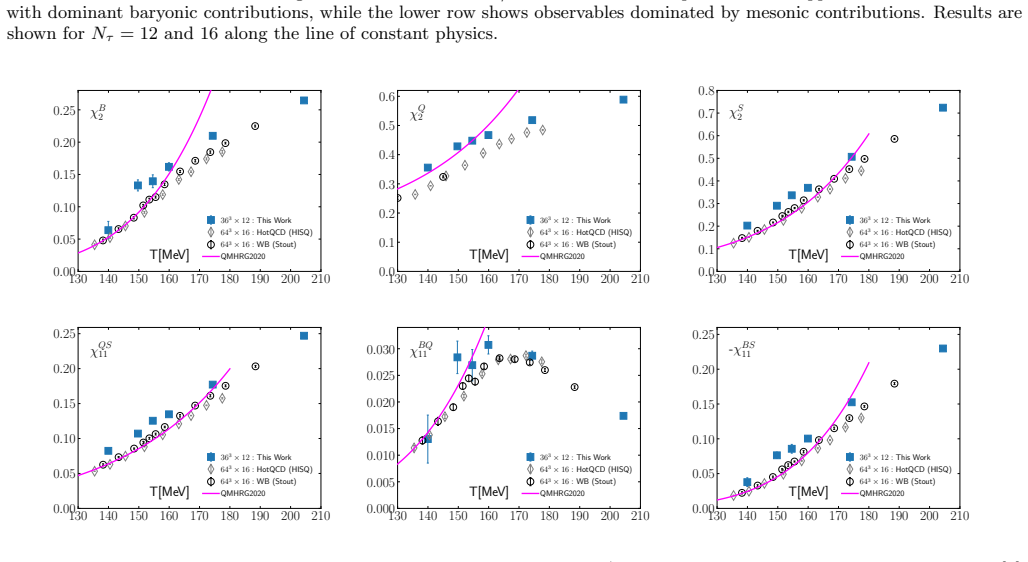
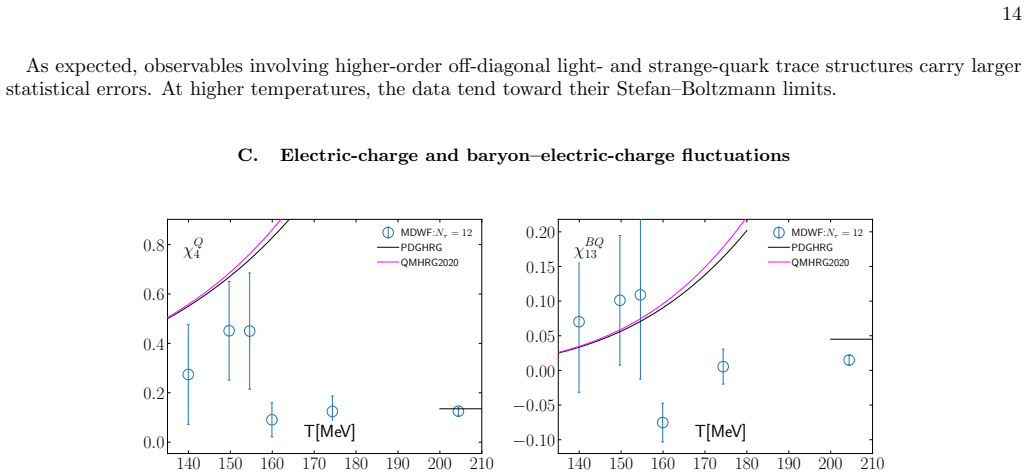
Using Möbius domain-wall fermions along a line of constant physics, second-order electric-charge, strangeness, and off-diagonal conserved-charge fluctuations in (2+1)-flavor QCD are consistent with QMHRG2020 hadron resonance gas calculations below the pseudocritical temperature. Across the crossover these observables rise rapidly and tend toward their Stefan-Boltzmann limits, while selected fourth-order cumulants at physical pion mass allow a first comparison with the same hadron resonance gas model.
What carries the argument
Second- and fourth-order cumulants of conserved charges obtained from quark-number susceptibilities on Möbius domain-wall fermion ensembles with N_tau=12 and 16.
Load-bearing premise
Finite-volume effects, lattice-spacing artifacts, and the tuning of the line of constant physics are controlled sufficiently at N_tau=12 for the physical pion mass that the reported agreement with the hadron resonance gas and the approach to Stefan-Boltzmann limits are not significantly changed by remaining systematics.
What would settle it
A finer-lattice or larger-volume calculation that finds statistically significant deviation from the QMHRG2020 predictions for second-order charge and strangeness fluctuations below the pseudocritical temperature would falsify the consistency claim.
Figures





read the original abstract
We calculate second- and selected fourth-order conserved-charge fluctuations in $(2+1)$-flavor QCD using M\"obius domain-wall fermions (MDWF) along a line of constant physics. Gauge ensembles were generated for two light-to-strange quark-mass ratios, $m_l/m_s=1/10$ and $1/27.4$, corresponding to heavier-than-physical and physical pion masses, respectively. For $m_l/m_s=1/10$, calculations were carried out on lattices with temporal extents $N_\tau=12$ and $16$, enabling an assessment of lattice-spacing effects at heavier pion mass. For $m_l/m_s=1/27.4$, calculations were performed at $N_\tau=12$, allowing us to study the light-quark-mass dependence down to the physical point. Below the pseudocritical temperature, second-order electric-charge, strangeness, and off-diagonal conserved-charge fluctuations are consistent with QMHRG2020 hadron resonance gas calculations. Across the crossover region, these observables rise rapidly and tend toward their Stefan--Boltzmann limits. Selected fourth-order cumulants were also computed at the physical pion mass. Although these observables are statistically more demanding, several channels with controlled uncertainties permit a first comparison with hadron resonance gas calculations.
Editorial analysis
A structured set of objections, weighed in public.
Referee Report
Summary. The paper computes second- and selected fourth-order conserved-charge fluctuations (quark number susceptibilities) in (2+1)-flavor QCD using Möbius domain-wall fermions along a line of constant physics. Gauge ensembles are generated at two light-to-strange mass ratios (m_l/m_s=1/10 and the physical 1/27.4), with N_τ=12 and 16 for the heavier mass and N_τ=12 only for the physical point. Below the pseudocritical temperature the second-order electric-charge, strangeness, and off-diagonal fluctuations are reported to agree with QMHRG2020 hadron-resonance-gas results; across the crossover they rise rapidly toward their Stefan-Boltzmann limits. Selected fourth-order cumulants at the physical mass are also compared to HRG expectations.
Significance. If the remaining discretization and volume systematics can be controlled, the results supply useful lattice data on conserved-charge fluctuations at the physical pion mass. Such observables are directly relevant to heavy-ion collision experiments and to tests of the hadron resonance gas model near the QCD crossover. The use of Möbius domain-wall fermions and the explicit line-of-constant-physics tuning are positive features; the physical-mass second-order results, even at a single N_τ, add to the existing literature.
major comments (2)
- [§4 and abstract] §4 (physical-mass results) and abstract: only N_τ=12 data exist at m_l/m_s=1/27.4 while N_τ=16 is available solely at the heavier m_l/m_s=1/10 ratio. This precludes a direct continuum extrapolation at the physical point. Because O(a²) artifacts in susceptibilities are known to remain sizable at a≈0.1 fm, the claimed consistency with QMHRG2020 below T_pc and the approach to Stefan-Boltzmann limits could be altered by residual lattice-spacing effects comparable to the quoted uncertainties.
- [Results section (fourth-order cumulants)] Results section (fourth-order cumulants): the manuscript states that several fourth-order channels have “controlled uncertainties,” yet no explicit error budget is provided that includes finite-volume corrections, residual lattice-spacing dependence, or the tuning precision of the line of constant physics at the physical mass. These observables are statistically demanding; without such a budget the extension of the HRG comparison to fourth order remains preliminary.
minor comments (2)
- [Introduction] The definition of the conserved-charge susceptibilities (e.g., χ_{11}^{BS}, χ_2^Q) should be restated explicitly in the introduction or methods section for readers who are not specialists in the notation.
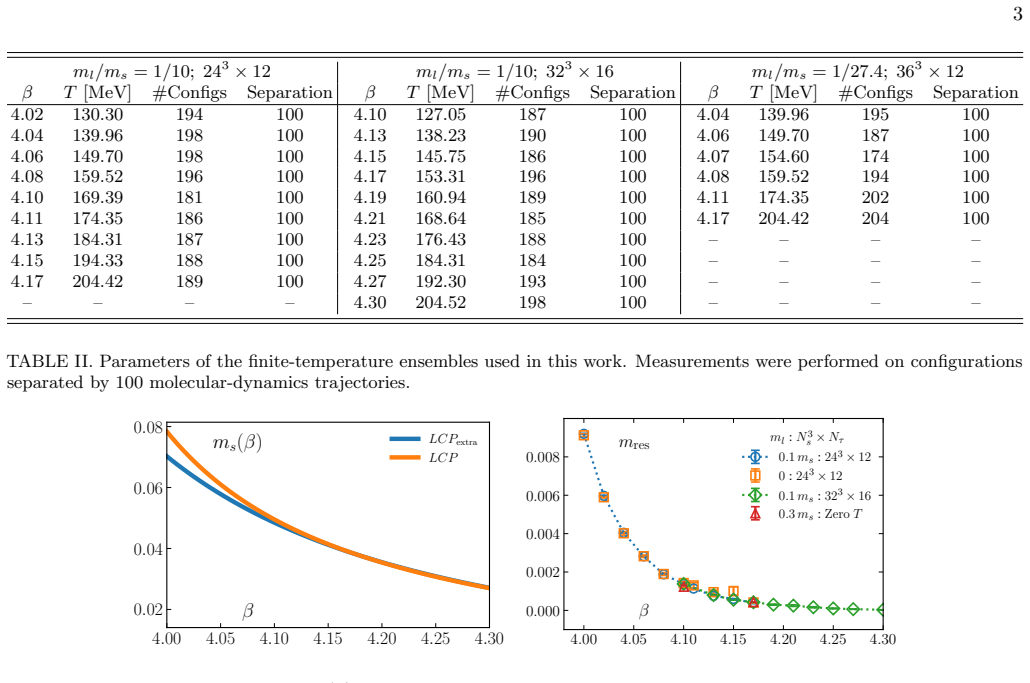
- Figure captions and axis labels could more clearly indicate which ensembles correspond to which mass ratio and N_τ value.
Simulated Author's Rebuttal
We thank the referee for the careful reading and constructive comments on our manuscript. We address each major comment below and indicate the changes we will make in the revised version.
read point-by-point responses
-
Referee: [§4 and abstract] §4 (physical-mass results) and abstract: only N_τ=12 data exist at m_l/m_s=1/27.4 while N_τ=16 is available solely at the heavier m_l/m_s=1/10 ratio. This precludes a direct continuum extrapolation at the physical point. Because O(a²) artifacts in susceptibilities are known to remain sizable at a≈0.1 fm, the claimed consistency with QMHRG2020 below T_pc and the approach to Stefan-Boltzmann limits could be altered by residual lattice-spacing effects comparable to the quoted uncertainties.
Authors: We agree that the lack of a second N_τ at the physical mass ratio prevents a direct continuum extrapolation. At the heavier mass ratio we do observe good agreement between N_τ=12 and N_τ=16 for the second-order susceptibilities below T_pc, with differences smaller than the statistical errors. In the revised manuscript we will add a dedicated paragraph that uses this comparison to estimate the possible size of O(a²) effects at the physical point and will qualify the statements in the abstract and §4 to reflect the remaining discretization uncertainty. We believe the main conclusions remain valid but will present them more cautiously. revision: partial
-
Referee: [Results section (fourth-order cumulants)] Results section (fourth-order cumulants): the manuscript states that several fourth-order channels have “controlled uncertainties,” yet no explicit error budget is provided that includes finite-volume corrections, residual lattice-spacing dependence, or the tuning precision of the line of constant physics at the physical mass. These observables are statistically demanding; without such a budget the extension of the HRG comparison to fourth order remains preliminary.
Authors: We accept the referee’s point that an explicit error budget is needed. In the revised manuscript we will insert a clear error-budget discussion for the fourth-order cumulants. It will quantify finite-volume effects (using our L T ≈ 3–4 volumes and HRG-based estimates), residual lattice-spacing dependence (informed by the N_τ=12 vs. 16 comparison at heavier mass), and the precision of the line-of-constant-physics tuning. We will also specify which channels satisfy our “controlled uncertainties” criterion and why. revision: yes
Circularity Check
No significant circularity: purely numerical lattice results benchmarked against independent external models.
full rationale
The paper presents direct Monte Carlo computations of second- and fourth-order conserved-charge susceptibilities on MDWF ensembles at fixed N_tau=12 (physical mass) and N_tau=12/16 (heavier mass). Central claims are numerical comparisons of these observables to the external QMHRG2020 hadron resonance gas model below T_pc and to Stefan-Boltzmann limits across the crossover; no internal derivation, ansatz, or fitted parameter is redefined or renamed as a prediction. Self-citations, if present, support only standard lattice methodology and do not carry the load-bearing content of the reported consistency or approach to limits. The derivation chain is therefore self-contained against external benchmarks.
Axiom & Free-Parameter Ledger
free parameters (3)
- light-to-strange quark mass ratio
- temporal lattice extent N_tau
- gauge coupling and quark masses along line of constant physics
axioms (2)
- domain assumption Möbius domain-wall fermions provide a valid discretization of QCD at the simulated lattice spacings and temperatures
- domain assumption QMHRG2020 hadron resonance gas model supplies an accurate reference for the confined phase
Reference graph
Works this paper leans on
-
[1]
Y. Aoki, G. Endrodi, Z. Fodor, S. D. Katz and K. K. Szabo,The Order of the quantum chromodynamics transition predicted by the standard model of particle physics,Nature443(2006) 675 [hep-lat/0611014]
work page Pith review arXiv 2006
- [2]
-
[3]
R. Bellwied, S. Borsanyi, Z. Fodor, J. N. Guenther, J. Noronha-Hostler, P. Parotto et al.,Off-diagonal correlators of conserved charges from lattice QCD and how to relate them to experiment,Phys. Rev. D101(2020) 034506 [ 1910.14592]
-
[4]
D. Bollweg, J. Goswami, O. Kaczmarek, F. Karsch, S. Mukherjee, P. Petreczky et al.,Second order cumulants of conserved charge fluctuations revisited: Vanishing chemical potentials,Phys. Rev. D104(2021) [2107.10011]
-
[5]
Bazavovet al.(HotQCD), Chiral crossover in QCD at zero and non-zero chemical potentials, Phys
A. Bazavov et al.,Chiral crossover in QCD at zero and non-zero chemical potentials,Phys. Lett. B795(2019) 15 [1812.08235]. 17
-
[6]
R. C. Brower, H. Neff and K. Orginos,The M¨ obius domain wall fermion algorithm,Comput. Phys. Commun.220(2017) 1 [1206.5214]. [7]JLQCDcollaboration,Large-scale simulations with chiral symmetry,PoSLATTICE2013(2014) 125 [1311.6941]
work page Pith review arXiv 2017
- [7]
-
[8]
S. Aoki, Y. Aoki, H. Fukaya, J. Goswami, S. Hashimoto, I. Kanamori et al.,Thermodynamics with M¨ obius domain wall fermions near physical point II,PoSLATTICE2022(2023) 176 [2303.05884]. [10]JLQCDcollaboration,Quark number susceptibility and conserved charge fluctuation for (2+1)-flavor QCD with M¨ obius domain wall fermions,PoSLATTICE2024(2025) 168 [2501.03509]
-
[9]
S. Hashimoto, S. Aoki, G. Cossu, H. Fukaya, T. Kaneko, J. Noaki et al.,Residual mass in five-dimensional fermion formulations,PoSLATTICE2013(2014) 431. [12]Flavour Lattice A veraging Group (FLAG)collaboration,FLAG Review 2021,Eur. Phys. J. C82(2022) 869 [2111.09849]
- [10]
- [11]
-
[12]
J. Foley, K. Jimmy Juge, A. O’Cais, M. Peardon, S. M. Ryan and J.-I. Skullerud,Practical all-to-all propagators for lattice QCD,Comput. Phys. Commun.172(2005) 145 [hep-lat/0505023]. [16]QCDSFcollaboration,Disconnected contributions to D-meson semi-leptonic decay form factors,PoSLATTICE2011 (2011) 283 [1111.4053]
- [13]
-
[14]
A. Hasenfratz, R. Hoffmann and S. Schaefer,Reweighting towards the chiral limit,Phys. Rev. D78(2008) 014515 [0805.2369]
- [15]
-
[16]
S. Borsanyi, Z. Fodor, S. D. Katz, S. Krieg, C. Ratti and K. Szabo,Fluctuations of conserved charges at finite temperature from lattice QCD,JHEP01(2012) 138 [1112.4416]
-
[17]
A. Bazavov et al.,The chiral and deconfinement aspects of the QCD transition,Phys. Rev. D85(2012) 054503 [ 1111.1710]
-
[18]
R. Bellwied, S. Borsanyi, Z. Fodor, J. G¨ unther, S. D. Katz, C. Ratti et al.,The QCD phase diagram from analytic continuation,Phys. Lett. B751(2015) 559 [1507.07510]. [23]HotQCDcollaboration,Fluctuations and Correlations of net baryon number, electric charge, and strangeness: A comparison of lattice QCD results with the hadron resonance gas model,Phys. R...
-
[19]
J. Goswami, F. Karsch, C. Schmidt, S. Mukherjee and P. Petreczky,Comparing conserved charge fluctuations from lattice QCD to HRG model calculations,Acta Phys. Polon. Supp.14(2021) 251 [2011.02812]
-
[20]
Grid: A next generation data parallel C++ QCD library,
P. Boyle, A. Yamaguchi, G. Cossu and A. Portelli,Grid: A next generation data parallel C++ QCD library,1512.03487
-
[21]
Grid: Data parallel c++ mathematical object library
P. Boyle, “Grid: Data parallel c++ mathematical object library.”https://github.com/paboyle/Grid
-
[22]
S. Ueda, S. Aoki, T. Aoyama, K. Kanaya, H. Matsufuru, S. Motoki et al.,Development of an object oriented lattice QCD code ’Bridge++’,J. Phys. Conf. Ser.523(2014) 012046
2014
- [23]
-
[24]
Lattice qcd code bridge++
“Lattice qcd code bridge++.”http://bridge.kek.jp/Lattice-code/, 30 June 2023
2023
-
[25]
L. Altenkort, D. A. Clarke, J. Goswami and H. Sandmeyer,Streamlined data analysis in Python, in40th International Symposium on Lattice Field Theory, 8, 2023,2308.06652
-
[26]
Analysistoolbox
D. A. Clarke et al., “Analysistoolbox.”https://github.com/LatticeQCD/AnalysisToolbox
discussion (0)
Sign in with ORCID, Apple, or X to comment. Anyone can read and Pith papers without signing in.