Recognition: unknown
A Deep Learning Approach to Describing the Plasma Sheath
Pith reviewed 2026-05-08 09:19 UTC · model grok-4.3
The pith
A physics-informed neural network learns parametric solutions to fluid models of the plasma sheath and acts as a fast surrogate across parameter ranges.
A machine-rendered reading of the paper's core claim, the machinery that carries it, and where it could break.
Core claim
The central claim is that a PINN can identify the parametric solution to fluid models of different physics fidelity of the plasma sheath by enforcing the PDE constraints during training, thereby producing an effective surrogate that efficiently predicts sheath profiles across a broad range of parameter regimes once training is complete.
What carries the argument
Physics-informed neural network that embeds the sheath fluid equations as soft constraints to learn continuous parametric mappings from inputs like density ratios and temperatures to full spatial profiles.
If this is right
- Sheath properties become available for rapid evaluation at any combination of input parameters after one training run.
- The same trained network can be reused for models that add successive physical effects such as collisions or secondary emission.
- Parametric studies of sheath dependence on upstream conditions become feasible at low computational cost.
- The surrogate can serve as a drop-in replacement for repeated calls to traditional sheath solvers inside larger plasma simulations.
Where Pith is reading between the lines
- Integration into device-scale codes could reduce overall runtime when sheath boundary conditions must be recomputed frequently.
- The method opens a route to embedding experimental sheath measurements as additional constraints for data-augmented models.
- Extension to time-dependent or multi-dimensional sheath problems would require only changes to the network architecture and loss terms.
Load-bearing premise
The chosen fluid models correctly capture the essential sheath physics and the PINN training converges to solutions that satisfy the equations without systematic artifacts.
What would settle it
Side-by-side comparison of PINN-generated profiles for electron density, ion velocity, and electrostatic potential against independent numerical solutions of the same fluid equations at multiple points across the tested parameter space.
Figures






read the original abstract
Despite their ubiquity, the rich physics present in a plasma sheath has inhibited the development of a generally applicable description of this critical region. The present study utilizes a physics-informed neural network (PINN) to evaluate a hierarchy of models of the plasma sheath. Unlike traditional deep learning methods, PINNs use the governing PDEs to constrain the predictions of a neural network, and thus do not require any experimental or simulation data to train. In this work, we utilize a PINN to identify the parametric solution to fluid models of different physics fidelity of the plasma sheath. While the offline training time of the PINN is often longer than a traditional solver, once trained, the PINN is able to efficiently predict the sheath profiles across a broad range of parameter regimes, thus yielding an effective surrogate of the plasma sheath.
Editorial analysis
A structured set of objections, weighed in public.
Referee Report
Summary. The manuscript proposes a physics-informed neural network (PINN) to solve a hierarchy of fluid models for the plasma sheath. Unlike data-driven methods, the PINN enforces the governing PDEs directly during training and requires no experimental or simulation data. The central claim is that, after offline training, the network efficiently predicts sheath profiles across a broad range of parameter regimes, thereby serving as an effective surrogate model for the plasma sheath.
Significance. If the verification gap is closed, the work could provide a practical parametric surrogate for sheath modeling in applications such as fusion edge plasmas and spacecraft charging. The data-free, PDE-constrained formulation is a methodological strength that aligns with the singularly perturbed nature of sheath equations. However, without demonstrated residual norms, comparisons to reference solvers, or convergence diagnostics, the significance remains prospective rather than established.
major comments (2)
- [Abstract] Abstract and results sections: the assertion that the trained PINN 'yields an effective surrogate' is unsupported by any quantitative evidence. No PDE residual norms, L2 errors against analytic limits or shooting-method/finite-volume reference solutions, or parametric convergence diagnostics are reported. For singularly perturbed sheath ODEs, plausible profiles can mask violations of boundary conditions or residuals when loss weights are imbalanced; these checks are load-bearing for the surrogate claim.
- [Methods/Results] Methods and results: the hierarchy of fluid models is introduced, yet no verification is shown that the PINN solutions satisfy the models to within a stated tolerance across the parameter space. Standard practice for PINN surrogates requires at least residual histograms, pointwise error plots versus reference solutions, and timing comparisons for the parametric case.
minor comments (2)
- [Results] Notation for the sheath potential, density, and velocity profiles should be defined explicitly in the first results figure or table to aid readability.
- [Methods] The manuscript would benefit from a brief statement of the neural-network architecture (layers, activation, optimizer) and the specific loss-weighting strategy used for the boundary-layer terms.
Simulated Author's Rebuttal
We thank the referee for their thorough review and constructive suggestions. We agree that the current manuscript requires additional quantitative verification to substantiate the claim that the trained PINN serves as an effective surrogate. We will revise the manuscript to include the requested metrics and comparisons.
read point-by-point responses
-
Referee: [Abstract] Abstract and results sections: the assertion that the trained PINN 'yields an effective surrogate' is unsupported by any quantitative evidence. No PDE residual norms, L2 errors against analytic limits or shooting-method/finite-volume reference solutions, or parametric convergence diagnostics are reported. For singularly perturbed sheath ODEs, plausible profiles can mask violations of boundary conditions or residuals when loss weights are imbalanced; these checks are load-bearing for the surrogate claim.
Authors: We acknowledge that the manuscript does not presently report PDE residual norms, L2 errors relative to analytic or numerical reference solutions, or parametric convergence diagnostics. This omission weakens the surrogate claim, particularly for singularly perturbed sheath equations. In the revised manuscript we will add these verifications, including residual norms, L2 errors against shooting-method and finite-volume solutions, boundary-condition satisfaction checks, and an assessment of loss-weight balance. We will also include residual histograms and pointwise error plots to demonstrate that plausible profiles do not conceal violations of the governing equations. revision: yes
-
Referee: [Methods/Results] Methods and results: the hierarchy of fluid models is introduced, yet no verification is shown that the PINN solutions satisfy the models to within a stated tolerance across the parameter space. Standard practice for PINN surrogates requires at least residual histograms, pointwise error plots versus reference solutions, and timing comparisons for the parametric case.
Authors: We agree that explicit verification across the parameter space is required. The revised manuscript will present residual histograms, pointwise error plots against reference solvers, and timing benchmarks that quantify the offline training cost versus the online inference speed of the trained PINN. These additions will confirm that the network solutions satisfy each fluid model to within a stated tolerance over the examined parameter regimes and will directly support the surrogate-model utility. revision: yes
Circularity Check
No circularity: PINN enforces PDE constraints directly without data fitting or self-referential reduction
full rationale
The paper trains a physics-informed neural network solely on the governing PDEs and boundary conditions of a hierarchy of fluid sheath models. The resulting parametric solutions are obtained by minimizing residuals of those same equations, with no fitted output data, no self-citation load-bearing premises, and no renaming of known results. The surrogate capability follows directly from the parameterized PDE enforcement rather than any construction that equates outputs to inputs by definition. No steps reduce to self-definition, fitted predictions, or imported uniqueness theorems.
Axiom & Free-Parameter Ledger
axioms (1)
- domain assumption The fluid plasma equations (continuity, momentum, Poisson) constitute an accurate model for the sheath at the chosen fidelity levels.
Reference graph
Works this paper leans on
-
[1]
Additionally, since NNs are continuous and differentiable, predictions can be made at an arbitrary point within the trained domain
and PyTorch [36]. Additionally, since NNs are continuous and differentiable, predictions can be made at an arbitrary point within the trained domain. These predictions take typically a few microseconds each, and when combined with the parametric capabilities of PINNs, allow PINNs to serve as a rapid surrogate model. An important choice when designing PINN...
-
[2]
Model A minimal consistent model of the sheath can be formed by introducing a constant uniform source of ions and electrons throughout the plasma volume to balance losses to the surrounding walls (see Fig. 1). The temperature is held constant for ions and electrons, under the assumption that the heat conductivity is sufficient to force a nearly constant t...
-
[3]
h l factor
Results There are three free parameters that characterize the solution for the model described in Sec. III A 1: the electron-to-ion mass ratio,me/mi, the ion-to-electron temperature ratio,Ti/Te, and the collisionality,λ De/λin. The mass ratio is trained from hydrogen to argon, the temperature ratio is trained between 0 and 1, and the collisionality is tra...
-
[4]
The two kinds of recombina- tion considered are radiative recombination and three-body recombination
Model A more complete description of the plasma-sheath transition region can be achieved by includ- ing self-consistent collisional ionization and recombination sources. The two kinds of recombina- tion considered are radiative recombination and three-body recombination. There are three main factors that determine the impact of collisional ionization and ...
-
[5]
We used the PyTorch library [36] for this model
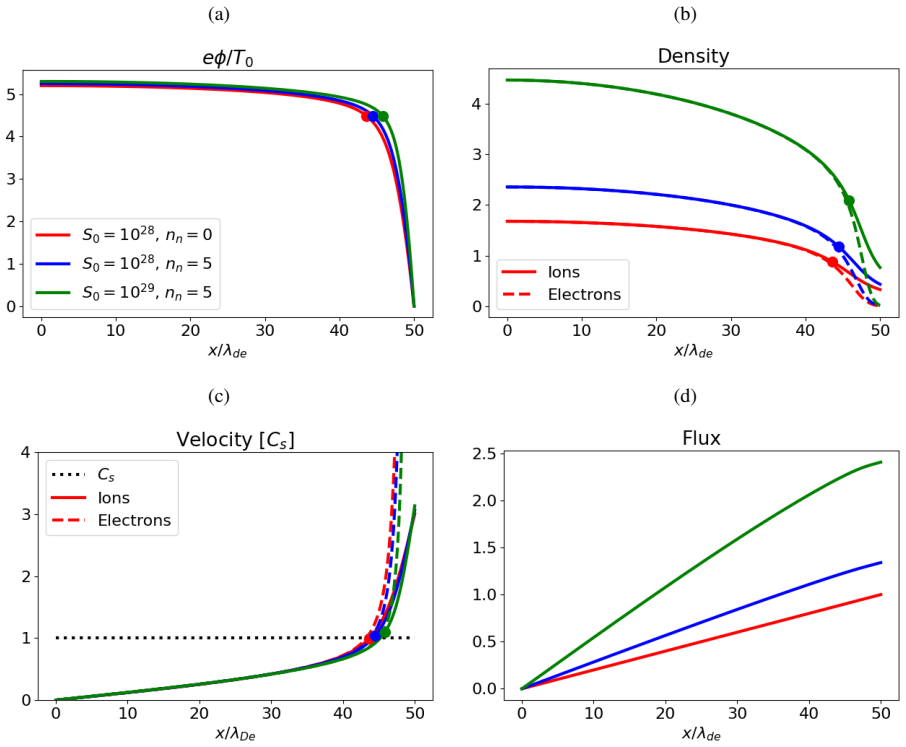
Results The model is five dimensional with one spatial dimension and four physical parameters. We used the PyTorch library [36] for this model. The electron temperature is varied between 1 eV and 20 eV ,Ti/Te is varied between 0 and 1,S 0 is varied between10 28 and10 29 m−3s−1, and finally neutral density is varied between 0 and 5. We find it convenient t...
-
[6]
Model The last fluid model we will consider incorporates an electron heat equation, and thus allows us to relax the constant temperature assumption made in the previous models. Relaxing the constant electron temperature assumption will prevent the use of Boltzmann electrons, such that both the electron momentum and heat equations must be added to the mode...
-
[7]
The neural network contained three hidden layers of twenty neurons each in a fully connected feed-forward neural network
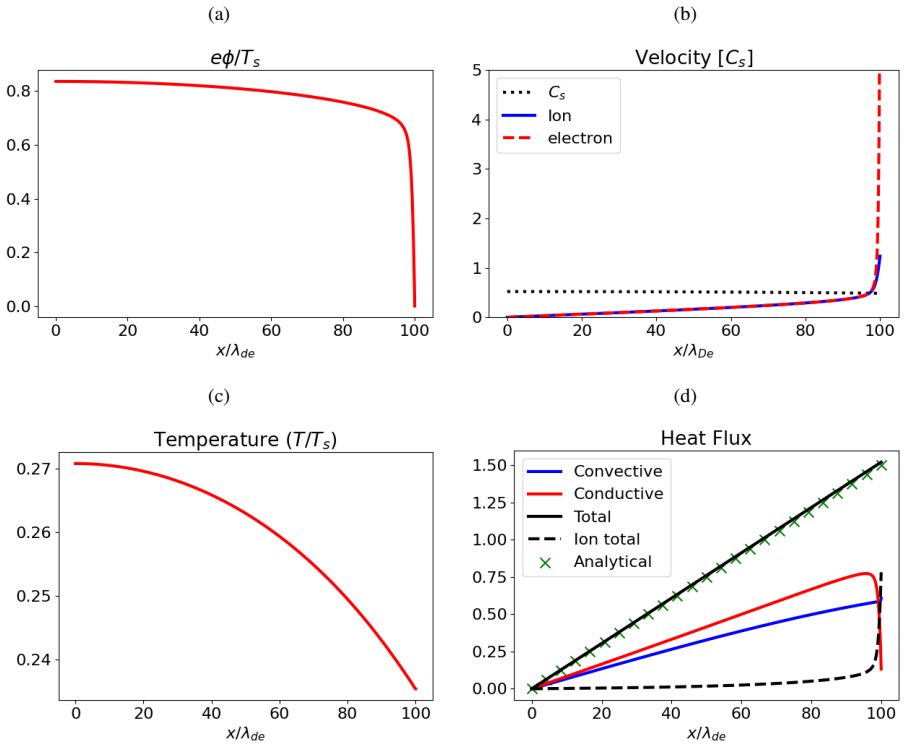
Results For this model, hydrogen is the ion species considered, with the model trained with ADAM for the first ten thousand iterations and SSBroyden for the remainder with one hundred thousand Hammersley distributed training points. The neural network contained three hidden layers of twenty neurons each in a fully connected feed-forward neural network. Fo...
-
[8]
(7a) and (7b) can be written as ODEs and solved by a numerical scheme such as Runga-Kutta
Constant Source In order to verify the PINN solution, Eqs. (7a) and (7b) can be written as ODEs and solved by a numerical scheme such as Runga-Kutta. To put the sheath equations in a form that they can be readily integrated, Poisson’s equation is split into two ODEs: ∂ϕ ∂x =−E,(A1) ∂E ∂x = x Lui −n weϕ,(A2) where from Eq. (4) we can writen i =x/(Lu i)and ...
-
[9]
Complex Source Similar to the simple source case, this system, with the more complicated source, can be written into a series of ODEs, provided the ion temperature is assumed to be 0. The system is as follows: ∂ϕ ∂x =−E,(A4) ∂E ∂x =n weϕ ue ui −1 ,(A5) ∂ui ∂x = E ui − uiS uenweϕ −n nσin,(A6) ∂ue ∂x = S nweϕ +u eE,(A7) whereS= 1/L+n nnweϕ ¯Sionize, where ¯...
-
[10]
P. C. Stangeby et al.,The plasma boundary of magnetic fusion devices, vol. 224 (Institute of Physics Pub. Philadelphia, Pennsylvania, 2000)
2000
-
[11]
I. D. Kaganovich, A. Smolyakov, Y . Raitses, E. Ahedo, I. G. Mikellides, B. Jorns, F. Taccogna, R. Gueroult, S. Tsikata, A. Bourdon, et al., Physics of Plasmas27(2020)
2020
-
[12]
I. H. Hutchinson, Plasma Physics and Controlled Fusion44, 2603 (2002)
2002
-
[13]
M. A. Lieberman and A. J. Lichtenberg, MRS Bulletin30, 899 (1994)
1994
-
[14]
V . A. Godyak, Physics Letters A89, 80 (1982). 27
1982
-
[15]
Riemann, Physics of plasmas4, 4158 (1997)
K.-U. Riemann, Physics of plasmas4, 4158 (1997)
1997
-
[16]
Chodura, The Physics of Fluids25, 1628 (1982)
R. Chodura, The Physics of Fluids25, 1628 (1982)
1982
-
[17]
Hershkowitz, Physics of plasmas12(2005)
N. Hershkowitz, Physics of plasmas12(2005)
2005
-
[18]
Baalrud, C
S. Baalrud, C. Hegna, and J. Callen, Physical review letters103, 205002 (2009)
2009
-
[19]
G. E. Karniadakis, I. G. Kevrekidis, L. Lu, P. Perdikaris, S. Wang, and L. Yang, Nature Reviews Physics3, 422 (2021)
2021
-
[20]
Raissi, P
M. Raissi, P. Perdikaris, and G. Karniadakis, Journal of Computational Physics378, 686 (2019)
2019
-
[21]
B. P. van Milligen, V . Tribaldos, and J. Jim´enez, Physical review letters75, 3594 (1995)
1995
-
[22]
Trieschmann, L
J. Trieschmann, L. Vialetto, and T. Gergs, Journal of Micro/Nanopatterning, Materials, and Metrology 22, 041504 (2023)
2023
-
[23]
S. Ahn, J. Bae, S. Yoo, and S. K. Nam, Physics of Plasmas32(2025)
2025
-
[24]
Mathews, J
A. Mathews, J. W. Hughes, J. L. Terry, and S.-G. Baek, Physical Review Letters129, 235002 (2022)
2022
-
[25]
S. L. Brunton, J. L. Proctor, and J. N. Kutz, Proceedings of the national academy of sciences113, 3932 (2016)
2016
-
[26]
S. H. Rudy, S. L. Brunton, J. L. Proctor, and J. N. Kutz, Science advances3, e1602614 (2017)
2017
-
[27]
E. P. Alves and F. Fiuza, Physical Review Research4, 033192 (2022)
2022
-
[28]
Beving, M
L. Beving, M. Hopkins, and S. Baalrud, Plasma Sources Science and Technology31, 084009 (2022)
2022
-
[29]
K. U. Riemann, J. Seebacher, D. Tskhakaya, and S. Kuhn, Plasma physics and controlled fusion47, 1949 (2005)
1949
-
[30]
Robertson, Plasma Physics and Controlled Fusion55, 093001 (2013)
S. Robertson, Plasma Physics and Controlled Fusion55, 093001 (2013)
2013
-
[31]
M. H. Holmes,Introduction to numerical methods in differential equations(Springer, 2007)
2007
-
[32]
Alvarez-Laguna, T
A. Alvarez-Laguna, T. Magin, M. Massot, A. Bourdon, and P. Chabert, Plasma Sources Science and Technology29, 025003 (2020)
2020
-
[33]
Colella, M
P. Colella, M. R. Dorr, and D. D. Wake, Journal of Computational Physics149, 168 (1999)
1999
-
[34]
L. Sun, H. Gao, S. Pan, and J.-X. Wang, Computer Methods in Applied Mechanics and Engineering 361, 112732 (2020)
2020
-
[35]
C. J. McDevitt and X.-Z. Tang, Physics of Plasmas31(2024)
2024
-
[36]
B. Jang, A. A. Kaptanoglu, R. Gaur, S. Pan, M. Landreman, and W. Dorland, Physics of Plasmas31 (2024)
2024
-
[37]
Osborne, S
G. Osborne, S. Roy, E. Webb, C. J. McDevitt, and S. Roy,Physics-informed neural network for rapid ion trajectory prediction in ion-etch reactors, Accepted to Phys. Fluids (2025). 28
2025
-
[38]
C. M. Bishop and N. M. Nasrabadi,Pattern recognition and machine learning, vol. 4 (Springer, 2006)
2006
-
[39]
J. W. Burby, Q. Tang, and R. Maulik, Plasma Physics and Controlled Fusion63, 024001 (2020)
2020
-
[40]
Cuomo, V
S. Cuomo, V . S. Di Cola, F. Giampaolo, G. Rozza, M. Raissi, and F. Piccialli, Journal of Scientific Computing92, 88 (2022)
2022
- [41]
-
[42]
J. D. Toscano, V . Oommen, A. J. Varghese, Z. Zou, N. Ahmadi Daryakenari, C. Wu, and G. E. Karni- adakis, Machine Learning for Computational Science and Engineering1, 1 (2025)
2025
-
[43]
McDevitt, E
C. McDevitt, E. Fowler, and S. Roy, inAIAA Scitech 2024 F orum(2024), p. 1692
2024
-
[44]
Abadi, P
M. Abadi, P. Barham, J. Chen, Z. Chen, A. Davis, J. Dean, M. Devin, S. Ghemawat, G. Irving, M. Isard, et al., in12th USENIX symposium on operating systems design and implementation (OSDI 16)(2016), pp. 265–283
2016
-
[45]
Paszke, S
A. Paszke, S. Gross, F. Massa, A. Lerer, J. Bradbury, G. Chanan, T. Killeen, Z. Lin, N. Gimelshein, L. Antiga, et al., Advances in neural information processing systems32(2019)
2019
-
[46]
D. P. Kingma, arXiv preprint arXiv:1412.6980 (2014)
work page internal anchor Pith review arXiv 2014
-
[47]
D. C. Liu and J. Nocedal, Mathematical programming45, 503 (1989)
1989
-
[48]
Kiyani, K
E. Kiyani, K. Shukla, J. F. Urb ´an, J. Darbon, and G. E. Karniadakis, arXiv e-prints pp. arXiv–2501 (2025)
2025
-
[49]
J. F. Urb ´an, P. Stefanou, and J. A. Pons, Journal of Computational Physics523, 113656 (2025)
2025
-
[50]
Morales Crespo, Physics of Plasmas25(2018)
R. Morales Crespo, Physics of Plasmas25(2018)
2018
-
[51]
Valentini, Journal of Physics D: Applied Physics21, 311 (1988)
H.-B. Valentini, Journal of Physics D: Applied Physics21, 311 (1988)
1988
-
[52]
Sternberg and V
N. Sternberg and V . A. Godyak, Physica D: Nonlinear Phenomena97, 498 (1996)
1996
-
[53]
L. Lu, X. Meng, Z. Mao, and G. E. Karniadakis, SIAM Review63, 208 (2021)
2021
-
[54]
Raimbault and P
J.-L. Raimbault and P. Chabert, Plasma Sources Science and Technology18, 014017 (2008)
2008
-
[55]
A. S. Richardson (2019). [47]Phelps database,www.lxcat.net/Phelps, accessed: 6 December 2025
2019
-
[56]
Braginskii, Reviews of plasma physics1, 205 (1965)
S. Braginskii, Reviews of plasma physics1, 205 (1965)
1965
-
[57]
Helander and D
P. Helander and D. J. Sigmar,Collisional transport in magnetized plasmas, vol. 4 (Cambridge univer- sity press, 2005)
2005
-
[58]
Y . Li, B. Srinivasan, Y . Zhang, and X.-Z. Tang, Physical Review Letters128, 085002 (2022)
2022
-
[59]
Cagas, A
P. Cagas, A. Hakim, J. Juno, and B. Srinivasan, Physics of Plasmas24(2017)
2017
-
[60]
S. D. Baalrud, Physics of Plasmas19(2012). 29
2012
discussion (0)
Sign in with ORCID, Apple, or X to comment. Anyone can read and Pith papers without signing in.