Recognition: unknown
The potential of directional neutrino detection to observe neutrino spin oscillations
Pith reviewed 2026-05-08 11:09 UTC · model grok-4.3
The pith
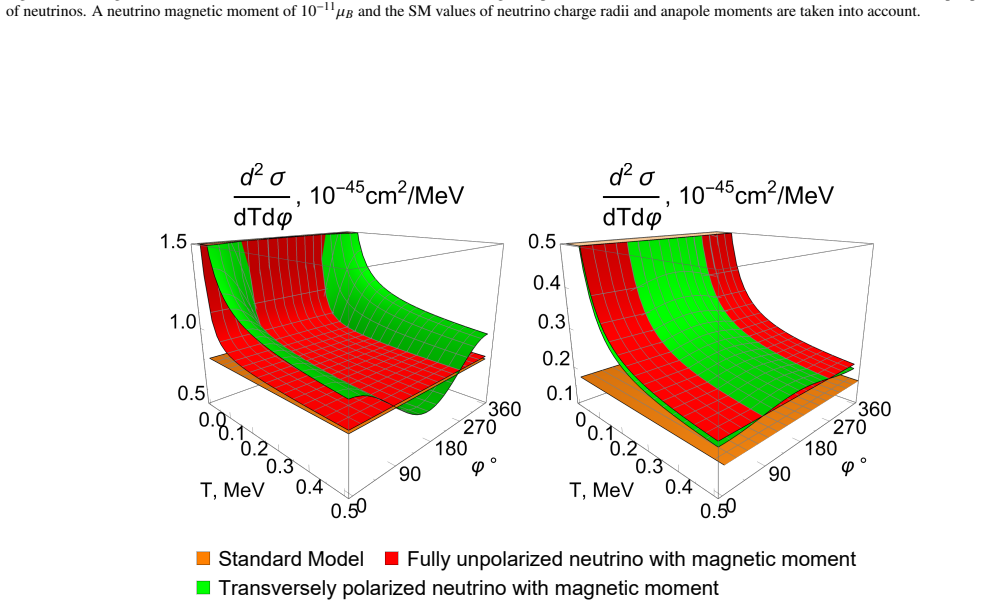
A superposition of left- and right-handed neutrino helicity states produces an azimuthal asymmetry in the angular distribution of recoil momenta.
A machine-rendered reading of the paper's core claim, the machinery that carries it, and where it could break.
Core claim
The central claim is that the coherent superposition of left- and right-handed helicity components in the neutrino state produces a nonzero azimuthal asymmetry in the differential cross section for elastic scattering. This effect is derived from the general treatment of arbitrary spin-flavor states and is shown numerically for scattering on electrons, protons, and the specified nuclei, indicating that directional information in the recoil momenta can serve as a direct signature of neutrino spin oscillations induced by magnetic moments.
What carries the argument
Azimuthal asymmetry in the angular distribution of recoil momenta, generated by interference between left- and right-handed helicity amplitudes in the neutrino scattering matrix element.
If this is right
- The asymmetry supplies an observable signature of neutrino spin oscillations in magnetic fields that is independent of overall flux reduction.
- Numerical results indicate the asymmetry is present and potentially measurable for elastic scattering on electrons, protons, argon-40, and xenon-132.
- Directional detection provides a new experimental channel to study neutrino magnetic moments through scattering rather than solely through propagation effects.
- The magnitude and form of the asymmetry depend on the precise spin-flavor composition of the incoming neutrino state.
Where Pith is reading between the lines
- This signature might enable inference of magnetic field strengths or coherence lengths in astrophysical neutrino sources if directional data are combined with energy spectra.
- The approach could be tested in existing or planned detectors with angular resolution by searching for the predicted left-right interference pattern in recoil tracks.
- If coherence is preserved over long distances, similar asymmetries might appear in other interaction channels or at higher energies where directional information remains accessible.
Load-bearing premise
The incoming neutrino arrives in a coherent superposition of left- and right-handed helicity states produced by spin oscillations, and this superposition remains intact until the scattering occurs.
What would settle it
Directional measurements of recoil particles in low-energy neutrino scattering events that show no azimuthal dependence despite the neutrino having traversed a region with a known magnetic field capable of inducing spin oscillations.
Figures


read the original abstract
A nonzero neutrino magnetic moment arises already in the minimally extended Standard Model with right-handed massive Dirac neutrinos. The well-known consequence of the neutrino magnetic moment is the phenomenon of neutrino spin oscillations in a magnetic field. It can manifest itself not only as a lack in the flux of active cosmic neutrinos arriving on Earth but also as characteristic features in low-energy neutrino elastic scattering processes. Following our approach developed earlier, in this work we study the influence of arbitrary spin-flavor state of incoming neutrino on low-energy neutrino scattering off different particles in a detector. We demonstrate that superposition of left- and right-handed helicity neutrino states gives rise to an azimuthal asymmetry in the angular distribution of the recoil momenta. We present numerical calculations for elastic neutrino scattering on electrons, protons and 40Ar and 132Xe nuclei, demonstrating the azimuthal-asymmetry effect. Our results indicate the unique potential of directional neutrino detection to observe the neutrino spin oscillations.
Editorial analysis
A structured set of objections, weighed in public.
Referee Report
Summary. The paper claims that neutrino spin oscillations in an external magnetic field produce an arbitrary spin-flavor superposition of left- and right-handed helicity states. When such a neutrino scatters elastically at low energy, the interference between the weak amplitude for left-helicity and the electromagnetic amplitude for right-helicity neutrinos generates an azimuthal asymmetry in the angular distribution of recoil momenta. Numerical results are shown for scattering on electrons, protons, 40Ar and 132Xe, and the authors conclude that directional neutrino detectors could thereby observe spin oscillations.
Significance. If the coherence of the helicity superposition is preserved and the asymmetry survives realistic detector effects, the result would supply a distinctive, directional signature of a nonzero neutrino magnetic moment that is complementary to flux-suppression searches. The explicit calculations for several detector-relevant targets give the claim concrete phenomenological content.
major comments (2)
- [theoretical framework and incoming-state description] The interference term 2 Re(A_L^* A_R) that produces the azimuthal asymmetry requires a stable relative phase between the left- and right-helicity amplitudes at the scattering vertex. The manuscript states that an arbitrary spin-flavor superposition reaches the detector but supplies no estimate of the coherence length, no integration over turbulent or stochastic magnetic-field realizations, and no minimum field-uniformity requirement; without these, it is impossible to judge whether the predicted φ modulation survives propagation to a terrestrial detector.
- [numerical results for elastic scattering] The abstract asserts that numerical calculations demonstrate the azimuthal-asymmetry effect, yet the provided text contains neither the explicit differential cross sections, the integration procedure over recoil angles, nor any assessment of statistical or systematic uncertainties. Consequently it is not possible to determine whether the asymmetry remains observable once finite angular resolution, backgrounds, and event statistics are included.
minor comments (1)
- [abstract] The abstract refers to 'our approach developed earlier' without a specific citation; adding the reference would help readers locate the prior formalism.
Simulated Author's Rebuttal
We thank the referee for the careful reading of our manuscript and the constructive comments. We address each major point below and will revise the manuscript to improve clarity where appropriate.
read point-by-point responses
-
Referee: [theoretical framework and incoming-state description] The interference term 2 Re(A_L^* A_R) that produces the azimuthal asymmetry requires a stable relative phase between the left- and right-helicity amplitudes at the scattering vertex. The manuscript states that an arbitrary spin-flavor superposition reaches the detector but supplies no estimate of the coherence length, no integration over turbulent or stochastic magnetic-field realizations, and no minimum field-uniformity requirement; without these, it is impossible to judge whether the predicted φ modulation survives propagation to a terrestrial detector.
Authors: We agree that a stable relative phase between helicity components is essential for the interference term to generate the azimuthal asymmetry. Our manuscript considers the general case of an arbitrary spin-flavor superposition arriving at the detector, as is standard in theoretical treatments of neutrino spin oscillations. We do not provide a coherence-length estimate or average over stochastic field realizations because these quantities are highly dependent on the specific magnetic-field environment (e.g., astrophysical source or terrestrial laboratory conditions) and lie outside the scope of the present work, which focuses on the scattering signature itself. In a revised version we will add an explicit statement of this assumption together with a brief discussion of the field-uniformity conditions required for coherence to be preserved. revision: partial
-
Referee: [numerical results for elastic scattering] The abstract asserts that numerical calculations demonstrate the azimuthal-asymmetry effect, yet the provided text contains neither the explicit differential cross sections, the integration procedure over recoil angles, nor any assessment of statistical or systematic uncertainties. Consequently it is not possible to determine whether the asymmetry remains observable once finite angular resolution, backgrounds, and event statistics are included.
Authors: The numerical results are obtained from the differential cross section that includes the interference between the weak left-helicity and electromagnetic right-helicity amplitudes. We will insert the explicit analytic expression for this differential cross section and describe the numerical integration over recoil energy and polar angle that yields the azimuthal distribution. The presented plots illustrate the ideal-case asymmetry for the listed targets. We acknowledge that a quantitative evaluation of finite angular resolution, backgrounds, and required event statistics is necessary to assess real-world observability; we will add a qualitative discussion of these detector effects in the revised conclusions section. revision: yes
Circularity Check
Minor self-citation to prior approach; central asymmetry calculation remains independent
full rationale
The paper states it follows 'our approach developed earlier' for studying spin-flavor states in scattering, but the core demonstration—that a left-right helicity superposition produces azimuthal asymmetry via the interference term in the differential cross section—is a direct kinematic calculation using standard weak and electromagnetic amplitudes. No equations reduce the predicted asymmetry to a fitted parameter or to the input superposition by construction, and no uniqueness theorem or ansatz is smuggled via self-citation. The coherence assumption is an external premise rather than a derived output, leaving the derivation self-contained against external benchmarks.
Axiom & Free-Parameter Ledger
axioms (2)
- domain assumption Neutrinos have a nonzero magnetic moment arising in the minimally extended Standard Model with right-handed Dirac neutrinos
- domain assumption Spin oscillations in a magnetic field produce a coherent superposition of left- and right-handed helicity states that reaches the detector
Reference graph
Works this paper leans on
-
[1]
Kajita, Nobel lecture: Discovery of atmospheric neu- trino oscillations, Rev
T. Kajita, Nobel lecture: Discovery of atmospheric neu- trino oscillations, Rev. Mod. Phys. 88 (2016) 030501. doi:10.1103/RevModPhys.88.030501
-
[2]
A. B. McDonald, Nobel lecture: The sudbury neu- trino observatory: Observation of flavor change for so- lar neutrinos, Rev. Mod. Phys. 88 (2016) 030502. doi:10.1103/RevModPhys.88.030502
-
[3]
Drewes, The phenomenology of right handed neu- trinos, Int
M. Drewes, The phenomenology of right handed neu- trinos, Int. J. Mod. Phys. E 22 (2013) 1330019. doi:10.1142/S0218301313300191
-
[4]
K. Fujikawa, R. E. Shrock, Magnetic moment of a mas- sive neutrino and neutrino-spin rotation, Phys. Rev. Lett. 45 (1980) 963–966. doi:10.1103/PhysRevLett.45.963
-
[5]
Cisneros, Effect of neutrino magnetic moment on solar neutrino observations, Astrophys
A. Cisneros, Effect of neutrino magnetic moment on solar neutrino observations, Astrophys. Space Sci. 10 (1971) 87–92. doi:10.1007/BF00654607
-
[6]
V oloshin, Resonant helicity flip ofν e due to magnetic moment and dynamics of supernova, Phys
M. V oloshin, Resonant helicity flip ofν e due to magnetic moment and dynamics of supernova, Phys. Lett. B 209 (1988) 360–364. doi:10.1016/0370-2693(88)90963-X
-
[7]
E. Akhmedov, Resonant amplification of neutrino spin ro- tation in matter and the solar neutrino problem, Phys. Lett. B 213 (1988) 64–68. doi:10.1016/0370-2693(88)91048-9
-
[8]
C.-S. Lim, W. Marciano, Resonant spin - flavor precession of solar and supernova neutrinos, Phys. Rev. D 37 (1988) 1368–1373. doi:10.1103/PhysRevD.37.1368
-
[9]
J. Pulido, E. Akhmedov, Resonance spin flavor pre- cession and solar neutrinos, Astropart. Phys. 13 (2000) 227–244. doi:10.1016/S0927-6505(99)00121-8. arXiv:hep-ph/9907399
-
[11]
E. Akhmedov, J. Pulido, Distinguishing magnetic moment from oscillation solutions of the solar neu- trino problem with Borexino, Phys. Lett. B 529 (2002) 193–198. doi:10.1016/S0370-2693(02)01254-6. arXiv:hep-ph/0201089
-
[12]
E. Akhmedov, J. Pulido, Solar neutrino oscillations and bounds on neutrino magnetic moment and solar magnetic field, Phys. Lett. B 553 (2003) 7–17. doi:10.1016/S0370- 2693(02)03182-9.arXiv:hep-ph/0209192
-
[13]
C. Giunti, A. Studenikin, Neutrino electromagnetic inter- actions: A window to new physics, Rev. Mod. Phys. 87 (2015) 531–591. doi:10.1103/RevModPhys.87.531
-
[14]
C. Giunti, K. A. Kouzakov, Y .-F. Li, A. V . Lokhov, A. I. Studenikin, S. Zhou, Electromagnetic neutrinos in labora- tory experiments and astrophysics, Ann. Phys. 528 (2016) 198–215. doi:https://doi.org/10.1002/andp.201500211
-
[15]
A. I. Studenikin, K. A. Kouzakov, The electromag- netic properties of the neutrino as a window to new physics, Moscow Univ. Phys. Bull. 75 (2020) 379–397. doi:10.3103/S0027134920050215
-
[16]
C. Giunti, K. Kouzakov, Y . Li, A. Studenikin, Neutrino electromagnetic properties, Annu. Rev. Nucl. Part. Sci. 75 (2025) 1–29. doi:10.1146/annurev-nucl-102122-023242. arXiv:2411.03122
-
[17]
J. Bernabéu, L. G. Cabral-Rosetti, J. Papavassiliou, J. Vi- dal, Charge radius of the neutrino, Phys. Rev. D 62 (2000) 113012. doi:10.1103/PhysRevD.62.113012
-
[18]
J. Bernabéu, J. Papavassiliou, J. Vidal, Observability of the neutrino charge radius, Phys. Rev. Lett. 89 (2002) 101802. doi:10.1103/PhysRevLett.89.101802
-
[19]
J. Bernabéu, J. Papavassiliou, J. Vidal, Erratum: Observ- ability of the neutrino charge radius [phys. rev. lett. 89, 101802 (2002)], Phys. Rev. Lett. 89 (2002) 229902(E). doi:10.1103/PhysRevLett.89.229902
-
[20]
J. Bernabéu, J. Papavassiliou, J. Vidal, The neutrino charge radius as a physical observ- able, Nucl. Phys. B 680 (2004) 450–478. doi:https://doi.org/10.1016/j.nuclphysb.2003.12.025
-
[21]
M. A. Corona, M. Cadeddu, N. Cargioli, F. Dordei, C. Giunti, Momentum dependent flavor radiative corrections to the coherent elastic neutrino-nucleus scattering for the neutrino charge-radius determina- tion, J. High Energy Phys. 2024 (2024) 271. doi:10.1007/JHEP05(2024)271
-
[22]
M. Cadeddu, C. Giunti, K. A. Kouzakov, Y . F. Li, A. I. Studenikin, Y . Y . Zhang, Neutrino charge radii from co- herent elastic neutrino-nucleus scattering, Phys. Rev. D 98 (2018) 113010. doi:10.1103/PhysRevD.98.113010
-
[23]
M. Cadeddu, C. Giunti, K. A. Kouzakov, Y . F. Li, A. I. Studenikin, Y . Y . Zhang, Erratum: Neutrino charge radii from coherent elastic neutrino-nucleus scattering [phys. rev. d 98, 113010 (2018)], Phys. Rev. D 101 (2020) 059902(E). doi:10.1103/PhysRevD.101.059902. 9
-
[24]
O. G. Miranda, D. K. Papoulias, G. S. Garcia, O. Sanders, M. Tórtola, J. W. F. Valle, Implications of the first detection of coherent elastic neutrino-nucleus scattering (cevns) with liquid argon, J. High Energy Phys. 2020 (2020) 130. doi:10.1007/JHEP05(2020)130
-
[25]
M. Cadeddu, F. Dordei, C. Giunti, Y . F. Li, E. Pic- ciau, Y . Y . Zhang, Physics results from the first co- herent observation of coherent elastic neutrino-nucleus scattering in argon and their combination with cesium- iodide data, Phys. Rev. D 102 (2020) 015030. doi:10.1103/PhysRevD.102.015030
-
[26]
H. Bonet, et al. (C. O. N. U. S. Collaboration), First upper limits on neutrino electromagnetic properties from the conus experiment, Eur. Phys. J. C 82 (2022) 813. doi:10.1140/epjc/s10052-022-10722-1
-
[27]
M. Atzori Corona, M. Cadeddu, N. Cargioli, F. Dordei, C. Giunti, Y . F. Li, C. A. Ternes, Y . Y . Zhang, Im- pact of the dresden-ii and coherent neutrino scattering data on neutrino electromagnetic properties and elec- troweak physics, J. High Energy Phys. 2022 (2022) 164. doi:10.1007/JHEP09(2022)164
-
[28]
Cadeddu, et al., SATURNE: Current status and physics potential, Int
M. Cadeddu, et al., SATURNE: Current status and physics potential, Int. J. Mod. Phys. E 33 (2024) 2441011. doi:10.1142/S0218301324410118
-
[29]
J. Monroe, P. Fisher, Neutrino backgrounds to dark matter searches, Phys. Rev. D 76 (2007) 033007. doi:10.1103/PhysRevD.76.033007
-
[30]
J. Vergados, H. Ejiri, Can solar neutrinos be a serious background in direct dark matter searches?, Nuclear Physics B 804 (2008) 144–159. doi:https://doi.org/10.1016/j.nuclphysb.2008.06.004
-
[31]
L. E. Strigari, Neutrino coherent scattering rates at direct dark matter detectors, New Journal of Physics 11 (2009) 105011. doi:10.1088/1367-2630/11/10/105011
-
[32]
J. Billard, E. Figueroa-Feliciano, L. Strigari, Implication of neutrino backgrounds on the reach of next generation dark matter direct detection experiments, Phys. Rev. D 89 (2014) 023524. doi:10.1103/PhysRevD.89.023524
-
[33]
C. A. J. O’Hare, New definition of the neutrino floor for direct dark matter searches, Phys. Rev. Lett. 127 (2021) 251802. doi:10.1103/PhysRevLett.127.251802
-
[34]
P. Grothaus, M. Fairbairn, J. Monroe, Directional dark matter detection beyond the neutrino bound, Phys. Rev. D 90 (2014) 055018. doi:10.1103/PhysRevD.90.055018
-
[35]
C. A. J. O’Hare, A. M. Green, J. Billard, E. Figueroa- Feliciano, L. E. Strigari, Readout strategies for di- rectional dark matter detection beyond the neutrino background, Phys. Rev. D 92 (2015) 063518. doi:10.1103/PhysRevD.92.063518
-
[36]
F. Mayet, A. Green, J. Battat, J. Billard, N. Bozorgnia, G. Gelmini, P. Gondolo, B. Kavanagh, S. Lee, D. Loomba, J. Monroe, B. Morgan, C. O’Hare, A. Peter, N. Phan, S. Vahsen, A review of the discovery reach of directional dark matter detection, Physics Reports 627 (2016) 1–49. doi:https://doi.org/10.1016/j.physrep.2016.02.007
-
[37]
C. A. J. O’Hare, B. J. Kavanagh, A. M. Green, Time- integrated directional detection of dark matter, Phys. Rev. D 96 (2017) 083011. doi:10.1103/PhysRevD.96.083011
-
[38]
C. A. J. O’Hare, Can we overcome the neutrino floor at high masses?, Phys. Rev. D 102 (2020) 063024. doi:10.1103/PhysRevD.102.063024
-
[39]
M. Askins, et al. (Theia collaboration), Theia: an ad- vanced optical neutrino detector, The European Physical Journal C 80 (2020) 416. doi:10.1140/epjc/s10052-020- 7977-8
-
[40]
Z. Yang, J. Liu, H. Duyang, W. Guo, X. He, Y . Hu, T. Li, Z. Liu, W. Luo, X. Luo, W. Y . Ma, X. Tan, F. Zeng, Y . Zhang, First attempt of directionality reconstruction for atmospheric neutrinos in a large homogeneous liquid scintillator detector, Phys. Rev. D 109 (2024) 052005. doi:10.1103/PhysRevD.109.052005
-
[41]
C. Lisotti, et al., CYGνS: detecting solar neu- trinos with directional gas time projection chambers, The European Physical Journal C 84 (2024) 1021. doi:10.1140/epjc/s10052-024-13392-3
-
[42]
Agafonova, et al
N. Agafonova, et al. (NEWSdm collaboration), Discovery potential for directional dark matter detection with nuclear emulsions, The European Physical Journal C 78 (2018)
2018
-
[43]
doi:10.1140/epjc/s10052-018-6060-1
-
[44]
M. C. Marshall, M. J. Turner, M. J. H. Ku, D. F. Phillips, R. L. Walsworth, Directional detection of dark matter with diamond, Quantum Science and Technology 6 (2021) 024011. doi:10.1088/2058-9565/abe5ed
-
[45]
R. Bernabei, P. Belli, F. Nozzoli, A. Incicchitti, Anisotropic scintillators for wimp direct detection: re- visited, The European Physical Journal C - Particles and Fields 28 (2003) 203–209. doi:10.1140/epjc/s2003- 01190-8
-
[46]
P. Belli, et al., Measurements of ZnWO 4 anisotropic response to nuclear recoils for the ADAMO project, The European Physical Journal A 56 (2020) 83. doi:10.1140/epja/s10050-020-00094-z
-
[47]
New Dark Matter Detectors using DNA or RNA for Nanometer Tracking
A. Drukier, K. Freese, A. Lopez, D. Spergel, C. Can- tor, G. Church, T. Sano, New Dark Matter Detectors using DNA or RNA for Nanometer Tracking (2012). arXiv:1206.6809
work page Pith review arXiv 2012
-
[48]
L. Capparelli, G. Cavoto, D. Mazzilli, A. Polosa, Di- rectional dark matter searches with carbon nanotubes, Physics of the Dark Universe 9-10 (2015) 24–30. doi:https://doi.org/10.1016/j.dark.2015.08.002. 10
-
[49]
directional dark matter searches with carbon nanotubes
L. Capparelli, G. Cavoto, D. Mazzilli, A. Polosa, Cor- rigendum to “directional dark matter searches with carbon nanotubes” [phys. dark univ. 9–10 (2015) 24–30], Physics of the Dark Universe 11 (2016) 79–80. doi:https://doi.org/10.1016/j.dark.2015.12.004
-
[50]
C. A. J. O’Hare, V . G. Matsos, J. Newton, K. Smith, J. Hochstetter, R. Jaiswar, W. Kyaw, A. McNamara, Z. Kuncic, S. N. Grellscheid, C. Bœhm, Particle detection and tracking with dna, The European Physical Journal C 82 (2022) 306. doi:10.1140/epjc/s10052-022-10264-6
-
[51]
K. A. Kouzakov, F. M. Lazarev, A. I. Stu- denikin, Electromagnetic interactions in elastic neutrino-nucleon scattering, Phys. Rev. D 111 (2025) 035025. doi:10.1103/PhysRevD.111.035025. arXiv:2412.02169
-
[52]
M. A. Corona, W. M. Bonivento, M. Cadeddu, N. Car- gioli, F. Dordei, New constraint on neutrino magnetic moment and neutrino millicharge from lux-zeplin dark matter search results, Phys. Rev. D 107 (2023) 053001. doi:10.1103/PhysRevD.107.053001. 11
discussion (0)
Sign in with ORCID, Apple, or X to comment. Anyone can read and Pith papers without signing in.