Recognition: unknown
Quasinormal Modes and Neutrino Energy Deposition for a Magnetically Charged Black Hole in a Hernquist Dark Matter Halo
Pith reviewed 2026-05-08 10:40 UTC · model grok-4.3
The pith
A black hole with magnetic charge inside a Hernquist dark matter halo shows opposing shifts in its ringing frequencies, shadow size, light deflection, and neutrino annihilation rate from the two effects.
A machine-rendered reading of the paper's core claim, the machinery that carries it, and where it could break.
Core claim
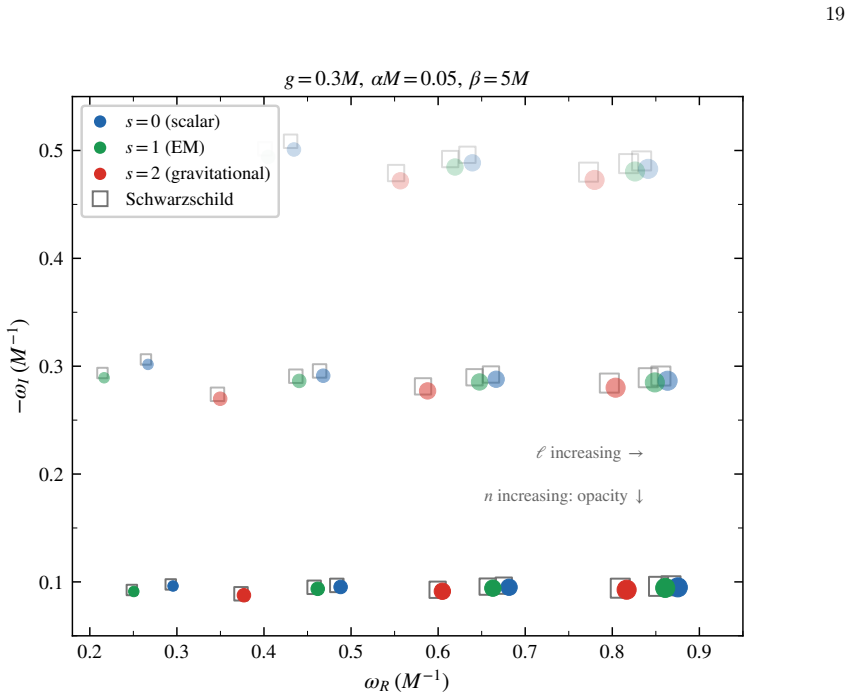
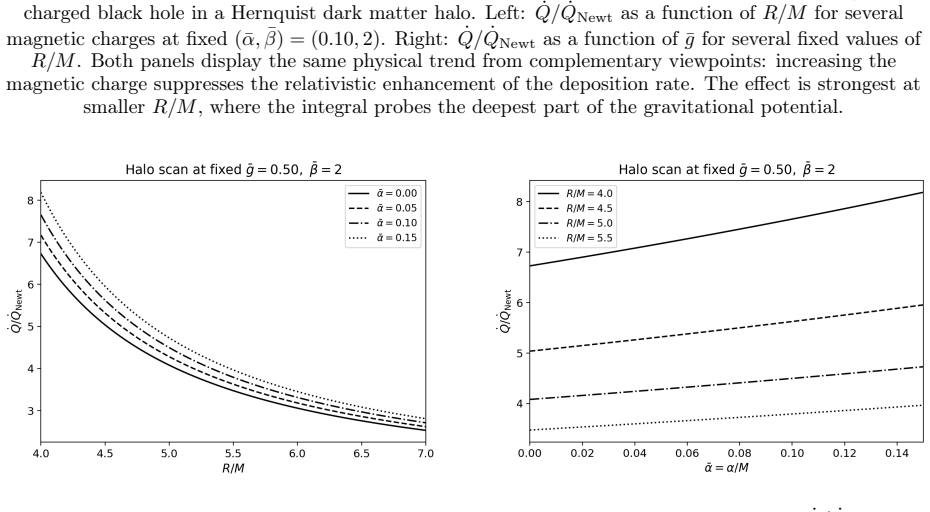
The background metric combines nonlinear-electrodynamics magnetic charge g with Hernquist halo parameters alpha and beta, yielding quasinormal spectra in which the charge increases both real oscillation frequency and damping rate while the halo shifts the spectrum oppositely, allowing partial cancellation for suitable parameters; at fixed asymptotic mass the residual terms reduce shadow radius and weak deflection angle relative to Schwarzschild; and the annihilation efficiency is suppressed by the magnetic sector but enhanced by the halo through its effect on the lapse function.
What carries the argument
The analytic static spherically symmetric metric sourced by nonlinear electrodynamics and the Hernquist halo profile, which supplies the background for all master equations and the integrated annihilation rate.
If this is right
- Magnetic charge raises real quasinormal frequencies and slightly increases damping, while the halo shifts both quantities in the opposite direction.
- For suitable parameter choices the charge and halo effects partially cancel at the level of individual modes.
- At fixed asymptotic mass the combined corrections reduce both the shadow radius and the weak deflection angle compared with Schwarzschild.
- Neutrino-pair annihilation is suppressed by the magnetic charge but enhanced by the halo's lowering of the lapse function in the T^9 kernel.
Where Pith is reading between the lines
- Because the two effects carry different relative weights in ringdown versus annihilation, simultaneous gravitational-wave and neutrino observations could disentangle magnetic charge from halo parameters even when they partially cancel in one channel.
- The partial cancellation in quasinormal modes implies that certain charge-halo pairs could mimic Schwarzschild ringdown while still producing measurable differences in shadow size or energy deposition.
- The analytic form allows direct comparison of how the same geometry affects linear perturbations and nonlinear high-energy processes without needing full numerical evolution.
Load-bearing premise
The given metric is an exact solution of the Einstein equations with the nonlinear-electrodynamics and Hernquist sources, and the high-order WKB plus Pade resummation reproduces the true quasinormal spectrum without significant error.
What would settle it
A precise measurement of the fundamental quasinormal mode real frequency and damping time for a black hole whose mass and halo parameters are known independently would confirm or rule out the predicted opposing shifts induced by magnetic charge versus halo concentration.
Figures





read the original abstract
We investigate quasinormal modes, shadow observables, weak gravitational lensing, and neutrino--antineutrino annihilation for a static, spherically symmetric black hole that carries a nonlinear-electrodynamics magnetic charge and is embedded in a Hernquist dark-matter halo. The geometry is controlled by the black-hole mass $M$, magnetic charge $g$, and halo parameters $(\alpha,\beta)$, and provides a simple analytic setting in which compact-object and environmental deformations can be studied simultaneously. We derive the scalar, electromagnetic, and axial gravitational master equations and compute the corresponding quasinormal spectra using a high-order WKB expansion supplemented by Pade resummation. The magnetic charge raises the real oscillation frequency and slightly increases the damping rate, whereas the Hernquist halo shifts the spectrum in the opposite direction; for suitable parameters the two effects partially cancel at the level of individual modes. We then connect the eikonal spectrum with the photon sphere and shadow radius, emphasizing the distinction between comparisons performed at fixed bare mass and at fixed asymptotic mass $\mathcal{M}=M+\alpha$. At fixed asymptotic mass, the residual NED and halo-concentration terms reduce the shadow and the weak-deflection angle relative to Schwarzschild at the first nontrivial order. Finally, we formulate neutrino-pair annihilation in the same background, including the angular factor, Tolman-redshifted $T^9$ kernel, integrated deposition rate, and reduced shell profile. The magnetic sector suppresses the annihilation efficiency, while the halo sector enhances it through its lowering of the lapse. These results show that ringdown, imaging, lensing, and high-energy deposition probe the same underlying competition between near-horizon magnetic structure and extended dark-matter environment, but with different parameter weights.
Editorial analysis
A structured set of objections, weighed in public.
Referee Report
Summary. The paper investigates quasinormal modes of scalar, electromagnetic, and axial gravitational perturbations, shadow radius, weak deflection angle, and neutrino-antineutrino annihilation for a static spherically symmetric black hole carrying a nonlinear-electrodynamics magnetic charge g and embedded in a Hernquist dark-matter halo with parameters α and β. The geometry is given analytically in terms of the bare mass M together with g, α, β. Master equations are derived and spectra are computed via high-order WKB supplemented by Padé resummation; the eikonal limit is linked to the photon sphere and shadow; and the energy-deposition rate is obtained from the Tolman-redshifted T⁹ kernel including angular factors. The central claim is that magnetic and halo contributions compete, producing partial cancellations in the QNM spectrum and opposite trends in shadow/lensing versus annihilation efficiency, with all observables ultimately probing the same near-horizon versus extended-environment competition but weighted differently. Comparisons are performed both at fixed bare mass and at fixed asymptotic mass ℳ = M + α.
Significance. If the background is a consistent Einstein solution, the work supplies a compact analytic laboratory in which compact-object and environmental deformations can be varied independently and their signatures compared across ringdown, imaging, lensing, and high-energy channels. The explicit fixed-M versus fixed-ℳ distinction and the inclusion of the full angular and redshift factors in the deposition integral are concrete strengths that facilitate multi-messenger modeling of black holes in non-vacuum settings.
major comments (2)
- [Background metric and field equations] The manuscript introduces the analytic metric controlled by (M, g, α, β) as sourced by nonlinear-electrodynamics magnetic charge plus Hernquist halo density but supplies no derivation or explicit verification that the Einstein tensor equals 8π times the sum of the NED and halo stress-energy tensors. Because every subsequent master equation, WKB spectrum, photon-sphere relation, and T⁹ integral rests on this geometry being an exact solution, the absence of this check renders the claimed competition between magnetic and halo effects ungrounded.
- [Quasinormal modes] § on quasinormal modes: the high-order WKB + Padé results are presented without convergence tables, truncation-error estimates, or cross-checks against an independent method (e.g., continued-fraction or time-domain integration). Consequently the quantitative statement that the two effects “partially cancel at the level of individual modes” cannot be assessed for robustness.
minor comments (3)
- The distinction between bare mass M and asymptotic mass ℳ should be stated explicitly in the abstract and introduction rather than only in the shadow/lensing section.
- Notation for the halo parameters α and β is introduced without a brief reminder of their physical meaning (scale radius and concentration) when they first appear in the metric.
- [Neutrino energy deposition] The neutrino-deposition section would benefit from a short paragraph comparing the obtained efficiency trends with existing results for Schwarzschild or Reissner–Nordström backgrounds.
Simulated Author's Rebuttal
We thank the referee for the careful reading and constructive comments on our manuscript. The two major points raised are addressed point-by-point below. We have revised the manuscript to incorporate the requested verifications and robustness checks.
read point-by-point responses
-
Referee: [Background metric and field equations] The manuscript introduces the analytic metric controlled by (M, g, α, β) as sourced by nonlinear-electrodynamics magnetic charge plus Hernquist halo density but supplies no derivation or explicit verification that the Einstein tensor equals 8π times the sum of the NED and halo stress-energy tensors. Because every subsequent master equation, WKB spectrum, photon-sphere relation, and T⁹ integral rests on this geometry being an exact solution, the absence of this check renders the claimed competition between magnetic and halo effects ungrounded.
Authors: We agree that explicit verification of the field equations is required to ground the analysis. In the revised manuscript we have inserted a dedicated subsection (now Section II.B) that computes all non-vanishing components of the Einstein tensor for the given line element and demonstrates that they are identically equal to 8π times the sum of the nonlinear-electrodynamics stress-energy tensor (with magnetic charge g) and the Hernquist halo energy-momentum tensor. This confirms that the metric is an exact solution and thereby substantiates the reported competition between the two sectors. revision: yes
-
Referee: [Quasinormal modes] § on quasinormal modes: the high-order WKB + Padé results are presented without convergence tables, truncation-error estimates, or cross-checks against an independent method (e.g., continued-fraction or time-domain integration). Consequently the quantitative statement that the two effects “partially cancel at the level of individual modes” cannot be assessed for robustness.
Authors: We accept that additional numerical validation is necessary. The revised version now contains (i) tables documenting the convergence of the WKB frequencies with increasing order and the stabilization under Padé resummation, (ii) explicit truncation-error estimates, and (iii) a cross-check of a representative subset of modes against the continued-fraction method, which agrees with the WKB-Padé values to within the quoted precision. These additions allow the partial-cancellation statement to be assessed quantitatively. revision: yes
Circularity Check
No significant circularity detected
full rationale
The paper treats the metric parameters M, g, α, β as independent free inputs and computes QNMs via high-order WKB with Pade resummation, photon-sphere/shadow relations, weak deflection angles, and neutrino deposition integrals using standard techniques applied to the given background. No reported quantity is defined in terms of a fitted output from the same data, nor does any central result reduce by construction to a self-citation or ansatz imported from the authors' prior work. The derivation chain remains self-contained with independent calculational content once the metric is adopted.
Axiom & Free-Parameter Ledger
free parameters (4)
- M
- g
- alpha
- beta
axioms (2)
- domain assumption The given line element is an exact solution of the Einstein equations sourced by nonlinear electrodynamics and Hernquist dark matter.
- domain assumption High-order WKB expansion with Pade resummation yields accurate quasinormal frequencies and damping rates for the derived master equations.
invented entities (2)
-
Nonlinear-electrodynamics magnetic charge g
no independent evidence
-
Hernquist dark matter halo with parameters alpha, beta
no independent evidence
Reference graph
Works this paper leans on
-
[1]
Redshifted temperature and integrated rate The local temperature is not independent of position. For a static spacetime the Tolman law gives T(r) p f(r) =T(R) p f(R).(87) This shows that the deeper the emission region lies in the gravitational potential, the hotter the local neutrino bath appears to a static observer. Since the annihilation rate scales as...
-
[2]
Probing a NED inspired Magnetically Charged Black Hole in the Hernquist Dark Matter Halo,
S. K. Jha, “Probing a NED inspired Magnetically Charged Black Hole in the Hernquist Dark Matter Halo,” arXiv:2512.24753 [gr-qc] (2025)
-
[3]
An Analytical Model for Spherical Galaxies and Bulges,
L. Hernquist, “An Analytical Model for Spherical Galaxies and Bulges,” Astrophys. J.356, 359 (1990)
1990
-
[4]
B. P. Abbottet al.[LIGO Scientific and Virgo], “Observation of Gravitational Waves from a Binary Black Hole Merger,” Phys. Rev. Lett.116, no.6, 061102 (2016) doi:10.1103/PhysRevLett.116.061102 [arXiv:1602.03837 [gr- qc]]
-
[5]
R. Abbottet al.[LIGO Scientific and Virgo], “Tests of general relativity with binary black holes from the second LIGO-Virgo gravitational-wave transient catalog,” Phys. Rev. D103, no.12, 122002 (2021) doi:10.1103/PhysRevD.103.122002 [arXiv:2010.14529 [gr-qc]]
-
[6]
K. Akiyamaet al.[Event Horizon Telescope], “First M87 Event Horizon Telescope Results. I. The Shadow of the Supermassive Black Hole,” Astrophys. J. Lett.875, L1 (2019) doi:10.3847/2041-8213/ab0ec7 [arXiv:1906.11238 [astro-ph.GA]]
-
[7]
2022, ApJL, 930, L12, doi: 10.3847/2041-8213/ac6674
K. Akiyamaet al.[Event Horizon Telescope], “First Sagittarius A* Event Horizon Telescope Results. I. The Shadow of the Supermassive Black Hole in the Center of the Milky Way,” Astrophys. J. Lett.930, no.2, L12 (2022) doi:10.3847/2041-8213/ac6674 [arXiv:2311.08680 [astro-ph.HE]]
-
[8]
Shadow of rotating regular black holes,
A. Abdujabbarov, M. Amir, B. Ahmedov and S. G. Ghosh, “Shadow of rotating regular black holes,” Phys. Rev. D93, no.10, 104004 (2016) [arXiv:1604.03809 [gr-qc]]
-
[9]
Shadow of rotating non-Kerr black hole,
F. Atamurotov, A. Abdujabbarov and B. Ahmedov, “Shadow of rotating non-Kerr black hole,” Phys. Rev. D88, no.6, 064004 (2013)
2013
-
[10]
F. Atamurotov and B. Ahmedov, “Optical properties of black hole in the presence of plasma: shadow,” Phys. Rev. D92, 084005 (2015) [arXiv:1507.08131 [gr-qc]]
-
[11]
Charged Particle Motion Around Rotating Black Hole in Braneworld Im- mersed in Magnetic Field,
A. Abdujabbarov and B. Ahmedov, “Charged Particle Motion Around Rotating Black Hole in Braneworld Im- mersed in Magnetic Field,” Phys. Rev. D81, 044022 (2010) [arXiv:0905.2730 [gr-qc]]
-
[12]
S. Vagnozzi, R. Roy, Y. D. Tsai, L. Visinelli, M. Afrin, A. Allahyari, P. Bambhaniya, D. Dey, S. G. Ghosh and P. S. Joshi,et al.“Horizon-scale tests of gravity theories and fundamental physics from the Event Horizon Telescope image of Sagittarius A,” Class. Quant. Grav.40, no.16, 165007 (2023) [arXiv:2205.07787 [gr-qc]]
- [13]
-
[14]
Hunting for extra dimensions in the shadow of M87*,
S. Vagnozzi and L. Visinelli, “Hunting for extra dimensions in the shadow of M87*,” Phys. Rev. D100, no.2, 024020 (2019) [arXiv:1905.12421 [gr-qc]]
-
[15]
A. Allahyari, M. Khodadi, S. Vagnozzi and D. F. Mota, “Magnetically charged black holes from non-linear electrodynamics and the Event Horizon Telescope,” JCAP02, 003 (2020) [arXiv:1912.08231 [gr-qc]]
-
[16]
Shadow signatures and energy accumulation in Lorentzian-Euclidean black holes
E. Battista, S. Capozziello and C. Y. Chen, “Shadow signatures and energy accumulation in Lorentzian-Euclidean black holes,” [arXiv:2601.10806 [gr-qc]]
work page internal anchor Pith review Pith/arXiv arXiv
-
[17]
Z. L. Wang and E. Battista, “Dynamical features and shadows of quantum Schwarzschild black hole in effective field theories of gravity,” Eur. Phys. J. C85, no.3, 304 (2025) [arXiv:2501.14516 [gr-qc]]
-
[18]
Rotating black holes in4DEinstein-Gauss-Bonnet gravity and its shadow,
R. Kumar and S. G. Ghosh, “Rotating black holes in4DEinstein-Gauss-Bonnet gravity and its shadow,” JCAP 07, 053 (2020) [arXiv:2003.08927 [gr-qc]]
-
[19]
Shadows of rotating five-dimensional charged EMCS black holes,
M. Amir, B. P. Singh and S. G. Ghosh, “Shadows of rotating five-dimensional charged EMCS black holes,” Eur. Phys. J. C78, no.5, 399 (2018) [arXiv:1707.09521 [gr-qc]]
- [21]
-
[22]
X. M. Kuang and A. Övgün, “Strong gravitational lensing and shadow constraint from M87* of slowly rotating Kerr-like black hole,” Annals Phys.447, 169147 (2022) [arXiv:2205.11003 [gr-qc]]
-
[23]
X. M. Kuang, Z. Y. Tang, B. Wang and A. Wang, “Constraining a modified gravity theory in strong gravitational lensing and black hole shadow observations,” Phys. Rev. D106, no.6, 064012 (2022) [arXiv:2206.05878 [gr-qc]]
-
[24]
Gravitational black hole shadow spectroscopy,
Pantig, Reggie C. and Övgün, Ali, “Gravitational black hole shadow spectroscopy,” Phys. Rev. D112, no.12, 124072 (2025) doi:10.1103/jmpd-8tn8 [arXiv:2509.05594 [gr-qc]]
-
[25]
Perturbation theory for gravitational shadows in static spherically sym- metric spacetimes,
Kobialko, Kirill and Gal’tsov, Dmitri, “Perturbation theory for gravitational shadows in static spherically sym- metric spacetimes,” Phys. Rev. D111, no.4, 044071 (2025) doi:10.1103/PhysRevD.111.044071 [arXiv:2410.16127 [gr-qc]]. 27
-
[26]
K. D. Kokkotas and B. G. Schmidt, “Quasinormal modes of stars and black holes,” Living Rev. Rel.2, 2 (1999) doi:10.12942/lrr-1999-2 [arXiv:gr-qc/9909058 [gr-qc]]
-
[27]
E. Berti, V. Cardoso and A. O. Starinets, “Quasinormal modes of black holes and black branes,” Class. Quant. Grav.26, 163001 (2009) doi:10.1088/0264-9381/26/16/163001 [arXiv:0905.2975 [gr-qc]]
-
[28]
Quasinormal modes of black holes: from astrophysics to string theory
R. A. Konoplya and A. Zhidenko, “Quasinormal modes of black holes: From astrophysics to string theory,” Rev. Mod. Phys.83, 793-836 (2011) doi:10.1103/RevModPhys.83.793 [arXiv:1102.4014 [gr-qc]]
-
[29]
O. Dreyer, B. J. Kelly, B. Krishnan, L. S. Finn, D. Garrison and R. Lopez-Aleman, Class. Quant. Grav.21, 787-804 (2004) doi:10.1088/0264-9381/21/4/003 [arXiv:gr-qc/0309007 [gr-qc]]
-
[30]
Black hole spectroscopy: from theory to experiment
E. Berti, V. Cardoso, G. Carullo, J. Abedi, N. Afshordi, S. Albanesi, V. Baibhav, S. Bhagwat, J. L. Blázquez- Salcedo and B. Bonga,et al.“Black hole spectroscopy: from theory to experiment,” [arXiv:2505.23895 [gr-qc]]
work page internal anchor Pith review arXiv
-
[31]
V. Cardoso, A. S. Miranda, E. Berti, H. Witek and V. T. Zanchin, “Geodesic stability, Lyapunov exponents and quasinormal modes,” Phys. Rev. D79, no.6, 064016 (2009) doi:10.1103/PhysRevD.79.064016 [arXiv:0812.1806 [hep-th]]
-
[32]
Blackholesingalacticcenters: Quasinormalringing, grey-bodyfactorsandUnruhtemperature,
R.A.Konoplya, “Blackholesingalacticcenters: Quasinormalringing, grey-bodyfactorsandUnruhtemperature,” Phys. Lett. B823, 136734 (2021) doi:10.1016/j.physletb.2021.136734 [arXiv:2109.01640 [gr-qc]]
-
[33]
Quasinormal modes of black holes embedded in halos of matter,
L. Pezzella, K. Destounis, A. Maselli and V. Cardoso, “Quasinormal modes of black holes embedded in halos of matter,” Phys. Rev. D111, no.6, 064026 (2025) doi:10.1103/PhysRevD.111.064026 [arXiv:2412.18651 [gr-qc]]
-
[34]
S. K. Jha, “Thermodynamics, Weak Gravitational Lensing, and Parameter Estimation of a Schwarzschild Black Hole Immersed in Hernquist Dark Matter Halo,” JCAP06, 033 (2025), arXiv:2503.19938 [gr-qc]
-
[35]
Shadow and quasi-normal modes of Schwarzschild–Hernquist black hole,
X. H. Feng and G. Y. Zhang, “Shadow and quasi-normal modes of Schwarzschild–Hernquist black hole,” Eur. Phys. J. C86, no.1, 36 (2026) doi:10.1140/epjc/s10052-026-15293-z [arXiv:2509.04001 [gr-qc]]
-
[36]
E. Ayon-Beato and A. Garcia, “Regular black hole in general relativity coupled to nonlinear electrodynamics,” Phys. Rev. Lett.80, 5056-5059 (1998) doi:10.1103/PhysRevLett.80.5056 [arXiv:gr-qc/9911046 [gr-qc]]
-
[37]
Regular magnetic black holes and monopoles from nonlinear electro- dynamics,
K. A. Bronnikov, “Regular magnetic black holes and monopoles from nonlinear electrodynamics,” Phys. Rev. D 63, 044005 (2001) doi:10.1103/PhysRevD.63.044005 [arXiv:gr-qc/0006014 [gr-qc]]
-
[38]
Bronnikov,Regular black holes sourced by nonlinear electrodynamics,2211.00743
K. A. Bronnikov, “Regular black holes sourced by nonlinear electrodynamics,” [arXiv:2211.00743 [gr-qc]]
-
[39]
J. D. Salmonson and J. R. Wilson, “General relativistic augmentation of neutrino pair annihilation energy de- position near neutron stars,” Astrophys. J.517, 859-865 (1999) doi:10.1086/307232 [arXiv:astro-ph/9908017 [astro-ph]]
-
[40]
K. Asano and T. Fukuyama, “Relativistic effects on neutrino pair annihilation above a Kerr black hole with the accretion disk,” Astrophys. J.546, 1019-1026 (2001) doi:10.1086/318312 [arXiv:astro-ph/0009453 [astro-ph]]
-
[41]
Neutrino pair annihilation in the gravitation of gamma-ray burst sources,
K. Asano and T. Fukuyama, “Neutrino pair annihilation in the gravitation of gamma-ray burst sources,” Astro- phys. J.531, 949-955 (2000) doi:10.1086/308513 [arXiv:astro-ph/0002196 [astro-ph]]
-
[42]
G. Lambiase and L. Mastrototaro, “Effects of modified theories of gravity on neutrino pair annihilation energy de- position near neutron stars,” Astrophys. J.904, no.1, 19 (2020) doi:10.3847/1538-4357/abba2c [arXiv:2009.08722 [astro-ph.HE]]
-
[43]
Neutrino pair annihilation (ν¯ν→e−e+) in the presence of quintessence surrounding a black hole,
G. Lambiase and L. Mastrototaro, “Neutrino pair annihilation (ν¯ν→e−e+) in the presence of quintessence surrounding a black hole,” Eur. Phys. J. C81, no.10, 932 (2021) doi:10.1140/epjc/s10052-021-09732-2 [arXiv:2012.09100 [astro-ph.HE]]
-
[44]
Neutrino pair annihilation above black-hole accretion disks in modified grav- ity,
G. Lambiase and L. Mastrototaro, “Neutrino pair annihilation above black-hole accretion disks in modified grav- ity,” Astrophys. J.934, 12 (2022). doi:10.3847/1538-4357/ac7140 [arXiv:2205.09785 [hep-ph]]
-
[45]
Gravitational lensing effects on neutrino oscillations around static black hole in effective quantum gravity,
S. Mannobova, B. Narzilloev, F. Atamurotov, A. Abdujabbarov, I. Hussain and B. Ahmedov, “Gravitational lensing effects on neutrino oscillations around static black hole in effective quantum gravity,” Phys. Dark Univ. 51, 102194 (2026)
2026
-
[46]
Gravitationallensingofneutrinos in the scalar-tensor-vector gravity,
O.Kholmuminov, B.Narzilloev, I.Hussain, A.AbdujabbarovandB.Ahmedov, “Gravitationallensingofneutrinos in the scalar-tensor-vector gravity,” Nucl. Phys. B1025, 117371 (2026) doi:10.1016/j.nuclphysb.2026.117371
-
[47]
M. Alloqulov, H. Chakrabarty, D. Malafarina, B. Ahmedov and A. Abdujabbarov, “Gravitational lensing of neutrinos in parametrized black hole spacetimes,” JCAP02, 070 (2025) [arXiv:2408.12916 [gr-qc]]
-
[48]
R. C. Pantig, A. Övgün and Á. Rincón, “Charged black holes in KR gravity: Weak deflection an- gle, shadow cast, quasinormal modes and neutrino annihilation,” Phys. Dark Univ.49, 102029 (2025) doi:10.1016/j.dark.2025.102029 [arXiv:2505.17947 [gr-qc]]
-
[49]
V. Cardoso, K. Destounis, F. Duque, R. P. Macedo and A. Maselli, “Black holes in galaxies: Environ- mental impact on gravitational-wave generation and propagation,” Phys. Rev. D105, no.6, L061501 (2022) doi:10.1103/PhysRevD.105.L061501 [arXiv:2109.00005 [gr-qc]]
-
[50]
Chandrasekhar,The Mathematical Theory of Black Holes(Oxford University Press, 1983)
S. Chandrasekhar,The Mathematical Theory of Black Holes(Oxford University Press, 1983)
1983
-
[51]
T. Regge and J. A. Wheeler, “Stability of a Schwarzschild singularity,” Phys. Rev.108, 1063-1069 (1957) doi:10.1103/PhysRev.108.1063
-
[52]
S. Iyer and C. M. Will, “Black Hole Normal Modes: A WKB Approach. 1. Foundations and Applica- tion of a Higher Order WKB Analysis of Potential Barrier Scattering,” Phys. Rev. D35, 3621 (1987) doi:10.1103/PhysRevD.35.3621
-
[53]
Quasinormal behavior of the d-dimensional Schwarzschild black hole and higher order WKB approach,
R. A. Konoplya, “Quasinormal behavior of the d-dimensional Schwarzschild black hole and higher order WKB approach,” Phys. Rev. D68, 024018 (2003) doi:10.1103/PhysRevD.68.024018 [arXiv:gr-qc/0303052 [gr-qc]]. 28
-
[54]
An Efficient Higher-Order WKB Code for Quasinormal Modes and Greybody Factors,
J. Matyjasek, R. A. Konoplya and A. Zhidenko, “An Efficient Higher-Order WKB Code for Quasinormal Modes and Greybody Factors,” Int. J. Grav. Theor. Phys.2, no.1, 5 (2026) doi:10.53941/ijgtp.2026.100005 [arXiv:2603.12466 [gr-qc]]
-
[55]
Photon Spheres and Sonic Horizons in Black Holes from Supergravity and Other Theories,
M. Cvetic, G. W. Gibbons and C. N. Pope, “Photon Spheres and Sonic Horizons in Black Holes from Supergravity and Other Theories,” Phys. Rev. D94, no.10, 106005 (2016) doi:10.1103/PhysRevD.94.106005 [arXiv:1608.02202 [gr-qc]]
-
[56]
A. A. Araújo Filho, N. Heidari and A. Övgün, “Geodesics, accretion disk, gravitational lensing, time delay, and effects on neutrinos induced by a non-commutative black hole,” JCAP06, 062 (2025) doi:10.1088/1475- 7516/2025/06/062 [arXiv:2412.08369 [gr-qc]]
-
[57]
The shadow and gamma-ray bursts of a Schwarzschild black hole in asymptotic safety,
Y. Shi and H. Cheng, “The shadow and gamma-ray bursts of a Schwarzschild black hole in asymptotic safety,” Commun. Theor. Phys.77, no.2, 025401 (2025) doi:10.1088/1572-9494/ad7e95 [arXiv:2304.01154 [gr-qc]]
-
[58]
M. Khodadi, G. Lambiase and L. Mastrototaro, “Spontaneous Lorentz symmetry breaking effects on GRBs jets arising from neutrino pair annihilation process near a black hole,” Eur. Phys. J. C83, no.3, 239 (2023) doi:10.1140/epjc/s10052-023-11369-2 [arXiv:2302.14200 [hep-ph]]
-
[59]
Energy extraction via magnetic reconnection in Lorentz breaking Kerr–Sen and Kiselev black holes,
A. Carleo, G. Lambiase and L. Mastrototaro, “Energy extraction via magnetic reconnection in Lorentz breaking Kerr–Sen and Kiselev black holes,” Eur. Phys. J. C82, no.9, 776 (2022) doi:10.1140/epjc/s10052-022-10751-w [arXiv:2206.12988 [gr-qc]]
-
[60]
Applications of the Gauss-Bonnet theorem to gravitational lensing,
G. W. Gibbons and M. C. Werner, “Applications of the Gauss-Bonnet theorem to gravitational lensing,” Class. Quant. Grav.25, 235009 (2008) [arXiv:0807.0854 [gr-qc]]
-
[61]
Gravitational bending angle of light for finite distance and the Gauss-Bonnet theorem,
A. Ishihara, Y. Suzuki, T. Ono, T. Kitamura and H. Asada, “Gravitational bending angle of light for finite distance and the Gauss-Bonnet theorem,” Phys. Rev. D94, no.8, 084015 (2016) [arXiv:1604.08308 [gr-qc]]
-
[62]
Gravitational deflection of light and shadow cast by rotating Kalb-Ramond black holes,
R. Kumar, S. G. Ghosh and A. Wang, “Gravitational deflection of light and shadow cast by rotating Kalb-Ramond black holes,” Phys. Rev. D101, no.10, 104001 (2020) [arXiv:2001.00460 [gr-qc]]
-
[63]
G. Crisnejo and E. Gallo, “Weak lensing in a plasma medium and gravitational deflection of massive particles using the Gauss-Bonnet theorem. A unified treatment,” Phys. Rev. D97, no.12, 124016 (2018) [arXiv:1804.05473 [gr-qc]]
-
[64]
Circular Orbit of a Particle and Weak Gravitational Lensing,
Z. Li, G. Zhang and A. Övgün, “Circular Orbit of a Particle and Weak Gravitational Lensing,” Phys. Rev. D 101, no.12, 124058 (2020) [arXiv:2006.13047 [gr-qc]]
-
[65]
H. Arakida, “Light deflection and Gauss–Bonnet theorem: definition of total deflection angle and its applications,” Gen. Rel. Grav.50, no.5, 48 (2018) [arXiv:1708.04011 [gr-qc]]
-
[66]
Pantig, Reggie C. and Övgün, Ali, “Reference-renormalized curvature-primitive Gauss-Bonnet formalism for finite-distance weak gravitational lensing in static spherical spacetimes,” Phys. Rev. Dna, no.?, page (2026) doi:10.1103/8w6b-fnzb [arXiv:2604.16807 [gr-qc]]
work page internal anchor Pith review Pith/arXiv arXiv doi:10.1103/8w6b-fnzb 2026
-
[67]
Laser Interferometer Space Antenna
P. Amaro-Seoaneet al.[LISA], “Laser Interferometer Space Antenna,” [arXiv:1702.00786 [astro-ph.IM]]. 29 TABLE V: Effect of the Hernquist dark-matter halo on quasinormal-mode frequencies. The parameters are fixed tog= 0.4M,β= 5M, andn= 0, while the halo parameterαMvaries from 0 to 0.20. Units are M= 1. The last column shows the signed relative deviation∆ωR...
work page internal anchor Pith review arXiv 1962
discussion (0)
Sign in with ORCID, Apple, or X to comment. Anyone can read and Pith papers without signing in.