Recognition: unknown
Mechanisms of high energy polarized photoproduction of π⁻Delta⁺⁺
Pith reviewed 2026-05-08 11:03 UTC · model grok-4.3
The pith
A Regge model fit to polarized photoproduction data extracts a πNΔ coupling constant consistent with the Δ(1232) decay width and provides first values for three other vertices.
A machine-rendered reading of the paper's core claim, the machinery that carries it, and where it could break.
Core claim
The Regge amplitude model incorporating π, ρ, b₁, and a₂ trajectory exchanges, when fit simultaneously to GlueX SDME data and SLAC differential cross sections, confirms the dominance of pion exchange at small momentum transfer and yields an extracted πNΔ coupling constant consistent with the value obtained from the Δ(1232) decay width, while supplying the first extractions of the ρNΔ, b₁NΔ, and a₂NΔ coupling constants.
What carries the argument
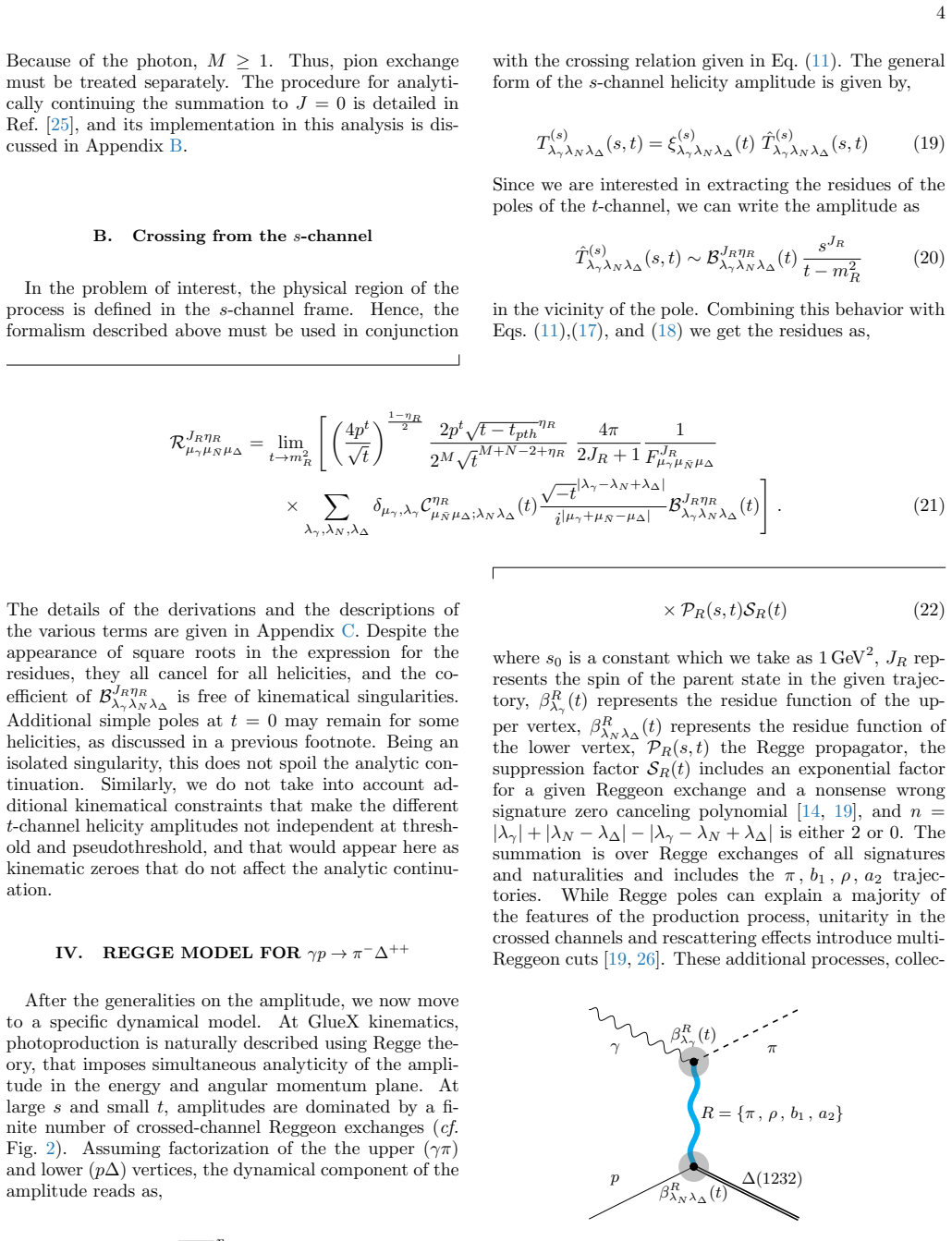
The Regge amplitude model with π, ρ, b₁, and a₂ trajectory exchanges, together with analytic continuation from the s-channel to the t-channel that removes kinematical singularities and isolates dynamical residues at the meson poles.
Load-bearing premise
The Regge amplitude model with only the four listed trajectories plus the analytic continuation procedure accurately captures the full dynamics without significant missing contributions or unhandled singularities in the kinematic range studied.
What would settle it
An independent extraction of the πNΔ coupling constant from a different reaction or decay process that deviates substantially from the value obtained here, or new high-energy SDME data that cannot be described by the four-trajectory model.
Figures




read the original abstract
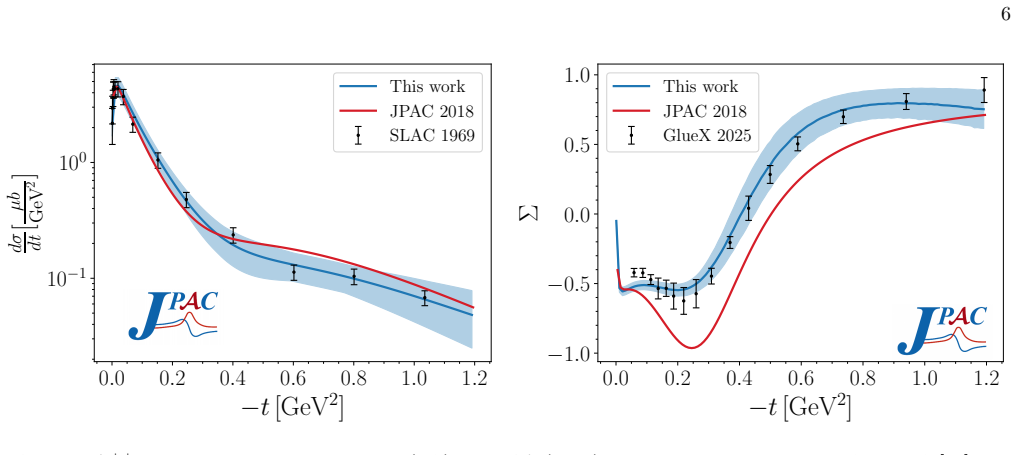
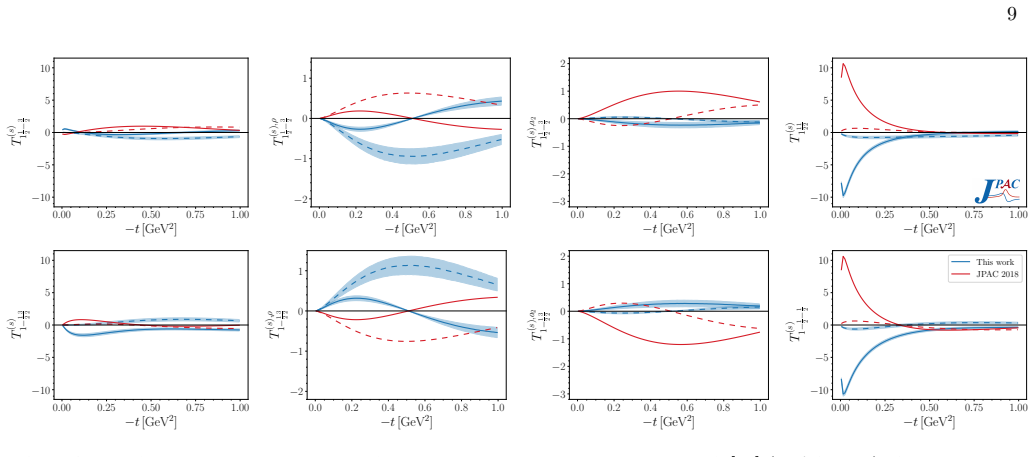
We present an amplitude analysis of high-energy polarized photoproduction of $\pi^-\Delta^{++}$ within a Regge exchange framework. A Regge amplitude model incorporating $\pi$, $\rho$, $b_1$, and $a_2$ trajectory exchanges is fit simultaneously to spin density matrix elements measured by the GlueX experiment at photon energies of $E_\gamma = 8.2$--$8.8$ GeV and differential cross section data from SLAC. By including SDME data, the fit constrains not only the magnitudes but also the relative phases of the helicity amplitudes. The results confirm the dominance of pion exchange at small momentum transfer, while natural parity exchanges become significant at larger $t$. We analytically continue the $s$-channel amplitude to the $t$-channel, taking care of the kinematical singularities, and isolate the dynamical residues at the meson poles. The extracted $\pi N\Delta$ coupling constant is found to be consistent with the value obtained from the decay width of the $\Delta(1232)$. For the $\rho N\Delta$, $b_1 N\Delta$, and $a_2 N\Delta$ vertices, first extractions of the relevant coupling constants are provided.
Editorial analysis
A structured set of objections, weighed in public.
Referee Report
Summary. The manuscript presents an amplitude analysis of high-energy polarized photoproduction of π⁻Δ⁺⁺ within a Regge exchange framework. A model incorporating π, ρ, b₁, and a₂ trajectory exchanges is simultaneously fit to GlueX spin density matrix elements at E_γ = 8.2–8.8 GeV and SLAC differential cross section data. The s-channel amplitude is analytically continued to the t-channel poles after removal of kinematical singularities to isolate dynamical residues. The extracted πNΔ coupling is reported consistent with the Δ(1232) decay width, while first extractions are provided for the ρNΔ, b₁NΔ, and a₂NΔ couplings.
Significance. If the results hold, the work supplies the first extractions of the ρNΔ, b₁NΔ, and a₂NΔ coupling constants in this kinematic regime, which can inform Regge phenomenology and photoproduction modeling. The external cross-check of the πNΔ coupling against the independent decay-width value provides useful grounding and reduces circularity for that parameter. The simultaneous use of SDME data to constrain both magnitudes and relative phases of helicity amplitudes is a methodological strength that strengthens the phase information in the extracted residues.
major comments (2)
- [Abstract] Abstract and results sections: the description of the fit to GlueX SDMEs and SLAC cross sections supplies no χ² per degree of freedom, goodness-of-fit metrics, or uncertainties on the four extracted coupling constants. Without these quantitative indicators it is not possible to assess whether the four-trajectory model adequately describes the data or whether the extracted residues are robust.
- [Analytic continuation] Analytic continuation procedure: the manuscript states that kinematical singularities are removed when continuing the s-channel amplitude to the t-channel poles, but provides no explicit demonstration, residual plots, or stability tests confirming that no spurious singularities remain in the kinematic range of the data. This step is load-bearing for the physical interpretation of the isolated dynamical residues at the meson poles.
minor comments (1)
- [Abstract] The abstract and introduction would benefit from a brief statement of the kinematic range in t covered by the data sets to clarify the domain of validity of the extracted couplings.
Simulated Author's Rebuttal
We thank the referee for the careful review and constructive comments. We address each major point below and have revised the manuscript to incorporate quantitative fit metrics and expanded details on the analytic continuation.
read point-by-point responses
-
Referee: [Abstract] Abstract and results sections: the description of the fit to GlueX SDMEs and SLAC cross sections supplies no χ² per degree of freedom, goodness-of-fit metrics, or uncertainties on the four extracted coupling constants. Without these quantitative indicators it is not possible to assess whether the four-trajectory model adequately describes the data or whether the extracted residues are robust.
Authors: We agree that the absence of χ²/dof and parameter uncertainties limits the ability to evaluate fit quality and robustness. In the revised manuscript we have added the χ² per degree of freedom for the simultaneous fit to the GlueX SDME and SLAC cross-section data, together with uncertainties on the four extracted couplings obtained from the covariance matrix. These quantitative indicators are now reported in the results section and abstract. revision: yes
-
Referee: [Analytic continuation] Analytic continuation procedure: the manuscript states that kinematical singularities are removed when continuing the s-channel amplitude to the t-channel poles, but provides no explicit demonstration, residual plots, or stability tests confirming that no spurious singularities remain in the kinematic range of the data. This step is load-bearing for the physical interpretation of the isolated dynamical residues at the meson poles.
Authors: We acknowledge that the original text provided insufficient explicit verification of the singularity removal. The revised manuscript now includes the explicit analytic expressions used to cancel kinematical singularities, a description of the continuation path, and stability tests performed by varying the continuation parameters. Residual plots demonstrating the absence of spurious singularities in the relevant t range have been added to a new appendix. revision: yes
Circularity Check
No significant circularity in Regge fit and residue extraction
full rationale
The paper fits a four-trajectory Regge model to independent GlueX SDME and SLAC cross-section data, then analytically continues the fitted s-channel amplitudes to extract t-channel residues at the meson poles. The πNΔ coupling is cross-checked against the external Δ(1232) decay width, while the remaining couplings are reported as new extractions from the same data-driven fit. No self-definitional loops, load-bearing self-citations, or reductions of claimed results to fitted inputs by construction appear in the abstract or described procedure; the derivation chain remains anchored to external measurements and standard analytic continuation.
Axiom & Free-Parameter Ledger
free parameters (5)
- πNΔ coupling constant
- ρNΔ coupling constant
- b1NΔ coupling constant
- a2NΔ coupling constant
- Regge trajectory parameters and residues
axioms (3)
- domain assumption Regge pole exchanges with the listed trajectories dominate the amplitude in the studied kinematic range
- domain assumption Kinematical singularities are removed without residual effects during analytic continuation from s to t channel
- ad hoc to paper Only π, ρ, b1, and a2 exchanges are needed; other contributions are negligible
Reference graph
Works this paper leans on
-
[1]
This feature of the SDMEs and the information present in there is encoded in the √−t |λN −λ∆| behavior of the half-angle factor in the amplitude. Continuing to the polarised SDMEs, the diagonal el- ements of theρ 1 add up to the BSA shown in Fig. 3. The interpretation of the BSA is straight forward in the reflectivity basis. Using the definition of theρ 1...
-
[2]
At large values ofs, this symmetry is realized by the production z x y γ p π+ ϕ θ ⃗ ϵ′ Φ FIG
Reflectivity and SDMEs The helicity states possess a symmetry under reflection about the plane containing their momenta [48]. At large values ofs, this symmetry is realized by the production z x y γ p π+ ϕ θ ⃗ ϵ′ Φ FIG. 6: The GJ frame of reference. Herepstands for the target proton, and⃗ ϵ′ the polarization vector of the photon. The direction of the 3-mo...
2018
-
[3]
N. Brambilla, S. Eidelman, C. Hanhart, A. Nefediev, C.- P. Shen, C. E. Thomas, A. Vairo, and C.-Z. Yuan, Phys. Rept.873, 1 (2020), arXiv:1907.07583 [hep-ex]
-
[4]
Mezzadri and S
G. Mezzadri and S. Spataro, Rev. Phys.8, 100070 (2022)
2022
- [5]
-
[6]
N. H¨ usken, E. S. Norella, and I. Polyakov, Mod. Phys. Lett. A40, 2530002 (2025), arXiv:2410.06923 [hep-ph]
- [7]
-
[8]
Navaset al.(Particle Data Group), Phys
S. Navaset al.(Particle Data Group), Phys. Rev. D110, 030001 (2024)
2024
-
[9]
Duggeret al.(GlueX), arXiv:1210.4508 [hep-ex] (2012)
M. Duggeret al.(GlueX), arXiv:1210.4508 [hep-ex] (2012)
-
[10]
F. Afzalet al.(GlueX), Phys. Rev. Lett.133, 261903 (2024), arXiv:2407.03316 [nucl-ex]
-
[11]
D. Winney and A. P. Szczepaniak, arXiv:2512.21805 19 [hep-ph] (2025)
-
[12]
I. M. Barbour and W. Malone, Nucl. Phys. B82, 477 (1974)
1974
-
[13]
R. B. Clark and E. Ugaz, Phys. Rev. D11, 671 (1975)
1975
-
[14]
Gotsman, Phys
E. Gotsman, Phys. Rev.186, 1543 (1969)
1969
-
[15]
B.-G. Yu and K.-J. Kong, Phys. Lett. B769, 262 (2017), [Erratum: Phys.Lett.B 772, 877–877 (2017)], arXiv:1611.09629 [hep-ph]
- [16]
-
[17]
F. Afzalet al.(GlueX), Phys. Lett. B863, 139368 (2025), arXiv:2406.12829 [nucl-ex]
-
[18]
Boyarski, R
A. Boyarski, R. E. Diebold, S. D. Ecklund, G. E. Fischer, Y. Murata, B. Richter, and W. S. C. Williams, Phys. Rev. Lett.22, 148 (1969)
1969
-
[19]
T. L. Trueman and G. C. Wick, Annals Phys.26, 322 (1964)
1964
-
[20]
A. D. Martin and T. D. Spearman,Elementary Parti- cle Theory(North-Holland Publishing Co., Amsterdam, 1970)
1970
-
[21]
P. D. B. Collins, Phys. Rept.1, 103 (1971)
1971
-
[22]
Hara, Phys
Y. Hara, Phys. Rev.136, B507 (1964)
1964
-
[23]
L.-L. C. Wang, Phys. Rev.142, 1187 (1966)
1966
-
[24]
Cohen-Tannoudji, A
G. Cohen-Tannoudji, A. Morel, and H. Navelet, Annals Phys.46, 239 (1968)
1968
-
[25]
J. D. Jackson and G. E. Hite, Phys. Rev.169, 1248 (1968)
1968
-
[26]
A. Pilloni, J. Nys, M. Mikhasenko, M. Albaladejo, C. Fern´ andez-Ram´ ırez, A. Jackura, V. Mathieu, N. Sher- rill, T. Skwarnicki, and A. P. Szczepaniak (JPAC), Eur. Phys. J. C78, 727 (2018), arXiv:1805.02113 [hep-ph]
-
[27]
G. Montanaet al.(JPAC), Phys. Rev. D110, 114012 (2024), arXiv:2407.19577 [hep-ph]
-
[28]
A. C. Irving and R. P. Worden, Phys. Rept.34, 117 (1977)
1977
-
[29]
P. K. Williams, Phys. Rev. D1, 1312 (1970)
1970
-
[30]
S.-i. Nam and B.-G. Yu, Phys. Rev. C84, 025203 (2011), arXiv:1105.1447 [hep-ph]
-
[31]
V. Mathieu, A. Pilloni, M. Albaladejo, L. Bibrzy- cki, A. Celentano, C. Fern´ andez-Ram´ ırez, and A. P. Szczepaniak (JPAC), Phys. Rev. D102, 014003 (2020), arXiv:2005.01617 [hep-ph]
- [32]
-
[33]
Henyey, Am
F. Henyey, Am. J. Phys.39, 1477 (1971)
1971
-
[34]
Gribov,Strong Interactions of Hadrons at High En- ergies : Gribov Lectures on Theoretical Physics(Oxford University Press, 2009)
V. Gribov,Strong Interactions of Hadrons at High En- ergies : Gribov Lectures on Theoretical Physics(Oxford University Press, 2009)
2009
- [35]
-
[36]
James and M
F. James and M. Roos, Comput. Phys. Commun.10, 343 (1975)
1975
-
[37]
Brun and F
R. Brun and F. Rademakers, Nucl. Instrum. Meth. A 389, 81 (1997)
1997
-
[38]
Albaladejoet al.(JPAC), Novel approaches in hadron spectroscopy, Prog
M. Albaladejoet al.(JPAC), Prog. Part. Nucl. Phys. 127, 103981 (2022), arXiv:2112.13436 [hep-ph]
-
[39]
Stichel, Zeitschrift f¨ ur Physik180, 170 (1964)
P. Stichel, Zeitschrift f¨ ur Physik180, 170 (1964)
1964
-
[40]
Ravndal, Phys
F. Ravndal, Phys. Rev. D2, 1278 (1970)
1970
-
[41]
Elster, K
C. Elster, K. Holinde, D. Schutte, and R. Machleidt, Phys. Rev. C38, 1828 (1988)
1988
-
[42]
Janssen, K
G. Janssen, K. Holinde, and J. Speth, Phys. Rev. C54, 2218 (1996)
1996
- [43]
-
[44]
N. Fettes and U. G. Meissner, Nucl. Phys. A679, 629 (2001), arXiv:hep-ph/0006299
-
[45]
Arenhovel, Nucl
H. Arenhovel, Nucl. Phys. A247, 473 (1975)
1975
-
[46]
D. Ronchen, M. Doring, F. Huang, H. Haberzettl, J. Haidenbauer, C. Hanhart, S. Krewald, U. G. Meiss- ner, and K. Nakayama, Eur. Phys. J. A49, 44 (2013), arXiv:1211.6998 [nucl-th]
-
[47]
Cohen-Tannoudji, P
G. Cohen-Tannoudji, P. Salin, and A. Morel, Nuovo Cim. A55, 412 (1968)
1968
-
[48]
B.-G. Yu and K.-J. Kong, Phys. Rev. C96, 025208 (2017), arXiv:1702.06929 [nucl-th]
-
[49]
S. Adhikariet al.(GlueX), Phys. Rev. C105, 035201 (2022), arXiv:2107.12314 [nucl-ex]
-
[50]
S. U. Chung and T. L. Trueman, Phys. Rev. D11, 633 (1975)
1975
-
[51]
V. Mathieu, M. Albaladejo, C. Fern´ andez-Ram´ ırez, A. W. Jackura, M. Mikhasenko, A. Pilloni, and A. P. Szczepaniak (JPAC), Phys. Rev. D100, 054017 (2019), arXiv:1906.04841 [hep-ph]
discussion (0)
Sign in with ORCID, Apple, or X to comment. Anyone can read and Pith papers without signing in.