Recognition: unknown
Ab initio short-range nuclear matrix elements for neutrinoless double-beta decay
Pith reviewed 2026-05-08 09:05 UTC · model grok-4.3
The pith
Ab initio calculations produce a range of short-range neutrinoless double-beta decay matrix elements for four key isotopes that lies generally below phenomenological estimates.
A machine-rendered reading of the paper's core claim, the machinery that carries it, and where it could break.
Core claim
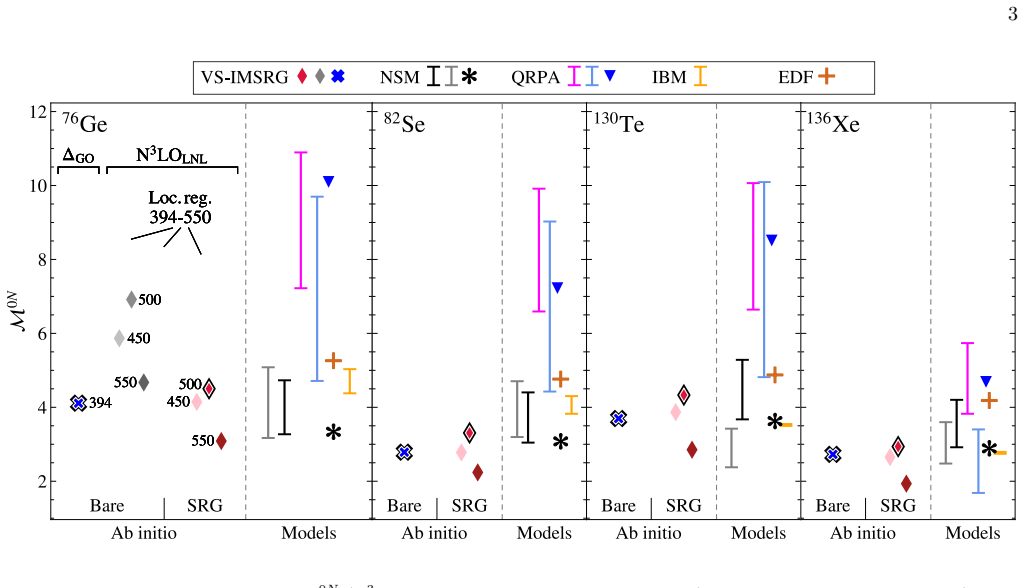
Starting from different nuclear forces derived from chiral effective field theory, the in-medium similarity renormalization group is applied to obtain an effective valence-space Hamiltonian along with consistently transformed 0νββ-decay operators. This produces converged short-range nuclear matrix elements for the isotopes 76Ge, 82Se, 130Te and 136Xe whose range is consistent with but generally smaller than phenomenological values, which in turn supply updated constraints on sterile-neutrino mixing-mass parameters when a fourth neutrino is included.
What carries the argument
The in-medium similarity renormalization group transformation that simultaneously generates an effective valence-space Hamiltonian and consistently transformed short-range 0νββ operators from chiral EFT forces.
Load-bearing premise
The in-medium similarity renormalization group supplies an accurate effective valence-space Hamiltonian together with consistently transformed short-range operators when starting from chiral EFT forces.
What would settle it
An independent ab initio computation of the same matrix elements using a different many-body method that produces values lying systematically outside the reported range would falsify the central claim.
Figures


read the original abstract
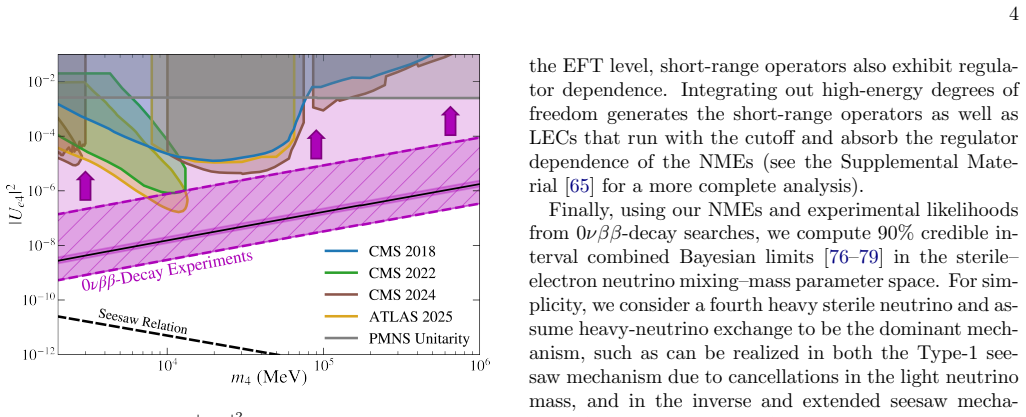
We present converged ab initio calculations of short-range neutrinoless double-beta ($0\nu\beta\beta$) decay nuclear matrix elements for the key experimental isotopes $^{76}$Ge, $^{82}$Se, $^{130}$Te and $^{136}$Xe. Starting from different nuclear forces derived from chiral effective field theory, we apply the in-medium similarity renormalization group to obtain an effective valence-space Hamiltonian along with consistently transformed $0\nu\beta\beta$-decay operators. We then obtain a range of values for the matrix elements that is consistent with, but generally smaller than, those from phenomenology. Finally, we combine our results with current limits from $0\nu\beta\beta$-decay searches to obtain constraints for the sterile-neutrino mixing-mass parameter space when considering the inclusion of a fourth sterile neutrino.
Editorial analysis
A structured set of objections, weighed in public.
Referee Report
Summary. The manuscript presents converged ab initio calculations of short-range neutrinoless double-beta decay nuclear matrix elements for the isotopes 76Ge, 82Se, 130Te, and 136Xe. Starting from multiple chiral EFT forces, the in-medium similarity renormalization group is used to derive effective valence-space Hamiltonians together with consistently transformed 0νββ operators; the resulting matrix-element range is reported to be consistent with but generally smaller than phenomenological values, and these results are combined with experimental limits to constrain the sterile-neutrino mixing-mass parameter space.
Significance. If the IMSRG-transformed operators prove reliable, the work supplies valuable ab initio benchmarks that could tighten interpretations of 0νββ searches and furnish falsifiable constraints on sterile neutrinos. The use of several chiral forces and the explicit focus on short-range contributions represent a clear methodological advance over purely phenomenological approaches.
major comments (2)
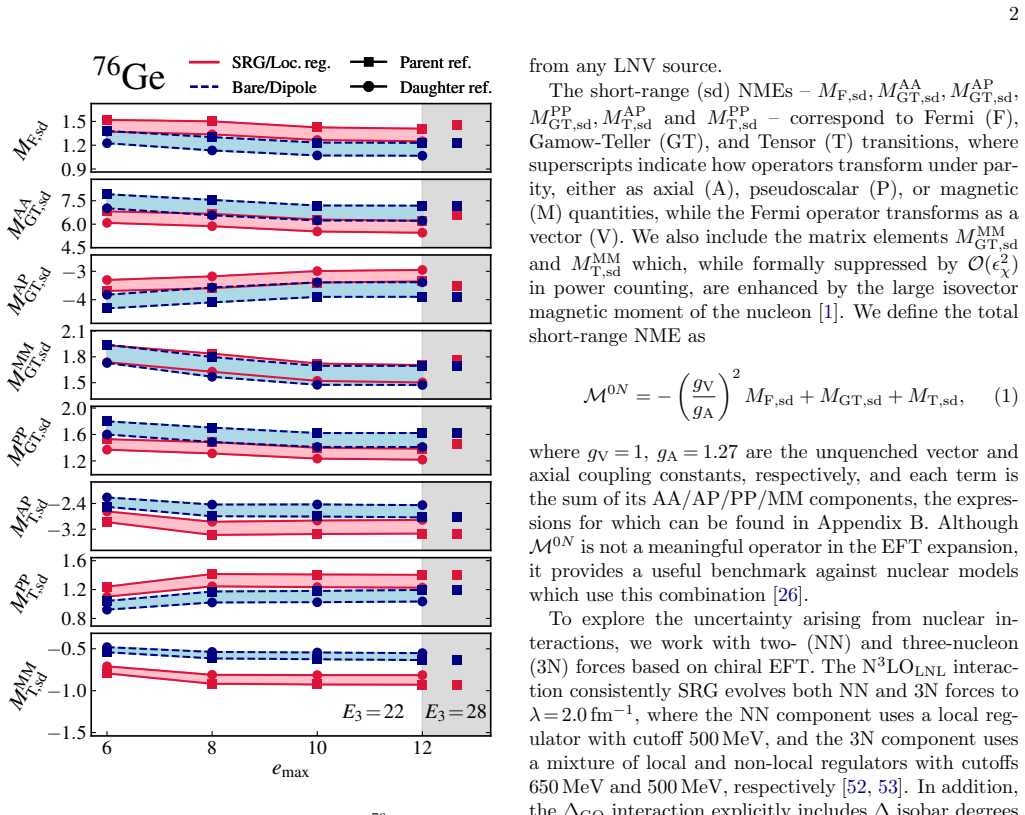
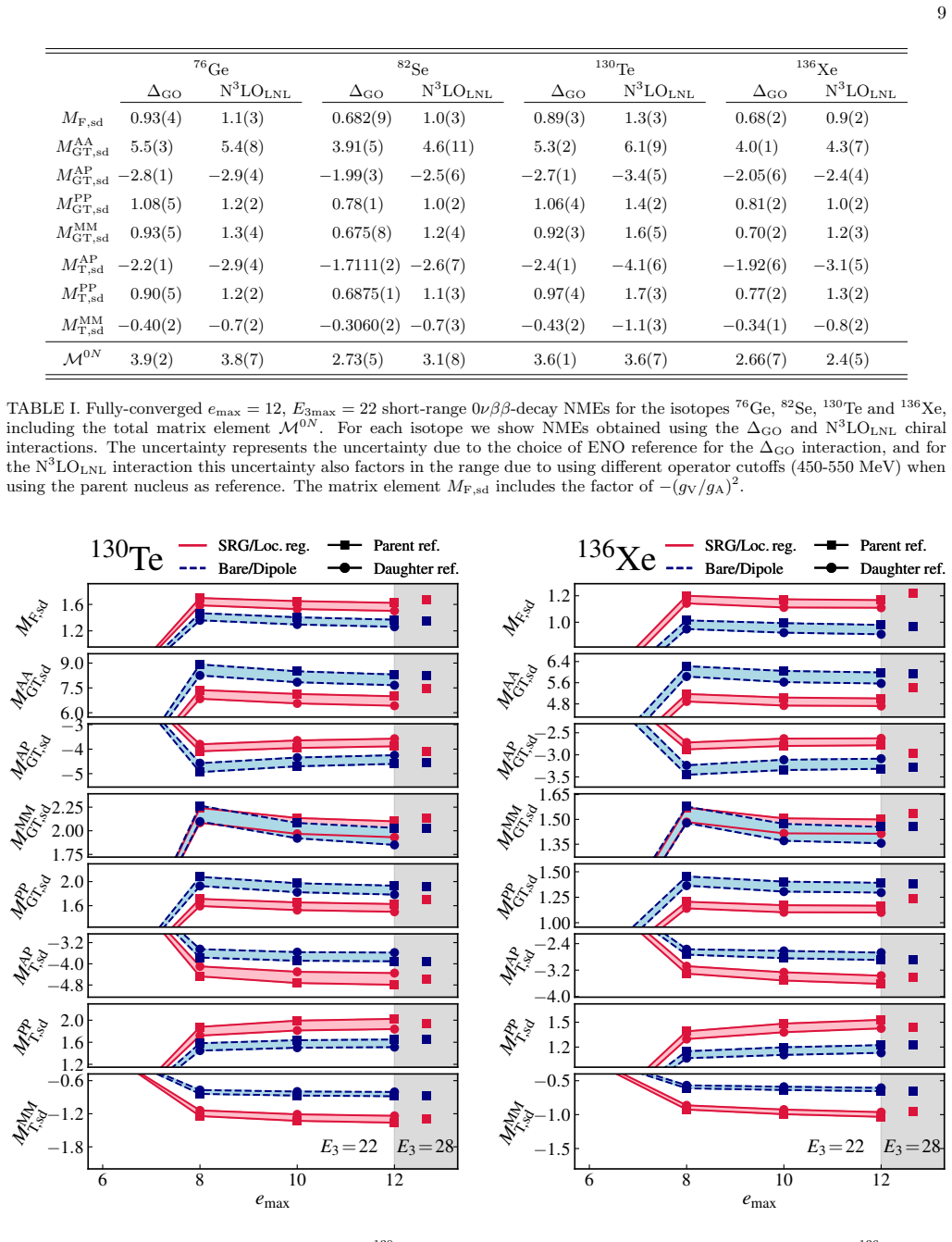
- [Abstract and Results] The abstract and results sections assert that the calculations are converged and that the matrix elements are reliably smaller than phenomenology, yet no explicit convergence plots, quantified truncation errors, or full error budgets for the NMEs are provided; without these, the central claim that the reported range can be used for sterile-neutrino constraints rests on an unverified assertion.
- [Methods (IMSRG transformation)] The methods description of the IMSRG evolution states that short-range 0νββ operators are transformed consistently with the Hamiltonian, but supplies insufficient detail on the truncation level (e.g., IMSRG(2) vs. higher), the treatment of induced many-body operators, or numerical checks that the short-range piece remains stable under the flow; because the headline NME range and derived sterile-neutrino limits depend directly on this transformed operator, the omission is load-bearing.
minor comments (2)
- [Notation and definitions] Notation for the short-range operator components and the precise definition of the sterile-neutrino mixing parameter should be clarified with an explicit equation or table entry to avoid ambiguity when readers compare to other works.
- [Computational details] A brief statement on the computational cost or basis-size dependence of the valence-space diagonalizations would help readers assess the practical reproducibility of the quoted NME values.
Simulated Author's Rebuttal
We thank the referee for the careful reading of our manuscript and for the positive assessment of its significance. We address each major comment below and describe the revisions that will be made to strengthen the presentation of convergence and methodological details.
read point-by-point responses
-
Referee: [Abstract and Results] The abstract and results sections assert that the calculations are converged and that the matrix elements are reliably smaller than phenomenology, yet no explicit convergence plots, quantified truncation errors, or full error budgets for the NMEs are provided; without these, the central claim that the reported range can be used for sterile-neutrino constraints rests on an unverified assertion.
Authors: We agree that explicit demonstrations of convergence and a quantified error budget would make the central claims more robust. Although the manuscript reports results that are stable across multiple chiral forces and model spaces, we will revise the Results section to include convergence plots of the short-range NMEs versus the IMSRG flow parameter and basis size for each isotope. We will also add a dedicated paragraph quantifying truncation uncertainties from the spread across forces and from comparisons to phenomenological benchmarks, thereby supporting the use of the reported NME range for sterile-neutrino constraints. revision: yes
-
Referee: [Methods (IMSRG transformation)] The methods description of the IMSRG evolution states that short-range 0νββ operators are transformed consistently with the Hamiltonian, but supplies insufficient detail on the truncation level (e.g., IMSRG(2) vs. higher), the treatment of induced many-body operators, or numerical checks that the short-range piece remains stable under the flow; because the headline NME range and derived sterile-neutrino limits depend directly on this transformed operator, the omission is load-bearing.
Authors: We appreciate the referee drawing attention to this point. Our calculations employ the IMSRG(2) truncation, with operators transformed consistently at the two-body level and induced higher-body contributions neglected in accordance with the Hamiltonian evolution. In the revised manuscript we will expand the Methods section to state the truncation scheme explicitly, describe the treatment of induced operators, and present numerical checks (e.g., flow-parameter dependence of the short-range operator) that confirm its stability. These additions will directly address the reliability of the transformed operators underlying the reported NME values and sterile-neutrino limits. revision: yes
Circularity Check
No circularity: matrix elements computed from independent chiral EFT inputs via established IMSRG transformation
full rationale
The derivation begins with chiral EFT nuclear forces (external to this work) and applies the IMSRG method to generate an effective valence-space Hamiltonian together with consistently transformed short-range 0νββ operators. The resulting nuclear matrix elements for 76Ge, 82Se, 130Te and 136Xe are obtained by direct many-body calculation in the valence space; these numbers are then combined with existing experimental half-life limits to constrain sterile-neutrino parameters. No step defines a quantity in terms of itself, renames a fitted result as a prediction, or relies on a load-bearing self-citation whose validity is presupposed by the present paper. The IMSRG transformation and chiral forces are taken from prior independent literature and are not adjusted to reproduce the final NME values reported here. The sterile-neutrino constraints follow arithmetically from the computed NMEs and external data, introducing no definitional loop.
Axiom & Free-Parameter Ledger
axioms (2)
- domain assumption Chiral effective field theory provides a systematic expansion for nuclear forces and currents that can be truncated at a given order while remaining consistent with QCD symmetries.
- domain assumption The in-medium similarity renormalization group produces an effective valence-space Hamiltonian and consistently transformed operators whose truncation errors are controllable for the nuclei considered.
Reference graph
Works this paper leans on
-
[1]
Cirigliano, W
V. Cirigliano, W. Dekens, J. de Vries, M. L. Graesser, and E. Mereghetti, JHEP12, 097 (2018)
2018
-
[2]
F. F. Deppisch, L. Graf, J. Harz, and W.-C. Huang, Phys. Rev. D98, 055029 (2018)
2018
-
[3]
Fileviez P´ erez, Physics Reports597, 1 (2015)
P. Fileviez P´ erez, Physics Reports597, 1 (2015)
2015
-
[4]
Brdar, A
V. Brdar, A. J. Helmboldt, S. Iwamoto, and K. Schmitz, Phys. Rev. D100, 075029 (2019)
2019
-
[5]
ˇSimkovic, J
F. ˇSimkovic, J. Vergados, and A. Faessler, Phys. Rev. D82, 113015 (2010)
2010
-
[6]
P. D. Bolton, F. F. Deppisch, and P. S. Bhupal Dev, JHEP03, 170 (2020)
2020
-
[7]
A. E. L. Dieperink and T. de Forest, Phys. Rev. C10, 543 (1974)
1974
-
[8]
Ahmed, A
F. Ahmed, A. Neacsu, and M. Horoi, Physics Letters B769, 299 (2017)
2017
-
[9]
Agostini, G
M. Agostini, G. Benato, J. A. Detwiler, J. Men´ endez, and F. Vissani, Rev. Mod. Phys.95, 025002 (2023)
2023
-
[10]
de Vries, M
J. de Vries, M. Drewes, Y. Georis, J. Klari´ c, and V. Plakkot, JHEP05, 090 (2025)
2025
-
[11]
Minkowski, Physics Letters B67, 421 (1977)
P. Minkowski, Physics Letters B67, 421 (1977)
1977
-
[12]
R. N. Mohapatra and G. Senjanovi´ c, Phys. Rev. Lett. 44, 912 (1980)
1980
-
[13]
Drewes, Int
M. Drewes, Int. J. Mod. Phys. E22, 1330019 (2013)
2013
-
[14]
Agostiniet al.(GERDA Collaboration), Phys
M. Agostiniet al.(GERDA Collaboration), Phys. Rev. Lett.125, 252502 (2020)
2020
-
[15]
Acharyaet al.(LEGEND Collaboration), Phys
H. Acharyaet al.(LEGEND Collaboration), Phys. Rev. Lett.136, 022701 (2026)
2026
-
[16]
D. Q. Adamset al., Science390, 1029 (2025)
2025
-
[17]
Antonet al.(EXO-200 Collaboration), Phys
G. Antonet al.(EXO-200 Collaboration), Phys. Rev. Lett.123, 161802 (2019)
2019
-
[18]
Abeet al.(KamLAND-Zen Collaboration), Phys
S. Abeet al.(KamLAND-Zen Collaboration), Phys. Rev. Lett.135, 262501 (2025)
2025
-
[19]
Adhikariet al.(nEXO Collaboration), J
G. Adhikariet al.(nEXO Collaboration), J. Phys. G 49, 015104 (2021)
2021
-
[20]
Abgrallet al.(LEGEND Collaboration), (2021), arXiv:2107.11462 [physics.ins-det]
N. Abgrallet al.(LEGEND Collaboration), (2021), arXiv:2107.11462 [physics.ins-det]
-
[21]
Trotta (CUPID Collaboration), Nuclear Instruments and Methods in Physics Research Section A: Accelera- tors, Spectrometers, Detectors and Associated Equip- ment1066, 169657 (2024)
D. Trotta (CUPID Collaboration), Nuclear Instruments and Methods in Physics Research Section A: Accelera- tors, Spectrometers, Detectors and Associated Equip- ment1066, 169657 (2024)
2024
-
[22]
Albaneseet al.(SNO+ Collaboration), Journal of Instrumentation16, P08059 (2021)
V. Albaneseet al.(SNO+ Collaboration), Journal of Instrumentation16, P08059 (2021)
2021
-
[23]
Pascoli, R
S. Pascoli, R. Ruiz, and C. Weiland, JHEP2019 (2019)
2019
-
[24]
A. M. Abdullahi, P. B. Alz´ as, B. Batell, J. Beacham, A. Boyarsky, S. Carbajal, A. Chatterjee, J. I. Crespo- Anad´ on, F. F. Deppisch, A. D. Roeck,et al., Journal of Physics G: Nuclear and Particle Physics50, 020501 (2023)
2023
-
[25]
C. H. de Lima, D. McKeen, J. N. Ng, M. Shamma, and D. Tuckler, Phys. Rev. D111, 075002 (2025)
2025
-
[26]
Men´ endez, J
J. Men´ endez, J. Phys. G45, 014003 (2018)
2018
-
[27]
Horoi and A
M. Horoi and A. Neacsu, Phys. Rev. C93, 024308 (2016)
2016
-
[28]
Men´ endez, A
J. Men´ endez, A. Poves, E. Caurier, and F. Nowacki, Nucl. Phys. A818, 139 (2009)
2009
-
[29]
Faessler, M
A. Faessler, M. Gonz´ alez, S. Kovalenko, and F. ˇSimkovic, Phys. Rev. D90, 096010 (2014)
2014
-
[30]
D.-L. Fang, A. Faessler, and F. ˇSimkovic, Phys. Rev. C97, 045503 (2018)
2018
-
[31]
Hyv¨ arinen and J
J. Hyv¨ arinen and J. Suhonen, Phys. Rev. C91, 024613 (2015)
2015
-
[32]
Barea, J
J. Barea, J. Kotila, and F. Iachello, Phys. Rev. C91, 034304 (2015)
2015
-
[33]
T. R. Rodr´ ıguez and G. Mart´ ınez-Pinedo, Phys. Rev. Lett.105, 252503 (2010)
2010
-
[34]
Yoshida, N
S. Yoshida, N. Shimizu, T. Togashi, and T. Otsuka, Phys. Rev. C98, 061301 (2018)
2018
-
[35]
Horoi, A
M. Horoi, A. Neacsu, and S. Stoica, Phys. Rev. C106, 054302 (2022). 6
2022
-
[36]
Horoi, A
M. Horoi, A. Neacsu, and S. Stoica, Phys. Rev. C107, 045501 (2023)
2023
-
[37]
Castillo, L
D. Castillo, L. Jokiniemi, P. Soriano, and J. Men´ endez, Physics Letters B860, 139181 (2025)
2025
-
[38]
Epelbaum, H.-W
E. Epelbaum, H.-W. Hammer, and U.-G. Meißner, Rev. Mod. Phys.81, 1773 (2009)
2009
-
[39]
Machleidt and D
R. Machleidt and D. R. Entem, Phys. Rep.503, 1 (2011)
2011
-
[40]
Hergert, Front
H. Hergert, Front. in Phys.8, 379 (2020)
2020
-
[41]
J. M. Yao, A. Belley, R. Wirth, T. Miyagi, C. G. Payne, S. R. Stroberg, H. Hergert, and J. D. Holt, Phys. Rev. C103, 014315 (2021)
2021
-
[42]
J. M. Yao, B. Bally, J. Engel, R. Wirth, T. R. Rodr´ ıguez, and H. Hergert, Phys. Rev. Lett.124, 232501 (2020)
2020
-
[43]
Belley, C
A. Belley, C. G. Payne, S. R. Stroberg, T. Miyagi, and J. D. Holt, Phys. Rev. Lett.126, 042502 (2021)
2021
-
[44]
Novario, P
S. Novario, P. Gysbers, J. Engel, G. Hagen, G. R. Jansen, T. D. Morris, P. Navr´ atil, T. Papenbrock, and S. Quaglioni, Phys. Rev. Lett.126, 182502 (2021)
2021
-
[45]
Belleyet al., Phys
A. Belleyet al., Phys. Rev. Lett.132, 182502 (2024)
2024
-
[46]
S. R. Stroberg, S. K. Bogner, H. Hergert, and J. D. Holt, Ann. Rev. Nucl. Part. Sci.69, 307 (2019)
2019
- [47]
-
[48]
R. N. Mohapatra and J. W. F. Valle, Phys. Rev. D34, 1642 (1986)
1986
-
[49]
Okada and O
N. Okada and O. Yasuda, Int. J. Mod. Phys. A12, 3669 (1997)
1997
-
[50]
F. F. Deppisch, L. Graf, F. Iachello, and J. Kotila, Phys. Rev. D102, 095016 (2020)
2020
-
[51]
L. S. Song, J. M. Yao, P. Ring, and J. Meng, Phys. Rev. C95, 024305 (2017)
2017
-
[52]
Leistenschneider, M
E. Leistenschneider, M. P. Reiter, S. Ayet San Andr´ es, B. Kootte, J. D. Holt, P. Navr´ atil, C. Babcock, C. Bar- bieri, B. R. Barquest, J. Bergmann,et al., Phys. Rev. Lett.120, 062503 (2018)
2018
-
[53]
Som` a, P
V. Som` a, P. Navr´ atil, F. Raimondi, C. Barbieri, and T. Duguet, Phys. Rev. C101, 014318 (2020)
2020
-
[54]
W. G. Jiang, A. Ekstr¨ om, C. Forss´ en, G. Hagen, G. R. Jansen, and T. Papenbrock, Phys. Rev. C102, 054301 (2020)
2020
-
[55]
N. M. Parzuchowski, S. R. Stroberg, P. Navr´ atil, H. Hergert, and S. K. Bogner, Phys. Rev. C96, 034324 (2017)
2017
-
[56]
ˇSimkovic, A
F. ˇSimkovic, A. Faessler, H. M¨ uther, V. Rodin, and M. Stauf, Phys. Rev. C79, 055501 (2009)
2009
-
[57]
Miyagi, Eur
T. Miyagi, Eur. Phys. J. A59, 150 (2023)
2023
-
[58]
S. R. Stroberg, A. Calci, H. Hergert, J. D. Holt, S. K. Bogner, R. Roth, and A. Schwenk, Phys. Rev. Lett. 118, 032502 (2017)
2017
-
[59]
T. D. Morris, N. M. Parzuchowski, and S. K. Bogner, Phys. Rev. C92, 034331 (2015)
2015
-
[60]
Hergert, S
H. Hergert, S. K. Bogner, T. D. Morris, A. Schwenk, and K. Tsukiyama, Phys. Rep.621, 165 (2016)
2016
-
[61]
Miyagi, S
T. Miyagi, S. R. Stroberg, J. D. Holt, and N. Shimizu, Phys. Rev. C102, 034320 (2020)
2020
-
[62]
IMSRG++,
S. R. Stroberg, “IMSRG++,” (2018)
2018
-
[63]
Shimizu, T
N. Shimizu, T. Mizusaki, Y. Utsuno, and Y. Tsunoda, Computer Physics Communications244, 372 (2019)
2019
-
[64]
Miyagi, S
T. Miyagi, S. R. Stroberg, P. Navr´ atil, K. Hebeler, and J. D. Holt, Phys. Rev. C105, 014302 (2022)
2022
-
[65]
See Supplemental Material at URL-will-be-inserted- by-publisher for convergence plots for other isotopes, SRG/Regulator analysis and methods for sterile neu- trino constraints
-
[66]
Aadet al.(ATLAS), Eur
G. Aadet al.(ATLAS), Eur. Phys. J. C86, 153 (2026)
2026
-
[67]
Aadet al.(ATLAS), JHEP07, 196 (2025)
G. Aadet al.(ATLAS), JHEP07, 196 (2025)
2025
-
[68]
A. M. Sirunyanet al.(CMS), Phys. Rev. Lett.120, 221801 (2018)
2018
-
[69]
Tumasyanet al.(CMS), JHEP07, 081 (2022)
A. Tumasyanet al.(CMS), JHEP07, 081 (2022)
2022
-
[70]
Hayrapetyanet al.(CMS), Phys
A. Hayrapetyanet al.(CMS), Phys. Rev. D110, 012004 (2024)
2024
-
[71]
Hayrapetyanet al.(CMS), JHEP06, 123 (2024)
A. Hayrapetyanet al.(CMS), JHEP06, 123 (2024)
2024
-
[72]
Hayrapetyanet al.(CMS), JHEP06, 183 (2024)
A. Hayrapetyanet al.(CMS), JHEP06, 183 (2024)
2024
-
[73]
Blennow, E
M. Blennow, E. Fern´ andez-Mart´ ınez, J. Hern´ andez- Garc´ ıa, J. L´ opez-Pav´ on, X. Marcano, and D. Naredo- Tuero, JHEP08, 030 (2023)
2023
-
[74]
Hebeler, S
K. Hebeler, S. K. Bogner, R. J. Furnstahl, A. Nogga, and A. Schwenk, Phys. Rev. C83, 031301 (2011)
2011
-
[75]
Simonis, S
J. Simonis, S. R. Stroberg, K. Hebeler, J. D. Holt, and A. Schwenk, Phys. Rev. C96, 014303 (2017)
2017
-
[76]
S. D. Biller, Phys. Rev. D104, 012002 (2021)
2021
-
[77]
Caldwell, A
A. Caldwell, A. Merle, O. Schulz, and M. Totzauer, Phys. Rev. D96, 073001 (2017)
2017
-
[78]
Guzowski, L
P. Guzowski, L. Barnes, J. Evans, G. Karagiorgi, N. Mc- Cabe, and S. S¨ oldner-Rembold, Phys. Rev. D92, 012002 (2015)
2015
-
[79]
Lisi and A
E. Lisi and A. Marrone, Phys. Rev. D106, 013009 (2022)
2022
-
[80]
Mitra, G
M. Mitra, G. Senjanovi´ c, and F. Vissani, Nuclear Physics B856, 26 (2012)
2012
discussion (0)
Sign in with ORCID, Apple, or X to comment. Anyone can read and Pith papers without signing in.