Recognition: unknown
Revisiting confinement scalings and fusion performance with a perspective optimized for extrapolation
Pith reviewed 2026-05-08 09:06 UTC · model grok-4.3
The pith
Fusion triple product scales approximately as plasma current squared in tokamaks
A machine-rendered reading of the paper's core claim, the machinery that carries it, and where it could break.
Core claim
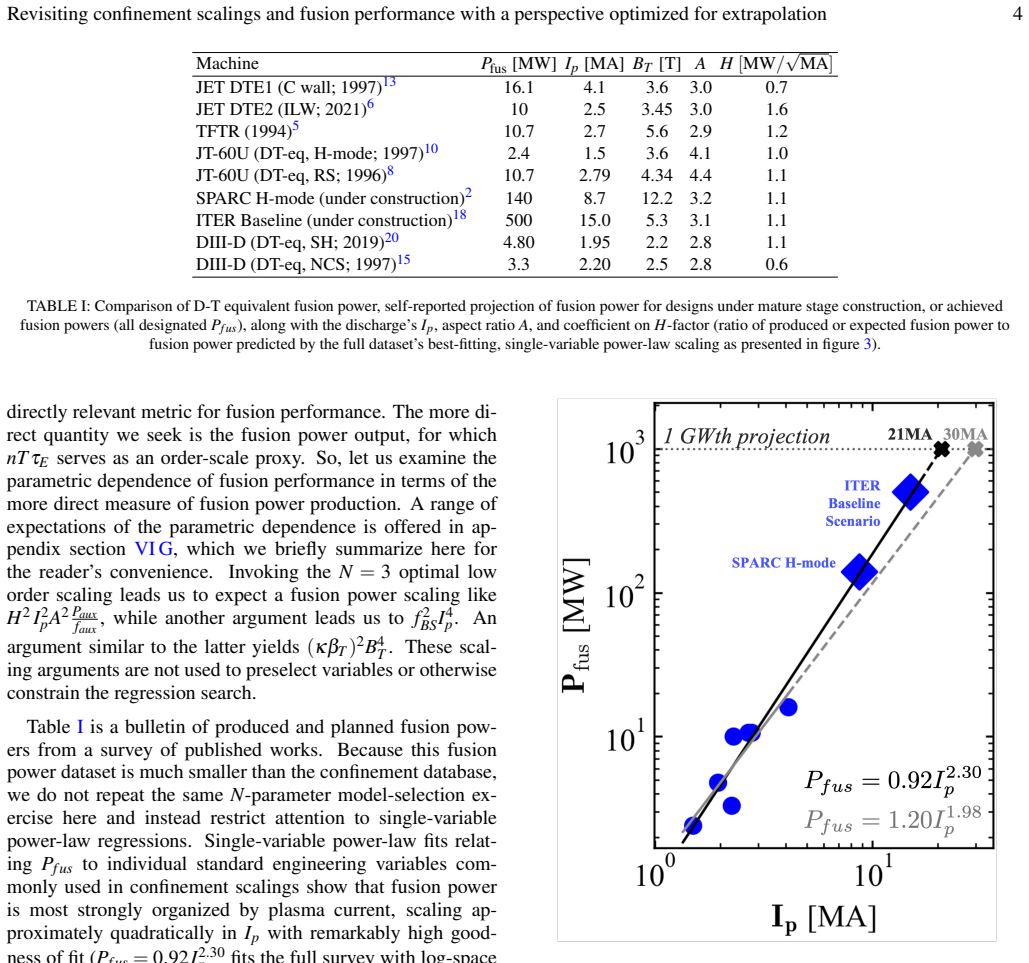
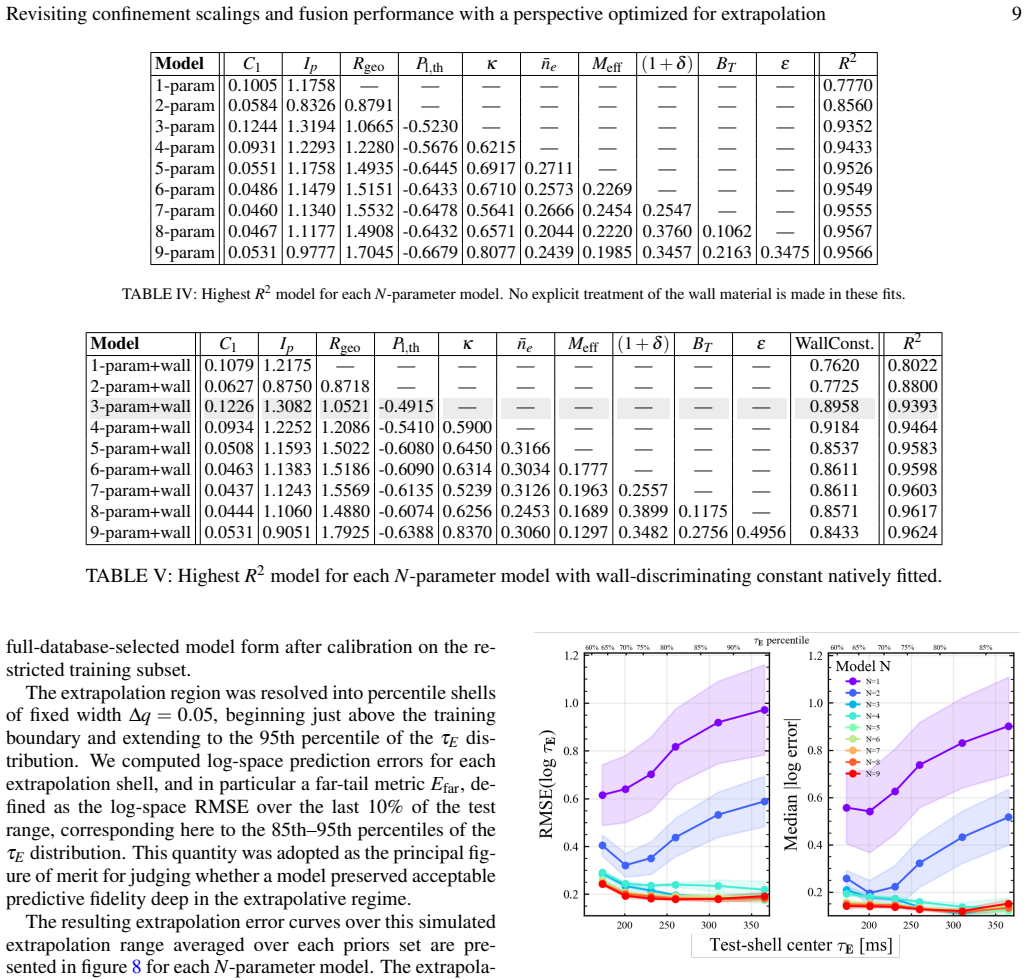
By systematically searching for minimally complex confinement scalings that optimize the tradeoff between variance capture and extrapolative robustness, the authors determine that models centered near N=3 to N=4 perform best, with plasma current, machine size, heating power, and elongation emerging as the main engineering levers together with an empirically inferred metallic-wall penalty. When translated into reactor-performance terms, the fusion triple product scales approximately as I_p squared while the empirical fusion power scaling exhibits a similarly near-quadratic dependence on plasma current over the survey of top discharges. Projecting to reactors, these results suggest that high-f
What carries the argument
Extrapolation-optimized low-order empirical confinement scaling that identifies plasma current as the dominant term for fusion performance metrics
If this is right
- The fusion triple product scales approximately as I_p squared.
- Empirical fusion power shows a near-quadratic dependence on plasma current across high-performing discharges.
- High-field devices with metal walls may require higher plasma current than standard IPB98(y,2) projections imply.
- Gigawatt-class tokamak performance likely demands operation at I_p greater than or equal to 20 MA.
Where Pith is reading between the lines
- Design studies for compact reactors could shift emphasis toward maximizing achievable plasma current alongside field strength.
- The metallic-wall penalty may compound with impurity or divertor physics in ways that require separate experimental checks at higher parameters.
- Cross-validation against other confinement databases could test whether the quadratic dependence persists when additional variables are included.
Load-bearing premise
Low-order empirical models optimized on the current ITPA database will continue to describe confinement physics at the much higher magnetic fields, densities, and wall conditions of future reactors without new dominant loss channels or regime changes.
What would settle it
A high-performance discharge in a high-field metallic-wall tokamak whose measured triple product deviates substantially below the I_p squared trend at parameters outside the present database range would falsify the extrapolated claim.
Figures






read the original abstract
Recent advances in high-temperature-superconductor technology have made substantially higher toroidal magnetic fields technologically accessible, reopening the design space for compact, high-field tokamak reactors. Because reactor performance projections remain anchored to empirical confinement scalings, the recent update to the ITPA global H-mode confinement database raises an important question: what does the present experimental record and its uncertainty imply for the path to reactor-grade fusion performance? In this work, we revisit confinement extrapolation from an explicitly extrapolation-oriented perspective and, to complement its implications in terms of a direct reactor performance measure, present a cross-machine empirical scaling for fusion power. We systematically search for a minimally complex confinement scaling that optimizes the tradeoff between variance capture and extrapolative robustness. We find that low-order models centered near $N=3$ to $N=4$ optimize this tradeoff, with plasma current, machine size, heating power, and elongation emerging as the dominant engineering levers, together with an empirically inferred confinement penalty associated with metallic walls. Recast in reactor-performance terms, the results indicate that both the fusion triple product and fusion power are governed primarily by plasma current: the triple product scales approximately as $I_p^2$, and the empirical fusion power scaling exhibits a similarly near-quadratic dependence over a survey of the highest performing discharges across several machines. Projecting to reactors, these results suggest that high-field devices with metal walls may require higher plasma current than standard IPB98$(y,2)$-based expectations imply, and that gigawatt-class tokamak performance likely demands operation at $I_p \gtrsim 20\mathrm{MA}$.
Editorial analysis
A structured set of objections, weighed in public.
Referee Report
Summary. The manuscript analyzes the updated ITPA global H-mode confinement database from an extrapolation-oriented perspective, systematically identifying low-order empirical models (N=3 to N=4) that optimize the tradeoff between variance capture and extrapolative robustness. Plasma current, machine size, heating power, and elongation are identified as dominant levers, along with an empirically inferred metallic-wall confinement penalty. Recast in reactor-performance terms, the fusion triple product is reported to scale approximately as I_p^2, with a complementary cross-machine empirical scaling for fusion power also showing near-quadratic I_p dependence. The work concludes that high-field metal-wall tokamaks may require I_p ≳ 20 MA for gigawatt-class performance, exceeding standard IPB98(y,2)-based expectations.
Significance. If the I_p^2 scaling and associated extrapolations prove robust, the results would carry substantial implications for compact high-field tokamak reactor design by indicating that higher plasma currents are needed than conventional scalings suggest, particularly under metallic-wall conditions. The paper earns credit for its explicit optimization criterion for extrapolative robustness, the cross-machine survey of highest-performing discharges for the fusion-power scaling, and the parameter-free aspects of the low-order model selection. These elements strengthen the data-driven perspective, though the empirical foundation without external validation limits the strength of the conclusions.
major comments (2)
- [Abstract] Abstract: the claim that the triple product scales approximately as I_p^2 after recasting the N=3–4 model does not specify the fixed values chosen for the remaining variables (R, P, kappa) or the substitution rules for I_p-dependent operational limits. Without these details or sensitivity tests, it is unclear whether the quadratic exponent is robust or an artifact of the recasting procedure, directly affecting the load-bearing conclusion that I_p ≳ 20 MA is required.
- [Results (scaling optimization and reactor projections)] The section presenting the scaling optimization and reactor projections: the I_p^2 dependence and fusion-power scaling are derived from fits to the same selected high-performance discharges used to evaluate them, with no reported cross-validation on held-out data, uncertainty propagation into the extrapolated regime, or comparison against independent physics-based models. This circularity in the fit procedure undermines the claimed extrapolative robustness of the central I_p^2 result.
minor comments (2)
- [Abstract] Abstract: the number of discharges and machines included in the highest-performing survey should be stated explicitly to allow readers to gauge the statistical basis of the near-quadratic fusion-power scaling.
- [Introduction or Methods] Notation: the exponent N in the low-order models should be defined on first use with a clear statement of how it relates to the standard power-law form of confinement scalings.
Simulated Author's Rebuttal
We thank the referee for the thoughtful and constructive report. We address the two major comments point by point below. We agree that the abstract requires explicit details on the recasting procedure and will revise to include them. We also acknowledge the need for additional validation steps in the results and will incorporate cross-validation and uncertainty propagation in the revised manuscript.
read point-by-point responses
-
Referee: [Abstract] Abstract: the claim that the triple product scales approximately as I_p^2 after recasting the N=3–4 model does not specify the fixed values chosen for the remaining variables (R, P, kappa) or the substitution rules for I_p-dependent operational limits. Without these details or sensitivity tests, it is unclear whether the quadratic exponent is robust or an artifact of the recasting procedure, directly affecting the load-bearing conclusion that I_p ≳ 20 MA is required.
Authors: We agree that the abstract and main text lack sufficient specification of the recasting assumptions. In the revised manuscript we will state the representative fixed values (R = 6.2 m, P = 50 MW, κ = 1.8) chosen to reflect a high-field metal-wall reactor design, and we will detail the substitution rules that incorporate I_p-dependent operational limits (Greenwald density, Troyon beta, and q95 constraints). We will also add a short sensitivity study varying these fixed parameters over plausible ranges to demonstrate that the near-quadratic I_p dependence remains stable. These clarifications will be inserted in both the abstract and the reactor-projection section. revision: yes
-
Referee: [Results (scaling optimization and reactor projections)] The section presenting the scaling optimization and reactor projections: the I_p^2 dependence and fusion-power scaling are derived from fits to the same selected high-performance discharges used to evaluate them, with no reported cross-validation on held-out data, uncertainty propagation into the extrapolated regime, or comparison against independent physics-based models. This circularity in the fit procedure undermines the claimed extrapolative robustness of the central I_p^2 result.
Authors: The referee correctly notes the absence of explicit validation steps. The low-order model selection (N = 3–4) was performed on the full ITPA database, while the fusion-power scaling is a separate survey of the highest-performing discharges; however, we recognize that this distinction is not sufficient without further checks. In revision we will add k-fold cross-validation on the confinement database to assess stability of the I_p exponent, Monte-Carlo propagation of coefficient uncertainties into the extrapolated triple-product and power values, and a concise comparison of our empirical exponents with those from physics-based models (e.g., the ITER physics basis and selected gyrokinetic results). These additions will be placed in a new subsection on robustness and will strengthen the extrapolative claims without altering the core empirical approach. revision: partial
Circularity Check
Empirical model selection and recasting contain no definitional or self-referential reduction
full rationale
The paper selects low-order empirical scalings by optimizing a tradeoff between variance explained and an internal robustness metric on the ITPA H-mode database, then algebraically recasts the resulting multi-variable expression into reactor-relevant quantities (triple product and fusion power) while holding auxiliary parameters at representative values. This procedure is self-contained: the I_p^2 dependence emerges from the fitted exponents and the chosen fixed-point substitution rather than from any prior assumption that the output must equal the input. No self-citation supplies a uniqueness theorem, no fitted coefficient is relabeled as an independent prediction, and the abstract's claims remain falsifiable against future data outside the fitting set. The derivation therefore does not collapse to its own inputs by construction.
Axiom & Free-Parameter Ledger
free parameters (2)
- exponents in the N=3 to N=4 scaling
- metallic-wall penalty factor
axioms (2)
- domain assumption The ITPA global H-mode database is representative of the physics that will govern confinement in high-field reactors.
- domain assumption A low-order power-law model is adequate to capture the dominant dependencies without missing higher-order interactions or regime transitions.
Reference graph
Works this paper leans on
-
[1]
out-of-distribution
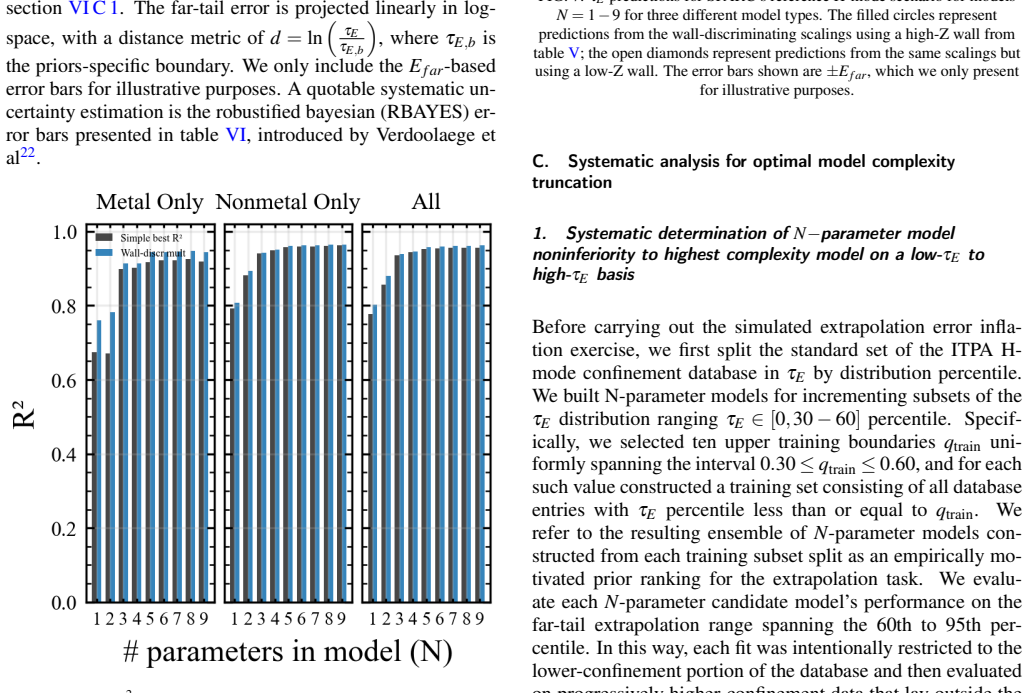
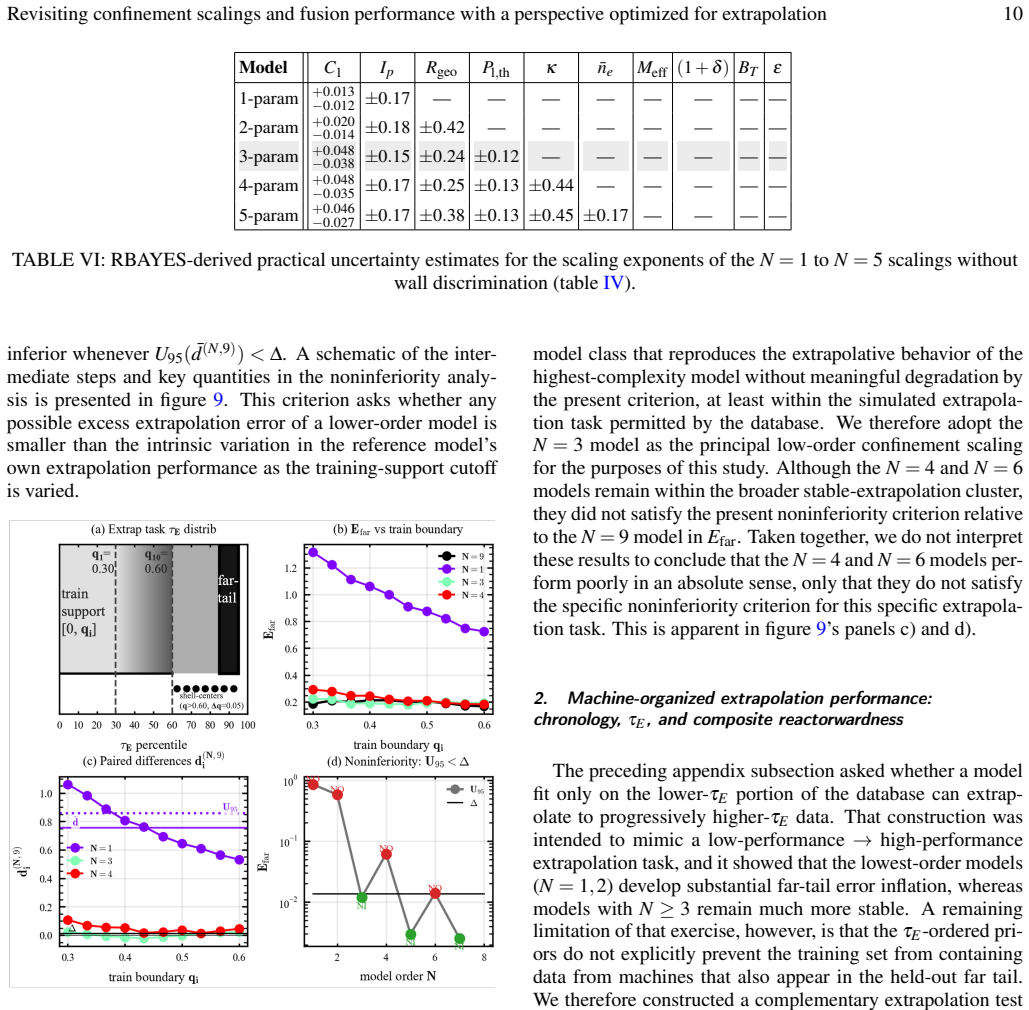
Systematic determination ofN−parameter model noninferiority to highest complexity model on a low-τE to high-τE basis Before carrying out the simulated extrapolation error infla- tion exercise, we first split the standard set of the ITPA H- mode confinement database inτ E by distribution percentile. We built N-parameter models for incrementing subsets of t...
2044
-
[2]
incl" columns include all points from table I, while
Machine-organized extrapolation performance: chronology,τ E, and composite reactorwardness The preceding appendix subsection asked whether a model fit only on the lower-τ E portion of the database can extrap- olate to progressively higher-τ E data. That construction was intended to mimic a low-performance→high-performance extrapolation task, and it showed...
-
[3]
With the same assumptions,Q∝ H2 I2 pA2/f aux
Invoking the optimal low-order confinement scaling from this work (N=3parameters) Approximating our optimal low-order scaling for the ther- mal energy confinement time asτ E,th ∝I pRgeo/P1/2 L,th; neglect- ing radiative losses; and assuming all of the thermal loss power comes from the auxiliary heating, fusion power takes the form, Pf us ∝(nT) 2 V∝ (Pl,th...
-
[4]
Resulting scaling from toroidal beta This invokation finds that fusion power density scales quar- tically with the toroidal magnetic field and square of toroidal beta,β T = ⟨p⟩ B2 T /2µ0 , Pf us ∝n 2T 2 ∝p 2 ∝β 2 T B4 T While it’s true thatB T andβ T are technically independent quantities, in practice they are difficult to independently move at high perfo...
-
[5]
Pf us ∝n 2T 2 ∝β 2 p I4 p
Resulting scaling from poloidal beta This invokation finds that fusion power density scales quar- tically withI p and quadratically with poloidalβ,β p = ⟨p⟩ I2p/2µ0 . Pf us ∝n 2T 2 ∝β 2 p I4 p. As is the case with toroidalβ,β p’s dependence onI2 p makes Pf us’s parametric dependence difficult to interpret. Let us at- tempt to disambiguate this by substitu...
2020
-
[6]
arXiv:2505.03834 [physics]. 26P.N. Yushmanov, T. Takizuka, K.S. Riedel, O.J.W.F. Kardaun, J.G. Cordey, S.M. Kaye, and D.E. Post. Scalings for tokamak energy confinement.Nu- clear Fusion, 30(10):1999–2006, October 1990. 27Hartmut Zohm. On the size of tokamak fusion power plants.Philosophical Transactions of the Royal Society A: Mathematical, Physical and E...
discussion (0)
Sign in with ORCID, Apple, or X to comment. Anyone can read and Pith papers without signing in.