Recognition: unknown
String theory in the infrared
Pith reviewed 2026-05-08 10:39 UTC · model grok-4.3
The pith
Worldsheet analysis shows string theory imposes UV/IR scaling relations on higher-derivative Wilson coefficients and vacuum energy that effective field theory cannot detect.
A machine-rendered reading of the paper's core claim, the machinery that carries it, and where it could break.
Core claim
A worldsheet analysis reveals that higher-derivative Wilson coefficients and the vacuum energy exhibit UV/IR relations which are invisible from the viewpoint of effective field theory, leading to parametric inequalities which take the form of holographic bounds.
What carries the argument
Worldsheet analysis in species limits that extracts universal UV/IR scaling relations linking higher-derivative Wilson coefficients to the vacuum energy in string-derived gravity theories.
If this is right
- Effective theories of gravity from string theory obey universal scaling relations between infrared data that generic theories lack.
- Higher-derivative Wilson coefficients are parametrically tied to the vacuum energy through UV/IR connections.
- The resulting inequalities take the form of holographic bounds that constrain the landscape of low-energy string phases.
- These features lend theoretical support to swampland-motivated phenomenological scenarios with potential cosmological signatures.
Where Pith is reading between the lines
- The relations could distinguish string-derived models from generic quantum-gravity effective theories via precision measurements of Wilson coefficients in cosmological data.
- Extending the worldsheet approach to broader classes of compactifications might generate additional testable bounds on early-universe parameters.
- Because the relations are invisible in pure effective field theory, they suggest string theory supplies new constraints that observations of dark energy or inflation could probe indirectly.
Load-bearing premise
The worldsheet analysis in species limits accurately captures universal infrared data of string-derived effective theories and produces relations that remain valid beyond the specific setups considered.
What would settle it
A explicit computation in a concrete string compactification where the higher-derivative Wilson coefficients and vacuum energy fail to obey the predicted parametric scaling from the worldsheet relations.
Figures


read the original abstract
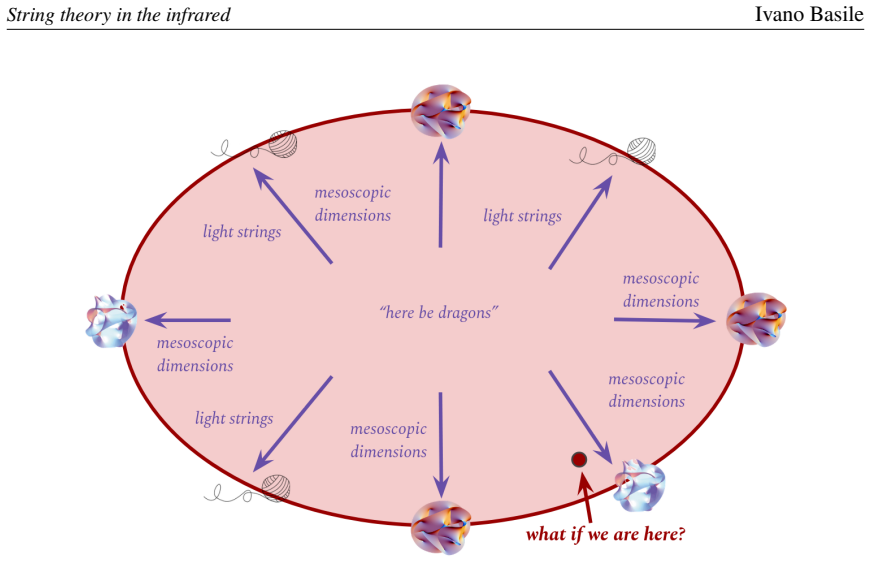
I briefly summarize a recent research program aiming to probe the landscape of low-energy phases of string theory from a global perspective. Borrowing conceptual lessons from the swampland program, I will discuss how the effective theories of gravity produced by low-energy string theory are far from generic; rather, their infrared data is connected by universal scaling relations which become non-trivial in species limits. In particular, a worldsheet analysis reveals that higher-derivative Wilson coefficients and the vacuum energy exhibit UV/IR relations which are invisible from the viewpoint of effective field theory, leading to parametric inequalities which take the form of holographic bounds. This lends a more solid theoretical support to swampland-motivated phenomenological scenarios, and to the broader hopes of extracting less direct, but empirically accessible, signatures of string theory from cosmological observations.
Editorial analysis
A structured set of objections, weighed in public.
Referee Report
Summary. The manuscript summarizes a research program that employs worldsheet analysis in species limits to identify universal UV/IR scaling relations connecting higher-derivative Wilson coefficients and the vacuum energy in string-derived effective theories of gravity. These relations are presented as invisible to standard EFT reasoning and as yielding parametric inequalities that resemble holographic bounds, thereby lending theoretical support to swampland conjectures and suggesting possible cosmological signatures of string theory.
Significance. If the claimed relations hold with the asserted generality, the work would provide a concrete bridge between worldsheet string methods and low-energy data, offering a mechanism to constrain the string landscape from IR observables and strengthening the case for swampland-motivated phenomenology. The approach could open avenues for extracting string-theoretic predictions from cosmology, but its impact hinges on demonstrating that the relations are both rigorously derived and universal beyond the specific setups examined.
major comments (2)
- [Abstract] Abstract: The central claim that 'a worldsheet analysis reveals' UV/IR relations and parametric inequalities is stated without any equations, derivations, or explicit computations. No section supplies the worldsheet correlators, species-limit scalings, or steps that produce the claimed relations for Wilson coefficients or vacuum energy, preventing verification of whether they follow rigorously or remain model-dependent.
- [Abstract] Abstract: The assertion that the relations are 'universal' and 'invisible from the viewpoint of effective field theory' rests on the assumption that the chosen worldsheet regimes in species limits capture all relevant IR data for generic string-derived EFTs. No cross-checks, general derivation, or argument ruling out model-specific artifacts are provided to support extending the results beyond the concrete examples considered.
minor comments (2)
- The manuscript is written as a brief summary of a research program; expanding it with at least one explicit worked example (e.g., a specific worldsheet computation and the resulting inequality) would substantially improve clarity and allow readers to assess the method.
- Terminology such as 'species limits' and 'holographic bounds' is used without a concise definition or reference to the precise parametric regime in which the inequalities are claimed to hold.
Simulated Author's Rebuttal
We thank the referee for the careful review and constructive feedback on our summary of the research program. We address each major comment below and indicate the revisions we will make to the manuscript.
read point-by-point responses
-
Referee: [Abstract] Abstract: The central claim that 'a worldsheet analysis reveals' UV/IR relations and parametric inequalities is stated without any equations, derivations, or explicit computations. No section supplies the worldsheet correlators, species-limit scalings, or steps that produce the claimed relations for Wilson coefficients or vacuum energy, preventing verification of whether they follow rigorously or remain model-dependent.
Authors: We agree that the abstract and current manuscript text are high-level and do not contain the explicit worldsheet correlators or step-by-step derivations. This work is structured as a concise summary of an ongoing research program whose technical details appear in the cited papers. To address the concern, we will revise the manuscript by adding a brief outline of the key worldsheet analysis steps and species-limit scalings, together with precise references to the sections of the cited works where the full computations are carried out. This will enable verification while preserving the summary character of the paper. revision: yes
-
Referee: [Abstract] Abstract: The assertion that the relations are 'universal' and 'invisible from the viewpoint of effective field theory' rests on the assumption that the chosen worldsheet regimes in species limits capture all relevant IR data for generic string-derived EFTs. No cross-checks, general derivation, or argument ruling out model-specific artifacts are provided to support extending the results beyond the concrete examples considered.
Authors: The claim of universality rests on the fact that the species limit is a general regime in perturbative string theory and that the relevant worldsheet CFT data are determined by the string spectrum rather than by model-specific details. The invisibility to standard EFT follows because the relations encode string-scale information not accessible from IR data alone. We acknowledge that the manuscript would benefit from an explicit general argument and at least one additional cross-check. In revision we will add a short paragraph outlining why the scaling relations follow from the structure of the worldsheet theory in the species limit and reference existing checks in related compactifications. We do not assert that the relations hold for arbitrary EFTs, only for those realized by string theory. revision: partial
Circularity Check
No significant circularity; derivation relies on worldsheet computations
full rationale
The paper summarizes a research program deriving UV/IR scaling relations for Wilson coefficients and vacuum energy via worldsheet analysis in species limits, yielding parametric inequalities resembling holographic bounds. These relations are presented as emerging from explicit worldsheet computations rather than being defined into the inputs or forced by self-citation chains. No equations or steps in the abstract reduce the claimed predictions to fitted parameters or prior self-referential results by construction. The universality claim for string-derived EFTs is an interpretive extension but does not exhibit the enumerated circular patterns (self-definitional, fitted-input-as-prediction, or load-bearing self-citation) based on the provided text. The derivation chain remains independent of its target conclusions.
Axiom & Free-Parameter Ledger
Forward citations
Cited by 1 Pith paper
-
The weak gravity conjecture in perturbative strings
A summary of a proposed proof that the Weak Gravity Conjecture follows from the structure of perturbative bosonic string theory.
Reference graph
Works this paper leans on
-
[1]
M. Bachmaier, G. Dvali and J. S. Valbuena-Bermúdez, [arXiv:2510.05237 [hep-th]]
-
[2]
S. Caron-Huot, Y. Z. Li, J. Parra-Martinez and D. Simmons-Duffin, JHEP05(2023), 122 doi:10.1007/JHEP05(2023)122 [arXiv:2201.06602 [hep-th]]
-
[3]
J. M. Maldacena and G. L. Pimentel, JHEP09(2011), 045 doi:10.1007/JHEP09(2011)045 [arXiv:1104.2846 [hep-th]]
-
[4]
G. T. Horowitz, M. Kolanowski, G. N. Remmen and J. E. Santos, Phys. Rev. Lett.131(2023) no.9, 091402 doi:10.1103/PhysRevLett.131.091402 [arXiv:2303.07358 [hep-th]]
-
[5]
G. T. Horowitz, M. Kolanowski, G. N. Remmen and J. E. Santos, JHEP05(2024), 122 doi:10.1007/JHEP05(2024)122 [arXiv:2403.00051 [hep-th]]
-
[6]
J. Calderón-Infante, A. Castellano and A. Herráez, SciPost Phys.19(2025) no.4, 096 doi:10.21468/SciPostPhys.19.4.096 [arXiv:2501.14880 [hep-th]]
-
[7]
G. R. Dvali, G. Gabadadze, M. Kolanovic and F. Nitti, Phys. Rev. D65(2002), 024031 doi:10.1103/PhysRevD.65.024031 [arXiv:hep-th/0106058 [hep-th]]
-
[8]
Veneziano, JHEP06(2002), 051 doi:10.1088/1126-6708/2002/06/051 [arXiv:hep- th/0110129 [hep-th]]
G. Veneziano, JHEP06(2002), 051 doi:10.1088/1126-6708/2002/06/051 [arXiv:hep- th/0110129 [hep-th]]
-
[9]
G. Dvali, Fortsch. Phys.58(2010), 528-536 doi:10.1002/prop.201000009 [arXiv:0706.2050 [hep-th]]
-
[10]
G. Dvali and M. Redi, Phys. Rev. D77(2008), 045027 doi:10.1103/PhysRevD.77.045027 [arXiv:0710.4344 [hep-th]]
-
[11]
G. Dvali and D. Lust, Fortsch. Phys.58(2010), 505-527 doi:10.1002/prop.201000008 [arXiv:0912.3167 [hep-th]]
- [12]
-
[13]
G. Dvali, C. Gomez and D. Lust, Fortsch. Phys.61(2013), 768-778 doi:10.1002/prop.201300002 [arXiv:1206.2365 [hep-th]]
-
[14]
S. Caron-Huot and Y. Z. Li, JHEP02(2025), 115 doi:10.1007/JHEP02(2025)115 [arXiv:2408.06440 [hep-th]]. 14 String theory in the infraredIvano Basile
-
[15]
B. Valeixo Bento and J. F. Melo, JHEP05(2025), 212 doi:10.1007/JHEP05(2025)212 [arXiv:2501.08230 [hep-th]]
-
[16]
R. Blumenhagen, A. Gligovic and A. Paraskevopoulou, JHEP10(2023), 145 doi:10.1007/JHEP10(2023)145 [arXiv:2305.10490 [hep-th]]
-
[17]
C. Aoufia, I. Basile and G. Leone, JHEP12(2024), 111 doi:10.1007/JHEP12(2024)111 [arXiv:2405.03683 [hep-th]]
-
[18]
Lectures in quantum gravity.SciPost Phys
I. Basile, L. Buoninfante, F. Di Filippo, B. Knorr, A. Platania and A. Tokareva, SciPost Phys. Lect.Notes98(2025),1doi:10.21468/SciPostPhysLectNotes.98[arXiv:2412.08690[hep-th]]
-
[19]
A. Bedroya, R. K. Mishra and M. Wiesner, JHEP01(2025), 144 doi:10.1007/JHEP01(2025)144 [arXiv:2405.00083 [hep-th]]
-
[20]
T. Clunan, S. F. Ross and D. J. Smith, Class. Quant. Grav.21(2004), 3447-3458 doi:10.1088/0264-9381/21/14/009 [arXiv:gr-qc/0402044 [gr-qc]]
-
[21]
P. A. Cano and Á. Murcia, JHEP08(2021), 042 doi:10.1007/JHEP08(2021)042 [arXiv:2104.07674 [hep-th]]
-
[22]
Evolving Dark Sector and the Dark Dimension Scenario,
A. Bedroya, G. Obied, C. Vafa and D. H. Wu, [arXiv:2507.03090 [astro-ph.CO]]
-
[23]
X. O. Camanho, J. D. Edelstein, J. Maldacena and A. Zhiboedov, JHEP02(2016), 020 doi:10.1007/JHEP02(2016)020 [arXiv:1407.5597 [hep-th]]
-
[24]
B. Bellazzini, C. Cheung and G. N. Remmen, Phys. Rev. D93(2016) no.6, 064076 doi:10.1103/PhysRevD.93.064076 [arXiv:1509.00851 [hep-th]]
-
[25]
S. Caron-Huot, Z. Komargodski, A. Sever and A. Zhiboedov, JHEP10(2017), 026 doi:10.1007/JHEP10(2017)026 [arXiv:1607.04253 [hep-th]]
-
[26]
I. Basile, D. Lüst and C. Montella, JHEP07(2024), 208 doi:10.1007/JHEP07(2024)208 [arXiv:2311.12113 [hep-th]]
-
[27]
A. Herráez, D. Lüst, J. Masias and M. Scalisi, SciPost Phys.18(2025), 083 doi:10.21468/SciPostPhys.18.3.083 [arXiv:2406.17851 [hep-th]]
-
[28]
D. Lust, S. Stieberger and T. R. Taylor, Nucl. Phys. B808(2009), 1-52 doi:10.1016/j.nuclphysb.2008.09.012 [arXiv:0807.3333 [hep-th]]
-
[29]
A. G. Cohen, D. B. Kaplan and A. E. Nelson, Phys. Rev. Lett.82(1999), 4971-4974 doi:10.1103/PhysRevLett.82.4971 [arXiv:hep-th/9803132 [hep-th]]
-
[30]
R.Bousso,JHEP07(1999),004doi:10.1088/1126-6708/1999/07/004[arXiv:hep-th/9905177 [hep-th]]
-
[31]
I. Basile and D. Lust, Fortsch. Phys.73(2025) no.4, 2400265 doi:10.1002/prop.202400265 [arXiv:2409.12231 [hep-th]]. 15 String theory in the infraredIvano Basile
-
[32]
UV/IR relations from the worldsheet,
C. Aoufia, I. Basile, G. Leone and M. Lotito, [arXiv:2603.11157 [hep-th]]
-
[33]
S. J. Lee, W. Lerche and T. Weigand, JHEP02(2022), 190 doi:10.1007/JHEP02(2022)190 [arXiv:1910.01135 [hep-th]]
-
[34]
M. B. Green and P. Vanhove, Phys. Rev. D61(2000), 104011 doi:10.1103/PhysRevD.61.104011 [arXiv:hep-th/9910056 [hep-th]]
-
[36]
Fourth Order Gravity as General Relativity Plus Matter,
W. Fischler and L. Susskind, Phys. Lett. B171(1986), 383-389 doi:10.1016/0370- 2693(86)91425-5
-
[37]
N. Kitazawa, Phys. Lett. B660(2008), 415-421 doi:10.1016/j.physletb.2008.01.028 [arXiv:0801.1702 [hep-th]]
-
[38]
Aspects of strings without spacetime supersymmetry
G. Leone and S. Raucci, [arXiv:2509.24703 [hep-th]]
work page internal anchor Pith review Pith/arXiv arXiv
-
[39]
H. Ooguri and Y. Wang, JHEP12(2024), 154 doi:10.1007/JHEP12(2024)154 [arXiv:2405.00674 [hep-th]]
- [40]
-
[41]
Hellerman, JHEP08(2011), 130 doi:10.1007/JHEP08(2011)130 [arXiv:0902.2790 [hep- th]]
S. Hellerman, JHEP08(2011), 130 doi:10.1007/JHEP08(2011)130 [arXiv:0902.2790 [hep- th]]
-
[42]
S. Hellerman and C. Schmidt-Colinet, JHEP08(2011), 127 doi:10.1007/JHEP08(2011)127 [arXiv:1007.0756 [hep-th]]
-
[43]
N. Benjamin, S. Collier, A. L. Fitzpatrick, A. Maloney and E. Perlmutter, JHEP09(2021), 174 doi:10.1007/JHEP09(2021)174 [arXiv:2107.10744 [hep-th]]
-
[44]
C. Aoufia, A. Castellano and L. Ibáñez, JHEP02(2026), 203 doi:10.1007/JHEP02(2026)203 [arXiv:2506.03253 [hep-th]]
-
[45]
I. Antoniadis, S. Dimopoulos and A. Giveon, JHEP05(2001), 055 doi:10.1088/1126- 6708/2001/05/055 [arXiv:hep-th/0103033 [hep-th]]
-
[46]
L. A. Anchordoqui, I. Antoniadis and D. Lust, Fortsch. Phys.73(2025) no.8, e70015 doi:10.1002/prop.70015 [arXiv:2501.11690 [hep-th]]
-
[47]
M. Montero, C. Vafa and I. Valenzuela, JHEP02(2023), 022 doi:10.1007/JHEP02(2023)022 [arXiv:2205.12293 [hep-th]]
-
[48]
Averaging over Narain moduli space
A. Maloney and E. Witten, JHEP10(2020), 187 doi:10.1007/JHEP10(2020)187 [arXiv:2006.04855 [hep-th]]
-
[49]
M. Mirzakhani, J. Diff. Geom.94(2013) no.2, 267-300 [arXiv:1012.2167 [math.GN]]. 16 String theory in the infraredIvano Basile
-
[50]
M.Etheredge, B.Heidenreich, J.McNamara, T.Rudelius, I.RuizandI.Valenzuela, JHEP12 (2023), 182 doi:10.1007/JHEP12(2023)182 [arXiv:2306.16440 [hep-th]]
-
[51]
Alice in Warpland: KK modes, Warped Compactifications and the Swampland
S. Raucci, I. Ruiz and I. Valenzuela, [arXiv:2603.11163 [hep-th]]
work page internal anchor Pith review Pith/arXiv arXiv
-
[52]
A. Castellano, A. Herráez and L. E. Ibáñez, JHEP08(2022), 217 doi:10.1007/JHEP08(2022)217 [arXiv:2112.10796 [hep-th]]
-
[53]
A. Castellano, A. Herráez and L. E. Ibáñez, JHEP06(2023), 047 doi:10.1007/JHEP06(2023)047 [arXiv:2212.03908 [hep-th]]
-
[54]
N. Cribiori and F. Tonioni, JHEP02(2026), 035 doi:10.1007/JHEP02(2026)035 [arXiv:2507.02738 [hep-th]]
-
[55]
A domain wall bound on anti-de Sitter vacua,
N. Cribiori, A. Paraskevopoulou and T. Van Riet, [arXiv:2603.08779 [hep-th]]. 17
discussion (0)
Sign in with ORCID, Apple, or X to comment. Anyone can read and Pith papers without signing in.