Recognition: unknown
Fraunhofer Patterns in Atomic Josephson Junctions
Pith reviewed 2026-05-08 09:03 UTC · model grok-4.3
The pith
Synthetic magnetic fields induce Fraunhofer-like modulations of the critical current in atomic Josephson junctions.
A machine-rendered reading of the paper's core claim, the machinery that carries it, and where it could break.
Core claim
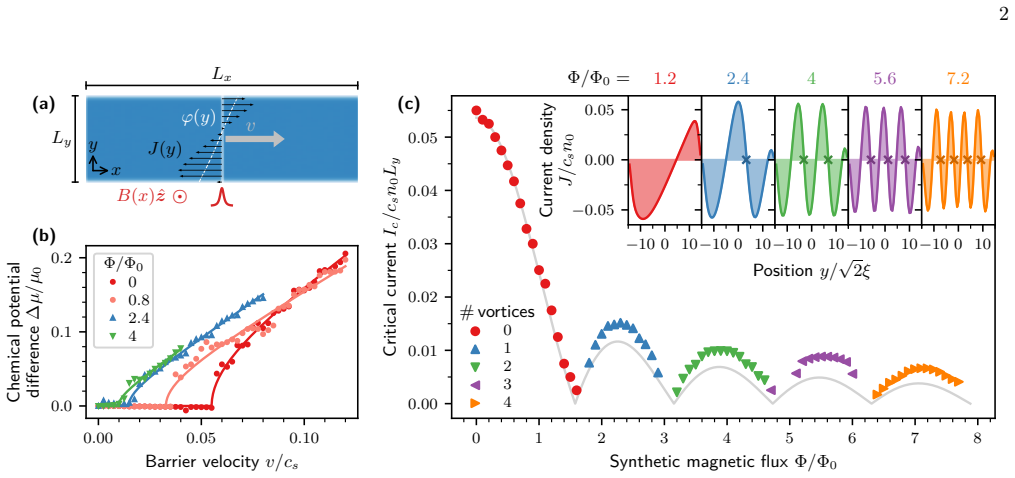
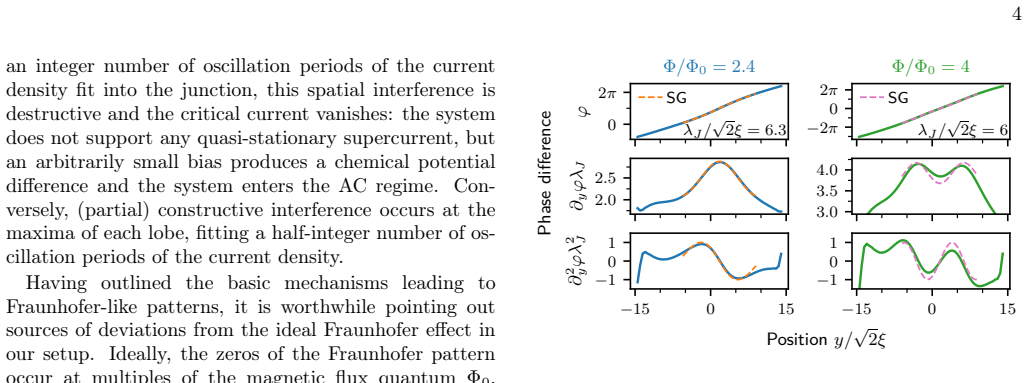
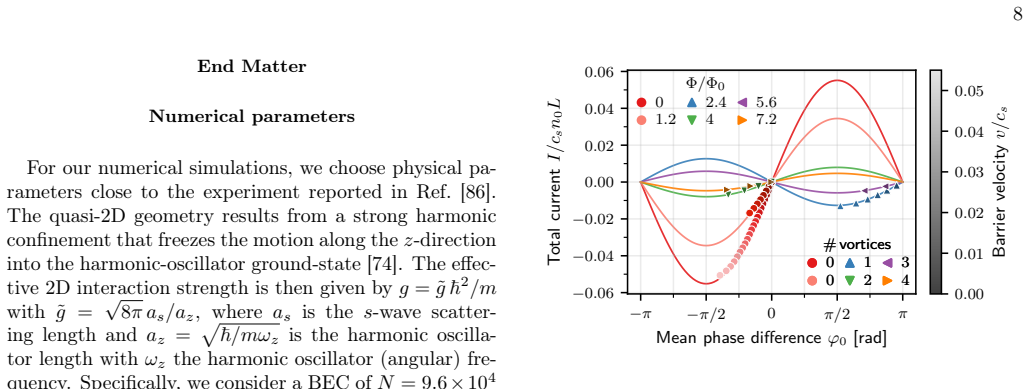
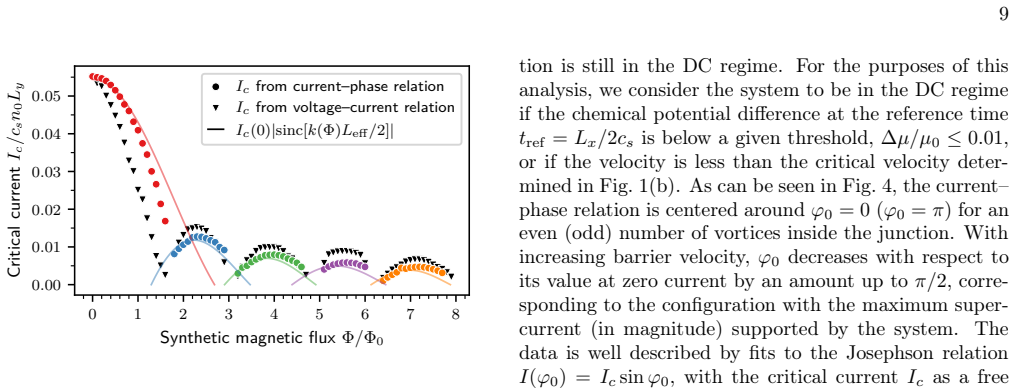
Synthetic magnetic fields induce Fraunhofer-like modulations of the critical current in atomic Josephson junctions. Although analogous to the patterns in superconducting devices, the effect shows distinctive features due to the neutral nature of the superfluid. The underlying spatial interference mechanisms are investigated and the role of Josephson vortices in forming modulated current distributions is clarified through numerical simulations.
What carries the argument
Synthetic magnetic fields applied to neutral atomic superfluids in a Josephson junction, which produce spatially modulated supercurrents through interference and the formation of Josephson vortices.
If this is right
- Atomic Josephson junctions gain tunable control over critical current via applied synthetic fields.
- Spatial coherence in neutral superfluid junctions can be probed with new precision.
- Josephson vortex dynamics become directly observable through current modulation patterns.
- Matter-wave circuits acquire an additional handle for engineering interference effects.
Where Pith is reading between the lines
- Similar setups could map electromagnetic phenomena onto neutral-atom systems for analog simulation.
- Time-dependent synthetic fields might reveal dynamic versions of the same interference patterns.
- The approach connects to broader efforts in engineering gauge fields for ultracold atoms.
Load-bearing premise
The numerical simulations accurately capture the spatial interference and Josephson vortex dynamics without major unaccounted effects from experimental imperfections or model approximations.
What would settle it
An experiment measuring the critical current versus synthetic field strength in an atomic Josephson junction that finds no periodic modulation would contradict the central claim.
Figures


read the original abstract
Driven atomic Josephson junctions allow one to monitor phase-coherent dynamics with unprecedented control and flexibility of the system's physical conditions. While cold-atom manifestations of the Josephson effect have been extensively studied in a wide variety of settings, atomic Josephson junctions in synthetic electromagnetic fields remain largely unexplored. Here, we show that synthetic magnetic fields can induce Fraunhofer-like modulations of the critical current in atomic Josephson junctions. Although this effect presents analogies to the Fraunhofer patterns found in superconducting devices, distinctive features emerge due to the neutral nature of the superfluid. We investigate the underlying spatial interference mechanisms and elucidate the role of Josephson vortices in the formation of spatially modulated current distributions based on numerical simulations. Our results open up new avenues for matter-wave circuits to deepen our understanding of spatial coherence in Josephson junctions, which are fundamental to the development of novel quantum technologies.
Editorial analysis
A structured set of objections, weighed in public.
Referee Report
Summary. The manuscript claims that synthetic magnetic fields induce Fraunhofer-like modulations of the critical current in atomic Josephson junctions. It argues that while analogies exist with superconducting Fraunhofer patterns, distinctive features arise due to the neutral nature of the atomic superfluid. The authors investigate the underlying spatial interference mechanisms and the role of Josephson vortices using numerical simulations, concluding that these results open avenues for matter-wave circuits and quantum technologies.
Significance. If the numerical results hold after validation, the work would be significant for extending Josephson physics to neutral superfluids under synthetic gauge fields, providing a platform to study spatial coherence beyond charged systems. The focus on vortex dynamics and interference mechanisms is a constructive contribution, though the current evidence strength is limited by the absence of reported numerical validation details.
major comments (1)
- [Numerical methods / simulation details] The central claim rests on numerical simulations (presumably of the time-dependent Gross-Pitaevskii equation with synthetic gauge fields). The manuscript provides no convergence tests with respect to grid spacing, system size, or synthetic-field ramp rate in the numerical methods description. Without these, it is not possible to exclude that the reported Fraunhofer-like modulations arise partly from discretization artifacts or boundary effects rather than the claimed physical interference mechanism.
minor comments (1)
- [Abstract] The abstract refers to 'distinctive features due to the neutral nature' without a concise preview of what these features are (e.g., absence of Lorentz force or specific vortex pinning behavior); adding one sentence would improve accessibility.
Simulated Author's Rebuttal
We thank the referee for the careful review and constructive comment on our manuscript. We address the concern regarding numerical validation below and will revise the manuscript accordingly to strengthen the presentation of our results.
read point-by-point responses
-
Referee: The central claim rests on numerical simulations (presumably of the time-dependent Gross-Pitaevskii equation with synthetic gauge fields). The manuscript provides no convergence tests with respect to grid spacing, system size, or synthetic-field ramp rate in the numerical methods description. Without these, it is not possible to exclude that the reported Fraunhofer-like modulations arise partly from discretization artifacts or boundary effects rather than the claimed physical interference mechanism.
Authors: We agree that explicit convergence tests were not reported in the submitted manuscript, which limits the ability to fully assess numerical robustness. In the revised version, we will add a dedicated paragraph in the Methods section (or a new Appendix) providing these details. Our simulations of the time-dependent Gross-Pitaevskii equation with synthetic gauge fields were performed using a standard split-step Fourier method on a grid with spacing Δx ≈ 0.2 ξ (ξ the healing length), a system size large enough that edge densities are <1% of the bulk, and an adiabatic ramp of the synthetic field over timescales ≫ 1/ω_J (Josephson frequency). Additional checks (halving the grid spacing and increasing system size by 25%) show that the period and amplitude of the Fraunhofer-like modulations change by <4%, confirming they arise from the physical interference and vortex dynamics rather than artifacts. These tests will be documented with quantitative figures of merit to address the concern directly. revision: yes
Circularity Check
No circularity: results emerge from independent numerical simulations
full rationale
The paper's central claim—that synthetic magnetic fields induce Fraunhofer-like critical-current modulations—is established via direct numerical integration of the time-dependent Gross-Pitaevskii equation with an added synthetic gauge field. This produces emergent spatial interference patterns and Josephson vortex motion as outputs, without any parameter fitting to target data, self-referential definitions, or load-bearing self-citations. The abstract explicitly frames the investigation as simulation-driven exploration of physical mechanisms rather than an analytical derivation that reduces to its inputs by construction. No ansatzes, uniqueness theorems, or renamings of known results are invoked in the described chain.
Axiom & Free-Parameter Ledger
Reference graph
Works this paper leans on
-
[1]
A. J. Leggett, Macroscopic quantum systems and the quantum theory of measurement, Prog. Theor. Phys. Supp.69, 80 (1980)
1980
-
[2]
Clarke, From slugs to macroscopic quantum phenom- ena (2025), nobel Prize Lecture in Physics, delivered 8 December 2025
J. Clarke, From slugs to macroscopic quantum phenom- ena (2025), nobel Prize Lecture in Physics, delivered 8 December 2025
2025
-
[3]
M. H. Devoret, From macroscopic quantum phenomena to artificial atoms (2025), nobel Prize Lecture in Physics, delivered 8 December 2025
2025
-
[4]
J. M. Martinis, Prehistoric superconducting qubits (2025), nobel Prize Lecture in Physics, delivered 8 De- cember 2025
2025
-
[5]
L. P. Pitaevskii and S. Stringari,Bose–Einstein Con- densation and Superfluidity, 1st ed., International Series of Monographs on Physics, Vol. 164 (Oxford University Press, Oxford, United Kingdom, 2016)
2016
-
[6]
Tinkham,Introduction to Superconductivity, Dover Books on Physics Series (Dover Publications, New York, 2004)
M. Tinkham,Introduction to Superconductivity, Dover Books on Physics Series (Dover Publications, New York, 2004)
2004
-
[7]
A. J. Leggett, Quantum liquids, Science319, 1203 (2008)
2008
-
[8]
A. J. Leggett and F. Sols, On the concept of sponta- neously broken gauge symmetry in condensed matter physics, Found. Phys.21, 353 (1991)
1991
-
[9]
Sachdev,Quantum phases of matter(Cambridge Uni- versity Press, 2023)
S. Sachdev,Quantum phases of matter(Cambridge Uni- versity Press, 2023)
2023
-
[10]
Imry, Physics of mesoscopic systems, inDirections in Condensed Matter Physics: Memorial Volume in Honor of Shang-Keng Ma(World Scientific, 1986) pp
Y. Imry, Physics of mesoscopic systems, inDirections in Condensed Matter Physics: Memorial Volume in Honor of Shang-Keng Ma(World Scientific, 1986) pp. 101–163
1986
-
[11]
J. P. Dowling and G. J. Milburn, Quantum technology: the second quantum revolution, Philos Trans A Math Phys Eng Sci361, 1655 (2003)
2003
-
[12]
A. Acín, I. Bloch, H. Buhrman, T. Calarco, C. Eichler, J. Eisert, D. Esteve, N. Gisin, S. J. Glaser, F. Jelezko, et al., The quantum technologies roadmap: a European community view, New J. Phys.20, 080201 (2018)
2018
-
[13]
W. P. Schleich, K. S. Ranade, C. Anton, M. Arndt, M. Aspelmeyer, M. Bayer, G. Berg, T. Calarco, H. Fuchs, E. Giacobino,et al., Quantum technology: from research to application, Appl. Phys. B122, 130 (2016)
2016
-
[14]
Barone and G
A. Barone and G. Paternò,Physics and applications of the Josephson effect(Wiley, New York, 1982)
1982
-
[15]
Josephson, Possible new effects in superconductive tunnelling, Phys
B. Josephson, Possible new effects in superconductive tunnelling, Phys. Lett.1, 251 (1962)
1962
-
[16]
P. W. Anderson and J. M. Rowell, Probable observation of the Josephson superconducting tunneling effect, Phys. Rev. Lett.10, 230 (1963)
1963
-
[17]
J. M. Rowell, Magnetic field dependence of the Josephson tunnel current, Phys. Rev. Lett.11, 200 (1963)
1963
-
[18]
R. C. Jaklevic, J. Lambe, A. H. Silver, and J. E. Mer- cereau, Quantum interference effects in Josephson tun- neling, Phys. Rev. Lett.12, 159 (1964)
1964
-
[19]
Börcsök, S
B. Börcsök, S. Komori, A. I. Buzdin, and J. W. A. Robin- son, Fraunhofer patterns in magnetic Josephson junc- tions with non-uniform magnetic susceptibility, Sci. Rep. 9, 5347 (2019)
2019
-
[20]
A. Q. Chen, M. J. Park, S. T. Gill, Y. Xiao, D. Reig-i Plessis, G. J. MacDougall, M. J. Gilbert, and N. Mason, Finite momentum Cooper pairing in three-dimensional topologicalinsulatorJosephsonjunctions,Nat.Commun. 6 9, 3478 (2018)
2018
-
[21]
Yabuki, R
N. Yabuki, R. Moriya, M. Arai, Y. Sata, S. Morikawa, S. Masubuchi, and T. Machida, Supercurrent in van der Waals Josephson junction, Nat. Commun.7, 10616 (2016)
2016
-
[22]
Ghatak, O
S. Ghatak, O. Breunig, F. Yang, Z. Wang, A. A. Taskin, and Y. Ando, Anomalous Fraunhofer patterns in gated Josephson junctions based on the bulk-insulating topo- logical insulator BiSbTeSe2, Nano Lett.18, 5124 (2018)
2018
-
[23]
Rashidi, W
A. Rashidi, W. Huynh, B. Guo, S. Ahadi, and S. Stem- mer, Vortex-induced anomalies in the superconducting quantum interference patterns of topological insulator Josephson junctions, npj Quantum Mater.9, 70 (2024)
2024
-
[24]
Bloch, J
I. Bloch, J. Dalibard, and S. Nascimbene, Quantum sim- ulations with ultracold quantum gases, Nat. Phys.8, 267 (2012)
2012
-
[25]
Yago Malo, L
J. Yago Malo, L. Lepori, L. Gentini, and M. L. Chio- falo, Atomic quantum technologies for quantum matter and fundamental physics applications, Technologies12, 64 (2024)
2024
-
[26]
Amico, D
L. Amico, D. Anderson, M. Boshier, J.-P. Brantut, L.-C. Kwek, A. Minguzzi, and W. von Klitzing, Colloquium: Atomtronic circuits: From many-body physics to quan- tum technologies, Rev. Mod. Phys.94, 041001 (2022)
2022
-
[27]
J. Polo, W. J. Chetcuti, E. C. Domanti, P. Kitson, A. Os- terloh, F. Perciavalle, V. P. Singh, and L. Amico, Per- spective on new implementations of atomtronic circuits, Quantum Sci. Technol.9, 030501 (2024)
2024
-
[28]
Raghavan, A
S. Raghavan, A. Smerzi, S. Fantoni, and S. R. Shenoy, Coherent oscillations between two weakly coupled Bose- Einstein condensates: Josephson effects,πoscillations, and macroscopic quantum self-trapping, Phys. Rev. A 59, 620 (1999)
1999
-
[29]
Giovanazzi, A
S. Giovanazzi, A. Smerzi, and S. Fantoni, Josephson ef- fects in dilute Bose–Einstein condensates, Phys. Rev. Lett.84, 4521 (2000)
2000
-
[30]
Meier and W
F. Meier and W. Zwerger, Josephson tunneling between weakly interacting Bose–Einstein condensates, Phys. Rev. A64, 033610 (2001)
2001
-
[31]
J. Polo, V. Ahufinger, F. W. J. Hekking, and A. Min- guzzi, Damping of Josephson oscillations in strongly cor- related one-dimensional atomic gases, Phys. Rev. Lett. 121, 090404 (2018)
2018
-
[32]
J.Polo, R.Dubessy, P.Pedri, H.Perrin,andA.Minguzzi, Oscillations and decay of superfluid currents in a one- dimensional Bose gas on a ring, Phys. Rev. Lett.123, 195301 (2019)
2019
-
[33]
V. P. Singh, N. Luick, L. Sobirey, and L. Mathey, Joseph- son junction dynamics in a two-dimensional ultracold Bose gas, Phys. Rev. Res.2, 033298 (2020)
2020
-
[34]
A. K. Saha and R. Dubessy, Dynamical phase diagram of a one-dimensional Bose gas in a box with a tunable weak link: From Bose–Josephson oscillations to shock waves, Phys. Rev. A104, 023316 (2021)
2021
-
[35]
Zaccanti and W
M. Zaccanti and W. Zwerger, Critical Josephson current in BCS-BEC–crossover superfluids, Phys. Rev. A100, 063601 (2019)
2019
-
[36]
Xhani, E
K. Xhani, E. Neri, L. Galantucci, F. Scazza, A. Burchi- anti, K.-L. Lee, C. F. Barenghi, A. Trombettoni, M. In- guscio, M. Zaccanti, G. Roati, and N. P. Proukakis, Critical Transport and Vortex Dynamics in a Thin Atomic Josephson Junction, Phys. Rev. Lett.124, 045301 (2020)
2020
-
[37]
Xhani, L
K. Xhani, L. Galantucci, C. F. Barenghi, G. Roati, A. Trombettoni, and N. P. Proukakis, Dynamical phase diagram of ultracold Josephson junctions, New J. Phys. 22, 123006 (2020)
2020
-
[38]
Wlazłowski, K
G. Wlazłowski, K. Xhani, M. Tylutki, N. P. Proukakis, and P. Magierski, Dissipation Mechanisms in Fermionic Josephson Junction, Phys. Rev. Lett.130, 023003 (2023)
2023
-
[39]
Jährling, V
S. Jährling, V. P. Singh, and L. Mathey, Designing atom- tronic circuits via superfluid dynamics, Phys. Rev. Res. 7, 033112 (2025)
2025
-
[40]
F. S. Cataliotti, S. Burger, C. Fort, P. Maddaloni, F. Mi- nardi, A. Trombettoni, A. Smerzi, and M. Inguscio, Josephson Junction Arrays with Bose-Einstein Conden- sates, Science293, 843 (2001)
2001
-
[41]
Albiez, R
M. Albiez, R. Gati, J. Fölling, S. Hunsmann, M. Cris- tiani,andM.K.Oberthaler,Directobservationoftunnel- ingandnonlinearself-trappinginasinglebosonicJoseph- son junction, Phys. Rev. Lett.95, 010402 (2005)
2005
-
[42]
S. Levy, E. Lahoud, I. Shomroni, and J. Steinhauer, The a.c. and d.c. Josephson effects in a Bose–Einstein con- densate, Nature449, 579 (2007)
2007
-
[43]
Luick, L
N. Luick, L. Sobirey, M. Bohlen, V. P. Singh, L. Mathey, T. Lompe, and H. Moritz, An ideal Josephson junction in an ultracold two-dimensional Fermi gas, Science369, 89 (2020)
2020
-
[44]
L. J. LeBlanc, A. B. Bardon, J. McKeever, M. H. T. Extavour, D. Jervis, J. H. Thywissen, F. Piazza, and A. Smerzi, Dynamics of a tunable superfluid junction, Phys. Rev. Lett.106, 025302 (2011)
2011
-
[45]
S.-C. Ji, T. Schweigler, M. Tajik, F. Cataldini, J. a. Sabino, F. S. Møller, S. Erne, and J. Schmiedmayer, Floquet engineering a bosonic Josephson junction, Phys. Rev. Lett.129, 080402 (2022)
2022
-
[46]
Valtolina, A
G. Valtolina, A. Burchianti, A. Amico, E. Neri, K. Xhani, J. A. Seman, A. Trombettoni, A. Smerzi, M. Zaccanti, M. Inguscio, and G. Roati, Josephson effect in fermionic superfluids across the BEC–BCS crossover, Science350, 1505 (2015)
2015
-
[47]
Spagnolli, G
G. Spagnolli, G. Semeghini, L. Masi, G. Ferioli, A. Trenkwalder, S. Coop, M. Landini, L. Pezzè, G. Mod- ugno, M. Inguscio, A. Smerzi, and M. Fattori, Crossing Over from Attractive to Repulsive Interactions in a Tun- nelingBosonicJosephsonJunction,Phys.Rev.Lett.118, 230403 (2017)
2017
-
[48]
Burchianti, F
A. Burchianti, F. Scazza, A. Amico, G. Valtolina, J. A. Seman, C. Fort, M. Zaccanti, M. Inguscio, and G. Roati, Connecting Dissipation and Phase Slips in a Joseph- son Junction between Fermionic Superfluids, Phys. Rev. Lett.120, 025302 (2018)
2018
-
[49]
W. J. Kwon, G. Del Pace, R. Panza, M. Inguscio, W. Zw- erger, M. Zaccanti, F. Scazza,and G.Roati, Stronglycor- related superfluid order parameters from DC Josephson supercurrents, Science369, 84 (2020)
2020
-
[50]
Del Pace, W
G. Del Pace, W. J. Kwon, M. Zaccanti, G. Roati, and F. Scazza, Tunneling transport of unitary fermions across the superfluid transition, Phys. Rev. Lett.126, 055301 (2021)
2021
-
[51]
K. S. Gan, V. P. Singh, L. Amico, and R. Dumke, Joseph- son Dynamics in 2D Ring-shaped Condensates (2025), arXiv:2509.00533
work page internal anchor Pith review Pith/arXiv arXiv 2025
-
[52]
L. Pezzè, K. Xhani, C. Daix, N. Grani, B. Donelli, F. Scazza, D. Hernandez-Rajkov, W. J. Kwon, G. Del Pace, and G. Roati, Stabilizing persistent cur- rents in an atomtronic Josephson junction necklace, Na- 7 ture Communications15, 10.1038/s41467-024-47759-7 (2024)
- [53]
-
[54]
V. P. Singh, J. Polo, L. Mathey, and L. Amico, Shapiro steps in driven atomic Josephson junctions, Phys. Rev. Lett.133, 093401 (2024)
2024
-
[55]
Del Pace, D
G. Del Pace, D. Hernández-Rajkov, V. P. Singh, N. Grani, M. F. Fernández, G. Nesti, J. A. Seman, M. In- guscio, L.Amico,andG.Roati,Shapirostepsinstrongly- interacting Fermi gases, Science390, 1125 (2025)
2025
-
[56]
Bernhart, M
E. Bernhart, M. Röhrle, V. P. Singh, L. Mathey, L. Am- ico, and H. Ott, Observation of Shapiro steps in an ul- tracold atomic Josephson junction, Science390, 1130 (2025)
2025
- [57]
-
[58]
V. P. Singh, L. Amico, and L. Mathey, Atomic Josephson parametric amplifier, Phys. Rev. Res.8, L012067 (2026)
2026
-
[59]
and Mishra, Pankaj Kumar, Fractional Shapiro steps in a cavity-coupled Josephson ring conden- sate, Phys
Pradhan, Nalinikanta and Kanamoto, Rina and Bhat- tacharya, M. and Mishra, Pankaj Kumar, Fractional Shapiro steps in a cavity-coupled Josephson ring conden- sate, Phys. Rev. Res.7, 043188 (2025)
2025
-
[60]
B. Zhu, V. P. Singh, J. Okamoto, and L. Mathey, Dynam- ical control of the conductivity of an atomic Josephson junction, Phys. Rev. Res.3, 013111 (2021)
2021
-
[61]
van Houselt and H
A. van Houselt and H. J. Zandvliet, Colloquium: Time- resolved scanning tunneling microscopy, Rev. Mod. Phys. 82, 1593 (2010)
2010
-
[62]
Andersen, C
M. Andersen, C. Ryu, P. Cladé, V. Natarajan, A. Vaziri, K. Helmerson, and W. Phillips, Quantized rotation of atoms from photons with orbital angular momentum, Phys. Rev. Lett.97, 170406 (2006)
2006
-
[63]
Cooper, Rapidly rotating atomic gases, Adv
N. Cooper, Rapidly rotating atomic gases, Adv. Phys. 57, 539 (2008)
2008
-
[64]
A. L. Fetter, Rotating trapped Bose–Einstein conden- sates, Rev. Mod. Phys.81, 647 (2009)
2009
-
[65]
Andrelczyk, M
G. Andrelczyk, M. Brewczyk, L. Dobrek, M. Gajda, and M. Lewenstein, Optical generation of vortices in trapped Bose–Einstein condensates, Phys. Rev. A64, 043601 (2001)
2001
-
[66]
Kumar, R
A. Kumar, R. Dubessy, T. Badr, C. De Rossi, M. de Goër de Herve, L. Longchambon, and H. Perrin, Producing superfluid circulation states using phase im- printing, Phys. Rev. A97, 043615 (2018)
2018
-
[67]
Del Pace, K
G. Del Pace, K. Xhani, A. Muzi Falconi, M. Fedrizzi, N. Grani, D. Hernandez Rajkov, M. Inguscio, F. Scazza, W. J. Kwon, and G. Roati, Imprinting persistent cur- rents in tunable fermionic rings, Phys. Rev. X12, 041037 (2022)
2022
-
[68]
Dalibard, F
J. Dalibard, F. Gerbier, G. Juzeli¯ unas, and P. Öh- berg, Colloquium: Artificial gauge potentials for neutral atoms, Rev. Mod. Phys.83, 1523 (2011)
2011
-
[69]
Goldman, G
N. Goldman, G. Juzeli¯ unas, P. Öhberg, and I. B. Spiel- man, Light-induced gauge fields for ultracold atoms, Rep. Prog. Phys.77, 126401 (2014)
2014
-
[70]
Ustinov, Solitons in Josephson junctions, Phys
A. Ustinov, Solitons in Josephson junctions, Phys. D: NonlinearPhenom.123,315(1998),annualInternational Conference of the Center for Nonlinear Studies
1998
-
[71]
Y.-J. Lin, R. L. Compton, K. Jiménez-García, J. V. Porto, and I. B. Spielman, Synthetic magnetic fields for ultracold neutral atoms, Nature462, 628 (2009)
2009
-
[72]
See Supplemental Material
-
[73]
The synthetic vector potential and magnetic field enter all physical quantities exclusively in the formqAandqB, such that the synthetic chargeqcan be chosen arbitrarily
-
[74]
Hadzibabic and J
Z. Hadzibabic and J. Dalibard, Two-dimensional Bose fluids: An atomic physics perspective, Riv. Nuovo Cim. 34, 389 (2011)
2011
-
[75]
V. M. Kaurov and A. B. Kuklov, Atomic Josephson vor- tices, Phys. Rev. A73, 013627 (2006)
2006
-
[76]
S.-W.Su, S.-C.Gou, A.Bradley, O.Fialko,andJ.Brand, Kibble–Zurek scaling and its breakdown for spontaneous generation of Josephson vortices in Bose–Einstein con- densates, Phys. Rev. Lett.110, 215302 (2013)
2013
-
[77]
S. S. Shamailov and J. Brand, Quasiparticles of widely tuneable inertial mass: The dispersion relation of atomic Josephson vortices and related solitary waves, SciPost Phys.4, 018 (2018)
2018
-
[78]
Plastovets and A
V. Plastovets and A. S. Mel’nikov, Electronic structure of a josephson vortex in a SIS junction, Phys. Rev. B 105, 094516 (2022)
2022
-
[79]
Roditchev, C
D. Roditchev, C. Brun, L. Serrier-Garcia, J. C. Cuevas, V. H. L. Bessa, M. V. Milošević, F. Debontridder, V. Stolyarov, and T. Cren, Direct observation of Joseph- son vortex cores, Nat. Phys.11, 332 (2015)
2015
-
[80]
S. Chen, S. Park, U. Vool, N. Maksimovic, D. A. Broad- way, M. Flaks, T. X. Zhou, P. Maletinsky, A. Stern, B. I. Halperin, and A. Yacoby, Current induced hidden states in Josephson junctions, Nat. Commun.15, 8059 (2024)
2024
discussion (0)
Sign in with ORCID, Apple, or X to comment. Anyone can read and Pith papers without signing in.