Recognition: unknown
Emerging Diversity Among the Main-Belt Comets: Insights from JWST and Ground-Based Observations of 457P/Lemmon-PANSTARRS
Pith reviewed 2026-05-08 09:15 UTC · model grok-4.3
The pith
Main-belt comet 457P shows clear dust activity but no detectable water or other gases in JWST spectra.
A machine-rendered reading of the paper's core claim, the machinery that carries it, and where it could break.
Core claim
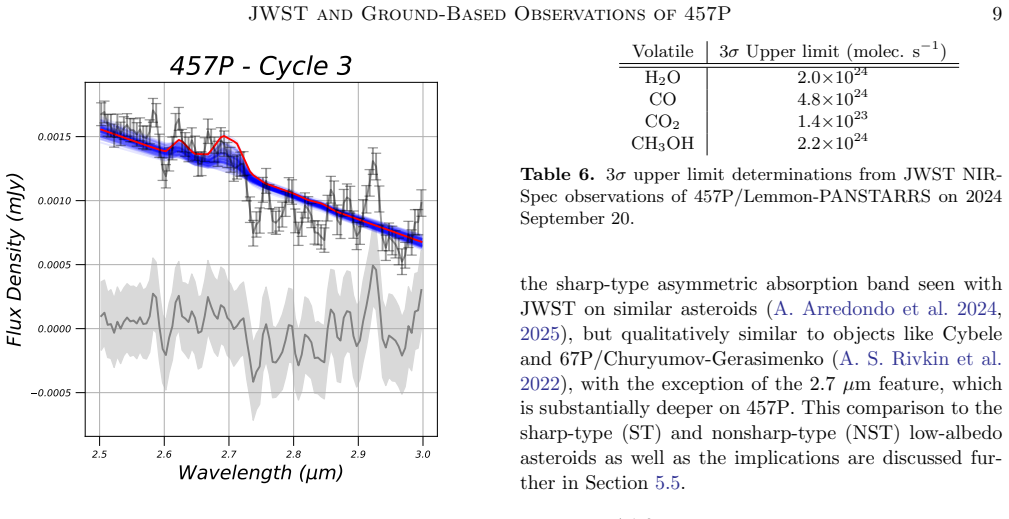
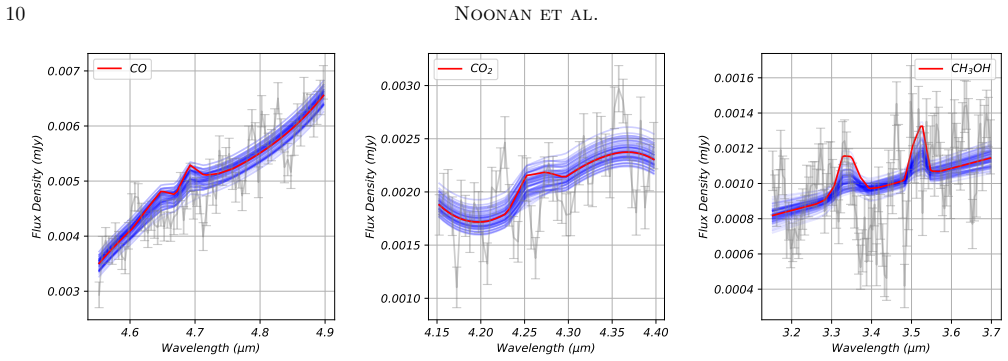
Despite unambiguous dust activity in both ground-based and JWST images, no H2O, CO, CO2, or CH3OH lines were detected, yielding an upper limit of Q(H2O) less than 2x10^24 molecules per second, equivalent to 0.035 kg/s. Because 457P lies inside the 5:2 mean-motion resonance with Jupiter, it is the first main-belt comet with a smaller semi-major axis to receive such sensitive gas searches. The authors conclude that 457P is likely more depleted in volatiles than the outer-belt objects 238P and 358P, whose dust-to-gas ratios had been used to predict detectable gas levels.
What carries the argument
Upper limits on molecular production rates derived from non-detections in NIRSpec spectra, compared against expected gas output scaled from dust activity using ratios measured in other main-belt comets.
If this is right
- Activity in main-belt comets is not uniform and may vary with orbital distance from the Sun.
- Some objects may sustain dust ejection with lower volatile content than previously assumed.
- Surveys that combine imaging with spectroscopy across a range of semi-major axes will distinguish between a continuous spectrum and distinct subclasses.
- Ice survival models for the asteroid belt must incorporate objects that produce little or no detectable gas.
Where Pith is reading between the lines
- Dust activity in 457P could be driven by less volatile ices or by non-sublimation processes such as rotational ejection of surface material.
- The diversity of main-belt comet behavior implies that their parent bodies experienced different thermal histories or formed at different distances.
- Targeted observations of inner main-belt active asteroids could test whether low gas output is common inside the 5:2 resonance.
Load-bearing premise
That the dust seen in 457P is driven by the same water-ice sublimation process that powers activity in the previously observed main-belt comets, so that gas production can be reliably predicted from the observed dust.
What would settle it
Detection of water or other gas lines at production rates above 2x10^24 molecules per second during a future active phase would show that 457P is not depleted relative to the other main-belt comets.
Figures




read the original abstract
We present JWST NIRSpec and NIRCam observations of 457P/Lemmon-PANSTARRS, a main-belt comet that displayed activity around its 2020 perihelion and that was observed to regain activity during its 2024 perihelion by a ground-based observing campaign. The previous successful measurements of water production from two main-belt comets by the JWST NIRSpec instrument confirmed the hypothesis that H2O reservoirs are responsible for activity in dynamically stable main-belt comets. However, the main-belt comets observed with JWST thus far, 238P/Read and 358P/PANSTARRS, occupy orbits in the outer main-belt, with main-belt comets with smaller semi-major axes not yet sensitively tested for H2O. We find that despite clearly displaying dust activity in both ground-based and JWST imaging over a broad period, there were no corresponding H2O, CO, CO2, or CH3OH emissions within sensitive upper limits; notable given 457P is the first main-belt comet with a semi-major axis within the 5:2 mean-motion resonance with Jupiter. We show that we were sensitive to production rates of gas predicted by the dust/gas ratios of 238P and 358P, and hypothesize that 457P may be more depleted than its companions; Q(H2O) must be less than 2x10^24 molecules/s, or 0.035 kg/s. Further surveying of main-belt comets across the parameter space of semi-major axis and eccentricity will shed light on whether 457P represents an edge member of a spectrum or a distinct subclass of main-belt comets.
Editorial analysis
A structured set of objections, weighed in public.
Referee Report
Summary. The manuscript reports JWST NIRSpec and NIRCam observations of main-belt comet 457P/Lemmon-PANSTARRS, which showed dust activity in both JWST and ground-based imaging around its 2024 perihelion. No H2O, CO, CO2, or CH3OH emissions were detected despite the dust activity, yielding an upper limit Q(H2O) < 2×10^24 molecules/s (0.035 kg/s). The authors note that 457P is the first MBC with semi-major axis inside the 5:2 Jupiter resonance and hypothesize that it is more volatile-depleted than the previously JWST-observed MBCs 238P and 358P, based on the non-detection being sensitive to gas rates expected from their dust/gas ratios.
Significance. If the sensitivity claim holds, the work demonstrates diversity in volatile content among MBCs and provides the first sensitive gas constraint for an inner-main-belt object, with implications for formation locations and activity drivers. The direct non-detection plus quantitative upper limit is a clear observational result that can be tested with future observations across the semi-major-axis range.
major comments (2)
- Abstract: the assertion that the observations were sensitive to gas production rates 'predicted by the dust/gas ratios of 238P and 358P' is load-bearing for the depletion hypothesis, yet the text provides no quantitative dust metrics (Afρ, mass-loss rate, or coma brightness) for 457P nor a direct numerical comparison to the prior objects. Without these values the scaling cannot be verified and the non-detection does not yet demonstrate greater depletion.
- The derivation of the Q(H2O) < 2×10^24 molecules/s upper limit requires explicit statement of the assumed dust-to-gas ratio, the specific line sensitivities used, and the error analysis from the non-detection; these details are needed to assess whether the limit is robust against variations in activity level or mechanism.
minor comments (2)
- The abstract should state the semi-major axis of 457P numerically to allow immediate comparison with 238P and 358P.
- Clarify the exact epochs of the JWST and ground-based observations relative to perihelion and to each other.
Simulated Author's Rebuttal
We thank the referee for their constructive and detailed review. We agree that the manuscript would benefit from greater quantitative transparency in the abstract and methods to support the sensitivity and depletion claims. We address each major comment below and have revised the manuscript accordingly.
read point-by-point responses
-
Referee: Abstract: the assertion that the observations were sensitive to gas production rates 'predicted by the dust/gas ratios of 238P and 358P' is load-bearing for the depletion hypothesis, yet the text provides no quantitative dust metrics (Afρ, mass-loss rate, or coma brightness) for 457P nor a direct numerical comparison to the prior objects. Without these values the scaling cannot be verified and the non-detection does not yet demonstrate greater depletion.
Authors: We acknowledge that the abstract as originally written did not include the specific numerical dust metrics needed for immediate verification of the scaling. The main text does report Afρ and mass-loss rate estimates for 457P from both ground-based and JWST data, along with comparisons to other MBCs, but we agree these should be summarized in the abstract for clarity. We have revised the abstract to include the measured Afρ value for 457P and a direct numerical comparison to the dust production levels of 238P and 358P, thereby allowing readers to confirm that the non-detection is sensitive to the gas rates expected from those ratios. revision: yes
-
Referee: The derivation of the Q(H2O) < 2×10^24 molecules/s upper limit requires explicit statement of the assumed dust-to-gas ratio, the specific line sensitivities used, and the error analysis from the non-detection; these details are needed to assess whether the limit is robust against variations in activity level or mechanism.
Authors: We agree that the original text did not provide a fully self-contained derivation of the upper limit. In the revised manuscript we have expanded the relevant methods and results sections to explicitly state the dust-to-gas ratio adopted for the sensitivity calculation, the specific NIRSpec line sensitivities and integration times used for H2O, CO, CO2, and CH3OH, and the statistical error analysis (including the 3-sigma threshold applied to the non-detection). We also include a brief discussion of how the limit remains robust under reasonable variations in activity level or dust-to-gas ratio. revision: yes
Circularity Check
No circularity: direct observational upper limits from non-detections
full rationale
The paper reports JWST and ground-based imaging plus spectroscopy of 457P showing dust activity but no detectable H2O, CO, CO2 or CH3OH lines, yielding a direct upper limit Q(H2O) < 2e24 molecules/s. The statement that observations were sensitive to gas rates 'predicted by the dust/gas ratios of 238P and 358P' uses external prior measurements only for context and sensitivity scaling; it does not reduce the upper-limit claim to any fitted parameter, self-definition, or equation within this work. No derivations, ansatzes, or uniqueness theorems appear. The result is self-contained empirical non-detection.
Axiom & Free-Parameter Ledger
Reference graph
Works this paper leans on
-
[1]
Agarwal, J., Kim, Y., Kelley, M. S. P., & Marschall, R. 2023, Dust Emission and Dynamics, arXiv e-prints, arXiv:2309.12759, doi: 10.48550/arXiv.2309.12759
-
[2]
Agarwal, J., & Mommert, M. 2018, Nucleus of active asteroid 358P/Pan-STARRS (P/2012 T1), A&A, 616, A54, doi: 10.1051/0004-6361/201832761 A’Hearn, M. F., Millis, R. C., Schleicher, D. O., Osip, D. J., & Birch, P. V. 1995, The ensemble properties of comets: Results from narrowband photometry of 85 comets, 1976-1992., Icarus, 118, 223, doi: 10.1006/icar.1995...
-
[3]
Arredondo, A., Becker, T. M., McAdam, M. M., et al. 2025, JWST Spectroscopy of (142) Polana: Connection to NEAs (101955) Bennu and (162173) Ryugu, PSJ, 6, 195, doi: 10.3847/PSJ/ade395
-
[4]
2024, JWST observations of asteroids (142) Polana and (225) Henrietta, in AAS/Division for Planetary Sciences Meeting Abstracts, Vol
Rivkin, A. 2024, JWST observations of asteroids (142) Polana and (225) Henrietta, in AAS/Division for Planetary Sciences Meeting Abstracts, Vol. 56, AAS/Division for Planetary Sciences Meeting Abstracts, 411.02 Astropy Collaboration, Price-Whelan, A. M., Sip˝ ocz, B. M., et al. 2018, The Astropy Project: Building an Open-science Project and Status of the ...
2024
-
[5]
Package, AJ, 156, 123, doi: 10.3847/1538-3881/aabc4f
-
[6]
Bida, T. A., Dunham, E. W., Massey, P., & Roe, H. G. 2014, Ground-based and Airborne Instrumentation for Astronomy V, in Proc. SPIE, Vol. 9147, Ground-based and Airborne Instrumentation for Astronomy V, 91472N, doi: 10.1117/12.2056872
-
[7]
Bohlin, R. C., Krick, J. E., Gordon, K. D., & Hubeny, I. 2022, How Do Spitzer IRAC Fluxes Compare to HST CALSPEC?, AJ, 164, 10, doi: 10.3847/1538-3881/ac6fe1 B¨ oker, T., Beck, T. L., Birkmann, S. M., et al. 2023, In-orbit Performance of the Near-infrared Spectrograph NIRSpec on the James Webb Space Telescope, PASP, 135, 038001, doi: 10.1088/1538-3873/acb846
-
[8]
F., Vokrouhlick´ y, D., Walsh, K
Bottke, W. F., Vokrouhlick´ y, D., Walsh, K. J., et al. 2015, In search of the source of asteroid (101955) Bennu: Applications of the stochastic YORP model, Icarus, 247, 191, doi: 10.1016/j.icarus.2014.09.046
-
[9]
T., Yeomans, D., Housen, K., & Consolmagno, G
Britt, D. T., Yeomans, D., Housen, K., & Consolmagno, G. 2002, Asteroids III (Tucson, University of Arizona Press), 485–500
2002
-
[10]
Burns, J. A., Lamy, P. L., & Soter, S. 1979, Radiation forces on small particles in the solar system, Icarus, 40, 1, doi: 10.1016/0019-1035(79)90050-2
-
[11]
2023, Zenodo, doi: 10.5281/zenodo.10022973
Bushouse, H., Eisenhamer, J., Dencheva, N., et al. 2023, JWST Calibration Pipeline, 1.12.5 Zenodo, doi: 10.5281/zenodo.10022973
-
[12]
1984, The ESO Faint Object Spectrograph and Camera / EFOSC, The Messenger, 38, 9
Buzzoni, B., Delabre, B., Dekker, H., et al. 1984, The ESO Faint Object Spectrograph and Camera / EFOSC, The Messenger, 38, 9
1984
-
[13]
2012, Planetary and Space Science, 73, 98–118, doi: 10.1016/j.pss.2012.03.009
Carry, B. 2012, Density of asteroids, Planet. Space Sci., 73, 98, doi: 10.1016/j.pss.2012.03.009
-
[14]
O., Kueny, J., Gustafsson, A., et al
Chandler, C. O., Kueny, J., Gustafsson, A., et al. 2019, Six Years of Sustained Activity in (6478) Gault, ApJL, 877, L12, doi: 10.3847/2041-8213/ab1aaa
-
[15]
Combi, M. R., M¨ akinen, T. T., Bertaux, J. L., Qu´ emerais, E., & Ferron, S. 2019, A survey of water production in 61 comets from SOHO/SWAN observations of hydrogen Lyman-alpha: Twenty-one years 1996-2016, Icarus, 317, 610, doi: 10.1016/j.icarus.2018.08.031
-
[16]
Cowan, J. J., & A’Hearn, M. F. 1979, Vaporization of comet nuclei: Light curves and life times, Moon and Planets, 21, 155, doi: 10.1007/BF00897085
-
[17]
2023, astropy/ccdproc: 2.4.1, 2.4.1 Zenodo, doi: 10.5281/zenodo.7986923
Craig, M., Crawford, S., Seifert, M., et al. 2023, astropy/ccdproc: 2.4.1, 2.4.1 Zenodo, doi: 10.5281/zenodo.7986923
-
[18]
, year = 2011, month = mar, volume =
Dressler, A., Bigelow, B., Hare, T., et al. 2011, IMACS: The Inamori-Magellan Areal Camera and Spectrograph on Magellan-Baade, PASP, 123, 288, doi: 10.1086/658908
-
[19]
, year = 2012, month = nov, volume =
Fink, U., & Rubin, M. 2012, The calculation of Afρand mass loss rate for comets, Icarus, 221, 721, doi: 10.1016/j.icarus.2012.09.001
-
[20]
541, Astronomical Data Analysis Software and Systems XXXIII
Fitzpatrick, M., Placco, V., Bolton, A., et al. 2024, Modernizing IRAF to Support Gemini Data Reduction, arXiv e-prints, arXiv:2401.01982, doi: 10.48550/arXiv.2401.01982
-
[21]
and Lang, Dustin and Goodman, Jonathan , title =
Foreman-Mackey, D., Hogg, D. W., Lang, D., & Goodman, J. 2013, emcee: The MCMC Hammer, PASP, 125, 306, doi: 10.1086/670067
-
[22]
Gardner, J. P., Mather, J. C., Abbott, R., et al. 2023, The James Webb Space Telescope Mission, PASP, 135, 068001, doi: 10.1088/1538-3873/acd1b5
-
[23]
2016, On-sky commissioning of Hamamatsu CCDs in GMOS-S, in Proc
Gimeno, G., Roth, K., Chiboucas, K., et al. 2016, On-sky commissioning of Hamamatsu CCDs in GMOS-S, in Proc. SPIE, Vol. 9908, Ground-based and Airborne Instrumentation for Astronomy VI, 99082S, doi: 10.1117/12.2233883
-
[24]
D., Yeomans, D
Giorgini, J. D., Yeomans, D. K., Chamberlin, A. B., et al. 1996, JPL’s On-Line Solar System Data Service, American Astronomical Society, 28, 25.04 JWST and Ground-Based Observations of 457P25
1996
-
[25]
Gomes, R., Levison, H. F., Tsiganis, K., & Morbidelli, A. 2005, Origin of the cataclysmic Late Heavy Bombardment period of the terrestrial planets, Nature, 435, 466, doi: 10.1038/nature03676
-
[26]
Hamilton, V. E., Kaplan, H. H., Connolly, H. C., et al. 2022, GRO 95577 (CR1) as a mineralogical analogue for asteroid (101955) Bennu, Icarus, 383, 115054, doi: 10.1016/j.icarus.2022.115054
-
[27]
1980, The sun among the stars
Hardorp, J. 1980, The sun among the stars. III - Energy distributions of 16 northern G-type stars and the solar flux calibration, A&A, 91, 221
1980
-
[28]
Holmberg, J., Flynn, C., & Portinari, L. 2006, The colours of the Sun, MNRAS, 367, 449, doi: 10.1111/j.1365-2966.2005.09832.x
-
[29]
Hook, I. M., Jørgensen, I., Allington-Smith, J. R., et al. 2004, The Gemini-North Multi-Object Spectrograph: Performance in Imaging, Long-Slit, and Multi-Object Spectroscopic Modes, PASP, 116, 425, doi: 10.1086/383624
-
[30]
H., Forshay, P., & Schwamb, M
Hsieh, H. H., Forshay, P., & Schwamb, M. 2016, Comet 238P/Read, Central Bureau Electronic Telegrams, 4307
2016
-
[31]
Hsieh, H. H., & Haghighipour, N. 2016, Potential Jupiter-Family comet contamination of the main asteroid belt, Icarus, 277, 19, doi: 10.1016/j.icarus.2016.04.043
-
[32]
Hsieh, H. H., Ishiguro, M., Knight, M. M., et al. 2018, The Reactivation and Nucleus Characterization of Main-belt Comet 358P/PANSTARRS (P/2012 T1), AJ, 156, 39, doi: 10.3847/1538-3881/aac81c
-
[33]
Hsieh, H. H., Ishiguro, M., Knight, M. M., et al. 2021, The Reactivation of Main-belt Comet 259P/Garradd (P/2008 R1), PSJ, 2, 62, doi: 10.3847/PSJ/abe59d
-
[34]
Hsieh, H. H., & Jewitt, D. 2006, A Population of Comets in the Main Asteroid Belt, Science, 312, 561, doi: 10.1126/science.1125150
-
[35]
Hsieh, H. H., Jewitt, D., & Ishiguro, M. 2009, Physical Properties of Main-Belt Comet P/2005 U1 (Read), AJ, 137, 157, doi: 10.1088/0004-6256/137/1/157
-
[36]
H., Yang, B., & Haghighipour, N
Hsieh, H. H., Yang, B., & Haghighipour, N. 2012, Optical and Dynamical Characterization of Comet-like Main-belt Asteroid (596) Scheila, ApJ, 744, 9, doi: 10.1088/0004-637X/744/1/9
-
[37]
Hsieh, H. H., Micheli, M., Kelley, M. S. P., et al. 2023, Observational Characterization of Main-Belt Comet and Candidate Main-Belt Comet Nuclei, PSJ, 4, 43, doi: 10.3847/PSJ/acbdfe
-
[38]
Hsieh, H. H., Noonan, J. W., Kelley, M. S. P., et al. 2025a, The Volatile Composition and Activity Evolution of Main-belt Comet 358P/PANSTARRS, PSJ, 6, 3, doi: 10.3847/PSJ/ad9199
-
[39]
N., Pierens, A., et al
Izidoro, A., Raymond, S. N., Pierens, A., et al. 2016, The Asteroid Belt as a Relic from a Chaotic Early Solar
2016
-
[40]
System, ApJ, 833, 40, doi: 10.3847/1538-4357/833/1/40
-
[41]
2022, A&A, 661, A80, doi: 10.1051/0004-6361/202142663
Jakobsen, P., Ferruit, P., Alves de Oliveira, C., et al. 2022, The Near-Infrared Spectrograph (NIRSpec) on the James Webb Space Telescope. I. Overview of the instrument and its capabilities, A&A, 661, A80, doi: 10.1051/0004-6361/202142663
work page internal anchor Pith review doi:10.1051/0004-6361/202142663 2022
-
[42]
Jewitt, D., & Hsieh, H. H. 2022, The Asteroid-Comet Continuum, arXiv e-prints, arXiv:2203.01397, doi: 10.48550/arXiv.2203.01397
-
[43]
Jewitt, D., & Hsieh, H. H. 2024, The Asteroid-Comet Continuum, in Comets III, ed. K. J. Meech, M. R
2024
-
[44]
Jewitt, D., Ishiguro, M., Weaver, H., et al. 2014, Hubble Space Telescope Investigation of Main-belt Comet 133P/Elst-Pizarro, AJ, 147, 117, doi: 10.1088/0004-6256/147/5/117
-
[45]
2009, Main-Belt Comet P/2008 R1 (Garradd), AJ, 137, 4313, doi: 10.1088/0004-6256/137/5/4313
Jewitt, D., Yang, B., & Haghighipour, N. 2009, Main-Belt Comet P/2008 R1 (Garradd), AJ, 137, 4313, doi: 10.1088/0004-6256/137/5/4313
-
[46]
Jewitt, D. C., & Meech, K. J. 1987, Surface Brightness Profiles of 10 Comets, ApJ, 317, 992, doi: 10.1086/165347
-
[47]
Jordi, K., Grebel, E. K., & Ammon, K. 2006, Empirical color transformations between SDSS photometry and other photometric systems, A&A, 460, 339, doi: 10.1051/0004-6361:20066082
-
[48]
Kareta, T., Noonan, J. W., Harris, W. M., & Springmann, A. 2023, Ice, Ice, Maybe? Investigating 46P/Wirtanen’s Inner Coma for Icy Grains, PSJ, 4, 85, doi: 10.3847/PSJ/accc28
-
[49]
Kelley, M. S. P., Hsieh, H. H., Bodewits, D., et al. 2023, Spectroscopic identification of water emission from a main-belt comet, Nature, 619, 720, doi: 10.1038/s41586-023-06152-y
-
[50]
Kim, Y., Jewitt, D., Agarwal, J., et al. 2022, Hubble Space Telescope Observations of Active Asteroid P/2020 O1 (Lemmon-PANSTARRS), ApJL, 933, L15, doi: 10.3847/2041-8213/ac78de
-
[51]
2020, SSRv, 216, 55, doi: 10.1007/s11214-020-00675-w
Kleine, T., Budde, G., Burkhardt, C., et al. 2020, The Non-carbonaceous-Carbonaceous Meteorite Dichotomy, SSRv, 216, 55, doi: 10.1007/s11214-020-00675-w
-
[52]
Ly, K., Deen, S., Nakano, S., & Green, D. W. E. 2023, Comet P/2016 N7 = P/2020 O1 (Lemmon-PANSTARRS), Central Bureau Electronic Telegrams, 5235, 1 26Noonan et al
2023
-
[53]
Marcus, J. N. 2007, Forward-Scattering Enhancement of Comet Brightness. I. Background and Model, International Comet Quarterly, 29, 39
2007
-
[54]
Molaro, J. L., Byrne, S., & Langer, S. A. 2015, Grain-scale thermoelastic stresses and spatiotemporal temperature gradients on airless bodies, implications for rock breakdown, Journal of Geophysical Research (Planets), 120, 255, doi: 10.1002/2014JE004729
-
[55]
Molaro, J. L., Hergenrother, C. W., Chesley, S. R., et al. 2020, Thermal Fatigue as a Driving Mechanism for Activity on Asteroid Bennu, Journal of Geophysical Research (Planets), 125, e06325, doi: 10.1029/2019JE006325
-
[56]
Mommert, M., Kelley, M., de Val-Borro, M., et al. 2019, sbpy: A Python module for small-body planetary astronomy, The Journal of Open Source Software, 4, 1426, doi: 10.21105/joss.01426
-
[57]
Moreno, F., Cabrera-Lavers, A., Vaduvescu, O., Licandro, J., & Pozuelos, F. 2013, The Dust Environment of Main-Belt Comet P/2012 T1 (PANSTARRS), ApJL, 770, L30, doi: 10.1088/2041-8205/770/2/L30
-
[58]
Nanne, J. A. M., Nimmo, F., Cuzzi, J. N., & Kleine, T. 2019, Origin of the non-carbonaceous-carbonaceous meteorite dichotomy, Earth and Planetary Science Letters, 511, 44, doi: 10.1016/j.epsl.2019.01.027
-
[59]
Protopapa, S., Kelley, M. S. P., Yang, B., et al. 2018, Icy Grains from the Nucleus of Comet C/2013 US 10 (Catalina), ApJL, 862, L16, doi: 10.3847/2041-8213/aad33b
-
[60]
Raponi, A., Ciarniello, M., Capaccioni, F., et al. 2016, The temporal evolution of exposed water ice-rich areas on the surface of 67P/Churyumov-Gerasimenko: spectral analysis, MNRAS, 462, S476, doi: 10.1093/mnras/stw3281
-
[61]
Raponi, A., Ciarniello, M., Capaccioni, F., et al. 2020, Infrared detection of aliphatic organics on a cometary nucleus, Nature Astronomy, 4, 500, doi: 10.1038/s41550-019-0992-8
-
[62]
Rauscher, B. J. 2024, NSClean: An Algorithm for Removing Correlated Noise from JWST NIRSpec Images, PASP, 136, 015001, doi: 10.1088/1538-3873/ad1b36
-
[63]
2024, Detection and Flagging of Showers and Snowballs in JWST,, Technical Report JWST-STScI-008545, 24 pages
Regan, M. 2024, Detection and Flagging of Showers and Snowballs in JWST,, Technical Report JWST-STScI-008545, 24 pages
2024
-
[64]
Rieke, M. J., Kelly, D. M., Misselt, K., et al. 2023, Performance of NIRCam on JWST in Flight, PASP, 135, 028001, doi: 10.1088/1538-3873/acac53
-
[65]
Rivkin, A. S., Emery, J. P., Howell, E. S., et al. 2022, The Nature of Low-albedo Small Bodies from 3µm Spectroscopy: One Group that Formed within the Ammonia Snow Line and One that Formed beyond It, PSJ, 3, 153, doi: 10.3847/PSJ/ac7217
-
[66]
S., Thomas, C
Rivkin, A. S., Thomas, C. A., Wong, I., et al. 2025, Observations and Quantitative Compositional Analysis of
2025
-
[67]
Ceres, Pallas, and Hygiea Using JWST/NIRSpec, PSJ, 6, 9, doi: 10.3847/PSJ/ad944c
-
[68]
G., & Bair, A
Schleicher, D. G., & Bair, A. N. 2011, The Composition of the Interior of Comet 73P/Schwassmann-Wachmann 3: Results from Narrowband Photometry of Multiple
2011
-
[69]
Components, AJ, 141, 177, doi: 10.1088/0004-6256/141/6/177
-
[70]
G., Millis, R
Schleicher, D. G., Millis, R. L., & Birch, P. V. 1998, Narrowband Photometry of Comet P/Halley: Variation with Heliocentric Distance, Season, and Solar Phase
1998
-
[71]
Angle, Icarus, 132, 397, doi: 10.1006/icar.1997.5902 Science Software Branch at STScI. 2012, PyRAF: Python alternative for IRAF, 2.2.1, Astrophysics Source Code Library, record ascl:1207.011 http://ascl.net/1207.011
-
[72]
Snodgrass, C., Agarwal, J., Combi, M., et al. 2017, The Main Belt Comets and ice in the Solar System, A&A Rv, 25, 5, doi: 10.1007/s00159-017-0104-7
-
[73]
Instrumentation in astronomy VI , year = 1986, editor =
Tody, D. 1986, Instrumentation in Astronomy VI, in Proc. SPIE, Vol. 627, Instrumentation in Astronomy VI, 733, doi: 10.1117/12.968154
-
[74]
1993, Astronomical Data Analysis Software and Systems II, in Astronomical Society of the Pacific Conference Series, Vol
Tody, D. 1993, Astronomical Data Analysis Software and Systems II, in Astronomical Society of the Pacific Conference Series, Vol. 52, Astronomical Data Analysis Software and Systems II, 173
1993
-
[75]
Tonry, J. L. 2011, An Early Warning System for Asteroid
2011
-
[76]
Impact, PASP, 123, 58, doi: 10.1086/657997
-
[77]
Tonry, J. L., Stubbs, C. W., Lykke, K. R., et al. 2012, The Pan-STARRS1 Photometric System, ApJ, 750, 99, doi: 10.1088/0004-637X/750/2/99
-
[78]
ATLAS: A High-Cadence All-Sky Survey System
Tonry, J. L., Denneau, L., Heinze, A. N., et al. 2018a, ATLAS: A High-cadence All-sky Survey System, PASP, 130, 064505, doi: 10.1088/1538-3873/aabadf
-
[79]
L., Denneau, L., Flewelling, H., et al
Tonry, J. L., Denneau, L., Flewelling, H., et al. 2018b, The ATLAS All-Sky Stellar Reference Catalog, ApJ, 867, 105, doi: 10.3847/1538-4357/aae386 van Dokkum, P. G. 2001, Cosmic-Ray Rejection by Laplacian Edge Detection, PASP, 113, 1420, doi: 10.1086/323894 van Dokkum, P. G., Bloom, J., & Tewes, M. 2012, L.A.Cosmic: Laplacian Cosmic Ray Identification, ht...
-
[80]
2016, Compositional Homogeneity of CM Parent Bodies, AJ, 152, 54, doi: 10.3847/0004-6256/152/3/54
Vernazza, P., Marsset, M., Beck, P., et al. 2016, Compositional Homogeneity of CM Parent Bodies, AJ, 152, 54, doi: 10.3847/0004-6256/152/3/54
discussion (0)
Sign in with ORCID, Apple, or X to comment. Anyone can read and Pith papers without signing in.