Recognition: unknown
Characterization of the Volatile Properties of 133P/Elst-Pizarro and Other Main-Belt Comets with JWST and Ground-Based Observations
Pith reviewed 2026-05-08 09:31 UTC · model grok-4.3
The pith
JWST NIRSpec observations measure water outgassing from main-belt comet 133P/Elst-Pizarro at two orbital positions, finding rates consistent with other MBCs and no hypervolatiles detected.
A machine-rendered reading of the paper's core claim, the machinery that carries it, and where it could break.
Core claim
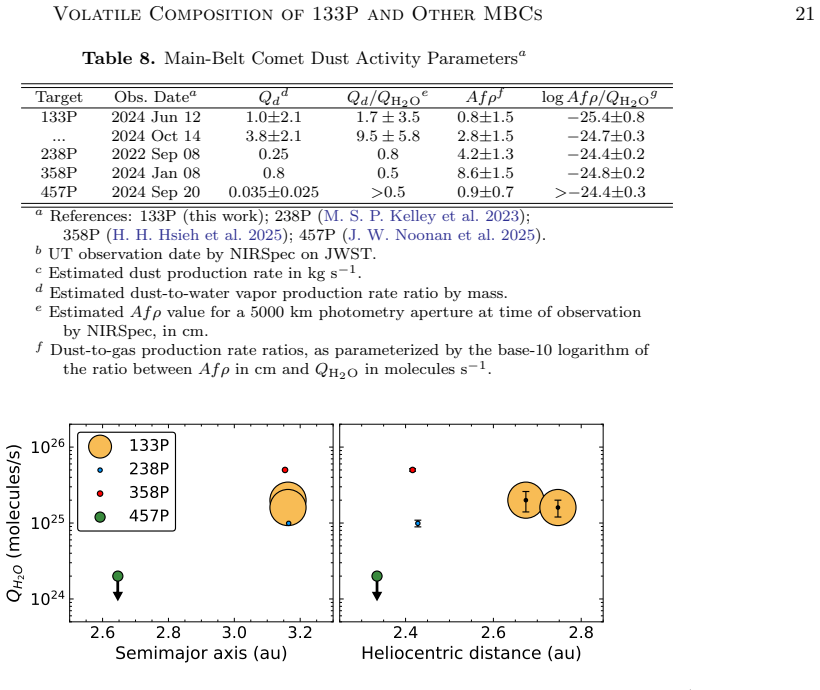
Using NIRSpec, water vapor outgassing rates for 133P are measured as Q(H2O) = (1.9 ± 0.6) × 10^25 molecules/s at true anomaly 8° (rh=2.674 au) and Q(H2O) = (1.4 ± 0.4) × 10^25 molecules/s at 37.4° (rh=2.747 au). CO, CO2, and CH3OH are not detected, with Q(CO2)/Q(H2O) < 0.009, matching levels in other MBCs. The log(Afrho/Q(H2O)) averages -24.6 ± 0.2 across three MBCs with detected water, and no correlations are found with nucleus size, semimajor axis, or heliocentric distance in the JWST MBC sample.
What carries the argument
NIRSpec spectroscopy of water vapor emission lines in the near-infrared, combined with standard cometary coma models to derive absolute production rates Q(H2O) from observed line fluxes.
If this is right
- Water production in 133P shows a possible 25% decline between the two observed points, though consistent with no change within errors.
- Hypervolatile depletion in 133P is at a similar level to previously observed main-belt comets.
- The dust-to-water ratio log(Afrho/Q(H2O)) is consistent at -24.6 ± 0.2 for all three MBCs with successful water detections.
- No clear correlations exist between water production rates and nucleus size, semimajor axis, or heliocentric distance for JWST-observed MBCs.
- Future observations should target MBCs interior to the 5A:2J MMR and at high inclinations, plus multiple visits per apparition.
Where Pith is reading between the lines
- These measurements suggest that main-belt comets may retain ice despite their location, potentially informing models of solar system formation and water delivery to terrestrial planets.
- Consistency in dust-to-gas ratios across MBCs could indicate a common activation mechanism or surface composition.
- Absence of correlations with orbital parameters may imply that activity is driven more by local surface properties than by global orbit.
- Additional JWST data could test if the slight decline in Q(H2O) is real or if rates vary more with true anomaly.
Load-bearing premise
The conversion from observed NIRSpec line fluxes to absolute water production rates relies on standard cometary coma models calibrated primarily on more active Jupiter-family comets.
What would settle it
An independent measurement of water production rate for 133P using a different instrument or modeling approach at a similar orbital position that differs by more than the reported uncertainties from the JWST values.
Figures






read the original abstract
We report results from an analysis of the volatile composition and evolution of main-belt comet (MBC) 133P/Elst-Pizarro using JWST NIRSpec and NIRCam observations and ground-based observations during its 2024 active apparition, and also assess the body of JWST MBC observations acquired to date. Using NIRSpec, we measure water vapor outgassing rates at two points in 133P's orbit, finding Q(H2O)=(1.9+/-0.6)x10^25 molecules/s on UT 2024 June 12 (at a true anomaly of nu=8 deg and heliocentric distance of rh=2.674 au), and Q(H2O)=(1.4+/-0.4)x10^25 molecules/s on UT 2024 October 14 (at nu=37.4 deg and rh=2.747 au). These measurements nominally represent a decline of ~25% in Q(H2O) between the visits, although they are also consistent with no change within uncertainties. We do not detect CO, CO2, or CH3OH, placing 133P's hypervolatile depletion (Q(CO2)/Q(H_2O)<0.009) at a similar level found for previously observed MBCs. We find log(Afrho/Q(H2O)) values for the three MBCs for which water vapor outgassing has been successfully detected that are consistent within uncertainties with an average value of log(Afrho/Q(H2O))=-24.6+/-0.2. Lastly, we find no clear correlations of water production rates with nucleus size, semimajor axis, or heliocentric distance among MBCs observed by JWST so far, but would particularly encourage future JWST observations of additional MBCs interior to the 5A:2J MMR with Jupiter and at high inclinations, as well as multiple observations of MBCs during single active apparitions to further investigate areas of interest identified from the current sample of JWST-observed MBCs.
Editorial analysis
A structured set of objections, weighed in public.
Referee Report
Summary. The paper reports JWST NIRSpec and NIRCam plus ground-based observations of main-belt comet 133P/Elst-Pizarro during its 2024 apparition. It derives water production rates Q(H2O) = (1.9 ± 0.6) × 10^25 and (1.4 ± 0.4) × 10^25 molecules s^-1 at true anomalies 8° and 37.4°, reports non-detections of CO, CO2, and CH3OH (yielding Q(CO2)/Q(H2O) < 0.009), finds that log(Afrho/Q(H2O)) for the three JWST-detected MBCs is consistent with an average of -24.6 ± 0.2, and reports no clear correlations between water production and nucleus size, semimajor axis, or heliocentric distance in the current JWST MBC sample.
Significance. If the absolute production rates hold, the work supplies the first multi-epoch JWST water measurements for an MBC and places quantitative limits on hypervolatile depletion that align with prior MBCs. The reported log(Afrho/Q(H2O)) average and the call for targeted future observations (interior to the 5:2 MMR, high-inclination targets, and repeat visits) provide a useful empirical benchmark for distinguishing MBC activity from other cometary populations. Direct space-based spectroscopy of faint comae and explicit upper limits are clear strengths.
major comments (1)
- [Section detailing NIRSpec data reduction and Q(H2O) derivation] The absolute Q(H2O) values rest on scaling NIRSpec line fluxes through standard coma models (excitation, radiative transfer, and terminal velocity) calibrated on high-activity JFCs with Q(H2O) > 10^27 s^-1. At the observed levels (~10^25 s^-1, rh ≈ 2.7 au) the coma is expected to be collisionally thin, so fixed assumptions on outflow speed and collision rates may not apply; no sensitivity runs or alternative-model results are referenced. This directly affects the reported ~25 % decline, the depletion ratio upper limit, and the cross-MBC log(Afrho/Q(H2O)) average.
minor comments (3)
- [Abstract] The abstract contains no information on the specific coma-model parameters, data-reduction pipeline, or systematic-error budget; adding one sentence on these points would improve immediate assessability.
- [Results and methods sections] Tables or text listing the exact model parameters (v_out, T_ex, scale lengths) adopted for each epoch and for the Afrho conversion would allow readers to reproduce or test the results.
- [Discussion of correlations] The statement of 'no clear correlations' with only three objects would be strengthened by explicit plots or a brief statistical note rather than qualitative description.
Simulated Author's Rebuttal
We thank the referee for their careful and constructive review of our manuscript. We address the single major comment below regarding the NIRSpec data reduction and Q(H2O) derivation. We have revised the manuscript to incorporate additional discussion and sensitivity analysis to strengthen the presentation of our results while maintaining the integrity of the reported values and conclusions.
read point-by-point responses
-
Referee: [Section detailing NIRSpec data reduction and Q(H2O) derivation] The absolute Q(H2O) values rest on scaling NIRSpec line fluxes through standard coma models (excitation, radiative transfer, and terminal velocity) calibrated on high-activity JFCs with Q(H2O) > 10^27 s^-1. At the observed levels (~10^25 s^-1, rh ≈ 2.7 au) the coma is expected to be collisionally thin, so fixed assumptions on outflow speed and collision rates may not apply; no sensitivity runs or alternative-model results are referenced. This directly affects the reported ~25 % decline, the depletion ratio upper limit, and the cross-MBC log(Afrho/Q(H2O)) average.
Authors: We thank the referee for this important point on model applicability. The Q(H2O) values were derived using established fluorescence excitation and radiative transfer models (as implemented in standard tools like those described in the literature for NIR cometary spectroscopy) that have been applied across a range of activity levels, including prior JWST observations of low-activity objects. The ~30% uncertainties quoted on each Q(H2O) measurement are intended to be conservative and encompass potential systematics from assumptions such as outflow velocity and collisional excitation rates. We note that the ~25% decline between the two epochs is already described in the manuscript as nominal and consistent with no change within uncertainties. For the CO2 non-detection, the upper limit on Q(CO2)/Q(H2O) is computed using consistent modeling assumptions for both the detected water lines and the CO2 upper limit, rendering the ratio relatively insensitive to absolute scaling uncertainties. The log(Afrho/Q(H2O)) average across the three MBCs similarly incorporates the per-object uncertainties. In the revised manuscript, we will add a paragraph discussing the applicability of these standard models to collisionally thin comae at MBC activity levels, cite relevant validation studies for low-Q regimes, and report the results of sensitivity tests (varying terminal velocity by ±20% and collision rates within plausible ranges), which show that derived Q(H2O) values change by <15% and remain within the quoted errors. These additions will not alter the reported numbers but will provide clearer context for the robustness of the decline, depletion limit, and cross-MBC average. revision: partial
Circularity Check
No significant circularity; derivations are direct observational reductions using external models
full rationale
The paper's key results are Q(H2O) values computed from NIRSpec line fluxes via standard Haser/vector coma models (excitation, radiative transfer, outflow velocity) that predate this work and were calibrated on JFCs. These models are not redefined or fitted here to match the reported rates, nor do any equations in the paper make the target Q(H2O) equivalent to its inputs by construction. Depletion ratios, log(Afrho/Q(H2O)) averages, and correlation checks are simple arithmetic comparisons of independently measured quantities. No self-citation chains, ansatzes smuggled via prior work, or renamings of known results appear as load-bearing steps. The derivation chain therefore remains self-contained against external benchmarks.
Axiom & Free-Parameter Ledger
axioms (2)
- domain assumption Standard cometary excitation and radiative-transfer models convert observed NIRSpec line fluxes to absolute production rates Q(H2O).
- domain assumption Non-detections of CO, CO2, and CH3OH can be converted to abundance upper limits relative to H2O using the same excitation assumptions.
Reference graph
Works this paper leans on
-
[1]
A’Hearn, M. F., Millis, R. C., Schleicher, D. O., Osip, D. J., & Birch, P. V. 1995, The ensemble properties of comets: Results from narrowband photometry of 85 comets, 1976-1992., Icarus, 118, 223, doi: 10.1006/icar.1995.1190 A’Hearn, M. F., Schleicher, D. G., Millis, R. L., Feldman, P. D., & Thompson, D. T. 1984, Comet Bowell 1980b, AJ, 89, 579, doi: 10....
-
[2]
Package, AJ, 156, 123, doi: 10.3847/1538-3881/aabc4f
-
[3]
Attree, N., Jorda, L., Groussin, O., et al. 2023, Activity distribution of comet 67P/Churyumov-Gerasimenko from combined measurements of non-gravitational forces and torques, A&A, 670, A170, doi: 10.1051/0004-6361/202245243
-
[4]
Muinonen, K. 2010, Polarimetry and photometry of the peculiar main-belt object 7968 = 133P/Elst-Pizarro, A&A, 514, A99, doi: 10.1051/0004-6361/200913339
-
[5]
Bida, T. A., Dunham, E. W., Massey, P., & Roe, H. G. 2014, Ground-based and Airborne Instrumentation for Astronomy V, in Proc. SPIE, Vol. 9147, Ground-based and Airborne Instrumentation for Astronomy V, 91472N, doi: 10.1117/12.2056872 B¨ oker, T., Beck, T. L., Birkmann, S. M., et al. 2023, In-orbit Performance of the Near-infrared Spectrograph NIRSpec on ...
-
[6]
T., Yeomans, D., Housen, K., & Consolmagno, G
Britt, D. T., Yeomans, D., Housen, K., & Consolmagno, G. 2002, Asteroids III (Tucson, University of Arizona Press), 485–500
2002
-
[7]
2023, Zenodo, doi: 10.5281/zenodo.10022973
Bushouse, H., Eisenhamer, J., Dencheva, N., et al. 2023, JWST Calibration Pipeline, 1.12.5 Zenodo, doi: 10.5281/zenodo.10022973
-
[8]
1984, The ESO Faint Object Spectrograph and Camera / EFOSC, The Messenger, 38, 9
Buzzoni, B., Delabre, B., Dekker, H., et al. 1984, The ESO Faint Object Spectrograph and Camera / EFOSC, The Messenger, 38, 9
1984
-
[9]
Cochran, A. L., & Schleicher, D. G. 1993, Observational Constraints on the Lifetime of Cometary H 2O, Icarus, 105, 235, doi: 10.1006/icar.1993.1121
-
[10]
Cowan, J. J., & A’Hearn, M. F. 1979, Vaporization of comet nuclei: Light curves and life times, Moon and Planets, 21, 155, doi: 10.1007/BF00897085
-
[11]
2023, astropy/ccdproc: 2.4.1, 2.4.1 Zenodo, doi: 10.5281/zenodo.7986923
Craig, M., Crawford, S., Seifert, M., et al. 2023, astropy/ccdproc: 2.4.1, 2.4.1 Zenodo, doi: 10.5281/zenodo.7986923 De Pr´ a, M. N., Licandro, J., Pinilla-Alonso, N., et al. 2020, The spectroscopic properties of the Lixiaohua family, cradle of Main Belt Comets, Icarus, 338, 113473, doi: 10.1016/j.icarus.2019.113473
-
[12]
, year = 2011, month = mar, volume =
Dressler, A., Bigelow, B., Hare, T., et al. 2011, IMACS: The Inamori-Magellan Areal Camera and Spectrograph on Magellan-Baade, PASP, 123, 288, doi: 10.1086/658908
-
[13]
W., Pizarro, O., Pollas, C., et al
Elst, E. W., Pizarro, O., Pollas, C., et al. 1996, Comet P/1996 N2 (Elst-Pizarro), IAUC, 6456
1996
-
[14]
Farinella, P., & Davis, D. R. 1992, Collision rates and impact velocities in the Main Asteroid Belt, Icarus, 97, 111, doi: 10.1016/0019-1035(92)90060-K Fern´ andez, J. A., Tancredi, G., Rickman, H., & Licand ro, J. 1999, The population, magnitudes, and sizes of Jupiter family comets, A&A, 352, 327
-
[15]
, year = 2012, month = nov, volume =
Fink, U., & Rubin, M. 2012, The calculation of Afρand mass loss rate for comets, Icarus, 221, 721, doi: 10.1016/j.icarus.2012.09.001
-
[16]
541, Astronomical Data Analysis Software and Systems XXXIII
Fitzpatrick, M., Placco, V., Bolton, A., et al. 2024, Modernizing IRAF to Support Gemini Data Reduction, arXiv e-prints, arXiv:2401.01982, doi: 10.48550/arXiv.2401.01982
-
[17]
Gardner, J. P., Mather, J. C., Abbott, R., et al. 2023, The James Webb Space Telescope Mission, PASP, 135, 068001, doi: 10.1088/1538-3873/acd1b5
-
[18]
F., Fitzsimmons, A., Denneau, L., et al
Gillan, A. F., Fitzsimmons, A., Denneau, L., et al. 2024, Dust Production Rates in Jupiter-family Comets: A Two Year Study with ATLAS Photometry, PSJ, 5, 25, doi: 10.3847/PSJ/ad1394
-
[19]
F., Fitzsimmons, A., Denneau, L., et al
Gillan, A. F., Fitzsimmons, A., Denneau, L., et al. 2025, Dust Production Rates in Jupiter-family Comets. II. Trends and Population Insights from ATLAS Photometry of 116 JFCs, PSJ, 6, 172, doi: 10.3847/PSJ/ade7fe
-
[20]
2016, On-sky commissioning of Hamamatsu CCDs in GMOS-S, in Proc
Gimeno, G., Roth, K., Chiboucas, K., et al. 2016, On-sky commissioning of Hamamatsu CCDs in GMOS-S, in Proc. SPIE, Vol. 9908, Ground-based and Airborne Instrumentation for Astronomy VI, 99082S, doi: 10.1117/12.2233883
-
[21]
D., Yeomans, D
Giorgini, J. D., Yeomans, D. K., Chamberlin, A. B., et al. 1996, JPL’s On-Line Solar System Data Service, American Astronomical Society, 28, 25.04
1996
-
[22]
Haghighipour, N. 2009, Dynamical constraints on the origin of Main Belt comets, Meteoritics and Planetary Science, 44, 1863, doi: 10.1111/j.1945-5100.2009.tb01995.x
-
[23]
Dvorak, R. 2016, Triggering Sublimation-driven Activity of Main Belt Comets, ApJ, 830, 22, doi: 10.3847/0004-637X/830/1/22 30Hsieh et al
-
[24]
Haghighipour, N., Maindl, T. I., Sch¨ afer, C. M., & Wandel, O. J. 2018, Triggering the Activation of Main-belt Comets: The Effect of Porosity, ApJ, 855, 60, doi: 10.3847/1538-4357/aaa7f3
-
[25]
1980, The sun among the stars
Hardorp, J. 1980, The sun among the stars. III - Energy distributions of 16 northern G-type stars and the solar flux calibration, A&A, 91, 221
1980
-
[26]
1957, Distribution d’intensit´ e dans la tˆ ete d’une com` ete, Bulletin de la Societe Royale des Sciences de Liege, 43, 740
Haser, L. 1957, Distribution d’intensit´ e dans la tˆ ete d’une com` ete, Bulletin de la Societe Royale des Sciences de Liege, 43, 740
1957
-
[27]
Hook, I. M., Jørgensen, I., Allington-Smith, J. R., et al. 2004, The Gemini-North Multi-Object Spectrograph: Performance in Imaging, Long-Slit, and Multi-Object Spectroscopic Modes, PASP, 116, 425, doi: 10.1086/383624
-
[28]
Hsieh, H. H. 2014a, IAU Symposium: Formation, Detection, and Characterization of Extrasolar Habitable Planets, in IAU Symposium, Vol. 293, IAU Symposium: Formation, Detection, and Characterization of Extrasolar Habitable Planets, 212–218, doi: 10.1017/S1743921313012866
-
[29]
Hsieh, H. H. 2014b, The nucleus of main-belt Comet P/2010 R2 (La Sagra), Icarus, 243, 16, doi: 10.1016/j.icarus.2014.08.033
-
[30]
Hsieh, H. H., & Haghighipour, N. 2016, Potential Jupiter-Family comet contamination of the main asteroid belt, Icarus, 277, 19, doi: 10.1016/j.icarus.2016.04.043
-
[31]
Hsieh, H. H., Ishiguro, M., Knight, M. M., et al. 2018a, The Reactivation and Nucleus Characterization of Main-belt Comet 358P/PANSTARRS (P/2012 T1), AJ, 156, 39, doi: 10.3847/1538-3881/aac81c
-
[32]
Hsieh, H. H., Ishiguro, M., Knight, M. M., et al. 2021, The Reactivation of Main-belt Comet 259P/Garradd (P/2008 R1), PSJ, 2, 62, doi: 10.3847/PSJ/abe59d
-
[33]
Hsieh, H. H., & Jewitt, D. 2006, A Population of Comets in the Main Asteroid Belt, Science, 312, 561, doi: 10.1126/science.1125150
-
[34]
H., Jewitt, D., & Fern´ andez, Y
Hsieh, H. H., Jewitt, D., & Fern´ andez, Y. R. 2009, Albedos of Main-Belt Comets 133P/Elst-Pizarro and 176P/LINEAR, ApJL, 694, L111, doi: 10.1088/0004-637X/694/2/L111
-
[35]
Snodgrass, C. 2010, The return of activity in main-belt comet 133P/Elst-Pizarro, MNRAS, 403, 363, doi: 10.1111/j.1365-2966.2009.16120.x
-
[36]
H., Jewitt, D
Hsieh, H. H., Jewitt, D. C., & Fern´ andez, Y. R. 2004, The Strange Case of 133P/Elst-Pizarro: A Comet among the
2004
-
[37]
Asteroids, AJ, 127, 2997, doi: 10.1086/383208
-
[38]
H., Novakovi´ c, B., Kim, Y., & Brasser, R
Hsieh, H. H., Novakovi´ c, B., Kim, Y., & Brasser, R. 2018b, Asteroid Family Associations of Active Asteroids, AJ, 155, 96, doi: 10.3847/1538-3881/aaa5a2
-
[39]
H., Pohlen, M., & Matulonis, A
Hsieh, H. H., Pohlen, M., & Matulonis, A. 2013, Comet 133P/Elst-Pizarro, Central Bureau Electronic Telegrams, 3564
2013
-
[40]
H., Yang, B., & Haghighipour, N
Hsieh, H. H., Yang, B., & Haghighipour, N. 2012a, Optical and Dynamical Characterization of Comet-like Main-belt Asteroid (596) Scheila, ApJ, 744, 9, doi: 10.1088/0004-637X/744/1/9
-
[41]
H., Yang, B., Haghighipour, N., et al
Hsieh, H. H., Yang, B., Haghighipour, N., et al. 2012b, Discovery of Main-belt Comet P/2006 VW 139 by Pan-STARRS1, ApJL, 748, L15, doi: 10.1088/2041-8205/748/1/L15
-
[42]
H., Yang, B., Haghighipour, N., et al
Hsieh, H. H., Yang, B., Haghighipour, N., et al. 2012c, Observational and Dynamical Characterization of Main-belt Comet P/2010 R2 (La Sagra), AJ, 143, 104, doi: 10.1088/0004-6256/143/5/104
-
[43]
H., Ishiguro, M., Kim, Y., et al
Hsieh, H. H., Ishiguro, M., Kim, Y., et al. 2018c, The 2016 Reactivations of the Main-belt Comets 238P/Read and 288P/(300163) 2006 VW 139, AJ, 156, 223, doi: 10.3847/1538-3881/aae528
-
[44]
Hsieh, H. H., Micheli, M., Kelley, M. S. P., et al. 2023, Observational Characterization of Main-Belt Comet and Candidate Main-Belt Comet Nuclei, PSJ, 4, 43, doi: 10.3847/PSJ/acbdfe
-
[45]
Hsieh, H. H., Noonan, J. W., Kelley, M. S. P., et al. 2025, The Volatile Composition and Activity Evolution of Main-belt Comet 358P/PANSTARRS, PSJ, 6, 3, doi: 10.3847/PSJ/ad9199
-
[46]
Huebner, W. F., & Mukherjee, J. 2015, Photoionization and photodissociation rates in solar and blackbody radiation fields, Planetary and Space Science, 106, 11, doi: 10.1016/j.pss.2014.11.022
-
[47]
2022, A&A, 661, A80, doi: 10.1051/0004-6361/202142663
Jakobsen, P., Ferruit, P., Alves de Oliveira, C., et al. 2022, The Near-Infrared Spectrograph (NIRSpec) on the James Webb Space Telescope. I. Overview of the instrument and its capabilities, A&A, 661, A80, doi: 10.1051/0004-6361/202142663
work page internal anchor Pith review doi:10.1051/0004-6361/202142663 2022
-
[48]
Jewitt, D. 1996, From Comets to Asteroids: When Hairy Stars Go Bald, Earth Moon and Planets, 72, 185, doi: 10.1007/BF00117517
-
[49]
2014, in Protostars and Planets VI, ed
Jewitt, D., Hsieh, H., & Agarwal, J. 2015, Asteroids IV (Tucson, University of Arizona Press), 221–241, doi: 10.2458/azu uapress 9780816532131-ch012
work page doi:10.2458/azu 2015
-
[50]
Jewitt, D., & Hsieh, H. H. 2024, The Asteroid-Comet Continuum, in Comets III, ed. K. J. Meech, M. R
2024
-
[51]
Jewitt, D., Ishiguro, M., Weaver, H., et al. 2014, Hubble Space Telescope Investigation of Main-belt Comet 133P/Elst-Pizarro, AJ, 147, 117, doi: 10.1088/0004-6256/147/5/117 Volatile Composition of 133P and Other MBCs31
-
[52]
2007, Comet 133P/Elst-Pizarro, IAUC, 8847
Jewitt, D., Lacerda, P., & Peixinho, N. 2007, Comet 133P/Elst-Pizarro, IAUC, 8847
2007
-
[53]
Jewitt, D. C., & Meech, K. J. 1987, Surface Brightness Profiles of 10 Comets, ApJ, 317, 992, doi: 10.1086/165347
-
[54]
H., Agarwal, J., Bowles, N., et al
Jones, G. H., Agarwal, J., Bowles, N., et al. 2018, The proposed Caroline ESA M3 mission to a Main Belt
2018
-
[55]
Comet, Advances in Space Research, 62, 1921, doi: 10.1016/j.asr.2018.02.032
-
[56]
2011, Analysis of the Activity on Main Belt Comet 133P/Elst-Pizarro, in EPSC-DPS Joint Meeting 2011, Vol
Kaluna, H., Meech, K., & Hsieh, H. 2011, Analysis of the Activity on Main Belt Comet 133P/Elst-Pizarro, in EPSC-DPS Joint Meeting 2011, Vol. 2011, 1375
2011
-
[57]
Keller, H. U., Mottola, S., Hviid, S. F., et al. 2017, Seasonal mass transfer on the nucleus of comet 67P/Chuyumov-Gerasimenko, MNRAS, 469, S357, doi: 10.1093/mnras/stx1726
-
[58]
Kelley, M. S. P., Hsieh, H. H., Bodewits, D., et al. 2023, Spectroscopic identification of water emission from a main-belt comet, Nature, 619, 720, doi: 10.1038/s41586-023-06152-y
-
[59]
Kim, Y., Jewitt, D., Agarwal, J., et al. 2022, Hubble Space Telescope Observations of Active Asteroid P/2020 O1 (Lemmon-PANSTARRS), ApJL, 933, L15, doi: 10.3847/2041-8213/ac78de
-
[60]
Licandro, J., Campins, H., Tozzi, G. P., et al. 2011, Testing the comet nature of main belt comets. The spectra of 133P/Elst-Pizarro and 176P/LINEAR, A&A, 532, A65, doi: 10.1051/0004-6361/201117018
-
[61]
Marcus, J. N. 2007, Forward-Scattering Enhancement of Comet Brightness. I. Background and Model, International Comet Quarterly, 29, 39
2007
-
[62]
Marschall, R., Markkanen, J., Gerig, S.-B., et al. 2020a, The dust-to-gas ratio, size distribution, and dust fall-back fraction of comet 67P/Churyumov-Gerasimenko: Inferences from linking the optical and dynamical properties of the inner comae., Frontiers in Physics, 8, 227, doi: 10.3389/fphy.2020.00227
-
[63]
2020b, Cometary Comae-Surface Links, SSRv, 216, 130, doi: 10.1007/s11214-020-00744-0
Marschall, R., Skorov, Y., Zakharov, V., et al. 2020b, Cometary Comae-Surface Links, SSRv, 216, 130, doi: 10.1007/s11214-020-00744-0
-
[64]
W., Hartogh, P., Rezac, L., et al
Marshall, D. W., Hartogh, P., Rezac, L., et al. 2017, Spatially resolved evolution of the local H 2O production rates of comet 67P/Churyumov-Gerasimenko from the MIRO instrument on Rosetta, A&A, 603, A87, doi: 10.1051/0004-6361/201730502
-
[65]
J., & Castillo-Rogez, J
Meech, K. J., & Castillo-Rogez, J. C. 2015, Proteus - A Mission to Investigate the Origins of Earth’s Water, IAU General Assembly, 22, 2257859
2015
-
[66]
Mommert, M., Kelley, M., de Val-Borro, M., et al. 2019, sbpy: A Python module for small-body planetary astronomy, The Journal of Open Source Software, 4, 1426, doi: 10.21105/joss.01426
-
[67]
W., Hsieh, H
Noonan, J. W., Hsieh, H. H., Kelley, M. S. P., et al. 2025, JWST and Ground-Based Observations of Main-Belt Comet 457P/Lemmon-PANSTARRS, PSJ, submitted
2025
-
[68]
Prialnik, D., & Rosenberg, E. D. 2009, Can ice survive in main-belt comets? Long-term evolution models of comet 133P/Elst-Pizarro, MNRAS, 399, L79, doi: 10.1111/j.1745-3933.2009.00727.x
-
[69]
Protopapa, S., Sunshine, J. M., Feaga, L. M., et al. 2014, Water ice and dust in the innermost coma of comet 103P/Hartley 2, Icarus, 238, 191, doi: 10.1016/j.icarus.2014.04.008
-
[70]
Raponi, A., Ciarniello, M., Capaccioni, F., et al. 2020, Infrared detection of aliphatic organics on a cometary nucleus, Nature Astronomy, 4, 500, doi: 10.1038/s41550-019-0992-8
-
[71]
Rauscher, B. J. 2024, NSClean: An Algorithm for Removing Correlated Noise from JWST NIRSpec Images, PASP, 136, 015001, doi: 10.1088/1538-3873/ad1b36
-
[72]
2024, Detection and Flagging of Showers and Snowballs in JWST,, Technical Report JWST-STScI-008545, 24 pages
Regan, M. 2024, Detection and Flagging of Showers and Snowballs in JWST,, Technical Report JWST-STScI-008545, 24 pages
2024
-
[73]
Rieke, M. J., Kelly, D. M., Misselt, K., et al. 2023, Performance of NIRCam on JWST in Flight, PASP, 135, 028001, doi: 10.1088/1538-3873/acac53
-
[74]
Rivkin, A. S., Emery, J. P., Howell, E. S., et al. 2022, The Nature of Low-albedo Small Bodies from 3µm Spectroscopy: One Group that Formed within the Ammonia Snow Line and One that Formed beyond It, PSJ, 3, 153, doi: 10.3847/PSJ/ac7217
-
[75]
Samarasinha, N. H., & Larson, S. M. 2014, Image enhancement techniques for quantitative investigations of morphological features in cometary comae: A comparative study, Icarus, 239, 168, doi: 10.1016/j.icarus.2014.05.028
-
[76]
H., Martin, M
Samarasinha, N. H., Martin, M. P., & Larson, S. M. 2013, Cometary Coma Image Enhancement Facility, http://cie.psi.edu
2013
-
[77]
Samarasinha, N. H., & Mueller, B. E. A. 2013, Relating Changes in Cometary Rotation to Activity: Current Status and Applications to Comet C/2012 S1 (ISON), ApJL, 775, L10, doi: 10.1088/2041-8205/775/1/L10
-
[78]
G., & Bair, A
Schleicher, D. G., & Bair, A. N. 2011, The Composition of the Interior of Comet 73P/Schwassmann-Wachmann 3: Results from Narrowband Photometry of Multiple
2011
-
[79]
Components, AJ, 141, 177, doi: 10.1088/0004-6256/141/6/177 32Hsieh et al
-
[80]
Schleicher, D. G., Knight, M. M., & Levine, S. E. 2013, The Nucleus of Comet 10P/Tempel 2 in 2013 and Consequences Regarding its Rotational State: Early Science from the Discovery Channel Telescope, AJ, 146, 137, doi: 10.1088/0004-6256/146/5/137
discussion (0)
Sign in with ORCID, Apple, or X to comment. Anyone can read and Pith papers without signing in.