Recognition: unknown
A Machine Learning Approach to Meteor Classification
Pith reviewed 2026-05-08 09:21 UTC · model grok-4.3
The pith
Machine learning on 28,000 meteor events produces a data-driven hardness classification for meteoroids.
A machine-rendered reading of the paper's core claim, the machinery that carries it, and where it could break.
Core claim
A combination of Factor Analysis (FA) and a Gaussian Mixture Model (GMM) applied to 13 directly observed meteor parameters from 28,177 events yields clusters most consistent with traditional models. Three FA-derived factors corresponding to meteoroid kinematics, activation thresholds, and size/geometry effects describe the underlying structure of meteoroid behavior. The activation factor emerges as the most discriminating for distinguishing asteroidal or cometary origin. Resulting 3-, 6-, and 11-cluster models reveal progressively finer compositional structure. From these, a physically motivated hardness classification scheme H_class is introduced as a data-driven extension of the Kb парамет
What carries the argument
Factor Analysis combined with a Gaussian Mixture Model applied to 13 observed parameters, which derives three factors and produces the H_class hardness scheme ranging from densest iron to softest cometary material.
If this is right
- The activation threshold factor is the primary distinguisher between asteroidal and cometary meteoroids.
- 3-, 6-, and 11-cluster models reveal increasing detail from broad regimes to subdivisions within populations.
- Application to nine well-studied meteor showers aids physical interpretation of the H_class groups in orbital space.
- An analytical FA-GMM formulation enables direct application of the model to future datasets without retraining.
- Machine learning methods can extract compositional information from modern optical meteor datasets at scale.
Where Pith is reading between the lines
- Future large-scale meteor surveys could apply this automated scheme to map distributions of solar system materials.
- Cross-checking H_class assignments against spectroscopic data or recovered meteorites could validate or refine the groups.
- Similar factor-analysis clustering might be tested on other optical transient datasets for compositional insights.
- Links between H_class and orbital parameters could help trace meteoroid streams to specific parent bodies.
Load-bearing premise
That the three factors derived from factor analysis and the clusters from the Gaussian mixture model correspond to real physical differences in meteoroid composition and origin rather than artifacts of the chosen algorithms or normalization.
What would settle it
Independently determining the compositions of a set of meteors via spectroscopy or ground recovery of meteorites and checking whether their assigned H_class values match the expected hardness; systematic mismatch would show the clusters do not reflect physical reality.
Figures



read the original abstract
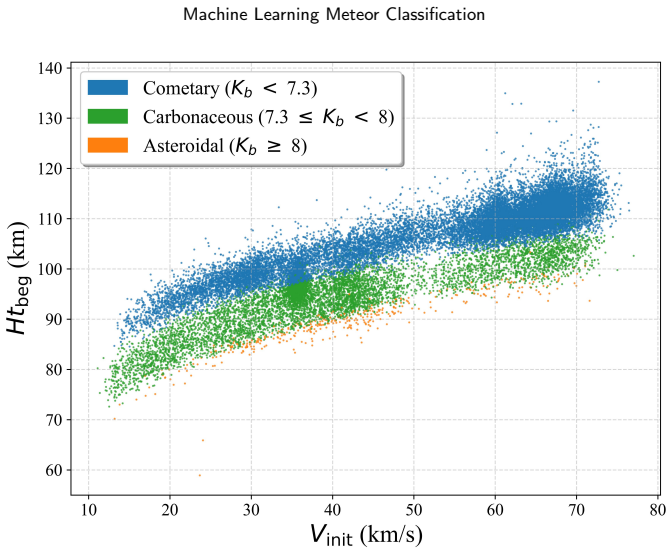
We use machine learning to develop a framework for classifying meteoroids based on 13 directly observed parameters from the Global Meteor Network. This method adds depth to the $K_{b}$ parameter, which uses only three parameters. We employ a semi-qualitative approach using 28,177 meteor events observed in 2023 by the Lowell Observatory Cameras for All-Sky Meteor Surveillance (LO-CAMS) network to evaluate multiple normalization, dimensionality-reduction, and clustering algorithms. We find that a combination of Factor Analysis (FA) and a Gaussian Mixture Model (GMM) results in clusters most consistent with traditional models. Three FA-derived factors corresponding to meteoroid kinematics, activation thresholds, and size/geometry effects describe the underlying structure of meteoroid behavior. The activation factor emerged as the most discriminating factor distinguishing whether a meteor is of asteroidal or cometary origin. Resulting 3, 6, and 11 cluster models reveal progressively finer compositional structure, from broad physical regimes to detailed subdivisions within cometary and asteroidal populations. From these results, we introduce a physically motivated hardness classification scheme: $H_{\mathrm{class}}$. $H_{\mathrm{class}}$ is a data-driven extension of $K_{b}$ which physically interprets clusters in terms of the densest iron meteoroids down to the softest cometary material. Application to nine well-studied meteor showers and analysis of clusters in orbital space aids in the physical interpretation of $H_{\mathrm{class}}$ groups. The $H_{\mathrm{class}}$ model is supported by an analytical FA-GMM formulation that enables application to future datasets. Our results demonstrate that machine learning methods can extract compositional information from modern optical meteor datasets at scale and offers a new framework for interpreting meteoroid populations.
Editorial analysis
A structured set of objections, weighed in public.
Referee Report
Summary. The manuscript applies Factor Analysis (FA) followed by Gaussian Mixture Model (GMM) clustering to 13 directly observed parameters from 28,177 meteors recorded by the LO-CAMS network in 2023. It identifies three latent factors (kinematics, activation thresholds, size/geometry), reports that the FA+GMM combination produces clusters most consistent with traditional models, and introduces H_class as a data-driven hardness classification extending the three-parameter Kb scheme. The work includes qualitative support via nine meteor showers and orbital-element analysis, plus an analytical FA-GMM formulation for future datasets.
Significance. If the unsupervised clusters demonstrably recover genuine compositional and origin distinctions rather than statistical artifacts, the framework would provide a scalable, reproducible method for interpreting large optical meteor datasets beyond the limitations of Kb. The explicit analytical formulation is a positive feature for reproducibility and extension to new observations.
major comments (4)
- [Abstract] Abstract: the central claim that FA+GMM clusters are 'most consistent with traditional models' is unsupported by any quantitative metric (agreement score, confusion matrix, or statistical test against Kb or other classifications). This absence directly undermines the physical motivation asserted for the H_class scheme.
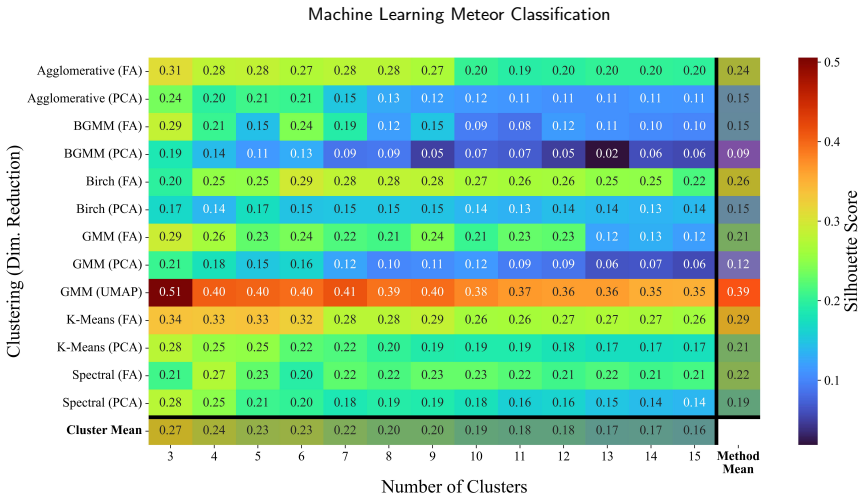
- [Results] The selection of exactly 3, 6, and 11 clusters is presented without reported validation criteria (silhouette scores, BIC, elbow plots, or stability across random seeds). Because H_class is defined from these clusters, the lack of justification makes the number of groups appear post-hoc and weakens the claim of progressively finer compositional structure.
- [Methods / Results] The assignment of physical labels to the three FA factors (kinematics, activation thresholds, size/geometry) and the interpretation that the activation factor distinguishes asteroidal vs. cometary origin occur after the FA step. No a priori physical model or independent compositional labels are used to validate these interpretations, leaving open the possibility that the factors reflect parameter correlations or normalization choices instead of ablation physics.
- [Methods] No ablation or sensitivity tests are described for the choice among normalization schemes, the impact of the specific 13 parameters, or robustness to subsetting the 28,177-event sample. Given that the method is positioned as adding depth to Kb, such tests are required to establish that the recovered structure is not an artifact of preprocessing.
minor comments (3)
- [Abstract / Methods] The term 'semi-qualitative approach' is used in the abstract but not defined in the methods; a brief clarification of what this entails (e.g., which steps are quantitative vs. interpretive) would improve clarity.
- [Results] The manuscript would benefit from explicit reporting of cluster-assignment uncertainties or posterior probabilities from the GMM, especially when mapping clusters to H_class labels.
- [Discussion] A short comparison table or figure overlaying H_class against Kb values for the nine meteor showers would make the claimed consistency more transparent.
Simulated Author's Rebuttal
Thank you for the referee's thoughtful and constructive comments, which help improve the clarity and rigor of our work. We respond to each major comment point by point below, indicating revisions where appropriate.
read point-by-point responses
-
Referee: [Abstract] Abstract: the central claim that FA+GMM clusters are 'most consistent with traditional models' is unsupported by any quantitative metric (agreement score, confusion matrix, or statistical test against Kb or other classifications). This absence directly undermines the physical motivation asserted for the H_class scheme.
Authors: We thank the referee for highlighting this. While the manuscript supports the claim through qualitative analysis of meteor showers and orbital elements, we agree a quantitative metric would strengthen it. In the revised manuscript, we will include an agreement score or confusion matrix comparing H_class to Kb classifications, along with a statistical test to quantify consistency. revision: yes
-
Referee: [Results] The selection of exactly 3, 6, and 11 clusters is presented without reported validation criteria (silhouette scores, BIC, elbow plots, or stability across random seeds). Because H_class is defined from these clusters, the lack of justification makes the number of groups appear post-hoc and weakens the claim of progressively finer compositional structure.
Authors: The cluster numbers were chosen to progressively refine the traditional three-class Kb model (3 clusters), with 6 and 11 providing finer divisions based on observed data structure. We will revise to report validation criteria including silhouette scores, BIC, and cluster stability across seeds to justify these choices rigorously. revision: yes
-
Referee: [Methods / Results] The assignment of physical labels to the three FA factors (kinematics, activation thresholds, size/geometry) and the interpretation that the activation factor distinguishes asteroidal vs. cometary origin occur after the FA step. No a priori physical model or independent compositional labels are used to validate these interpretations, leaving open the possibility that the factors reflect parameter correlations or normalization choices instead of ablation physics.
Authors: The factor interpretations are derived from the parameter loadings and aligned with established meteoroid physics literature on kinematics, ablation thresholds, and size effects. As an unsupervised approach, labels are necessarily post-hoc. We will expand the discussion in the revision to include more explicit references to physical models and note the exploratory nature, while acknowledging potential influences from correlations. revision: partial
-
Referee: [Methods] No ablation or sensitivity tests are described for the choice among normalization schemes, the impact of the specific 13 parameters, or robustness to subsetting the 28,177-event sample. Given that the method is positioned as adding depth to Kb, such tests are required to establish that the recovered structure is not an artifact of preprocessing.
Authors: We agree on the importance of these tests. The original analysis considered multiple algorithms, but we will add sensitivity analyses in the revision, including variations in normalization, parameter importance via ablation studies, and robustness checks on data subsets to demonstrate that the recovered factors and clusters are stable and not artifacts. revision: yes
Circularity Check
No significant circularity in derivation chain
full rationale
The paper applies unsupervised FA and GMM clustering directly to 13 observed parameters from the 2023 LO-CAMS dataset. Factors (kinematics, activation thresholds, size/geometry) and the 3/6/11-cluster models emerge from the data without any presupposed physical labels or H_class scheme. H_class is defined afterward as a post-hoc interpretive extension of the existing Kb parameter, with qualitative consistency checks against meteor showers and orbital elements. No load-bearing step reduces by construction to a fitted constant, self-citation chain, or ansatz smuggled from prior work; the method is self-contained against the input observations.
Axiom & Free-Parameter Ledger
free parameters (1)
- Number of clusters
axioms (1)
- domain assumption The 13 directly observed parameters from the Global Meteor Network capture the relevant physical properties of meteoroids.
invented entities (1)
-
H_class
no independent evidence
Reference graph
Works this paper leans on
-
[1]
Astronomy & Astrophysics 696, A69
Ashimbekova,A.,Vaubaillon,J.,Koten,P.,2025. Towardsadefinitionofameteorcluster:Detectionofmeteorclustersfrommeteororbitdatabases. A&A 696, A69. doi:10.1051/0004-6361/202452445,arXiv:2503.16157. Babadzhanov, P.B.,
-
[2]
Fragmentation and densities of meteoroids. A&A 384, 317–321. doi:10.1051/0004-6361:20020010. Babadzhanov, P.B., Williams, I.P., Kokhirova, G.I.,
-
[3]
Cognitive Science36(5), 757–798 (2012).https://doi.org/10.1111/j
Meteor showers associated with 2003EH1. MNRAS 386, 2271–2277. doi:10.1111/j. 1365-2966.2008.13202.x. Barber, D.,
work page doi:10.1111/j 2008
-
[4]
Atmospheric deceleration and light curves of Draconid meteors and implications for the structure of cometary dust. A&A 473, 661–672. doi:10.1051/0004-6361:20078131. Borovička, J., Spurný, P., Shrbený, L.,
-
[5]
Data on 824 fireballs observed by the digital cameras of the European Fireball Network in 2017-
2017
-
[6]
Analysis of orbital and physical properties of centimeter-sized meteoroids
II. Analysis of orbital and physical properties of centimeter-sized meteoroids. A&A 667, A158. doi:10.1051/0004-6361/202244197, arXiv:2209.11254. Buccongello, N., Brown, P.G., Vida, D., Pinhas, A.,
-
[7]
A physical survey of meteoroid streams: Comparing cometary reservoirs. Icarus 410, 115907. doi:10.1016/j.icarus.2023.115907,arXiv:2312.00897. Hemmelgarn et al.:Preprint submitted to ElsevierPage 26 of 35 Machine Learning Meteor Classification Campello, R., Moulavi, D., Sander, J.,
-
[8]
Fireball end heights: A diagnostic for the structure of meteoric material. J. Geophys. Res. 81, 6257–6275. doi:10.1029/JB081i035p06257. Cherkassky, V., Ma, Y.,
-
[9]
Neural Computation 15, 1691–1714
Comparison of model selection for regression. Neural Computation 15, 1691–1714. URL:https://doi.org/10.1162/089976603321891864, doi:10.1162/089976603321891864, arXiv:https://direct.mit.edu/neco/article-pdf/15/7/1691/815658/089976603321891864.pdf. Colas, F., Zanda, B., Bouley, S., Jeanne, S., Malgoyre, A., Birlan, M., Blanpain, C., Gattacceca, J., Jorda, L...
-
[10]
Astronomy and Astrophysics , keywords =
FRIPON: a worldwide network to track incoming meteoroids. A&A 644, A53. doi:10.1051/0004-6361/202038649,arXiv:2012.00616. Cordonnier, L.E., Obenberger, K.S., Holmes, J.M., Taylor, G.B., Vida, D.,
-
[11]
Journal of Geophysical Research: Space Physics 129, e2024JA032643
Not so fast: A new catalog of meteor persistent trains. Journal of Geophysical Research: Space Physics 129, e2024JA032643. URL:https:// agupubs.onlinelibrary.wiley.com/doi/abs/10.1029/2024JA032643, doi:https://doi.org/10.1029/2024JA032643, arXiv:https://agupubs.onlinelibrary.wiley.com/doi/pdf/10.1029/2024JA032643. e2024JA032643 2024JA032643. Dempster, A.P...
-
[12]
Journal of the Royal Statistical Society: Series B (Methodological) , author =
Maximum likelihood from incomplete data via the em algorithm. Journal of the Royal Statistical Society: Series B (Methodological) 39, 1–22. URL:https://doi.org/10.1111/j.2517-6161.1977.tb01600.x, doi:10. 1111/j.2517-6161.1977.tb01600.x. Devillepoix, H., Cupák, M., Bland, P., Sansom, E., Towner, M., Howie, R., Hartig, B., Jansen-Sturgeon, T., Shober, P., A...
-
[13]
A machine learning classification of meteorite spectra applied to understanding asteroids. Icarus 406, 115718. URL:https://www.sciencedirect.com/science/article/pii/S0019103523002956, doi:https: //doi.org/10.1016/j.icarus.2023.115718. Egal, A., Brown, P.G., Rendtel, J., Campbell-Brown, M., Wiegert, P.,
-
[14]
Activity of the Eta-Aquariid and Orionid meteor showers. A&A 640, A58. doi:10.1051/0004-6361/202038115,arXiv:2006.08576. Egal,A.,Wiegert,P.,Brown,P.,Moser,D.,Campbell-Brown,M.,Moorhead,A.,Ehlert,S.,Moticska,N.,2019. Meteorshowermodeling:Pastand futuredraconidoutbursts. Icarus330,123–141. URL:https://www.sciencedirect.com/science/article/pii/S0019103518308...
-
[15]
Monthly Notices of the Royal Astronomical Society 469, S39–S44
Fractal dust constrains the collisional history of comets. Monthly Notices of the Royal Astronomical Society 469, S39–S44. URL:https://doi.org/10.1093/mnras/stx971, doi:10.1093/mnras/stx971, arXiv:https://academic.oup.com/mnras/article-pdf/469/Suppl_2/S39/17484368/stx971.pdf. Gural, P.S.,
-
[16]
Array programming with NumPy. Nature 585, 357–362. URL: Hemmelgarn et al.:Preprint submitted to ElsevierPage 27 of 35 Machine Learning Meteor Classification https://doi.org/10.1038/s41586-020-2649-2, doi:10.1038/s41586-020-2649-2. Hemmelgarn, S., Moskovitz, N., Pilorz, S., Jenniskens, P.,
- [17]
-
[18]
Computing in Science and Engineering , keywords =
Matplotlib: A 2d graphics environment. Computing in Science & Engineering 9, 90–95. doi:10.1109/MCSE.2007.55. Jenniskens,P.,2004. 2003eh1isthequadrantidshowerparentcomet. TheAstronomicalJournal127,3018. URL:https://doi.org/10.1086/ 383213, doi:10.1086/383213. Jenniskens, P.,
-
[19]
Cams: Cameras for allsky meteor surveillance to establish minor meteor showers. Icarus 216, 40–61. URL:https://www.sciencedirect.com/science/article/pii/ S0019103511003290, doi:https://doi.org/10.1016/j.icarus.2011.08.012. Jewitt, D., Li, J.,
-
[20]
Activity in Geminid Parent (3200) Phaethon. AJ 140, 1519–1527. doi:10.1088/0004-6256/140/5/1519, arXiv:1009.2710. Jo, H., Ishiguro, M.,
-
[21]
Dynamical study of Geminid formation assuming a rotational instability scenario. A&A 683, A68. doi:10.1051/ 0004-6361/202347898,arXiv:2401.03682. Jolliffe, I.,
-
[22]
The parent bodies of the Quadrantid meteoroid stream. A&A 470, 1123–1136. doi:10.1051/0004-6361: 20077329. Kennedy, A.B.W., Sankey, H.R.,
-
[23]
Minutes of the Proceedings of the Institu- tion of Civil Engineers 134, 278–312
The thermal efficiency of steam engines. Minutes of the Proceedings of the Institu- tion of Civil Engineers 134, 278–312. URL:https://doi.org/10.1680/imotp.1898.19100, doi:10.1680/imotp.1898.19100, arXiv:https://www.emerald.com/jmipi/article-pdf/134/1898/278/2558573/imotp_1898_19100.pdf. Kikwaya, J.B., Campbell-Brown, M., Brown, P.G.,
-
[24]
Bulk density of small meteoroids. A&A 530, A113. doi:10.1051/0004-6361/ 201116431. Koten,P.,Borovička,J.,Spurný,P.,Betlem,H.,Evans,S.,2004. Atmospherictrajectoriesandlightcurvesofshowermeteors. A&A428,683–690. doi:10.1051/0004-6361:20041485. Levison, H.F.,
-
[25]
Thermal decomposition as the activity driver of near-Earth asteroid (3200) Phaethon. Nature Astronomy 8, 60–68. doi:10.1038/s41550-023-02091-w,arXiv:2207.08968. McInnes, L., Healy, J., Melville, J.,
-
[26]
UMAP: Uniform Manifold Approximation and Projection for Dimension Reduction
Umap: Uniform manifold approximation and projection for dimension reduction. URL:https: //arxiv.org/abs/1802.03426,arXiv:1802.03426. Mcintosh, B.A.,
work page internal anchor Pith review arXiv
-
[27]
Comet p/machholz and the quadrantid meteor stream. Icarus 86, 299–304. URL:https://www.sciencedirect.com/ science/article/pii/001910359090219Y, doi:https://doi.org/10.1016/0019-1035(90)90219-Y. McIntosh, B.A., Hajduk, A.,
-
[28]
Comet Halley meteor stream: a new model. MNRAS 205, 931–943. doi:10.1093/mnras/205.4.931. McIntosh, B.A., Jones, J.,
-
[29]
The Halley comet meteor stream - Numerical modelling of its dynamic evolution. MNRAS 235, 673–693. doi:10.1093/mnras/235.3.673. McKinney, W.,
-
[30]
D ata S tructures for S tatistical C omputing in P ython
doi:10.25080/Majora-92bf1922-00a. Miller, G.J., Brandler, S., Roman, C.P., Yang, K.,
-
[31]
Handbook of research methods in public administration. CRC press. Mills,T.,Brown,P.G.,Mazur,M.J.,Vida,D.,Gural,P.S.,Moorhead,A.V.,2021.Ironrain:measuringtheoccurrencerateandoriginofsmallironme- teoroidsatearth. MonthlyNoticesoftheRoyalAstronomicalSociety508,3684–3696. URL:https://doi.org/10.1093/mnras/stab2743, doi:10.1093/mnras/stab2743,arXiv:https://aca...
-
[32]
(Ed.), Meteoroids 2001 Conference, pp
The AKM video meteor network, in: Warmbein, B. (Ed.), Meteoroids 2001 Conference, pp. 315–318. Molau, S., Barentsen, G.,
2001
-
[33]
Status and history of the IMO Video Meteor Network, in: Jopek, T.J., Rietmeijer, F.J.M., Watanabe, J., Williams, I.P. (Eds.), Meteoroids 2013, pp. 297–305. Neslušan,L.,Hajduková,M.,Jakubík,M.,2013a. Meteor-showercomplexofasteroid2003EH1comparedwiththatofcomet96P/Machholz. A&A 560, A47. doi:10.1051/0004-6361/201322228. Neslušan, L., Kaňuchová, Z., Tomko, D...
-
[34]
arXiv e-prints , arXiv:2507.01501doi:10.48550/arXiv.2507.01501,arXiv:2507.01501
Meteoroid stream identification with HDBSCAN unsupervised clustering algorithm. arXiv e-prints , arXiv:2507.01501doi:10.48550/arXiv.2507.01501,arXiv:2507.01501. Peña-Asensio, E., Trigo-Rodríguez, J.M., Grèbol-Tomàs, P., Regordosa-Avellana, D., Rimola, A.,
-
[35]
Deep machine learning for meteor monitoring:Advanceswithtransferlearningandgradient-weightedclassactivationmapping. Planet.SpaceSci.238,105802. doi:10.1016/j. pss.2023.105802,arXiv:2310.16826. Pedregosa, F., Varoquaux, G., Gramfort, A., Michel, V., Thirion, B., Grisel, O., Blondel, M., Prettenhofer, P., Weiss, R., Dubourg, V., Vanderplas, J., Passos, A., ...
work page doi:10.1016/j 2023
-
[36]
Silhouettes: A graphical aid to the interpretation and validation of cluster analysis. Journal of Computational and Applied Mathematics 20, 53–65. URL:https://www.sciencedirect.com/science/article/pii/0377042787901257, doi:https: //doi.org/10.1016/0377-0427(87)90125-7. Hemmelgarn et al.:Preprint submitted to ElsevierPage 28 of 35 Machine Learning Meteor C...
-
[37]
Monthly Notices of the Royal Astronomical Society 456, 78–84
A preliminary numerical model of the geminid meteoroid stream. Monthly Notices of the Royal Astronomical Society 456, 78–84. URL:https://doi.org/10.1093/mnras/stv2626, doi:10.1093/mnras/stv2626, arXiv:https://academic.oup.com/mnras/article-pdf/456/1/78/3658524/stv2626.pdf. Sicking, W.,
-
[38]
WGN, Journal of the International Meteor Organization 37, 55–62
A meteor shower catalog based on video observations in 2007-2008. WGN, Journal of the International Meteor Organization 37, 55–62. SonotaCo, Masuzawa, T., Sekiguchi, T., Miyoshi, T., Fujiwara, Y., Maeda, K., Uehara, S.,
2007
-
[39]
"general intelligence," objectively determined and measured. The American Journal of Psychology 15, 201–292. URL: http://www.jstor.org/stable/1412107. Sugar, G., Moorhead, A., Brown, P., Cooke, W.,
-
[40]
Meteor shower detection with density-based clustering. MAPS 52, 1048–1059. doi:10.1111/maps.12856,arXiv:1702.02656. The Pandas Development Team,
-
[41]
pandas development team, pandas-dev/pandas: Pandas (Feb
pandas-dev/pandas: Pandas. URL:https://doi.org/10.5281/zenodo.3509134, doi:10.5281/ zenodo.3509134. Thurstone, L.,
-
[42]
Vaubaillon, J., Colas, F., Jorda, L.,
A method for synthesis of factor analysis studies doi:https://doi.org/10.21236/AD0047524. Vaubaillon, J., Colas, F., Jorda, L.,
-
[43]
A new method to predict meteor showers. I. Description of the model. A&A 439, 751–760. doi:10.1051/0004-6361:20041544. Čapek, D., Koten, P., Spurný, P., Shrbený, L.,
-
[44]
Astronomy & Astrophysics 666, A144
Ejection velocities, age, and formation process of SPE meteoroid cluster. A&A 666, A144. doi:10.1051/0004-6361/202243055,arXiv:2207.14029. Verniani, F.,
-
[45]
Monthly Notices of the Royal Astronomical So- ciety 515, 2322–2339
Comput- ing optical meteor flux using global meteor network data. Monthly Notices of the Royal Astronomical So- ciety 515, 2322–2339. URL:https://doi.org/10.1093/mnras/stac1766, doi:10.1093/mnras/stac1766, arXiv:https://academic.oup.com/mnras/article-pdf/515/2/2322/45192083/stac1766.pdf. Vida, D., Brown, P.G., Campbell-Brown, M., Egal, A.,
-
[46]
First holistic modelling of meteoroid ablation and fragmentation: A case study of the Orionids recorded by the Canadian Automated Meteor Observatory. Icarus 408, 115842. doi:10.1016/j.icarus.2023.115842, arXiv:2310.12776. Vida,D.,Gural,P.S.,Brown,P.G.,Campbell-Brown,M.,Wiegert,P.,2019.Estimatingtrajectoriesofmeteors:anobservationalmontecarloapproach – i. ...
-
[47]
The Global Meteor Network – Methodology and first results. Monthly Notices of the Royal Astronomical Society 506, 5046–5074. URL:https://doi.org/10.1093/mnras/stab2008, doi:10.1093/mnras/stab2008, arXiv:https://academic.oup.com/mnras/article-pdf/506/4/5046/39627793/stab2008.pdf. Vinh, N.X., Epps, J., Bailey, J.,
-
[48]
Information theoretic measures for clusterings comparison: is a correction for chance necessary?, in: Proceedings of the 26th Annual International Conference on Machine Learning, Association for Computing Machinery, New York, NY, USA. p. 1073–1080. URL:https://doi.org/10.1145/1553374.1553511, doi:10.1145/1553374.1553511. Vojáček,V.,Borovička,J.,Koten,P.,S...
-
[49]
A statistical approach to quantifying uncertainty in meteoroid physical properties. Icarus 441, 116698. doi:10.1016/j.icarus.2025.116698,arXiv:2506.21701. Waskom, M.L.,
-
[50]
URL:https://doi.org/10.21105/ joss.03021, doi:10.21105/joss.03021. Whipple, F.L.,
- [51]
-
[52]
Monthly Notices of the Royal Astronomical Society 262, 231–248
The geminid meteor stream and asteroid 3200 phaethon. Monthly Notices of the Royal Astronomical Society 262, 231–248. URL:https://doi.org/10.1093/mnras/262.1.231, doi:10.1093/mnras/262.1.231, arXiv:https://academic.oup.com/mnras/article-pdf/262/1/231/18539577/mnras262-0231.pdf. Ye, Q., Vaubaillon, J.,
-
[53]
The 2022 encounter of the outburst material from comet 73p/schwassmann–wachmann
2022
-
[54]
Monthly Notices of the RoyalAstronomicalSociety:Letters515,L45–L49. URL:https://doi.org/10.1093/mnrasl/slac070,doi:10.1093/mnrasl/slac070, arXiv:https://academic.oup.com/mnrasl/article-pdf/515/1/L45/54645478/slac070.pdf. Zou, H., Hastie, T., Tibshirani, R.,
-
[55]
1214/009053607000000127, doi:10.1214/009053607000000127
URL:http://dx.doi.org/10. 1214/009053607000000127, doi:10.1214/009053607000000127. Zubović,D.,Vida,D.,Gural,P.,Šegon,D.,2015. Advancesinthedevelopmentofalow-costvideometeorstation. ProceedingsoftheInternational Meteor Conference, Mistelbach, Austria , 27–30. Hemmelgarn et al.:Preprint submitted to ElsevierPage 29 of 35 Machine Learning Meteor Classificati...
-
[56]
(15) The factor loadings𝑊and feature-specific noise variancesΨare estimated from the training data by maximizing the FA likelihood, after which the Varimax rotation is applied to the loadings. This rotation is an input parameter to theFactorAnalysisfunction and is incorporated directly into the factor loadings𝑊, so we will not go through the mathematical ...
discussion (0)
Sign in with ORCID, Apple, or X to comment. Anyone can read and Pith papers without signing in.