Effect of kinetic energy operator on double heterostructures spectra
Pith reviewed 2026-05-25 06:56 UTC · model grok-4.3
The pith
Different kinetic energy operators produce distinct bound-state spectra in double heterostructures with position-dependent mass.
A machine-rendered reading of the paper's core claim, the machinery that carries it, and where it could break.
Core claim
Using two complementary techniques—the transcendental equation method for feasible cases and the poles of the reflection coefficient for arbitrary double heterostructures—the energy spectra are calculated for various kinetic energy operators. These spectra complement those from prior references by including another operator and enable critical analysis of statements about the relevance of certain operators in simpler heterostructures.
What carries the argument
The poles of the reflection coefficient of the heterostructure, which locate the bound-state energies for arbitrary double heterostructures, together with the transcendental equation obtained from an analytical process for specific cases.
If this is right
- The spectra for an additional kinetic energy operator complement those already reported in previous references.
- These methods allow critical analysis of statements that have been made about the relevance of some kinetic energy operators in some simpler heterostructures.
- The reflection coefficient approach can be used practically in any double heterostructure.
Where Pith is reading between the lines
- If the reflection coefficient method is reliable, it could be applied to test consistency of operator choices in triple heterostructures or other extended potential profiles.
- Experimental spectra from position-dependent mass systems could be compared against these predictions to assess which operator better matches physical observations.
Load-bearing premise
That the poles of the reflection coefficient correctly yield the bound-state energy spectra for arbitrary double heterostructures, and that the transcendental equation method applies without additional unstated conditions when feasible.
What would settle it
A direct numerical solution of the position-dependent mass Schrödinger equation for a chosen double heterostructure and kinetic energy operator whose bound-state energies fail to match the reflection coefficient poles or the roots of the transcendental equation.
Figures



read the original abstract
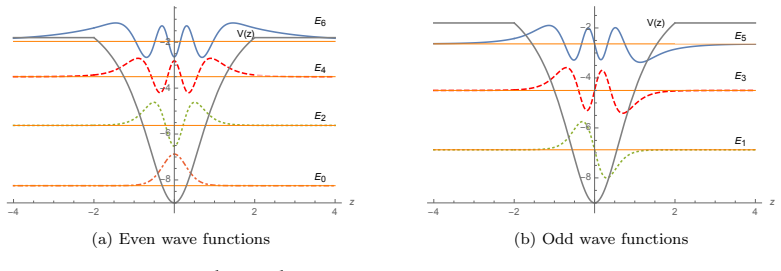
We report on the effect of the kinetic energy operator ambiguity on the energy spectra of various double heterostructures when the mass of the charge carriers, subjected to a potential, depends on position. The spectra are calculated using two complementary techniques. In the first case, which is not always possible, the energy spectrum satisfies a transcendental equation, which is obtained through an analytical process. While in the second, which can be used practically in any double heterostructure (DH), the energy spectra correspond to the poles of the reflection coefficient of the heterostructure. The spectra thus obtained complement those already reported in a previous reference, since we now include the spectra of another kinetic energy operator (KEO). Finally, we show how these methods allow us to critically analyze some statements that have been made about the relevance of some kinetic energy operators in some simpler heterostructures.
Editorial analysis
A structured set of objections, weighed in public.
Referee Report
Summary. The manuscript examines the effect of different kinetic energy operators on the energy spectra of double heterostructures with position-dependent carrier mass. Spectra are obtained via two complementary techniques: an analytical transcendental equation (when feasible) and the poles of the reflection coefficient (presented as generally applicable). The work extends prior results by including spectra for an additional KEO and uses the methods to critically analyze statements on KEO relevance in simpler heterostructures.
Significance. If the reflection-coefficient poles are rigorously shown to correspond to bound states for arbitrary KEOs, the results would usefully complement existing literature on position-dependent-mass problems and provide a basis for evaluating KEO choices. The absence of explicit derivations, error analysis, or validation against known limits in the provided description reduces the assessed significance of the central claims.
major comments (1)
- [Abstract] Abstract: the assertion that energy spectra 'correspond to the poles of the reflection coefficient of the heterostructure' for any double heterostructure and any KEO lacks an explicit derivation. Different KEO orderings (BenDaniel-Duke, Zhu-Kroemer, etc.) alter the form of the Schrödinger equation, the interface matching conditions, and the definition of the asymptotic current; without showing that the pole-to-bound-state mapping survives these changes, the complementary spectra and the subsequent critical analysis rest on an unverified assumption.
minor comments (1)
- The qualifier 'when feasible' for the transcendental-equation method is left undefined; specifying the precise conditions (e.g., symmetry requirements or potential forms) under which the method applies would improve clarity.
Simulated Author's Rebuttal
We thank the referee for the careful reading of the manuscript and the detailed comment. We address the major comment below.
read point-by-point responses
-
Referee: [Abstract] Abstract: the assertion that energy spectra 'correspond to the poles of the reflection coefficient of the heterostructure' for any double heterostructure and any KEO lacks an explicit derivation. Different KEO orderings (BenDaniel-Duke, Zhu-Kroemer, etc.) alter the form of the Schrödinger equation, the interface matching conditions, and the definition of the asymptotic current; without showing that the pole-to-bound-state mapping survives these changes, the complementary spectra and the subsequent critical analysis rest on an unverified assumption.
Authors: We agree that the abstract asserts general applicability of the reflection-coefficient pole method without an explicit derivation of the pole-to-bound-state correspondence. In the body of the manuscript the reflection coefficient is constructed case-by-case using the probability current and interface conditions appropriate to each KEO (including the additional operator treated here), and the resulting poles are shown to reproduce the spectra obtained from the transcendental equation when the latter exists. Nevertheless, a single general derivation that the correspondence survives arbitrary changes in the differential operator, matching rules, and current definition is not supplied. We will add this derivation (most likely as an appendix) in the revised manuscript so that the claim for arbitrary KEOs and the subsequent critical analysis rest on a verified foundation. revision: yes
Circularity Check
No significant circularity; derivation uses standard QM methods
full rationale
The paper computes spectra for double heterostructures via two standard techniques: (1) transcendental equations obtained analytically from the position-dependent-mass Schrödinger equation under different KEO orderings, and (2) poles of the reflection coefficient. These are presented as complementary, with the transcendental route used “when feasible” and the reflection-coefficient route as the general tool. No equations or claims reduce a derived quantity to a fitted input by construction, nor does any load-bearing step rest solely on a self-citation whose content is unverified. The mention of a “previous reference” supplies complementary spectra for one additional KEO but does not justify the mapping from poles to bound states or the critical analysis; both follow from the explicit application of the two methods to the structures. The derivation chain is therefore self-contained against external benchmarks of quantum mechanics.
Axiom & Free-Parameter Ledger
Reference graph
Works this paper leans on
- [1]
-
[2]
J. Thomsen, G. T. Einevoll, and P. C. Hemmer. Operator ordering in effective-mass theory.Phys. Rev. B, 39, 1989
work page 1989
-
[3]
A. de Souza Dutra and C.A.S. Almeida. Exact solvability of potentials with spatially dependent effective masses.Physics Letters A, 275(1), 2000
work page 2000
-
[4]
R. Valencia, J. Avenda˜ no, A. Bernal, and J. Garc´ ıa. Energy spectra of position-dependent masses in double heterostructures.Physica Scripta, 95(7), 2020
work page 2020
-
[5]
R. A. Morrow and K. R. Brownstein. Model effective-mass hamiltonians for abrupt heterojunctions and the associated wave-function-matching conditions.Phys. Rev. B, 30, 1984
work page 1984
-
[6]
R. A. Morrow. Establishment of an effective-mass hamiltonian for abrupt heterojunctions.Phys. Rev. B, 35, 1987
work page 1987
-
[7]
G. T. Einevoll and P. C. Hemmer. The effective-mass hamiltonian for abrupt heterostructures.Journal of Physics C: Solid State Physics, 21(36), 1988
work page 1988
-
[8]
W.E. Hagston, P. Harrison, T. Piorek, and T. Stirner. Boundary conditions on current carrying states and the implications for observations of bloch oscillations.Superlattices and Microstructures, 15(2), 1994
work page 1994
- [9]
-
[10]
M. J. Godfrey and A. M. Malik. Boundary conditions and spurious solutions in envelope-function theory.Phys. Rev. B, 53, 1996
work page 1996
- [11]
-
[12]
B. A. Foreman. Connection rules versus differential equations for envelope functions in abrupt heterostructures. Phys. Rev. Lett., 80, 1998
work page 1998
-
[13]
M. Pistol. Boundary conditions in the effective-mass approximation with a position-dependent mass.Phys. Rev. B, 60, 1999
work page 1999
-
[14]
L.C. Lew Yan Voon. Discontinuities in the effective-mass equation.Superlattices and Microstructures, 31(6), 2002
work page 2002
-
[15]
I. V. Tokatly, A. G. Tsibizov, and A. A. Gorbatsevich. Interface electronic states and boundary conditions for envelope functions.Phys. Rev. B, 65, 2002
work page 2002
- [16]
-
[17]
M. Gadella, S ¸. Kuru, and J. Negro. Self-adjoint hamiltonians with a mass jump: General matching conditions. Physics Letters A, 362(4), 2007
work page 2007
-
[18]
M. Gadella, J. Negro, and L.M. Nieto. Bound states and scattering coefficients of the−aδ(x)+bδ ′(x) potential. Physics Letters A, 373(15), 2009
work page 2009
-
[19]
P. Kurasov. Distribution theory for discontinuous test functions and differential operators with generalized coefficients.Journal of Mathematical Analysis and Applications, 201(1), 1996
work page 1996
-
[20]
F. S. A. Cavalcante, R. N. Costa Filho, J. Ribeiro Filho, C. A. S. de Almeida, and V. N. Freire. Form of the quantum kinetic-energy operator with spatially varying effective mass.Phys. Rev. B, 55, 1997
work page 1997
-
[21]
Omar Mustafa and S. Mazharimousavi. Ordering ambiguity revisited via position dependent mass pseudo- momentum operators.International Journal of Theoretical Physics, 46, 07 2006
work page 2006
-
[22]
D. J. BenDaniel and C. B. Duke. Space-charge effects on electron tunneling.Phys. Rev., 152, 1966. 15
work page 1966
-
[23]
Qi-Gao Zhu and H. Kroemer. Interface connection rules for effective-mass wave functions at an abrupt het- erojunction between two different semiconductors.Phys. Rev. B, 27, 1983
work page 1983
- [24]
-
[25]
T. Gora and F. Williams. Theory of electronic states and transport in graded mixed semiconductors.Phys. Rev., 177, 1969
work page 1969
-
[26]
J. R. F. Lima, M. Vieira, C. Furtado, F. Moraes, and C. Filgueiras. Yet another position-dependent mass quantum model.Journal of Mathematical Physics, 53(7), 2012
work page 2012
- [27]
-
[28]
D. Zhu. A new potential with the spectrum of an isotonic oscillator.Journal of Physics A: Mathematical and General, 20(13), 1987
work page 1987
-
[29]
J. F. Cari˜ nena, A. M. Perelomov, M. F. Ra˜ nada, and M. Santander. A quantum exactly solvable nonlinear oscillator related to the isotonic oscillator.Journal of Physics A: Mathematical and Theoretical, 41(8), 2008
work page 2008
-
[30]
S. M. Ikhdair and R. Sever. Relativistic and nonrelativistic bound states of the isotonic oscillator by nikiforov- uvarov method.Journal of Mathematical Physics, 52(12), 2011
work page 2011
-
[31]
J. Sesma. The generalized quantum isotonic oscillator.Journal of Physics A: Mathematical and Theoretical, 43(18), 2010
work page 2010
-
[32]
V. V. Dodonov, V. I. Man’ko, and L. Rosa. Quantum singular oscillator as a model of a two-ion trap: An amplification of transition probabilities due to small-time variations of the binding potential.Phys. Rev. A, 57:2851–2858, Apr 1998
work page 1998
-
[33]
V.V. Dodonov, I.A. Malkin, and V.I. Man’ko. Even and odd coherent states and excitations of a singular oscillator.Physica, 72(3):597–615, 1974
work page 1974
-
[34]
S. M. Nagiyev, E. I. Jafarov, and R. M. Imanov. On a dynamical symmetry group of the relativistic linear singular oscillator.Europhysics Letters, 76(2):175, sep 2006
work page 2006
-
[35]
Francisco M. Fern´ andez. On the quantum-mechanical singular harmonic oscillator. https://arxiv.org/abs/2112.03693, 2023
-
[36]
Self-adjoint extension procedure for a singular oscillator
Anzor Khelashvili and Teimuraz Nadareishvili. Self-adjoint extension procedure for a singular oscillator. https://arxiv.org/abs/2406.12927, 2024
-
[37]
Fl¨ ugge.Practical Quantum Mechanics
S. Fl¨ ugge.Practical Quantum Mechanics. 0072-7830. Springer, Berlin, Heidelberg, 1999
work page 1999
-
[38]
M. Abramowitz and I.A. Stegun.Handbook of Mathematical Functions: With Formulas, Graphs, and Mathe- matical Tables. Applied mathematics series. Dover Publications, 1965. 16 6 Tables Symmetric Double Heterostructure (2) V(z) m(z) -4 -2 0 2 4 z -5 0 5 10 15 Vin(z) =−µ 2/(1 +z 2), m in(z) =σ 2/(1 +z 2) V0 =V 2 =V in(z0),m 0 =m 2 =m in(z0). σ= 4,µ= 3,z 0 =−z ...
work page 1965
discussion (0)
Sign in with ORCID, Apple, or X to comment. Anyone can read and Pith papers without signing in.