Recognition: unknown
How fast can a quantum gate be? Exact speed limits from geometry
Pith reviewed 2026-05-08 11:33 UTC · model grok-4.3
The pith
A bounded spectral width in the Hamiltonian imposes tight minimum times on quantum gates that differ by operation.
A machine-rendered reading of the paper's core claim, the machinery that carries it, and where it could break.
Core claim
For any unitary generated by a Hamiltonian with bounded spectral width, the minimal evolution time is fixed by the geometry of the shortest curve obeying the curvature constraint; time-optimal gates map to helices, and the gate duration is governed by the slowest-evolving operator under the bottleneck principle.
What carries the argument
The mapping of unitary evolution onto space curves in Euclidean space whose curvature is bounded by the Hamiltonian spectral width, turning the speed-limit problem into one of finding minimal-length curves.
If this is right
- Standard gates acquire distinct minimum durations set by their individual slowest-evolving operators.
- Gates with identical entangling power can still require different minimal times.
- Time-optimal implementations correspond to helical curves of varying dimension in the geometric representation.
- The overall gate time is dictated by whichever operator component evolves most slowly.
Where Pith is reading between the lines
- Circuit designers could select gates partly on the basis of these fundamental time bounds when speed is critical.
- The same geometric bottleneck view may apply to other control tasks such as state preparation or pulse shaping.
- Experimental tests in platforms with tunable spectral widths would directly test whether the predicted limits are reached.
Load-bearing premise
The driving Hamiltonian has a bounded spectral width throughout the evolution.
What would settle it
Measure the shortest time in which a Toffoli gate can be implemented in a system with a known, fixed Hamiltonian spectral width and check whether it matches or exceeds the predicted geometric limit.
Figures


read the original abstract
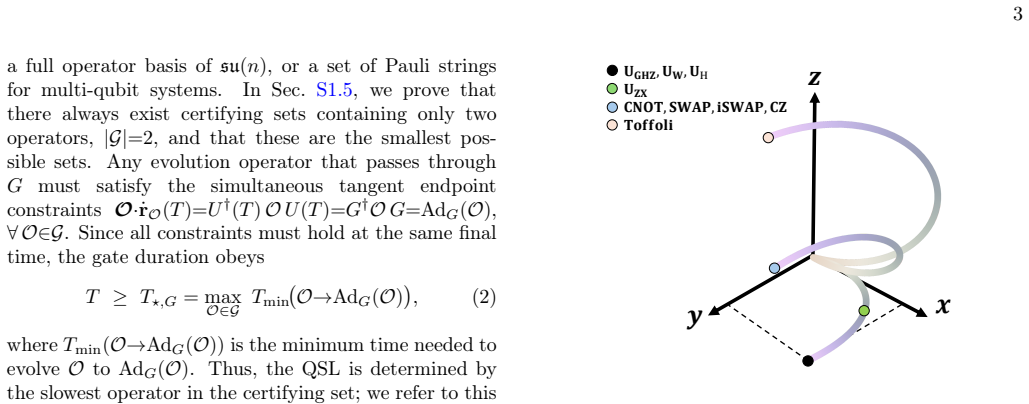
The speed of quantum evolution is limited under finite energy resources. While most quantum speed limits (QSLs) are formulated in terms of quantum states, they can be extended to the evolution operator itself, and thus impose fundamental limits on how quickly logical gate operations can be implemented on a quantum computer. Here, we derive a general, tight QSL that holds for any unitary evolution under the constraint that the spectral width of the Hamiltonian is bounded. We apply this result to obtain QSLs for several standard quantum gates, including Hadamard, CNOT, and Toffoli gates, finding that the QSL can vary significantly across different gates, including ones with the same entangling power. These findings can be understood geometrically using the Space Curve Quantum Control formalism, which maps unitary evolution to space curves in Euclidean space. In this formalism, the problem of finding QSLs is recast as the problem of finding minimal-length curves obeying a curvature bound. We find that time-optimal gates map to helices of varying dimensions, and that QSLs can be understood from the perspective of a bottleneck principle in which the operator that evolves the slowest governs the minimal gate time.
Editorial analysis
A structured set of objections, weighed in public.
Referee Report
Summary. The paper derives a general, tight quantum speed limit (QSL) for any unitary evolution under the constraint of bounded spectral width of the Hamiltonian. It recasts the problem geometrically via the Space Curve Quantum Control formalism, mapping unitary evolution to space curves in Euclidean space where QSLs become minimal-length curves subject to a curvature bound. Time-optimal solutions are identified as helices whose dimension depends on the target gate, with a bottleneck principle determining the minimal time based on the slowest-evolving operator. The QSL is applied to standard gates including Hadamard, CNOT, and Toffoli, yielding distinct minimal times even for gates sharing the same entangling power.
Significance. If the central derivation holds, the work supplies an exact, geometry-driven framework for gate speed limits that extends beyond state-based QSLs and directly informs quantum circuit optimization. The explicit identification of helices as optimal curves and the bottleneck principle provide a clear, falsifiable geometric picture of why minimal times differ across gates. This is a substantive advance for understanding fundamental limits in quantum control under energy constraints.
major comments (2)
- [Applications to quantum gates] Applications section (gates): the claim that QSLs differ significantly for CNOT and Toffoli despite equal entangling power is load-bearing for the paper's main result; the explicit computation of the helix dimension, curvature bound, and bottleneck operator for each gate must be shown in detail to confirm the variation arises from the geometry rather than from an incomplete mapping of the multi-qubit Hamiltonian.
- [General QSL derivation] Derivation of the general QSL: the equivalence between the bounded spectral width constraint and the curvature bound on the space curve must be verified to be tight and bijective; if the mapping introduces any slack, the claimed exactness of the QSL for arbitrary unitaries would not hold.
minor comments (3)
- A table summarizing the computed QSL values, helix dimensions, and bottleneck operators for all treated gates (Hadamard, CNOT, Toffoli, etc.) would improve readability and allow direct comparison.
- The notation for spectral width, curve curvature, and the bottleneck operator should be introduced with a single consistent symbol set in the methods section and used uniformly thereafter.
- Figure captions for the space-curve illustrations should explicitly label the curvature bound and the helix parameters corresponding to each gate.
Simulated Author's Rebuttal
We thank the referee for their careful reading, positive summary, and recommendation of minor revision. We address the two major comments point by point below, indicating the changes we will implement.
read point-by-point responses
-
Referee: [Applications to quantum gates] Applications section (gates): the claim that QSLs differ significantly for CNOT and Toffoli despite equal entangling power is load-bearing for the paper's main result; the explicit computation of the helix dimension, curvature bound, and bottleneck operator for each gate must be shown in detail to confirm the variation arises from the geometry rather than from an incomplete mapping of the multi-qubit Hamiltonian.
Authors: We agree that the explicit computations are required to substantiate the claim. In the revised manuscript we will add a new appendix (or expanded subsection) that supplies the full details for the CNOT and Toffoli gates: the helix dimension, the curvature bound derived from the spectral-width constraint, and the identity of the bottleneck operator in each case. These calculations will be performed within the Space Curve Quantum Control formalism and will demonstrate that the differing QSLs originate from the distinct geometric embeddings rather than from any incompleteness in the multi-qubit Hamiltonian mapping. The Hadamard gate will be included for completeness. revision: yes
-
Referee: [General QSL derivation] Derivation of the general QSL: the equivalence between the bounded spectral width constraint and the curvature bound on the space curve must be verified to be tight and bijective; if the mapping introduces any slack, the claimed exactness of the QSL for arbitrary unitaries would not hold.
Authors: The mapping is tight and bijective by construction of the Space Curve Quantum Control formalism: the bounded spectral width of the Hamiltonian is placed in one-to-one correspondence with the curvature bound on the space curve, with no slack, because the formalism realizes an isometric embedding that preserves minimal length under the given constraint. This guarantees exactness for arbitrary unitaries. To address the request for explicit verification we will insert a short clarifying paragraph (with a brief justification of bijectivity) immediately after the general derivation in the revised manuscript. revision: yes
Circularity Check
Derivation self-contained from spectral-width bound via geometric recasting
full rationale
The paper derives its general tight QSL directly from the bounded spectral width constraint on the Hamiltonian by reformulating unitary evolution as a minimal-length curve problem subject to a curvature bound within the Space Curve Quantum Control formalism. Time-optimal solutions are identified as helices whose dimension depends on the target gate, and the bottleneck principle follows from this geometry without any reduction to fitted inputs, self-definitional loops, or load-bearing self-citations. Applications to Hadamard, CNOT, and Toffoli gates produce distinct bounds even for equal entangling power, consistent with the independent geometric construction rather than tautological renaming or ansatz smuggling. The chain remains self-contained against external benchmarks.
Axiom & Free-Parameter Ledger
axioms (1)
- domain assumption Quantum evolution is unitary and governed by a Hamiltonian with bounded spectral width
Reference graph
Works this paper leans on
-
[1]
However, general multi-qubit gates do not always sat- urate this planar bound
ChoosingO=(X−Z)/ √ 2 so that ˆn′·ˆn=0, we haveb=−a=− ˆn′, and therefore T⋆,Hadamard=T2d=π/Ωmax. However, general multi-qubit gates do not always sat- urate this planar bound. This is because the SCQC tan- gent is constrained to remain on the adjoint orbit ofO. For example, ifO=ZZthe following constraint holds: (U †ZZU) 2=II,∀t, so the tangent cannot follo...
-
[2]
Deffner and S
S. Deffner and S. Campbell, Quantum speed limits: from Heisenberg’s uncertainty principle to optimal quantum control, J. Phys. A: Math. Theor.50, 453001 (2017)
2017
-
[3]
Aharonov and D
Y. Aharonov and D. Bohm, Time in the quantum theory andtheuncertaintyrelationfortimeandenergy,Physical Review122, 1649 (1961)
1961
-
[4]
Lloyd, Ultimate physical limits to computation, Na- ture406, 1047 (2000)
S. Lloyd, Ultimate physical limits to computation, Na- ture406, 1047 (2000)
2000
-
[5]
Pfeifer, How fast can a quantum state change with time?, Physical review letters70, 3365 (1993)
P. Pfeifer, How fast can a quantum state change with time?, Physical review letters70, 3365 (1993)
1993
-
[6]
Giovannetti, S
V. Giovannetti, S. Lloyd, and L. Maccone, Quantum lim- its to dynamical evolution, Physical Review A67, 052109 (2003)
2003
-
[7]
Campaioli, F
F. Campaioli, F. A. Pollock, F. C. Binder, and K. Modi, Tightening quantum speed limits for almost all states, Physical review letters120, 060409 (2018)
2018
-
[8]
Naseri, C
M. Naseri, C. Macchiavello, D. Bruß, P. Horodecki, and A. Streltsov, Quantum speed limits for change of basis, New Journal of Physics26, 023052 (2024)
2024
-
[9]
Mandelstam, The uncertainty relation between en- ergy and time in nonrelativistic quantum mechanics, J
L. Mandelstam, The uncertainty relation between en- ergy and time in nonrelativistic quantum mechanics, J. Phys.(USSR)9, 249 (1945)
1945
-
[10]
Margolus and L
N. Margolus and L. B. Levitin, The maximum speed of dynamical evolution, Physica D: Nonlinear Phenomena 120, 188 (1998)
1998
-
[11]
L. B. Levitin and T. Toffoli, Fundamental limit on the rate of quantum dynamics: the unified bound is tight, Physical review letters103, 160502 (2009)
2009
-
[12]
Farmanian and V
A. Farmanian and V. Karimipour, Quantum speed limits for implementation of unitary transformations, Physical Review A110, 042611 (2024)
2024
-
[13]
Impens and D
F. Impens and D. Guéry-Odelin, Approaching the quan- tum speed limit in quantum gates with geometric control, Physical Review A112, 042614 (2025)
2025
-
[14]
P. M. Poggi, Geometric quantum speed limits and short- time accessibility to unitary operations, Physical Review A99, 042116 (2019)
2019
-
[15]
Russell and S
B. Russell and S. Stepney, The geometry of speed limit- ing resources in physical models of computation, Interna- tional Journal of Foundations of Computer Science28, 321 (2017)
2017
-
[16]
Barnes, F
E. Barnes, F. A. Calderon-Vargas, W. Dong, B. Li, J. Zeng, and F. Zhuang, Dynamically corrected gates from geometric space curves, Quantum Science and Tech- nology7, 023001 (2022)
2022
-
[17]
Buterakos, S
D. Buterakos, S. Das Sarma, and E. Barnes, Geometrical formalism for dynamically corrected gates in multiqubit systems, PRX Quantum2, 010341 (2021)
2021
-
[18]
Zeng and E
J. Zeng and E. Barnes, Fastest pulses that implement dynamically corrected single-qubit phase gates, Physical Review A98, 012301 (2018)
2018
-
[19]
X. Wang, M. Allegra, K. Jacobs, S. Lloyd, C. Lupo, and M. Mohseni, Quantum brachistochrone curves as geodesics: Obtaining accurate minimum-time protocols for the control of quantum systems, Physical review let- ters114, 170501 (2015)
2015
-
[20]
A. Carlini, A. Hosoya, T. Koike, and Y. Okudaira, Quan- tum brachistochrone, arXiv preprint quant-ph/0511039 (2005)
-
[21]
Koike, Quantum brachistochrone, Philosophical Transactions of the Royal Society A: Mathematical, Physical and Engineering Sciences380(2022)
T. Koike, Quantum brachistochrone, Philosophical Transactions of the Royal Society A: Mathematical, Physical and Engineering Sciences380(2022)
2022
-
[22]
Khaneja, R
N. Khaneja, R. Brockett, and S. J. Glaser, Time optimal control in spin systems, Physical Review A63, 032308 (2001)
2001
-
[23]
Khaneja, S
N. Khaneja, S. J. Glaser, and R. Brockett, Sub- riemannian geometry and time optimal control of three spin systems: Quantum gates and coherence transfer, Physical Review A65, 032301 (2002)
2002
-
[24]
Garon, S
A. Garon, S. Glaser, and D. Sugny, Time-optimal con- trol of su (2) quantum operations, Physical Review A—Atomic, Molecular, and Optical Physics88, 043422 (2013)
2013
-
[25]
Van Damme, Q
L. Van Damme, Q. Ansel, S. Glaser, and D. Sugny, Ro- bust optimal control of two-level quantum systems, Phys- ical Review A95, 063403 (2017)
2017
-
[26]
Boscain, M
U. Boscain, M. Sigalotti, and D. Sugny, Introduction to the pontryagin maximum principle for quantum optimal control, PRX Quantum2, 030203 (2021)
2021
-
[27]
M. A. Nielsen, M. R. Dowling, M. Gu, and A. C. Do- herty, Optimal control, geometry, and quantum comput- ing, Physical Review A—Atomic, Molecular, and Optical 6 Physics73, 062323 (2006)
2006
- [28]
-
[29]
M. A. Nielsen, M. R. Dowling, M. Gu, and A. C. Doherty, Quantum computation as geometry, Science311, 1133 (2006)
2006
-
[30]
M. Gu, A. Doherty, and M. A. Nielsen, Quantum con- trol via geometry: An explicit example, Physical Review A—Atomic, Molecular, and Optical Physics78, 032327 (2008)
2008
- [31]
-
[32]
R. A. Horn and C. R. Johnson,Matrix analysis(Cam- bridge university press, 2012). 7 Supplemental Material S1 Space curve quantum control and quantum speed limits. . . . . . . . . . . . . . . . . . . . . . . . . . . . . . . . . . . . 7 S1.1 SCQC and the Frenet-Serret equations . . . . . . . . . . . . . . . . . . . . . . . . . . . . . . . . . . . . . . . . ...
2012
-
[33]
Assume U †Sjk U=V †Sjk Vfor allj̸=k, and define W:=V U †
It is therefore enough to work with the family{Sjk }j̸=k. Assume U †Sjk U=V †Sjk Vfor allj̸=k, and define W:=V U †. Then W †Sjk W=S jk for allj̸=k, soWcommutes with everyS jk: W Sjk =S jk Wfor allj̸=k. 14 We show that this impliesW=λI. WriteW= (w ab)n a,b=1. Fixj̸=b. Sincen≥3, we may choosekdistinct from bothjandb. Comparing the(k, b) entry ofW S jk =S jk...
discussion (0)
Sign in with ORCID, Apple, or X to comment. Anyone can read and Pith papers without signing in.