Recognition: unknown
Revisiting the Role of Plasma Sheet Bubbles in Stormtime Energy Transport Using RCM-I
Pith reviewed 2026-05-08 08:29 UTC · model grok-4.3
The pith
Plasma sheet bubbles account for about 40% of the ring current energy buildup during geomagnetic storms, saturating even as storms intensify.
A machine-rendered reading of the paper's core claim, the machinery that carries it, and where it could break.
Core claim
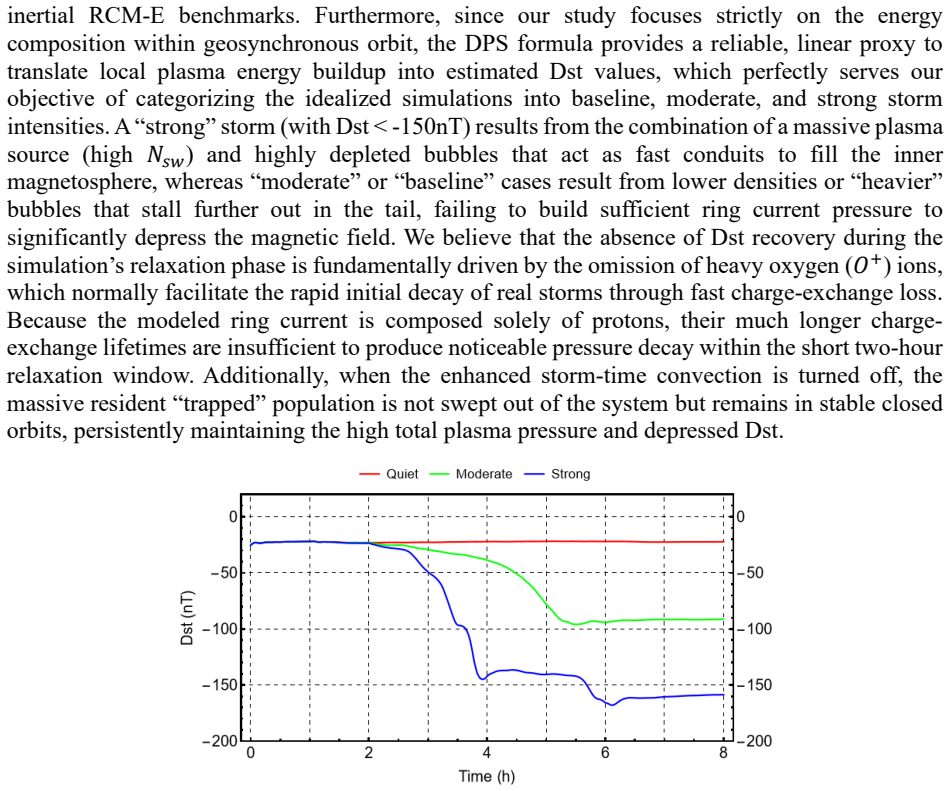
In three idealized storm simulations with RCM-I, a stratified ensemble of about 100,000 test particles weighted by plasma pressure and entropy was traced backward to classify energy sources. Results indicate bubble contributions rise with storm strength but level off near 40% of total ring current energy for R less than 6.6 Earth radii, even at Dst around -180 nT. The pre-existing trapped population contributes about 40%, and non-bubble transport 15%. When restricted to newly injected plasma, bubbles supply 73% of the inward flux, aligning with MHD studies, while inertial braking removes roughly 40% of the bubble energy flux through oscillatory flows and tailward returns.
What carries the argument
Lagrangian particle backtracking technique that traces test particles backward in time within RCM-I simulations to determine whether their energy came from bubble injections, non-bubble transport, or pre-existing trapped populations.
If this is right
- Bubble contributions to ring current energy increase with storm intensity but saturate around 40% inside geosynchronous orbit.
- Inertial braking in the model generates return flows that remove about 40% of the inward bubble energy flux.
- When only newly transported plasma is considered, bubbles account for roughly 73% of the inward energy transport.
- The trapped ring current population remains a major contributor at about 40%, limiting the net replacement by bubbles.
Where Pith is reading between the lines
- This implies that global MHD models may capture the net transport better than equilibrium approximations.
- Spacecraft observations of bubble events during storms should check for associated return flows to assess net energy deposition.
- Future simulations could test if varying inertial parameters changes the saturation level of bubble contributions.
Load-bearing premise
That the backtracking of 100,000 weighted test particles in the RCM-I runs correctly identifies energy origins without major numerical artifacts from inertial braking or return flows.
What would settle it
Comparing the simulated energy partition to multi-spacecraft observations of ring current composition and bubble-related flows during an intense storm reaching Dst of -180 nT.
Figures


read the original abstract
Plasma sheet bubbles, defined as entropy-depleted flux tubes, are widely regarded as an efficient mechanism for transporting plasma into the inner magnetosphere during geomagnetic storms. Equilibrium simulations using the Rice Convection Model (RCM-E) predict that bubbles can account for up to 60% of storm-time ring current energy during intense storms. However, global simulations and observations suggest a more moderate net contribution. In this study, we quantify the contribution of plasma sheet bubbles to ring current buildup using a Lagrangian particle backtracking technique applied to three idealized storm simulations conducted with the inertialized Rice Convection Model (RCM-I). A stratified ensemble of about 100,000 test particles, weighted by local plasma pressure and entropy, was traced backward in time to determine whether their energy originated from bubble injections, non-bubble plasma sheet transport, or pre-existing trapped populations. Our results show that bubble contributions increase with storm intensity but saturate near 40% of the total ring current energy inside R<6.6Re, even for strong storms (Dst about -180nT). The trapped population remains comparably important (about 40%), while non-bubble transport contributes about 15%. This saturation is notably lower than the 61% predicted by RCM-E and is attributed to inertial braking, which generates oscillatory flows and tailward return streams that remove approximately 40% of the inward bubble energy flux. When only newly transported plasma is considered, bubbles account for about 73% of the inward transport, consistent with global MHD and flux-based studies. These results reconcile equilibrium modeling, global simulations, and spacecraft observations by demonstrating that bubbles dominate inward transport but do not fully replace the resident ring current population due to inertial limitations.
Editorial analysis
A structured set of objections, weighed in public.
Referee Report
Summary. The paper uses three idealized storm simulations in the inertialized Rice Convection Model (RCM-I) and applies Lagrangian backtracking to a stratified ensemble of ~100,000 weighted test particles to partition ring-current energy origins. It reports that plasma-sheet bubbles contribute ~40% of the total energy inside R<6.6 Re (saturating even at Dst~-180 nT), with trapped populations contributing ~40% and non-bubble transport ~15%; when only newly transported plasma is considered, bubbles account for ~73%. The lower net bubble contribution relative to RCM-E (61%) is attributed to inertial braking that generates oscillatory flows and tailward return streams removing ~40% of the inward bubble energy flux.
Significance. If the particle-tracing results hold, the work supplies a concrete quantitative bridge between equilibrium RCM-E predictions, global MHD simulations, and observations by demonstrating that bubbles dominate new inward transport yet inertial limitations keep their net ring-current share from exceeding ~40%. The explicit attribution to inertial braking and the 73% figure for new transport are useful for model development and for interpreting spacecraft data on storm-time injections.
major comments (2)
- [§3.2] §3.2 (Lagrangian backtracking): the headline 40%/73% energy-partitioning numbers are obtained exclusively by classifying the origin of each weighted test particle after backward tracing. No convergence test with particle number, no forward-backward consistency check, and no direct comparison of the particle-derived fluxes against the model's Eulerian energy-transport diagnostics are presented. In the presence of the oscillatory braking and tailward return flows that the paper itself invokes, interpolation or diffusion errors could systematically misattribute energy removed by those flows.
- [§4.1–4.3] §4.1–4.3 (results for the three idealized runs): the saturation claim at ~40% (and the reconciliation with RCM-E) rests on only three idealized storm intensities. No sensitivity tests to particle weighting, grid resolution, or the precise definition of “bubble” versus “non-bubble” flux tubes are shown, leaving the robustness of the 40% versus 61% distinction unquantified.
minor comments (2)
- [Abstract and §4] Abstract and §4: the percentages are given as “about 40%,” “about 15%,” and “about 73%” without stating whether they are means across the three runs or values from the strongest storm; adding the actual range or standard deviation would improve clarity.
- [Figure captions and §3.2] Figure captions and §3.2: ensure that any plots of particle trajectories or energy histograms explicitly label the three storm intensities and the weighting scheme used for the ~100,000 particles.
Simulated Author's Rebuttal
We thank the referee for the constructive comments and the positive evaluation of the work's significance in providing a quantitative link between modeling approaches. We respond to each major comment below.
read point-by-point responses
-
Referee: [§3.2] §3.2 (Lagrangian backtracking): the headline 40%/73% energy-partitioning numbers are obtained exclusively by classifying the origin of each weighted test particle after backward tracing. No convergence test with particle number, no forward-backward consistency check, and no direct comparison of the particle-derived fluxes against the model's Eulerian energy-transport diagnostics are presented. In the presence of the oscillatory braking and tailward return flows that the paper itself invokes, interpolation or diffusion errors could systematically misattribute energy removed by those flows.
Authors: We recognize the value of additional validation for the Lagrangian backtracking approach. The manuscript employs a stratified ensemble of approximately 100,000 weighted test particles to ensure representative sampling of the plasma distribution. We agree that convergence tests and Eulerian comparisons were not explicitly presented. In the revised manuscript, we will incorporate a convergence study by subsampling the particle ensemble and will add a direct comparison between the particle-traced energy contributions and the Eulerian diagnostics for energy transport. Concerning potential errors from oscillatory flows, the backtracking uses a time-reversible integrator with fine temporal resolution to limit diffusion and interpolation inaccuracies, and the origin classification is anchored in entropy conservation, which is less sensitive to such effects. These revisions will bolster the reliability of the 40% and 73% figures. revision: partial
-
Referee: [§4.1–4.3] §4.1–4.3 (results for the three idealized runs): the saturation claim at ~40% (and the reconciliation with RCM-E) rests on only three idealized storm intensities. No sensitivity tests to particle weighting, grid resolution, or the precise definition of “bubble” versus “non-bubble” flux tubes are shown, leaving the robustness of the 40% versus 61% distinction unquantified.
Authors: The selection of three idealized storms was designed to demonstrate the intensity-dependent saturation of bubble contributions. We concur that the robustness to methodological choices such as particle weighting, grid resolution, and bubble definition merits further quantification. For the revision, we will perform and report sensitivity tests to the entropy threshold used to identify bubbles, showing the range of resulting energy partitions. We will also discuss the influence of grid resolution by referencing convergence studies from related RCM-I work and estimate uncertainties in the current results. While conducting additional full storm simulations at varied resolutions is resource-intensive, the saturation trend is consistent across the presented cases. These enhancements will better substantiate the difference from the RCM-E prediction of 61%. revision: partial
Circularity Check
No circularity in Lagrangian partitioning of ring current energy sources
full rationale
The paper obtains its headline percentages (~40% bubble, ~40% trapped, ~15% non-bubble) by post-processing the velocity and entropy fields of three RCM-I runs with backward Lagrangian tracing of 100k weighted particles. Particle origins are classified by tracing each test particle to its injection or trapped status in the simulation output; the resulting fractions are therefore direct numerical outputs rather than quantities fitted to or defined in terms of the target percentages. No equation in the described chain equates the final result to an input parameter by construction, no self-citation supplies a uniqueness theorem that forces the 40% saturation, and the attribution to inertial braking follows from the RCM-I formulation itself. The derivation is therefore a self-contained numerical experiment whose central claim does not reduce to its own inputs.
Axiom & Free-Parameter Ledger
axioms (2)
- domain assumption RCM-I accurately captures inertial braking and oscillatory flows in the plasma sheet
- domain assumption Test-particle weighting by local pressure and entropy faithfully represents energy transport
Reference graph
Works this paper leans on
-
[1]
Angelopoulos, V ., Baumjohann, W., Kennel, C. F., Coroniti, F. V ., Kivelson, M. G., Pellat, R., Walker, R. J., Lühr, H., & Paschmann, G. (1992). Bursty bulk flows in the inner central plasma sheet. Journal of Geophysical Research: Space Physics, 97(A4), 4027–4039. https://doi.org/10.1029/91JA02701 Boyle, C. B., Reiff, P. H., & Hairston, M. R. (1997). Emp...
-
[2]
https://doi.org/10.1007/s11207-020-01675-3 Lemon, C., Toffoletto, F., Hesse, M., & Birn, J. (2003). Computing magnetospheric force equilibria. Journal of Geophysical Research: Space Physics, 108(A6), 2002JA009702. https://doi.org/10.1029/2002JA009702 Ohtani, S., Korth, H., Brandt, P. C., Blomberg, L. G., Singer, H. J., Henderson, M. G., Lucek, E. A., Frey...
discussion (0)
Sign in with ORCID, Apple, or X to comment. Anyone can read and Pith papers without signing in.