Recognition: unknown
Dbar{D}^ast-π J/psi scatterings of coupled channels for Z_c(3900) channel
Pith reviewed 2026-05-08 07:59 UTC · model grok-4.3
The pith
Quark-exchange interactions at short distances dominate the scattering amplitudes for the Zc(3900) channel.
A machine-rendered reading of the paper's core claim, the machinery that carries it, and where it could break.
Core claim
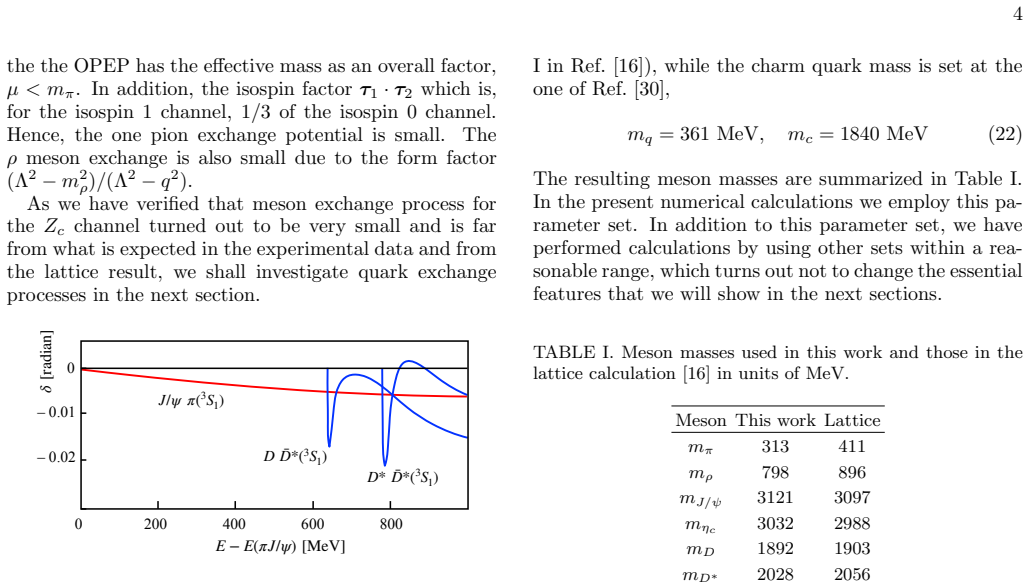
In the effective hadron-quark model the meson-exchange potentials are small, while the off-diagonal interactions by the quark exchanges at short distances, particularly for transitions between D Dbar* and J/psi pi, are strong and play the main role for the scattering amplitudes in the Zc(3900) channel.
What carries the argument
Coupled-channel effective model combining meson-exchange potentials (one-pion and D(*) exchanges) with quark-exchange potentials, where the latter supply the dominant off-diagonal transitions.
If this is right
- The Zc(3900) arises mainly from short-distance quark dynamics rather than molecular meson-exchange binding.
- Scattering amplitudes match lattice results without additional data-driven tuning for this channel.
- The model predicts measurable effects in related open-charm and hidden-charm channels.
- Similar quark-exchange dominance may appear in other near-threshold exotic states.
Where Pith is reading between the lines
- Models of other XYZ states that omit quark-exchange terms may systematically underestimate transition strengths between open- and hidden-charm channels.
- Higher-resolution lattice studies focused on sub-femtometer distances could directly test the claimed strength of these off-diagonal transitions.
- If quark exchanges dominate, the Zc(3900) likely contains significant compact four-quark components alongside any molecular component.
Load-bearing premise
The chosen meson-exchange and quark-exchange potentials in the effective model accurately capture the short-distance dynamics of the coupled channels without needing full non-perturbative QCD or extra parameters tuned to Zc(3900) data.
What would settle it
A lattice calculation or scattering measurement that finds the D Dbar* to J/psi pi transition amplitudes dominated by meson exchanges rather than quark exchanges would falsify the central claim.
Figures



read the original abstract
We perform coupled channel analysis for $D \bar D^*$, $J/\psi \pi$ and related meson pairs for the $Z_c(3900)$ channel in an effective model of hadrons and quarks. The model incorporates meson exchange potential such as one pion and $D^{(*)}$ meson exchanges, and quark exchanges. It turns out that the meson exchange potential is small, while the off-diagonal interactions by the quark exchanges at short distances, particularly for transitions between $D\bar D^*$-$J/\psi \pi$ are strong, which plays a main role for the scattering amplitudes for the $Z_c(3900)$ channel, in consistent with the results of the lattice simulations of the HALQCD group.
Editorial analysis
A structured set of objections, weighed in public.
Circularity Check
No significant circularity in the model-based derivation
full rationale
The paper defines an effective coupled-channel model that includes explicit meson-exchange potentials (one-pion and D(*) exchanges) plus quark-exchange terms at short distances, solves the resulting scattering equations for the D D-bar* – J/ψ π system, and reports the numerical outcome that quark-exchange off-diagonal potentials dominate while meson exchanges remain small. This dominance is presented as a computed result of the model dynamics and is then compared for consistency with independent HALQCD lattice phase shifts. No equation or step reduces by construction to a fitted parameter renamed as prediction, a self-definitional loop, or a load-bearing self-citation; the central claim is an output of the explicit solution rather than presupposed by the inputs.
Axiom & Free-Parameter Ledger
free parameters (1)
- quark-exchange coupling strengths
axioms (1)
- domain assumption Meson-exchange potentials can be reliably computed from known meson couplings while quark exchanges are modeled by a separate short-range operator.
Reference graph
Works this paper leans on
-
[1]
N. Brambilla et al., Eur. Phys. J. C71, 1534 (2011), arXiv:1010.5827 [hep-ph]
- [2]
- [3]
- [4]
-
[5]
Y. Yamaguchi, A. Hosaka, S. Takeuchi, and M. Tak- izawa, J. Phys. G47, 053001 (2020), arXiv:1908.08790 [hep-ph]
- [6]
- [7]
- [8]
- [9]
-
[10]
L. Fabbietti, V. Mantovani Sarti, and O. Vazquez Doce, Ann. Rev. Nucl. Part. Sci.71, 377 (2021), arXiv:2012.09806 [nucl-ex]
- [11]
- [12]
- [13]
-
[14]
Machleidt, K
R. Machleidt, K. Holinde, and C. Elster, Phys. Rept. 149, 1 (1987)
1987
- [15]
-
[16]
Ikeda (HAL QCD), The tetraquark candidate Zc(3900) from dynamical lattice QCD simulations, J
Y. Ikeda (HAL QCD), J. Phys. G45, 024002 (2018), arXiv:1706.07300 [hep-lat]
-
[17]
M. Ablikim et al. (BESIII), Phys. Rev. Lett.110, 252001 (2013), arXiv:1303.5949 [hep-ex]
- [18]
- [19]
-
[20]
M. Ablikim et al. (BESIII), Phys. Rev. Lett.112, 022001 (2014), arXiv:1310.1163 [hep-ex]
-
[21]
M. Ablikim et al. (BESIII), Phys. Rev. D92, 092006 (2015), arXiv:1509.01398 [hep-ex]
- [22]
- [23]
- [24]
-
[25]
Barnes and E
T. Barnes and E. S. Swanson, Phys. Rev. D46, 131 (1992)
1992
-
[26]
E. S. Swanson, Annals Phys.220, 73 (1992)
1992
-
[27]
Y. Yamaguchi, S. Ohkoda, S. Yasui, and A. Hosaka, Phys. Rev. D84, 014032 (2011), arXiv:1105.0734 [hep- ph]
- [28]
-
[29]
Y. Yamaguchi and E. Santopinto, Phys. Rev. D96, 014018 (2017), arXiv:1606.08330 [hep-ph]
-
[30]
Silvestre-Brac, Few Body Syst.20, 1 (1996)
B. Silvestre-Brac, Few Body Syst.20, 1 (1996)
1996
- [31]
-
[32]
S. Acharya et al. (ALICE), Phys. Rev. Lett.127, 172301 (2021), arXiv:2105.05578 [nucl-ex]
- [33]
-
[34]
Lyu, PoSHADRON2025, 200 (2026), arXiv:2509.03156 [hep-lat]
Y. Lyu, PoSHADRON2025, 200 (2026), arXiv:2509.03156 [hep-lat]
-
[35]
H. Fujii and D. Kharzeev, Phys. Rev. D60, 114039 (1999), arXiv:hep-ph/9903495
-
[36]
J. Tarr´ us Castell` a and G. Krein, Phys. Rev. D98, 014029 (2018), arXiv:1803.05412 [hep-ph]
discussion (0)
Sign in with ORCID, Apple, or X to comment. Anyone can read and Pith papers without signing in.