Recognition: unknown
Visualizing Vortex Cluster Dynamics in the Weak Type-II Superconductor CaSb₂
Pith reviewed 2026-05-08 07:13 UTC · model grok-4.3
The pith
Scanning SQUID imaging of CaSb2 shows vortex clusters with stronger boundary magnetism and quieter cores than expected for isolated vortices.
A machine-rendered reading of the paper's core claim, the machinery that carries it, and where it could break.
Core claim
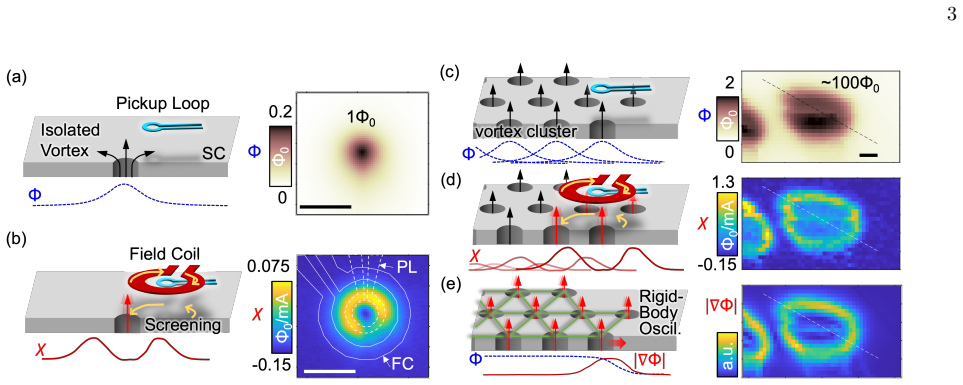
Scanning SQUID imaging of CaSb2 reveals dense vortex clusters with enhanced boundary susceptibility and suppressed internal vortex motion, which features inconsistent with both isolated vortex and flux tube behaviors. These measurements provide the first local visualization of magnetic dynamics within vortex clusters in a weakly pinned superconductor, offering a new route to probe non-monotonic vortex-vortex interactions that are typically expected in single-band type-II/1 or multiband type-1.5 superconductors. Although the superfluid density follows a single-gap BCS model and the Ginzburg-Landau parameter of CaSb2 lies slightly outside the type-II/1 regime, vortex clustering and spatially 1
What carries the argument
Scanning SQUID microscopy that maps local magnetic susceptibility and vortex motion inside dense clusters, treating the cluster itself as the object whose boundary-enhanced response and internal suppression carry the evidence for non-monotonic interactions.
If this is right
- Vortex clustering can occur and produce inhomogeneous dynamics even when the material parameters sit slightly outside the classic type-II/1 window.
- Local susceptibility measurements can distinguish collective cluster behavior from isolated-vortex or flux-tube pictures.
- Non-monotonic interactions become accessible to direct imaging in weakly pinned single-band superconductors.
- The single-gap BCS fit for superfluid density does not preclude cluster formation or position-dependent vortex motion.
Where Pith is reading between the lines
- Similar SQUID imaging on other weakly pinned materials near the type-II/1 boundary could test whether clustering is a general feature missed by mean-field models.
- If the boundary enhancement survives in cleaner samples, it would strengthen the case that the effect is interaction-driven rather than pinning-driven.
- The result invites microscopic calculations that allow non-monotonic forces inside a single-band framework without invoking multiband physics.
Load-bearing premise
That the observed clustering and spatially varying dynamics come from intrinsic non-monotonic vortex-vortex forces rather than from pinning variations, imaging artifacts, or material-specific defects.
What would settle it
A second sample of CaSb2 or a similar compound with the same Ginzburg-Landau parameter but demonstrably uniform pinning that shows no clusters or uniform internal motion under the same imaging conditions.
Figures



read the original abstract
Scanning SQUID imaging of CaSb$_2$ reveals dense vortex clusters with enhanced boundary susceptibility and suppressed internal vortex motion, which features inconsistent with both isolated vortex and flux tube behaviors. These measurements provide the first local visualization of magnetic dynamics within vortex clusters in a weakly pinned superconductor, offering a new route to probe non-monotonic vortex-vortex interactions that are typically expected in single-band type-II/1 or multiband type-1.5 superconductors. Although the superfluid density follows a single-gap BCS model and the Ginzburg-Landau parameter of CaSb$_2$ lies slightly outside the type-II/1 regime, vortex clustering and spatially inhomogeneous dynamics are clearly observed, indicating physics beyond existing microscopic theories for single-band superconductors.
Editorial analysis
A structured set of objections, weighed in public.
Referee Report
Summary. The manuscript reports scanning SQUID microscopy results on the weak type-II superconductor CaSb₂. It describes observations of dense vortex clusters featuring enhanced boundary susceptibility and suppressed internal vortex motion. These are presented as inconsistent with isolated vortex or flux-tube models. The superfluid density is shown to follow a single-gap BCS form, and the Ginzburg-Landau parameter κ lies slightly outside the type-II/1 regime, yet the authors interpret the clustering and inhomogeneous dynamics as evidence for non-monotonic vortex-vortex interactions, claiming the first local visualization of such dynamics in a weakly pinned superconductor.
Significance. If the attribution to intrinsic non-monotonic interactions holds after addressing alternatives, the work would provide a valuable new experimental probe of vortex interactions via local imaging of cluster dynamics. It extends the study of type-II/1 or type-1.5 physics to a single-gap material and combines imaging with thermodynamic characterization, potentially guiding future theory and experiments on vortex matter.
major comments (2)
- [Abstract] Abstract: The claim that the observed dense clusters, enhanced boundary susceptibility, and suppressed internal motion are 'clearly' inconsistent with isolated vortices, flux tubes, or pinning inhomogeneities lacks quantitative backing. No comparisons to pinning-only Ginzburg-Landau simulations, measured Jc maps for the pinning landscape, or deconvolved imaging models are referenced, making the central interpretation rest on an untested assumption that such effects are negligible. This is load-bearing for the claim of physics beyond single-band theory.
- [Abstract] Abstract: Although κ is noted to lie slightly outside the type-II/1 window, the manuscript does not provide a detailed calculation or reference showing how the observed clustering still requires non-monotonic interactions rather than local variations in κ or sample-specific effects. A quantitative estimate of the expected interaction range versus observed cluster sizes would clarify this point.
minor comments (2)
- The abstract and main text would benefit from explicit statements of the temperature and field ranges used for imaging, along with any data exclusion criteria or averaging procedures applied to the SQUID scans.
- Ensure all figures display raw data alongside processed images, include error bars on fitted superfluid density parameters, and provide scale bars with physical units.
Simulated Author's Rebuttal
We thank the referee for their careful reading and constructive comments on our manuscript. We have considered each point and provide detailed responses below, along with planned revisions to address the concerns about quantitative support for our interpretations.
read point-by-point responses
-
Referee: [Abstract] Abstract: The claim that the observed dense clusters, enhanced boundary susceptibility, and suppressed internal vortex motion are 'clearly' inconsistent with isolated vortices, flux tubes, or pinning inhomogeneities lacks quantitative backing. No comparisons to pinning-only Ginzburg-Landau simulations, measured Jc maps for the pinning landscape, or deconvolved imaging models are referenced, making the central interpretation rest on an untested assumption that such effects are negligible. This is load-bearing for the claim of physics beyond single-band theory.
Authors: We acknowledge that additional quantitative analysis would strengthen the distinction from pinning-only effects. The observed enhanced boundary susceptibility and suppressed internal dynamics within clusters differ qualitatively from standard pinning-induced behavior in weakly pinned type-II materials, as supported by our critical current measurements. In the revised manuscript, we will add a section estimating pinning strength from measured Jc values and reference theoretical expectations for pinning-induced clustering to show why these cannot account for the full set of observations. Full Ginzburg-Landau simulations of pinning landscapes are beyond the scope of this experimental study but will be noted as a direction for future work. revision: partial
-
Referee: [Abstract] Abstract: Although κ is noted to lie slightly outside the type-II/1 window, the manuscript does not provide a detailed calculation or reference showing how the observed clustering still requires non-monotonic interactions rather than local variations in κ or sample-specific effects. A quantitative estimate of the expected interaction range versus observed cluster sizes would clarify this point.
Authors: We agree this would improve clarity. In the revised manuscript, we will include a calculation of the vortex interaction length scale using the measured κ value and compare it quantitatively to the observed cluster sizes from our SQUID images. This estimate will demonstrate that local κ variations are insufficient to explain the dense clustering and inhomogeneous dynamics. We will also add references to relevant works on type-II/1 and type-1.5 vortex interactions to contextualize the findings. revision: yes
Circularity Check
No circularity: experimental imaging study with direct observations
full rationale
The paper reports scanning SQUID microscopy measurements of vortex clusters in CaSb2, with claims based on observed spatial patterns of vortex density and dynamics. No mathematical derivation, parameter fitting, or model reduction is presented that equates outputs to inputs by construction. Central interpretations (e.g., non-monotonic interactions) are offered as inferences from data but do not rely on self-referential equations, fitted predictions renamed as results, or load-bearing self-citations of uniqueness theorems. The work is self-contained as an observational report; any interpretive caveats fall under experimental design rather than circular reasoning.
Axiom & Free-Parameter Ledger
axioms (1)
- standard math Ginzburg-Landau theory and single-gap BCS model remain valid descriptors for the overall superfluid density and GL parameter of CaSb2.
Reference graph
Works this paper leans on
-
[1]
A. A. Abrikosov, On the Magnetic properties of super- conductors of the second group.Sov. Phys. JETP5, 1174 (1957)
1957
-
[2]
Eilenberger & H
G. Eilenberger & H. B¨ uttner, Z. Physik224, 335–352 (1969)
1969
-
[3]
E. H. Brandt, Phys. Status Solidi B77, 105 (1976)
1976
-
[4]
Klein, J
U. Klein, J. Low. Temp. Phys.69, 1–37 (1987)
1987
-
[5]
H. W. Weber, M. Botlo, F. M. Sauerzopf, H. Wiesinger and U. Klein, Jpn. J. Appl. Phys.26, 917 (1987)
1987
-
[6]
V. D. Neverov, A. E. Lukyanov, A. V. Krasavin, A. A. Shanenko, M. D. Croitoru, and A. Vagov, Phys. Rev. B 110, 054502 (2024)
2024
-
[7]
Auer and H
J. Auer and H. Ullmaier, Phys. Rev. B7, 136 (1973)
1973
-
[8]
Babaev & M
E. Babaev & M. Speight, Phys. Rev. B72, 180502(R) (2005)
2005
-
[9]
Silaev & E
M. Silaev & E. Babaev, Phys. Rev. B84, 094515 (2011)
2011
-
[10]
Carlstr¨ om, J
J. Carlstr¨ om, J. Garaud, and E. Babaev, Phys. Rev. B 84, 134515 (2011)
2011
-
[11]
N Varney, K
C. N Varney, K. A. H. Sellin, Q.-Z. Wang, H. Fangohr, and E. Babaev, J. Phys.: Condens. Matter25, 415702 (2013)
2013
-
[12]
Silaev, T
M. Silaev, T. Winyard, and E. Babaev, Phys. Rev. B97, 174504 (2018)
2018
-
[13]
Tachiki, H
M. Tachiki, H. Matsumoto, and H. Umezawa, Phys. Rev. B20, 1915 (1979)
1915
-
[14]
Garaud, M
J. Garaud, M. N. Chernodub, and D. E. Kharzeev, Phys. Rev. B102, 184516 (2020)
2020
-
[15]
Samoilenka & E
A. Samoilenka & E. Babaev, Phys. Rev. B102, 184517 (2020)
2020
-
[16]
Moshchalkov, M
V. Moshchalkov, M. Menghini, T. Nishio, Q. H. Chen, A. V. Silhanek, V. H. Dao, L. F. Chibotaru, N. D. Zhigadlo, and J. Karpinski, Phys. Rev. Lett.102, 117001 (2009)
2009
-
[17]
Nishio, V
T. Nishio, V. H. Dao, Q. Chen, L. F. Chibotaru, K. Kadowaki, and V. V. Moshchalkov, Phys. Rev. B81, 020506(R) (2010)
2010
-
[18]
J.-Y. Ge, J. Gutierrez, A. Lyashchenko, V. Filipov, J. Li, and V. V. Moshchalkov, Phys. Rev. B 90, 184511 (2014)
2014
-
[19]
Huebener,Magnetic flux structures in superconduc- tors, 2nd ed
R .P. Huebener,Magnetic flux structures in superconduc- tors, 2nd ed. (Springer, New York, 2001)
2001
-
[20]
Brandt, U
E.H. Brandt, U. Essmann, Phys. Status Solidi (b)144, 13–38 (1987)
1987
-
[21]
S. Ooi, M. Tachiki, T. Mochiku, H. Ito, T. Kubo, A. Kikuchi, S. Arisawa, and K. Umemori, Phys. Rev. B111, 094519 (2025)
2025
-
[22]
Oudah, J
M. Oudah, J. Bannies, D. A. Bonn, and M. C. Aronson, Phys. Rev. B105, 184504 (2022)
2022
-
[23]
Ikeda, S
A. Ikeda, S. R. Saha, D. Graf, P. Saraf, D. S. Sokratov, Y. Hu, H. Takahashi, S. Yamane, A. Jayaraj, J. S lawi´ nska, M. B. Nardelli, S. Yonezawa, Y. Maeno, and J. Paglione, Phys. Rev. B106, 075151 (2022)
2022
-
[24]
W. Duan, J. Zhang, R. Kumar, H. Su, Y. Zhou, Z. Nie, Y. Chen, M. Smidman, C. Cao, Y. Song, and H. Yuan, Phys. Rev. B106, 214521 (2022)
2022
-
[25]
Takahashi, S
H. Takahashi, S. Kitagawa, K. Ishida, M. Kawaguchi, A. Ikeda, S. Yonezawa, and Y. Maeno, J. Phys. Soc. Jpn. 90, 073702 (2021)
2021
-
[26]
Oudah, Y
M. Oudah, Y. Cai, M. V. De Toro Sanchez, J. Bannies, M. C. Aronson, K. M. Kojima, D. A. Bonn, Phys. Rev. B110, 134524 (2024)
2024
-
[27]
Ikeda, M
A. Ikeda, M. Kawaguchi, S. Koibuchi, T. Hashimoto, T. Kawakami, S. Yonezawa, M. Sato, and Y. Maeno, Phys. Rev. Mater.4, 041801(R) (2020)
2020
-
[28]
M. H. Fischer, M. Sigrist, D. F. Agterberg, and Y. Yanase, Annu. Rev. Condens. Matter Phys.14, 153–172 (2023)
2023
-
[29]
J. R. Kirtley, L. Paulius, A. J. Rosenberg, J. C. Palm- strom, C. M. Holland, E. M. Spanton, D. Schiessl, C. L. Jermain, J. Gibbons, Y.-K.-K. Fung, M. E. Huber, D. C. Ralph, M. B. Ketchen, G. W. Gibson Jr., and K. A. Moler, Rev. Sci. Instrum.87, 093702 (2016)
2016
-
[30]
J. R. Kirtley, B. Kalisky, J. A. Bert, C. Bell, M. Kim, Y. Hikita, H. Y. Hwang, J. H. Ngai, Y. Segal, F. J. Walker, C. H. Ahn, and K. A. Moler, Phys. Rev. B85, 224518 (2012)
2012
-
[31]
J. R. Kirtleyet al., The response of small SQUID pickup loops to magnetic fields,Supercond. Sci. Technol.29, 124001(2016)
2016
-
[32]
I. P. Zhang, J. C. Palmstrom, H. Noad, L. Bishop-Van Horn, Y. Iguchi, Z. Cui, E. Mueller, J. R. Kirtley, I. R. Fisher, and K. A. Moler, Phys. Rev. B100, 024514 (2019)
2019
-
[33]
Iguchi, I
Y. Iguchi, I. P. Zhang, E. D. Bauer, F. Ronning, J. R. Kirtley, and K. A. Moler, Phys. Rev. B103, L220503 (2021)
2021
-
[34]
E. M. Spanton,Imaging current in materials, Ph.D. the- sis 2016, Stanford University
2016
-
[35]
J.-Y. Ge, V. N. Gladilin, J. Gutierrez, and V. V. Moshchalkov, inSuperconductors at the Nanoscale: From Basic Research to Applications, edited by R. W¨ ordenweber, V. V. Moshchalkov, S. Bending, and F. Tafuri (de Gruyter, Berlin, 2017), Chap. 5, pp. 165–193
2017
-
[36]
Bishop-Van Horn, Z
L. Bishop-Van Horn, Z. Cui, J. R. Kirtley, K. A. Moler, Rev. Sci. Instrum.90, 063705 (2019)
2019
-
[37]
Visualizing Vortex Cluster Dynamics in the Weak Type-II Superconductor CaSb 2
See Supplementary Material and Figs. S4 for detailed estimates of vibration amplitude and comparison with ∂Φ/∂z. 6 Supplemental Material for “Visualizing Vortex Cluster Dynamics in the Weak Type-II Superconductor CaSb 2 ” by Iguchiet al. Appendix A: scanning SQUID susceptometry and mechanical vibration in a cryostat To examine wether the observed suscepti...
discussion (0)
Sign in with ORCID, Apple, or X to comment. Anyone can read and Pith papers without signing in.