Recognition: unknown
Effects of Porous Media Properties and Flow Environment on Drug Release from Porous Implants
Pith reviewed 2026-05-08 07:15 UTC · model grok-4.3
The pith
Drug release from porous implants accelerates in later stages at high Reynolds numbers while extending operational time.
A machine-rendered reading of the paper's core claim, the machinery that carries it, and where it could break.
Core claim
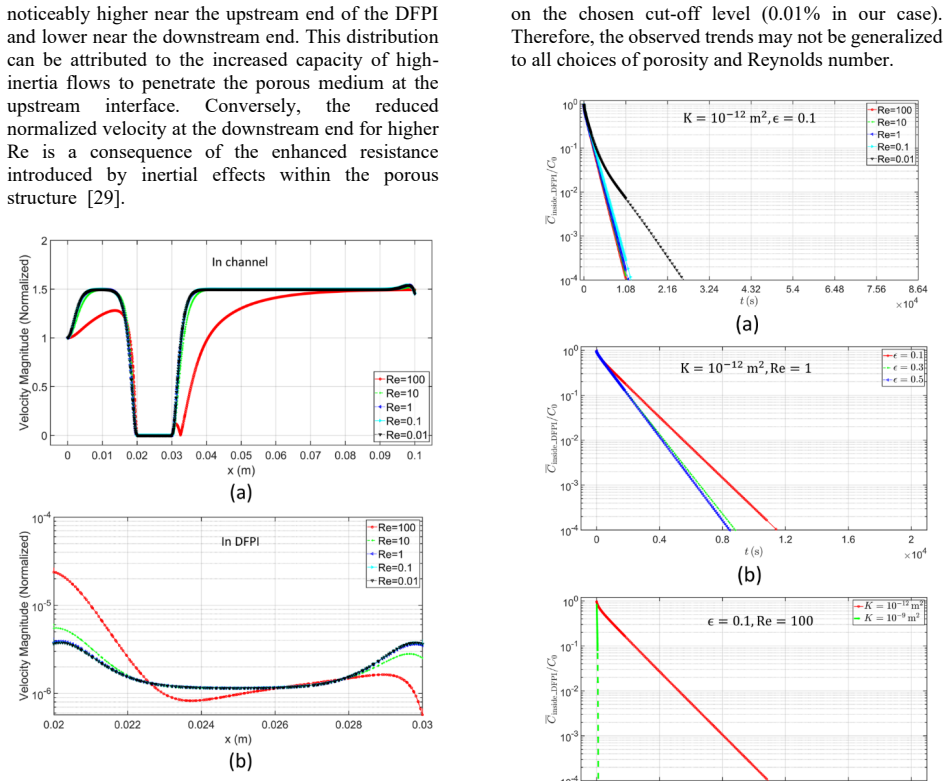
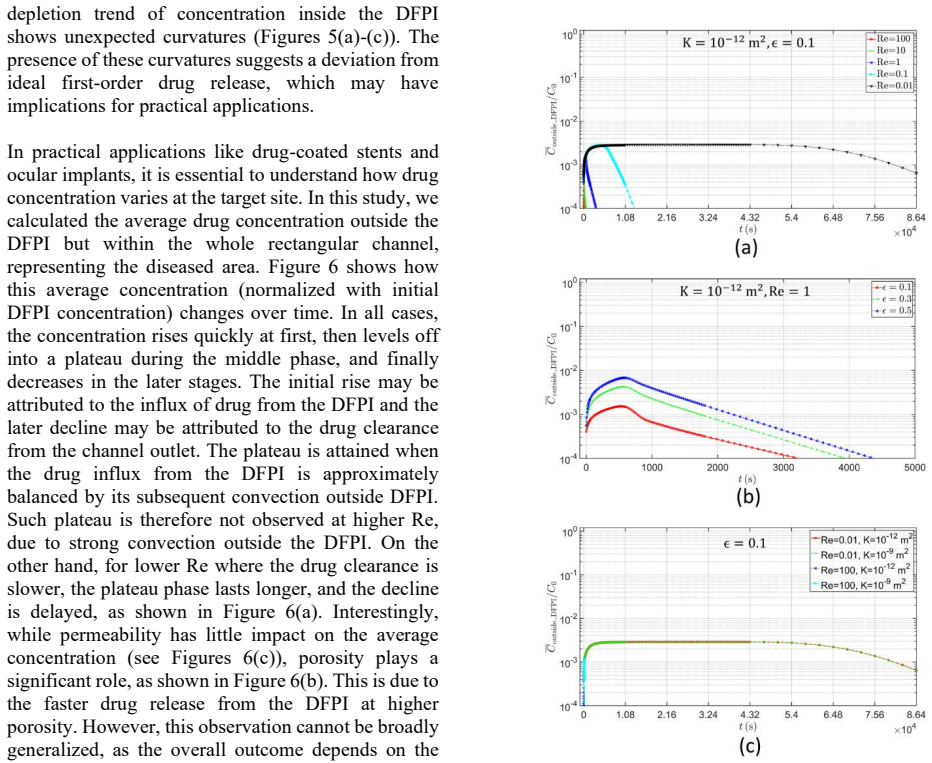
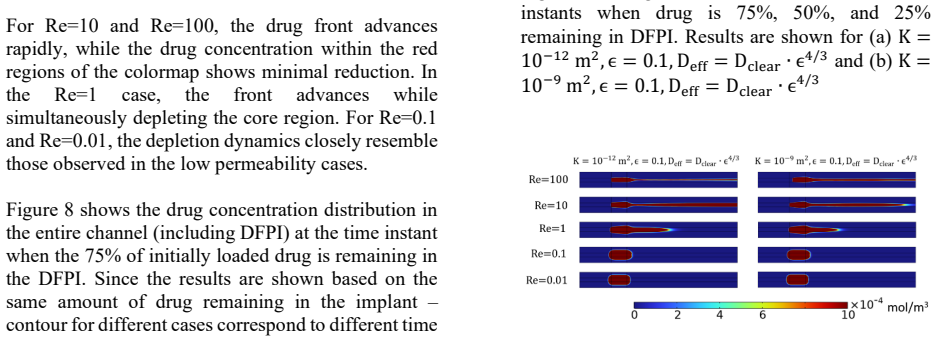
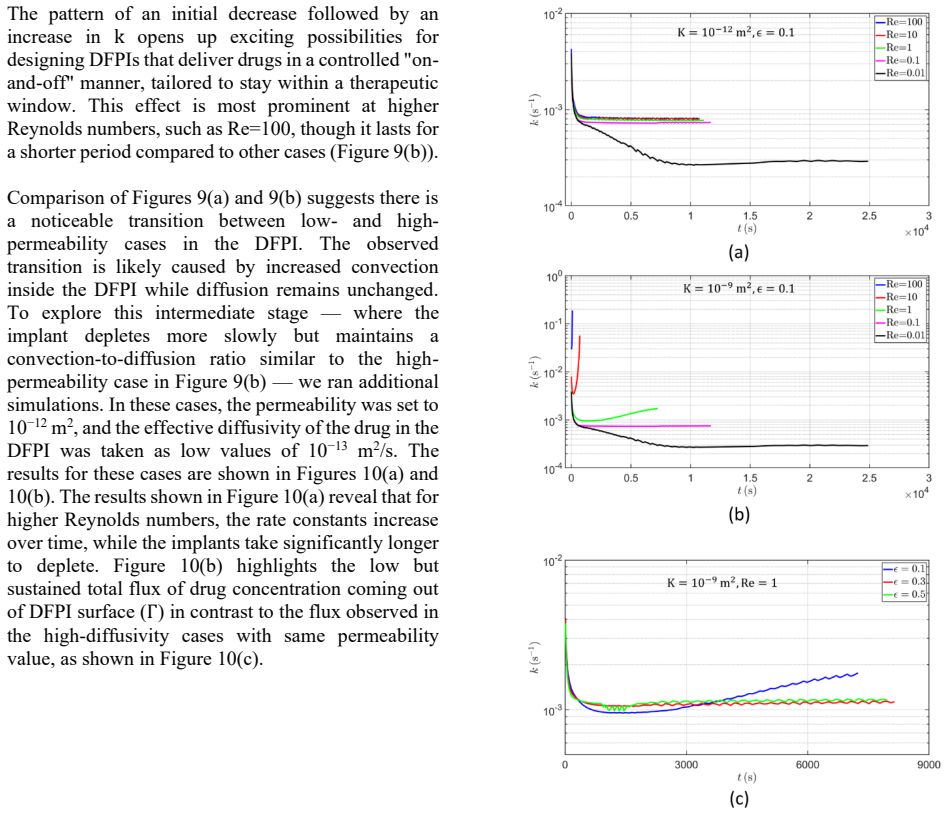
Drug release from DFPIs is represented as an apparent first-order process with a time-dependent rate constant. Simulations reveal that this rate constant rises in the later stages of release under high Reynolds number flow conditions, while the overall configuration preserves a prolonged operational time for the implant. The model combines Forchheimer-extended Darcy flow inside the homogeneous saturated porous medium with species transport both within the implant and into the surrounding channel.
What carries the argument
The time-dependent rate constant fitted to an apparent first-order release model, which quantifies how changes in Reynolds number and porous properties modify the drug release profile over time.
If this is right
- High Reynolds number flows produce an increase in the effective release rate constant during late stages.
- The implant maintains extended operational periods under the flow conditions that trigger the late-stage rate increase.
- Drug availability in the surrounding channel varies with both porous media characteristics and external flow environment.
- The observed kinetics support development of DFPI designs that adapt delivery to specific application needs.
Where Pith is reading between the lines
- The time-dependent rate approach could be tested on other porous drug carriers such as scaffolds or beads under dynamic flow.
- Varying implant porosity or permeability might amplify or dampen the late-stage rate increase predicted by the model.
- In vivo flow conditions with pulsatile rather than steady flow could alter the timing of the observed rate constant changes.
Load-bearing premise
The complex release process can be accurately captured by modeling it as an apparent first-order process with a time-dependent rate constant.
What would settle it
Laboratory measurements of cumulative drug release versus time from a DFPI in a flow channel at high Reynolds number, which would confirm or refute whether the effective rate constant increases after an initial period.
Figures



read the original abstract
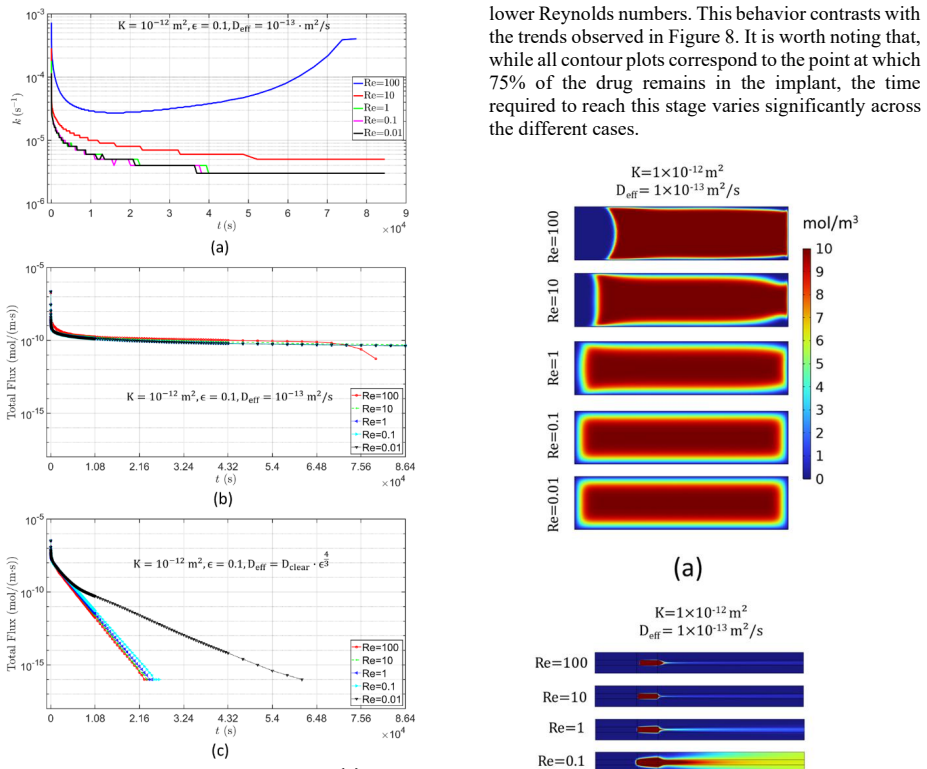
Drug-Filled Porous Implants (DFPIs) are an innovative solution for delivering drugs in a controlled and sustained manner to target sites. To optimize their performance across various physiological conditions, it is essential to understand how fluid flow and porous media properties influence the drug release process. In this work, we numerically investigate a wide range of flow conditions and their effects on drug release from DFPI. The DFPI is modeled as a homogeneous, saturated porous medium, with flow through the porous structure modeled using the Forchheimer-extended Darcy law. Drug diffusion within the DFPI and its transport through the surrounding channel are simulated using a diluted species transport approach. The results reveal the impact of flow conditions and porous media characteristics on the drug release profile of the implant and drug availability within the channel. The variations in drug release behavior are analyzed by modeling the release as an apparent first-order process with a time-dependent rate constant. Notably, the results highlight specific conditions under which the rate constant increases during the later stages of drug release from the DFPI, particularly at high Reynolds numbers, while also ensuring a prolonged operational time period of the implant. These findings suggest the potential for developing intelligent DFPI designs capable of delivering drugs in a manner more attuned to the specific needs of the application.
Editorial analysis
A structured set of objections, weighed in public.
Referee Report
Summary. The paper numerically investigates drug release from drug-filled porous implants (DFPIs) modeled as homogeneous saturated porous media. Flow is governed by the Forchheimer-extended Darcy law, and drug transport is modeled via diluted-species advection-diffusion equations in the implant and surrounding channel. Release profiles are post-processed by fitting the integrated drug mass M(t) to an apparent first-order form with time-dependent rate constant k(t). The central claim is that k(t) increases during later stages of release, particularly at high Reynolds numbers, while supporting prolonged implant operation, with implications for intelligent DFPI design.
Significance. If the reported non-monotonic k(t) behavior is shown to be robust rather than a fitting artifact, the work could provide useful numerical guidance for tailoring porous implant performance to physiological flow conditions. The modeling framework (Forchheimer-Darcy plus species transport) is standard and appropriate for the problem, and the broad parameter exploration of Re and porous properties is a strength. However, without experimental validation or quantitative fit diagnostics, the translational significance remains limited to preliminary modeling insights.
major comments (3)
- [§4] §4 (drug release kinetics analysis): The post-processing of M(t) via dM/dt = -k(t)M is presented without derivation from the underlying advection-diffusion equations or any justification for why a first-order form should hold once advection dominates at high Re. The claimed late-stage increase in k(t) lacks support from R² values, residual plots, or comparisons to alternative models (e.g., Higuchi or direct PDE solution), raising the possibility that the trend is an artifact of forcing an exponential fit onto convectively flushed profiles.
- [§3] §3 (numerical methods): No mesh convergence studies, solver tolerances, or specific ranges/values for permeability, porosity, and the Forchheimer coefficient are reported. These choices are load-bearing for the reliability of the simulated release curves and the extracted k(t) trends.
- [Abstract and §5] Abstract and §5 (conclusions): The statement that the conditions 'ensure a prolonged operational time period' is not quantified (e.g., via time-to-50%-release or comparison metrics across Re), weakening the link between the k(t) observation and the design implication.
minor comments (2)
- [§3] Notation for the time-dependent rate constant k(t) should be introduced with an explicit equation in the methods or results to avoid ambiguity in how it is computed from M(t).
- [Figures] Figure captions for release profiles and k(t) curves would benefit from explicit mention of the Reynolds number range and porous property values used in each panel for easier cross-reference with the text.
Simulated Author's Rebuttal
We thank the referee for their constructive and detailed review of our manuscript. We have addressed each major comment point by point below and will incorporate revisions to improve the rigor and clarity of the work.
read point-by-point responses
-
Referee: [§4] §4 (drug release kinetics analysis): The post-processing of M(t) via dM/dt = -k(t)M is presented without derivation from the underlying advection-diffusion equations or any justification for why a first-order form should hold once advection dominates at high Re. The claimed late-stage increase in k(t) lacks support from R² values, residual plots, or comparisons to alternative models (e.g., Higuchi or direct PDE solution), raising the possibility that the trend is an artifact of forcing an exponential fit onto convectively flushed profiles.
Authors: We agree that an explicit derivation of the apparent first-order form and quantitative fit diagnostics are needed to support the analysis. The time-dependent k(t) is introduced as a phenomenological descriptor to characterize how release kinetics evolve with flow conditions, rather than as an exact solution to the advection-diffusion equations. In the revised manuscript, we will add a derivation of k(t) from the integrated mass balance, report R² values and residual plots for representative low- and high-Re cases, and briefly discuss the applicability of the first-order form under advection-dominated regimes. These additions will confirm that the late-stage increase in k(t) at high Re arises from enhanced convective flushing and is not a fitting artifact. revision: yes
-
Referee: [§3] §3 (numerical methods): No mesh convergence studies, solver tolerances, or specific ranges/values for permeability, porosity, and the Forchheimer coefficient are reported. These choices are load-bearing for the reliability of the simulated release curves and the extracted k(t) trends.
Authors: We acknowledge that these numerical details are essential for reproducibility and reliability. The revised manuscript will include mesh convergence studies, the solver tolerances used, and the specific values (or ranges) for permeability, porosity, and the Forchheimer coefficient. revision: yes
-
Referee: [Abstract and §5] Abstract and §5 (conclusions): The statement that the conditions 'ensure a prolonged operational time period' is not quantified (e.g., via time-to-50%-release or comparison metrics across Re), weakening the link between the k(t) observation and the design implication.
Authors: We will revise the abstract and section 5 to quantify the prolonged operational time using metrics such as time-to-50%-release and direct comparisons across Reynolds numbers, thereby strengthening the connection to the design implications. revision: yes
Circularity Check
No circularity: numerical simulation followed by descriptive post-processing analysis
full rationale
The paper solves the Forchheimer-extended Darcy and advection-diffusion equations numerically to compute the drug mass release M(t) under varying flow and porous media conditions. It then post-processes this output by re-expressing the release rate in the form of an apparent first-order process with a derived time-dependent rate constant k(t) = -(1/M) dM/dt. This is a definitional reparametrization of the computed M(t) curve rather than an input assumption that forces the reported behaviors (such as the late-stage increase in k(t) at high Re). No load-bearing claim reduces to a self-citation, fitted parameter, or ansatz by construction; the physical results originate from the independent PDE solution and are merely analyzed in the chosen coordinates. The chain is self-contained.
Axiom & Free-Parameter Ledger
axioms (2)
- domain assumption Flow through the porous implant obeys the Forchheimer-extended Darcy law
- domain assumption Drug transport follows diluted species transport equations
Reference graph
Works this paper leans on
-
[1]
In contrast, this lower limit diminishes and approaches zero for higher-permeability cases
For cases with lower permeability, a minimum drug depletion time from the implant is observed, regardless of variations in porosity and Reynolds number. In contrast, this lower limit diminishes and approaches zero for higher-permeability cases
-
[2]
on - and-off
By fine -tuning Reynolds numbers, permeability, and effective diffusivity, the drug depletion rate can be slowed down, while also enabling a significant increase in the rate constant following an initial decline. This opens up exciting opportunities to design DFPI systems with controlled "on - and-off" release patterns, tailored to meet specific therapeutic goals
-
[3]
It also appears to be correlated with the evolution of rate constants
Ratio of internal diffusive and convective fluxes in DFPI decide the depletion dynamics and drug distribution with time. It also appears to be correlated with the evolution of rate constants. This study specifically focuses on the convection - diffusion-driven drug release from porous implants (DFPIs). However, other factors like erosion, swelling, pH cha...
2021
-
[4]
S. J. Buwalda, T. Vermonden, and W. E. Hennink, Hydrogels for Therapeutic Delivery: Current Developments and Future Directions, Biomacromolecules 18, 316 (2017)
2017
-
[5]
Naahidi, M
S. Naahidi, M. Jafari, M. Logan, Y. Wang, Y. Yuan, H. Bae, B. Dixon, and P. Chen, Biocompatibility of hydrogel -based scaffolds for tissue engineering applications, Biotechnol Adv 35, 530 (2017)
2017
-
[6]
Foudazi, R
R. Foudazi, R. Zowada, I. Manas -Zloczower, and D. L. Feke, Porous Hydrogels: Present Challenges and Future Opportunities, Langmuir 39, 2092 (2023)
2092
-
[7]
Patel and P
P. Patel and P. Thareja, Hydrogels differentiated by length scales: A review of biopolymer-based hydrogel preparation methods, characterization techniques, and targeted applications, Eur Polym J 163, 110935 (2022)
2022
-
[8]
Z. Li, Y. Zhou, T. Li, J. Zhang, and H. Tian, Stimuli-responsive hydrogels: Fabrication and biomedical applications, View 3, 20200112 (2022)
2022
-
[9]
Salehi, S
S. Salehi, S. M. Naghib, H. R. Garshasbi , S. Ghorbanzadeh, and W. Zhang, Smart stimuli - responsive injectable gels and hydrogels for drug delivery and tissue engineering applications: A review, Front Bioeng Biotechnol 11, 1104126 (2023)
2023
-
[10]
Brighenti and M
R. Brighenti and M. P. Cosma, Mechanics of multi-stimuli temperature -responsive hydrogels, J Mech Phys Solids 169, 105045 (2022)
2022
-
[11]
Irfan, M
J. Irfan, M. A. Hussain, M. T. Haseeb, A. Ali, M. Farid-Ul-Haq, T. Tabassum, S. Z. Hussain, I. Hussain, and M. Naeem -Ul-Hassan, A pH - sensitive, stimuli-responsive, superabsorbent, smart hydrogel from psyllium ( Plantago ovata ) for intelligent drug delive ry, RSC Adv 11, 19755 (2021)
2021
-
[12]
R. D. Manga and P. K. Jha, Mathematical Models for Controlled Drug Release Through pH-Responsive Polymeric Hydrogels, J Pharm Sci 106, 629 (2017)
2017
-
[13]
Y. Xing, B. Zeng, and W. Yang, Light responsive hydrogels for controlled drug delivery, Front Bioeng Biotechnol 10, 1075670 (2022)
2022
-
[14]
Vázquez-González and I
M. Vázquez-González and I. Willner, Stimuli- Responsive Biomolecule -Based Hydrogels and Their Applications, Angewandte Chemie International Edition 59, 15342 (2020)
2020
-
[15]
Y. Wang, J. Li, M. Tang, C. Peng, G. Wang, J. Wang, X. Wang, X. Chang, J. Guo, and S. Gui, Smart stimuli -responsive hydrogels for drug delivery in periodontitis treatment, Biomedicine & Pharmacotherapy 162, 114688 (2023)
2023
-
[16]
N. Gull, S. M. Khan, M. T. Zahid Butt, S. Khalid, M. Shafiq, A. Islam, S. Asim, S. Hafeez, and R. U. Khan, In vitro study of chitosan-based multi-responsive hydrogels as drug release vehicles: a preclinical study, RSC Adv 9, 31078 (2019)
2019
-
[17]
T. R. Hoare and D. S. Kohane, Hydrogels in drug delivery: Progress and challenges, Polymer (Guildf) 49, 1993 (2008)
1993
-
[18]
Khanafer and K
K. Khanafer and K. Vafai, The role of porous media in biomedical engineering as related to magnetic resonance imaging and drug delivery, Heat and Mass Transfer/Waerme - Und Stoffuebertragung 42, 939 (2006)
2006
-
[19]
Duong, C
T. Duong, C. López-Iglesias, P. K. Szewczyk, U. Stachewicz, J. Barros, C. Alvarez-Lorenzo, M. Alnaief, and C. A. García -González, A Pathway From Porous Particle Technology Toward Tailoring Aerogels for Pulmonary Drug Administration, Front Bioeng Biotechnol 9, 671381 (2021)
2021
-
[20]
Verma, A
N. Verma, A. Singh, V. Yadav, P. Singh, A. Yadav, and S. Jaiswal, Super Porous Hydrogel Based Drug Delivery System: A Review, South Asian Research Journal of Pharmaceutical Sciences 3, 103 (2021)
2021
-
[21]
P. K. Pandey, M. Jain, and P. K. Jha, Drug delivery from a ring implant attached to intraocular lens: An in -silico investigation, J Pharm Sci 113, 3332 (2024)
2024
-
[22]
J . Penn and M
M. J . Penn and M. G. Hennessy, Optimal loading of hydrogel -based drug -delivery systems, Appl Math Model 112, 649 (2022)
2022
-
[23]
C. C. Lin and A. T. Metters, Hydrogels in controlled release formulations: Network design and mathematical modeling, Adv Drug Deliv Rev 58, 1379 (2006). 13
2006
-
[24]
P. K. Pandey, R. Agrawal, P. Mukul, and M. K. Das, Study on Pulsatile Blood Flow in Cerebral Stenosed Artery, in Fluid Mechanics and Fluid Power , edited by T. Prabu, P. Viswanathan, A. Agrawal, and J. Banerjee (Springer Singapore, Singapore, 2021), pp. 581–588
2021
-
[25]
Skalak, S
R. Skalak, S. R. Keller, and T. W. Secomb, Mechanics of blood flow., J Biomech Eng 103, 102 (1981)
1981
-
[26]
A. F. R. Pimenta, A. P. Serro, R. Colaço, and A. Chauhan, Optimization of intraocular lens hydrogels for dual drug release: Experimentation and modelling, European Journal of Pharmaceutics and Biopharmaceutics 141, 51 (2019)
2019
-
[27]
A. F. R. Pimenta, A. P. Serro, R. Colaço, and A. Chauhan, Drug delivery to the eye anterior chamber by intraocular lenses: An in vivo concentration estimation model, European Journal of Pharmaceutics and Biopharmaceutics 133, 63 (2018)
2018
-
[28]
D. King, C. McCormick, and S. McGinty, How Does Fluid Flow Influence Drug Release from Drug Filled Implants?, Pharm Res 39, 25 (2022)
2022
-
[29]
Tjaden, S
B. Tjaden, S. J. Cooper, D. J. Brett, D. Kramer, and P. R. Shearing, On the Origin and Application of the Bruggeman Correlation for Analysing Transport Phenomena in Electrochemical Systems, Current Opinion in Chemical Engineering
-
[30]
C. Seol, T. Kim, and T. Kim, The effect of permeability on the flow structure of porous square cylinders, J Fluid Mech 985, A29 (2024)
2024
-
[31]
Hou and P
R. Hou and P. Li, Flow control and heat transfer enhancement inside a two - dimensional channel using porous blocks and applying bleeding condition between them, J Therm Anal Calorim 143, 2609 (2021)
2021
-
[32]
Śnieżek, S
D. Śnieżek, S. B. Naqvi, and M. Matyka, Inertia onset in disordered porous media flow, Phys Rev E 110, (2024)
2024
-
[33]
M. S. Gomes-Filho, M. A. A. Barbosa, and F. A. Oliveira, A statistical mechanical model for drug release: Relations between release parameters and porosity, Physica A: Statistical Mechanics and Its Applications 540, 123165 (2020)
2020
-
[34]
Zhang and R
Q. Zhang and R. Fassihi, Release rate determination from in situ gel forming PLGA implant: a novel ‘shape -controlled basket in tube’ method, Journal of Pharmacy and Pharmacology 72, 1038 (2020)
2020
-
[35]
Sinn Aw, M
M. Sinn Aw, M. Kurian, and D. Losic, Non - eroding drug-releasing implants with ordered nanoporous and nanotubular structures: concepts for controlling drug release, Biomater Sci 2, 10 (2013)
2013
-
[36]
Farzan, R
M. Farzan, R. Roth, J. Schoelkopf, J. Huwyler, and M. Puchkov, The processes behind drug loading and release in porous drug delivery systems, European Journal of Pharmaceutics and Biopharmaceutics 189, 133 (2023)
2023
-
[37]
Donbrow and Y
M. Donbrow and Y. Samuelov, Zero order drug delivery from double -layered porous films: release rate profiles from ethyl cellulose, hydroxypropyl cellulose and polyethylene glycol mixtures, Journal of Pharmacy and Pharmacology 32, 463 (1980)
1980
discussion (0)
Sign in with ORCID, Apple, or X to comment. Anyone can read and Pith papers without signing in.