Recognition: unknown
Scissors modes in generalized Gross-Pitaevskii equations
Pith reviewed 2026-05-08 06:57 UTC · model grok-4.3
The pith
In the Thomas-Fermi regime the scissors mode frequency becomes independent of the nonlinearity form in generalized Gross-Pitaevskii equations.
A machine-rendered reading of the paper's core claim, the machinery that carries it, and where it could break.
Core claim
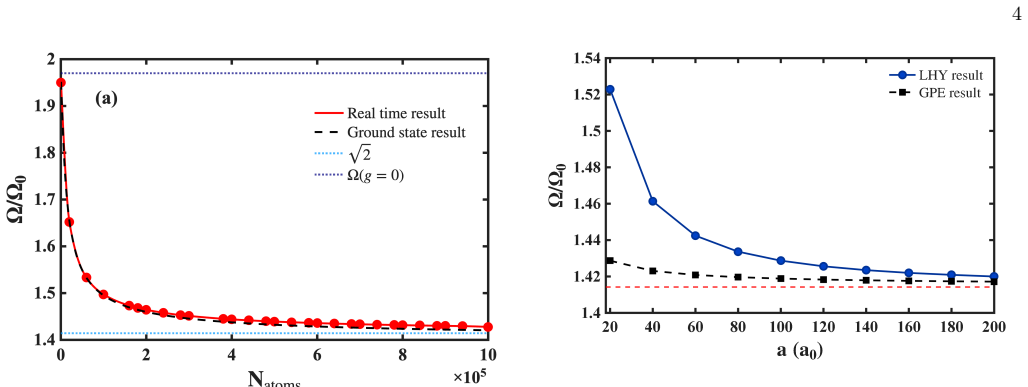
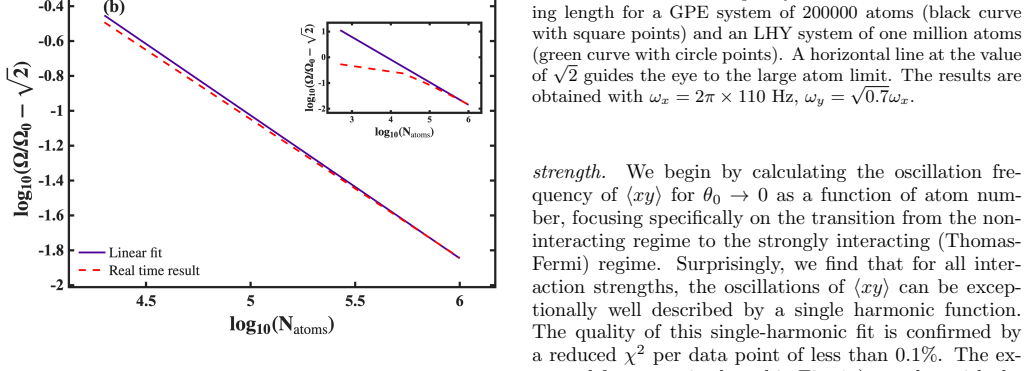
In systems governed by generalized Gross-Pitaevskii equations with power-law nonlinear terms, the frequency of the scissors mode becomes independent of the nonlinearity exponent once the system enters the Thomas-Fermi regime. This follows from an analytical derivation showing the mode is a pure shear mode that does not probe the equation of state or compressibility of the fluid. The independence is verified numerically for experimentally relevant Lee-Huang-Yang systems, where the frequency transitions from the non-interacting value to the fixed Thomas-Fermi value and remains identifiable even after strong quenches.
What carries the argument
The generalized Gross-Pitaevskii equation with arbitrary power-law nonlinearity, analyzed in the Thomas-Fermi approximation where the kinetic energy term is dropped from the mode equation.
If this is right
- The scissors mode frequency matches the known non-interacting value in the Thomas-Fermi limit regardless of the power-law exponent.
- The mode serves as a direct probe of shear or rotational flow without sensitivity to compressibility or equation of state.
- Strong sudden changes in trap parameters or interactions do not prevent clear identification of the mode frequency.
- Numerical checks for Lee-Huang-Yang corrections confirm the transition to the interaction-independent regime.
Where Pith is reading between the lines
- The same independence may hold for other shear-dominated collective modes in trapped nonlinear fluids.
- Experiments could vary the effective nonlinearity power through external fields and directly test constancy of the frequency.
- The result suggests the scissors mode remains useful even in systems where the precise form of the interaction is uncertain or complex.
Load-bearing premise
The system remains deep in the Thomas-Fermi regime so that the kinetic energy term can be neglected relative to the nonlinear interaction term when deriving the mode frequency.
What would settle it
Measuring a different scissors-mode frequency when the nonlinearity power is changed while the cloud stays in the Thomas-Fermi regime would falsify the claimed independence.
Figures


read the original abstract
We investigate scissors modes in nonlinear systems with arbitrary power-law dependence of the nonlinear term. Through analytical derivation, we establish a general expression demonstrating that, in the Thomas-Fermi regime, the frequency of the scissors mode is independent of the specific form of the nonlinearity. We conclude that the scissors mode is a shear mode that does not probe the compressibility of the system, which depends on nonlinearity. To validate our findings, we perform numerical simulations of experimentally relevant Lee-Huang-Yang (LHY) systems. Our results illustrate the transition of the scissors mode frequency from the non-interacting to the strongly interacting (Thomas-Fermi) regime. Finally, we demonstrate that the scissors mode frequency remains clearly identifiable even under strong quenches, which should facilitate the experimental observation of our findings.
Editorial analysis
A structured set of objections, weighed in public.
Referee Report
Summary. The manuscript investigates scissors modes for generalized Gross-Pitaevskii equations with arbitrary power-law nonlinearities. It derives analytically that, in the Thomas-Fermi regime, the scissors-mode frequency is independent of the specific nonlinearity. The result is interpreted as the mode being a pure shear mode that does not couple to compressibility. Numerical simulations for Lee-Huang-Yang corrected systems are used to illustrate the crossover from the non-interacting to the strongly interacting regime and to show that the frequency remains identifiable after strong quenches.
Significance. If the central claim holds, the work provides a general hydrodynamic insight that scissors modes in the TF limit decouple from the equation of state, which is useful for interpreting experiments across different interaction regimes, including beyond-mean-field corrections. The analytical derivation and the numerical demonstration of robustness under quenches are strengths that enhance the result's experimental relevance.
minor comments (1)
- The abstract refers to a 'general expression' for the frequency; including the explicit formula in the introduction or early in the results section would improve immediate accessibility.
Simulated Author's Rebuttal
We thank the referee for their positive assessment of our manuscript and for recommending acceptance. We appreciate the recognition that the analytical result on the independence of the scissors-mode frequency from the nonlinearity in the Thomas-Fermi regime offers a general hydrodynamic insight applicable across interaction regimes.
Circularity Check
Derivation self-contained; no circularity detected
full rationale
The claimed independence of scissors-mode frequency from nonlinearity form in the TF regime follows directly from linearizing the generalized hydrodynamic equations around equilibrium density using a divergence-free linear velocity field (scissors ansatz). This forces the first-order density perturbation to vanish identically, so the compressibility term (dn/dμ, which encodes the power-law exponent) drops out of the frequency equation regardless of the specific nonlinearity. The result is a standard hydrodynamic identity, not a fit, not a self-definition, and not reliant on self-citation chains. The TF approximation is an explicit, standard assumption stated up front, and the numerics are presented only as validation of the crossover, not as the source of the analytic claim.
Axiom & Free-Parameter Ledger
axioms (1)
- domain assumption Thomas-Fermi regime applies where interaction energy dominates kinetic energy
Reference graph
Works this paper leans on
-
[1]
This is the so-called ‘linear approximation’, which will be justifieda posteriori. In the linear approximation the equation for the evo- lution of the velocity field becomes m ∂v ∂t =∇ m(ω2 x −ω 2 y)(θ(t)−θ 0)xy .(10) This result is most easily derived by noticing that, by assumption, the densityn 0(r′) satisfies the time- independent gGPE (withµbeing the...
-
[2]
Y. V. Kartashov, G. E. Astrakharchik, B. A. Mal- omed, and L. Torner, Nature Reviews Physics1, 185–197 (2019)
2019
-
[3]
Dalfovo, S
F. Dalfovo, S. Giorgini, L. P. Pitaevskii, and S. Stringari, Rev. Mod. Phys.71, 463 (1999)
1999
-
[4]
E. P. Gross, Il Nuovo Cimento20, 454–477 (1961)
1961
-
[5]
Pitaevskii, Soviet Phys13, 451 (1961)
L. Pitaevskii, Soviet Phys13, 451 (1961)
1961
-
[6]
E. B. Kolomeisky, T. J. Newman, J. P. Straley, and X. Qi, Phys. Rev. Lett.85, 1146 (2000)
2000
-
[7]
K¨ ohler, Phys
T. K¨ ohler, Phys. Rev. Lett.89, 210404 (2002)
2002
-
[8]
Pieri and G
P. Pieri and G. C. Strinati, Phys. Rev. Lett.91, 030401 (2003)
2003
-
[9]
S. Choi, V. Dunjko, Z. D. Zhang, and M. Olshanii, Phys. Rev. Lett.115, 115302 (2015)
2015
-
[10]
Physical Review Letters 115(15), 155302 (2015) https://doi.org/10.1103/PhysRevLett.115.155302
D. Petrov, Physical Review Letters115(2015), 10.1103/physrevlett.115.155302
-
[11]
N. B. Jørgensen, G. M. Bruun, and J. J. Arlt, Phys. Rev. Lett.121, 173403 (2018)
2018
-
[13]
Gu´ ery-Odelin and S
D. Gu´ ery-Odelin and S. Stringari, Physical Review Let- ters83, 4452–4455 (1999)
1999
-
[14]
O. M. Marag` o, S. A. Hopkins, J. Arlt, E. Hodby, G. Hechenblaikner, and C. J. Foot, Physical Review Let- ters84, 2056–2059 (2000)
2056
-
[15]
N. L. Iudice and F. Palumbo, Physical Review Letters 41, 1532–1534 (1978)
1978
-
[16]
Richter, Progress in Particle and Nuclear Physics34, 261–284 (1995)
A. Richter, Progress in Particle and Nuclear Physics34, 261–284 (1995)
1995
-
[17]
O. M. Marag` o, G. Hechenblaikner, E. Hodby, S. A. Hop- kins, and C. J. Foot, Journal of Physics: Condensed Matter14, 343 (2001)
2001
-
[20]
I. Ferrier-Barbut, M. Wenzel, F. B¨ ottcher, T. Langen, M. Isoard, S. Stringari, and T. Pfau, Physical Review Letters120(2018), 10.1103/physrevlett.120.160402
-
[21]
L. P. Pitaevskii and S. Stringari, Bose-Einstein Condensation and Superfluidity, In- ternational series of monographs on physics (Oxford University Press, 2016)
2016
-
[22]
Schmitt, M
M. Schmitt, M. Wenzel, F. B¨ ottcher, I. Ferrier-Barbut, and T. Pfau, Nature539, 259 (2016), publisher: Nature Publishing Group
2016
- [23]
-
[24]
G. Semeghini, G. Ferioli, L. Masi, C. Mazzinghi, L. Wol- swijk, F. Minardi, M. Modugno, G. Modugno, M. Ingus- cio, and M. Fattori, Physical Review Letters120, 235301 (2018), arXiv: 1710.10890 Publisher: American Physical Society
-
[25]
T. G. Skov, M. G. Skou, N. B. Jørgensen, and J. J. Arlt, Physical Review Letters126(2021), 10.1103/phys- revlett.126.230404
-
[26]
Z.-H. Luo, W. Pang, B. Liu, Y.-Y. Li, and B. A. Mal- omed, Frontiers of Physics16(2020), 10.1007/s11467- 020-1020-2
-
[27]
C. J. Pethick and H. Smith, Bose–Einstein Condensation in Dilute Gases (Cam- bridge University Press, 2008)
2008
-
[28]
C. D. Rossi, R. Dubessy, K. Merloti, M. d. G. d. Herve, T. Badr, A. Perrin, L. Longchambon, and H. Perrin, New Journal of Physics18, 062001 (2016)
2016
-
[29]
R. K. Kumar, L. E. Young-S, D. Vudragovi´ c, A. Balaˇ z, P. Muruganandam, and S. K. Adhikari, Computer Physics Communications195, 117 (2015)
2015
-
[30]
N. Shukla, A. G. Volosniev, and J. R. Armstrong, Phys- ical Review A110(2024), 10.1103/physreva.110.053317
-
[31]
A. L. Fetter and D. L. Feder, Physical Review A58, 3185–3194 (1998)
1998
-
[32]
M. Suchorowski, A. Badamshina, M. Lemeshko, M. Tomza, and A. G. Volosniev, SciPost Physics18 (2025), 10.21468/scipostphys.18.2.059
-
[33]
J. P. Toennies, A. F. Vilesov, and K. B. Whaley, Physics Today54, 31–37 (2001)
2001
-
[34]
D’Errico, A
C. D’Errico, A. Burchianti, M. Prevedelli, L. Salasnich, F. Ancilotto, M. Modugno, F. Minardi, and C. Fort, Phys. Rev. Res.1, 033155 (2019)
2019
-
[35]
Z. Guo, F. Jia, L. Li, Y. Ma, J. M. Hutson, X. Cui, and D. Wang, Phys. Rev. Res.3, 033247 (2021)
2021
discussion (0)
Sign in with ORCID, Apple, or X to comment. Anyone can read and Pith papers without signing in.