Recognition: unknown
An Interactive Graphical Tool to Check the Coarray Continuity of Two-Fold Redundant Sparse Arrays (TFRSAs) Under Single Sensor Failures
Pith reviewed 2026-05-08 07:23 UTC · model grok-4.3
The pith
A graphical tool checks whether two-fold redundant sparse arrays keep a continuous difference coarray after any single sensor failure.
A machine-rendered reading of the paper's core claim, the machinery that carries it, and where it could break.
Core claim
The authors develop and test a comprehensive framework implemented as a MATLAB GUI that checks the coarray continuity of TFRSAs under single sensor failures, revealing that certain array positions can cause discontinuities despite the apparent redundancy.
What carries the argument
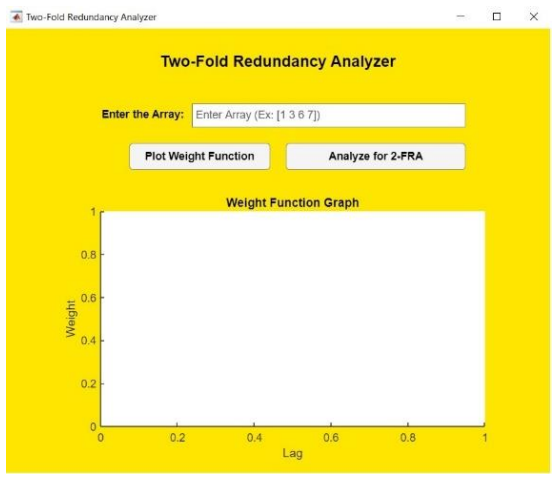
The interactive graphical user interface built in MATLAB App Designer, which accepts array positions as input and reports whether single sensor removals produce holes in the difference coarray.
If this is right
- Array designers can reject configurations that lose continuity under single failures before any hardware is built.
- Systems relying on fault-tolerant DOA estimation gain a concrete way to enforce the two-fold redundancy property.
- The tool makes explicit the distinction between nominal redundancy counts and actual continuity of the difference coarray.
Where Pith is reading between the lines
- The same simulation approach could be extended to check continuity under two or more simultaneous failures.
- Integration with array-optimization routines might allow automatic generation of provably continuous TFRSAs.
- Existing sparse-array designs in the literature could be re-examined with the tool to uncover previously unnoticed continuity problems.
Load-bearing premise
That validation against a handful of known examples from the sparse-array literature is sufficient to guarantee the tool correctly identifies all possible continuity failures across every conceivable TFRSA configuration.
What would settle it
A concrete falsifier would be an untested two-fold redundant sparse array in which manual computation shows a gap in the difference coarray after removing one specific sensor, yet the GUI reports that the coarray stays continuous.
Figures




read the original abstract
Two-fold redundant sparse arrays possess inbuilt redundancy to tackle single-element failures. This property enables them to perform accurate direction of arrival (DOA) estimation even during single sensor faults. However, recent literature suggests that some TFRSAs suffer from hidden dependencies whereby a single sensor fault at peculiar positions within the array cause discontinuities (holes) in the difference coarray (DCA). This violates the very idea of providing two-fold redundancy. Such hidden dependencies could prove catastrophic in many critical applications such as defense, autonomous driving, and biomedical imaging. Despite this issue, no formal tools or techniques exist to ascertain whether a given array configuration is truly twofold redundant or not. To address this gap, we provide a comprehensive framework and a first-ever graphical user interface (GUI). The GUI has been built using the features in MATLAB app designer and tested with known examples available in sparse array literature. Several numerical examples have been discussed to check the tool's response in each scenario. We conclude that the GUI is functionally accurate and can be an indispensable tool for sparse array designers in making informed choices about array configurations prior to real deployment.
Editorial analysis
A structured set of objections, weighed in public.
Referee Report
Summary. The paper presents a MATLAB-based graphical user interface (GUI) tool, built with App Designer, to verify whether two-fold redundant sparse arrays (TFRSAs) maintain a continuous difference coarray (DCA) under single-sensor failures. It identifies the problem of 'hidden dependencies' that can create holes in the DCA despite nominal two-fold redundancy, notes the absence of prior formal tools for this check, describes the GUI's features for array configuration input and failure simulation, reports testing against known examples from the sparse-array literature, and concludes that the tool is functionally accurate and useful for designers in applications such as DOA estimation.
Significance. If the tool's correctness holds, the work fills a practical gap by providing an interactive means to detect failure-induced coarray discontinuities before deployment in critical systems (defense, autonomous driving, biomedical imaging). The GUI approach lowers the barrier for array designers to evaluate configurations, and the focus on TFRSAs directly addresses a recently identified limitation in the redundancy literature.
major comments (1)
- [Abstract / Numerical Examples] Abstract and Numerical Examples section: The central claim that 'the GUI is functionally accurate' rests solely on testing against a handful of known examples from the sparse-array literature. No quantitative metrics (e.g., detection rates, false-negative counts), formal specification of the coarray-construction or hole-detection algorithm, proof of correctness, or exhaustive enumeration of edge-case TFRSA geometries and failure positions are provided. This leaves open the possibility of undetected implementation errors for untested configurations, directly undermining the guarantee that the tool identifies all continuity failures.
Simulated Author's Rebuttal
We thank the referee for the constructive comments on our manuscript. We address the major comment point by point below, providing clarifications on the validation approach and scope of the GUI tool.
read point-by-point responses
-
Referee: [Abstract / Numerical Examples] Abstract and Numerical Examples section: The central claim that 'the GUI is functionally accurate' rests solely on testing against a handful of known examples from the sparse-array literature. No quantitative metrics (e.g., detection rates, false-negative counts), formal specification of the coarray-construction or hole-detection algorithm, proof of correctness, or exhaustive enumeration of edge-case TFRSA geometries and failure positions are provided. This leaves open the possibility of undetected implementation errors for untested configurations, directly undermining the guarantee that the tool identifies all continuity failures.
Authors: We agree that the validation in the manuscript is based on testing against known examples from the sparse-array literature rather than quantitative metrics or a formal proof of correctness. The GUI implements the standard difference coarray (DCA) construction from array element positions, followed by a deterministic check for continuity (i.e., whether all integer lags from the minimum to maximum are present without holes). Since the process is fully deterministic with no stochastic components, metrics such as detection rates or false-negative counts do not apply in the usual sense; correctness is verified by matching the tool's output to analytically known results for specific TFRSA configurations where hidden dependencies induce holes. We acknowledge that this does not constitute exhaustive enumeration of all possible TFRSA geometries and failure positions, which would be computationally prohibitive. In the revised manuscript, we will expand the Numerical Examples section to include a clear specification of the coarray-construction and hole-detection steps (with pseudocode), additional edge-case examples drawn from the literature, and explicit discussion of the tool's limitations. This provides a stronger practical demonstration without altering the core contribution of the interactive GUI. revision: partial
Circularity Check
No circularity: tool validation on external literature examples
full rationale
The paper describes construction of a MATLAB GUI for checking difference-coarray continuity in TFRSAs under single-sensor failures, with validation performed on known examples drawn from the sparse-array literature. No mathematical derivations, equations, predictions, or first-principles results are present. The central claim of functional accuracy rests on external benchmarks rather than any self-referential definition, fitted input renamed as prediction, or load-bearing self-citation chain. This is a standard software-tool paper whose correctness can be assessed independently of its own inputs.
Axiom & Free-Parameter Ledger
Reference graph
Works this paper leans on
-
[1]
R. A. Monzingo, R. L. Haupt, and T. W. Miller, Introduction to Adaptive Arrays. IET Digital Library, 2011. doi: 10.1049/SBEW046E
-
[2]
H. Krim and M. Viberg, ‘Two decades of array signal processing research: the parametric approach’, IEEE Signal Process. Mag., vol. 13, no. 4, pp. 67–94, Jul. 1996, doi: 10.1109/79.526899
-
[3]
S. Haykin, J. P. Reilly, V . Kezys, and E. Vertatschitsch, ‘Some aspects of array signal processing’, IEE Proc. F - Radar Signal Process., vol. 139, no. 1, pp. 1–26, Feb. 1992, doi: 10.1049/ip-f-2.1992.0001
-
[4]
S. Bellofiore, C. A. Balanis, J. Foutz, and A. S. Spanias, ‘Smart-antenna systems for mobile communication networks. Part 1. Overview and antenna design’, IEEE Antennas Propag. Mag., vol. 44, no. 3, pp. 145–154, Jun. 2002, doi: 10.1109/MAP.2002.1039395
-
[5]
L. C. Godara, ‘Application of antenna arrays to mobile communications. II. Beam -forming and direction- of-arrival considerations’, Proc. IEEE, vol. 85, no. 8, pp. 1195–1245, Aug. 1997, doi: 10.1109/5.622504
-
[6]
Patwari, ‘Sparse Linear Antenna Arrays: A Review’, in Antenna Systems , H
A. Patwari, ‘Sparse Linear Antenna Arrays: A Review’, in Antenna Systems , H. Al -Rizzo and S. Abushamleh, Eds, IntechOpen, 2022. doi: 10.5772/intechopen.99444
-
[7]
M. Ebrahimi, M. Karimi, and M. Modarres -Hashemi, ‘Optimal sparse linear array design with reduced mutual coupling effect’, AEU - Int. J. Electron. Commun. , vol. 170, p. 154781, Oct. 2023, doi: 10.1016/j.aeue.2023.154781
-
[8]
C.-L. Liu and P. P. Vaidyanathan, ‘Cramér –Rao bounds for coprime and other sparse arrays, which find more sources than sensors’, Digit. Signal Process. , vol. 61, pp. 43 –61, Feb. 2017, doi: 10.1016/j.dsp.2016.04.011
-
[9]
X. Li et al., ‘Sparse Linear Arrays for Direction-of-Arrival Estimation: A Tutorial Overview’, IEEE Aerosp. Electron. Syst. Mag., pp. 1–25, 2025, doi: 10.1109/MAES.2025.3527917
-
[10]
W. Liu, M. Haardt, M. S. Greco, C. F. Mecklenbräuker, and P . Willett, ‘Twenty-Five Years of Sensor Array and Multichannel Signal Processing: A review of progress to date and potential research directions’, IEEE Signal Process. Mag., vol. 40, no. 4, pp. 80–91, Jun. 2023, doi: 10.1109/MSP.2023.3258060
-
[11]
L. Yang, Y . Han, and S. Zhou, ‘Chinese remainder theorem -assisted ambiguity -free DOA estimation for coprime arrays’, AEU - Int. J. Electron. Commun. , vol. 209, p. 156270, Apr. 2026, doi: 10.1016/j.aeue.2026.156270
-
[12]
P. Kulkarni and P. P. Vaidyanathan, ‘Interpolation for Weight -Constrained Nested Arrays Having Non - Central ULA Segments in the Coarray’, in ICASSP 2025 - 2025 IEEE International Conference on Acoustics, Speech and Signal Processing (ICASSP) , Apr. 2025, pp. 1 –5. doi: 10.1109/ICASSP49660.2025.10890061
-
[13]
S. Zhang, Z. Zhou, G. Cui, X. Tang, and P. Fan, ‘Enhanced Low-Redundancy Restricted Array for Direction of Arrival Estimation’, IEEE Trans. Aerosp. Electron. Syst., vol. 61, no. 2, pp. 3731 –3747, Apr. 2025, doi: 10.1109/TAES.2024.3491713
-
[14]
A. Camps, A. Cardama, and D. Infantes, ‘Synthesis of large low -redundancy linear arrays’, IEEE Trans. Antennas Propag., vol. 49, no. 12, pp. 1881–1883, Dec. 2001, doi: 10.1109/8.982474
-
[15]
Moffet, ‘Minimum-redundancy linear arrays’, IEEE Trans
A. Moffet, ‘Minimum-redundancy linear arrays’, IEEE Trans. Antennas Propag., vol. 16, no. 2, pp. 172 – 175, Mar. 1968, doi: 10.1109/TAP.1968.1139138
-
[16]
P. P. Vaidyanathan and P. Pal, ‘Sparse sensing with coprime arrays’, in 2010 Conference Record of the Forty Fourth Asilomar Conference on Signals, Systems and Computers , Nov. 2010, pp. 1405 –1409. doi: 10.1109/ACSSC.2010.5757766
-
[17]
Piya Pal, P. Pal, P.P. Vaidyanathan, and P . P. Vaidyanathan, ‘Nested Arrays: A Novel Approach to Array Processing With Enhanced Degrees of Freedom’, IEEE Trans. Signal Process., vol. 58, no. 8, Art. no. 8, Aug. 2010, doi: 10.1109/tsp.2010.2049264
-
[18]
Z. Zheng, W.-Q. Wang, Y . Kong, and Y . D. Zhang, ‘MISC Array: A New Sparse Array Design Achieving Increased Degrees of Freedom and Reduced Mutual Coupling Effect’, IEEE Trans. Signal Process. , vol. 67, no. 7, pp. 1728–1741, Apr. 2019, doi: 10.1109/TSP.2019.2897954
-
[19]
S. Wandale and K. Ichige, ‘xMISC: Improved Sparse Linear Array via Maximum Inter -Element Spacing Concept’, IEEE Signal Process. Lett., vol. 30, pp. 1327–1331, 2023, doi: 10.1109/LSP.2023.3316018
-
[20]
Z. Peng, Y . Ding, S. Ren, H. Wu, and W. Wang, ‘Coprime Nested Arrays for DOA Estimation: Exploiting the Nesting Property of Coprime Array’, IEEE Signal Process. Lett. , vol. 29, pp. 444 –448, 2022, doi: 10.1109/LSP.2021.3139577
-
[22]
Raiguru et al., ‘Hole-Free DCA for Augmented Co-Prime Array’, Circuits Syst
P. Raiguru et al., ‘Hole-Free DCA for Augmented Co-Prime Array’, Circuits Syst. Signal Process., vol. 41, no. 5, pp. 2977–2987, May 2022, doi: 10.1007/s00034-021-01909-0
-
[23]
D. Chen, K. Ye, C. Xing, L. Zhou, and H. Sun, ‘An improved sparse array design for improving DOA estimation performance under mutual coupling effect’, AEU - Int. J. Electron. Commun. , vol. 206, p. 156215, Feb. 2026, doi: 10.1016/j.aeue.2026.156215
-
[24]
X. Wang, L. Zhao, and Y . Jiang, ‘Super Augmented Nested Arrays: A New Sparse Array for Improved DOA Estimation Accuracy’, IEEE Signal Process. Lett. , vol. 31, pp. 26 –30, 2024, doi: 10.1109/LSP.2023.3340599
-
[25]
P. Raiguru, D. C. Panda, and R. K. Mishra, ‘Multi -Source Detection Performance of Some Linear Sparse Arrays’, IETE J. Res., vol. 0, no. 0, pp. 1–12, Mar. 2022, doi: 10.1080/03772063.2022.2038701
-
[26]
C.-L. Liu and P. P. Vaidyanathan, ‘Optimizing Minimum Redundancy Arrays for Robustness’, in 2018 52nd Asilomar Conference on Signals, Systems, and Computers , Oct. 2018, pp. 79 –83. doi: 10.1109/ACSSC.2018.8645482
-
[27]
C.-L. Liu and P. P. Vaidyanathan, ‘Composite Singer Arrays with Hole -free Coarrays and Enhanced Robustness’, in ICASSP 2019 - 2019 IEEE International Conference on Acoustics, Speech and Signal Processing (ICASSP) , Brighton, United Kingdom: IEEE, May 2019, pp. 4120 –4124. doi: 10.1109/ICASSP.2019.8683563
-
[28]
D. Zhu, F. Hu, L. Lang, P. Tang, X. Peng, and F. He, ‘Double Difference Bases and Thinned Arrays With Twofold Redundancy’, IEEE Trans. Antennas Propag. , vol. 65, no. 12, pp. 7366 –7371, Dec. 2017, doi: 10.1109/TAP.2017.2765738
-
[29]
A. Patwari, P. Raiguru, and A. Chandrasekaran, ‘ULA -inspired Two-Fold Redundant Sparse Linear Array with Closed-Form Expressions and 2/N Fragility’, in 2025 33rd European Signal Processing Conference (EUSIPCO), Sep. 2025, pp. 2267–2271. doi: 10.23919/EUSIPCO63237.2025.11226104
-
[30]
Double Difference Bases and Thinned Arrays With Twofold Redundancy
A. Patwari, ‘Comments on “Double Difference Bases and Thinned Arrays With Twofold Redundancy”’, Sep. 06, 2024, TechRxiv. doi: https://doi.org/10.36227/techrxiv.172565620.02854040/v1
-
[31]
P. Kunchala and A. Patwari, ‘A Leap -on-Success Exhaustive Search Method to Find Optimal Robust Minimum Redundancy Arrays (RMRAs): New Array Configurations for Sensor Counts 11 to 20’, Jul. 14, 2025, arXiv: arXiv:2507.10706. doi: 10.48550/arXiv.2507.10706
-
[32]
Accessed: Nov
‘Sensor Array Analyzer - Analyze beam patterns and performance characteristics of linear, planar, 3-D, and arbitrary sensor arrays - MATLAB’. Accessed: Nov. 22, 2025. [Online]. Available: https://in.mathworks.com/help/phased/ref/sensorarrayanalyzer-app.html
2025
-
[33]
Barkhausen-Institut/AntennaArraySimulator. (Sep. 30, 2024). Python. Barkhausen Institut gGmbH. Accessed: Jan. 09, 2025. [Online]. Available: https://github.com/Barkhausen - Institut/AntennaArraySimulator
2024
-
[34]
Accessed: Jan
‘GitHub - zinka/arraytool: Python based package for phased array antenna design and analysis’. Accessed: Jan. 09, 2025. [Online]. Available: https://github.com/zinka/arraytool/tree/master
2025
-
[35]
A. Patwari, A. Pandey, A. Dabade, and P. Raiguru, ‘Design and validation of a MATLAB -based GUI for coarray domain analysis of sparse linear arrays’, J. Adv. Signal Process., Jan. 2026, doi: 10.1186/s13634 - 025-01284-x
-
[36]
C. L. Liu and P. P. Vaidyanathan, ‘Remarks on the Spatial Smoothing Step in Coarray MUSIC’, IEEE Signal Process. Lett., vol. 22, no. 9, pp. 1438–1442, Sep. 2015, doi: 10.1109/LSP.2015.2409153
-
[37]
S. Wandale and K. Ichige, ‘A Generalized Extended Nested Array Design via Maximum Inter -Element Spacing Criterion’, IEEE Signal Process. Lett., vol. 30, pp. 31–35, 2023, doi: 10.1109/LSP.2023.3238912
-
[38]
A. Patwari and P. Kunchala, ‘Novel Sparse Linear Array Based on a New Suboptimal Number Sequence with a Hole -free Difference Co -array’, Prog. Electromagn. Res. Lett. , vol. 116, pp. 23 –30, 2024, doi: 10.2528/pierl23102706
-
[39]
P. Zhao, Q. Wu, G. Hu, L. Wang, and L. Wan, ‘Generalized Hole-Free Sparse Antenna Array Design With Even/Odd Maximum Interelement Spacing’, IEEE Antennas Wirel. Propag. Lett., vol. 24, no. 3, pp. 716 – 720, Mar. 2025, doi: 10.1109/LAWP.2024.3514150
-
[40]
A. Patwari, S. R. S, and G. R. Reddy, ‘Discovering Optimal Robust Minimum Redundancy Arrays (RMRAs) through Exhaustive Search and Algebraic Formulation of a New Sub-Optimal RMRA’, Dec. 30, 2025, arXiv: arXiv:2512.24155. doi: 10.48550/arXiv.2512.24155
discussion (0)
Sign in with ORCID, Apple, or X to comment. Anyone can read and Pith papers without signing in.