Recognition: unknown
Two-loop quarkonium Hamiltonian in annihilation channel
Pith reviewed 2026-05-08 07:45 UTC · model grok-4.3
The pith
The two-loop quarkonium Hamiltonian in the annihilation channel is now calculated in potential-NRQCD.
A machine-rendered reading of the paper's core claim, the machinery that carries it, and where it could break.
Core claim
We calculate the two-loop quarkonium Hamiltonian in the annihilation channel within the framework of potential-NRQCD effective field theory. The result agrees with the previous calculation of the corresponding four-quark operator in NRQCD for SU(N) color gauge group. We further obtain an expression with a more general color structure applicable to other gauge groups. Combined with the recently calculated two-loop Hamiltonian in the non-annihilation channel, this completes the full two-loop quarkonium Hamiltonian.
What carries the argument
Two-loop matching of potential-NRQCD to full QCD for the annihilation-channel contributions to the quark-antiquark potential.
If this is right
- The full two-loop quarkonium Hamiltonian is now available for use in precision calculations of bound-state energies and wave functions.
- Predictions for quarkonium spectra and annihilation rates can be made consistently at this order across effective-theory approaches.
- The general color-factor expression allows the same Hamiltonian to be applied in other non-Abelian gauge theories.
- Higher-order resummation or lattice comparisons can proceed with a complete perturbative input at two loops.
Where Pith is reading between the lines
- Future three-loop calculations in the same framework would become feasible once the two-loop baseline is established.
- The result could be inserted into numerical solvers for the Schrödinger equation to generate testable mass and width predictions for specific quarkonia.
- Consistency between this pNRQCD result and direct NRQCD operator matching supplies a cross-check that could be repeated at higher orders.
Load-bearing premise
The perturbative matching procedures in potential-NRQCD correctly capture all two-loop contributions in the annihilation channel without missing terms or color inconsistencies.
What would settle it
An independent two-loop computation of the four-quark operator in NRQCD that produces a numerically different result for the annihilation channel.
Figures

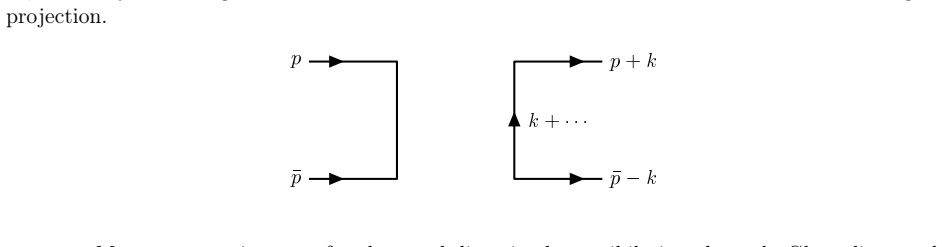

read the original abstract
We calculate the two-loop quarkonium Hamiltonian in the annihilation channel within the framework of potential-NRQCD effective field theory. The result agrees with the previous calculation of the corresponding four-quark operator in NRQCD for SU(N) color gauge group. We further obtain an expression with a more general color structure applicable to other gauge groups. Combined with the recently calculated two-loop Hamiltonian in the non-annihilation channel, this completes the full two-loop quarkonium Hamiltonian.
Editorial analysis
A structured set of objections, weighed in public.
Referee Report
Summary. The paper calculates the two-loop quarkonium Hamiltonian in the annihilation channel in potential-NRQCD effective field theory. It derives the relevant four-fermion operator coefficients via hard-scale matching, subtracts soft contributions, and shows agreement with the known NRQCD four-quark operator result for SU(N); it also supplies the generalization to arbitrary color structures. Combined with the prior non-annihilation channel result, this completes the full two-loop pNRQCD Hamiltonian.
Significance. If correct, the result supplies the missing annihilation-channel piece of the two-loop pNRQCD Hamiltonian, enabling consistent higher-order calculations of quarkonium spectra, decays, and production. The explicit reproduction of the existing NRQCD operator together with the color-factor extension constitutes a non-trivial cross-check and broadens applicability beyond SU(3).
minor comments (3)
- [Abstract] Abstract: the phrase 'the previous calculation' is not accompanied by a citation; adding the reference to the NRQCD four-quark operator paper would allow readers to locate the comparison immediately.
- [Results section] The manuscript states that the result 'agrees with' the prior NRQCD operator but does not display the explicit coefficient-by-coefficient comparison; including a short table or equation block that juxtaposes the two expressions would strengthen the verification claim.
- [Section on color generalization] Notation for the color structures (e.g., the definition of the generalized Casimir operators) is introduced without a dedicated equation number; numbering these definitions would improve traceability when the expressions are used in subsequent work.
Simulated Author's Rebuttal
We thank the referee for the careful review of our manuscript and for the positive assessment of its significance. The referee's summary accurately describes the calculation of the two-loop quarkonium Hamiltonian in the annihilation channel within pNRQCD, its agreement with the known NRQCD four-quark operator result for SU(N), the generalization to arbitrary gauge groups, and the completion of the full two-loop Hamiltonian when combined with the non-annihilation channel. Since the report contains no specific major comments, we have no individual points to address.
Circularity Check
Direct two-loop matching calculation with external cross-check
full rationale
The paper derives the two-loop annihilation-channel Hamiltonian via explicit perturbative matching in pNRQCD, computing hard-scale contributions and subtracting soft pieces already accounted for in the potential. The central result is then compared to an independent prior NRQCD four-quark operator calculation for SU(N), which serves as an external anchor rather than an input. The reference to the non-annihilation channel completes the full Hamiltonian but does not define or constrain the present derivation; no equation reduces by construction to a fitted parameter, self-citation, or ansatz from the same work. The procedure is a standard EFT matching computation whose correctness is directly testable by diagram evaluation.
Axiom & Free-Parameter Ledger
Reference graph
Works this paper leans on
-
[1]
N. Brambilla et al. [Quarkonium Working Group], doi:10.5170/CERN-2005-005 [arXiv:hep-ph/0412158 [hep-ph]]
-
[2]
Heavy quarkonium: progress, puzzles, and opportunities
N. Brambilla, S. Eidelman, B. K. Heltsley, R. Vogt, G. T. B odwin, E. Eichten, A. D. Frawley, A. B. Meyer, R. E. Mitchell and V. Papadimitrio u, et al. Eur. Phys. J. C 71 (2011), 1534 doi:10.1140/epjc/s10052-010-1534-9 [arXiv :1010.5827 [hep-ph]]
-
[3]
G. Mishima, Y. Sumino and H. Takaura, Phys. Rev. Lett. 133 (2024) no.23, 231903 doi:10.1103/PhysRevLett.133.231903 [arXiv:2407.00723 [hep-ph]]
-
[4]
A. Pineda and J. Soto, Nucl. Phys. B Proc. Suppl. 64 (1998), 428-432 doi:10.1016/S0920-5632(97)01102-X [arXiv:hep-ph/9707 481 [hep-ph]]
-
[5]
N. Brambilla, A. Pineda, J. Soto and A. Vairo, Rev. Mod. Ph ys. 77 (2005), 1423 doi:10.1103/RevModPhys.77.1423 [arXiv:hep-ph/0410047 [hep-ph]]
-
[6]
Kira—a feynman integral reduction program
P. Maierhöfer, J. Usovitsch and P. Uwer, Comput. Phys. Co mmun. 230 (2018), 99-112 doi:10.1016/j.cpc.2018.04.012 [arXiv:1705.05610 [hep- ph]]. 10
-
[7]
J. Klappert, F. Lange, P. Maierhöfer and J. Usovitsch, Co mput. Phys. Commun. 266 (2021), 108024 doi:10.1016/j.cpc.2021.108024 [arXiv:20 08.06494 [hep-ph]]
-
[8]
F. Lange, J. Usovitsch and Z. Wu, Comput. Phys. Commun. 322 (2026), 109999 doi:10.1016/j.cpc.2025.109999 [arXiv:2505.20197 [hep- ph]]
-
[9]
The FLINT team, FLINT: Fast Library for Number Theory, ht tps://flintlib.org
-
[10]
R. H. Lewis, Fermat: A Computer Algebra System for Polyn omial and Matrix Com- putation, http://home.bway.net/lewis/
-
[11]
Antonelliet al.(FENICE Collaboration), Nucl
M. Beneke and V. A. Smirnov, Nucl. Phys. B 522 (1998), 321-344 doi:10.1016/S0550- 3213(98)00138-2 [arXiv:hep-ph/9711391 [hep-ph]]
-
[12]
M. Gerlach, G. Mishima and M. Steinhauser, Phys. Rev. D 100 (2019) no.5, 054016 doi:10.1103/PhysRevD.100.054016 [arXiv:1907.08227 [he p-ph]]
-
[13]
S. Borowka, G. Heinrich, S. Jahn, S. P. Jones, M. Kerner, J. Schlenk and T. Zirke, Comput. Phys. Commun. 222 (2018), 313-326 doi:10.1016/j.cpc.2017.09.015 [arXiv:1703.09692 [hep-ph]]
-
[14]
S. Borowka, G. Heinrich, S. Jahn, S. P. Jones, M. Kerner a nd J. Schlenk, Comput. Phys. Commun. 240 (2019), 120-137 doi:10.1016/j.cpc.2019.02.015 [arXiv:1 811.11720 [physics.comp-ph]]
-
[15]
G. Heinrich, S. Jahn, S. P. Jones, M. Kerner, F. Langer, V . Magerya, A. Pöl- daru, J. Schlenk and E. Villa, Comput. Phys. Commun. 273 (2022), 108267 doi:10.1016/j.cpc.2021.108267 [arXiv:2108.10807 [hep- ph]]
-
[16]
G. Heinrich, S. P. Jones, M. Kerner, V. Magerya, A. Olsso n and J. Schlenk, Comput. Phys. Commun. 295 (2024), 108956 doi:10.1016/j.cpc.2023.108956 [arXiv:23 05.19768 [hep-ph]]
-
[17]
It is readable by Mathematica using “Get” command
The file is available at the preprint server https://arXiv.org as an ancillary file as- sociated with this letter. It is readable by Mathematica using “Get” command. See the header of the file for description. (If a system-dependent er ror occurs, try stripping off the header.) In addition we provide a file of the substitution rules for δ1Zg and the 2-loop HH ...
-
[18]
B. A. Kniehl, A. A. Penin, V. A. Smirnov and M. Steinhause r, Nucl. Phys. B 635 (2002), 357-383 doi:10.1016/S0550-3213(02)00403-0 [arX iv:hep-ph/0203166 [hep-ph]]
-
[19]
S. Moch, J. A. M. Vermaseren and A. Vogt, Nucl. Phys. B 688 (2004), 101-134 doi:10.1016/j.nuclphysb.2004.03.030 [arXiv:hep-ph/0403192 [hep-ph]]
-
[20]
C. Anzai, Y. Kiyo and Y. Sumino, Nucl. Phys. B 838 (2010), 28-46 [erratum: Nucl. Phys. B 890 (2015), 569] doi:10.1016/j.nuclphysb.2010.05.012 [arXi v:1004.1562 [hep- ph]]. 11
-
[21]
J. H. Piclum, doi:10.3204/DESY-THESIS-2007-014
-
[22]
J. Ellis, Comput. Phys. Commun. 210 (2017), 103-123 doi:10.1016/j.cpc.2016.08.019 [arXiv:1601.05437 [hep-ph]]
-
[23]
Dohse, TikZ-FeynHand: Basic User Guide, (2018), arXiv:1802.00689 [cs.OH]
M. Dohse, [arXiv:1802.00689 [cs.OH]]. 12
discussion (0)
Sign in with ORCID, Apple, or X to comment. Anyone can read and Pith papers without signing in.