Recognition: unknown
A Single Twist-Angle Selection Method for the Electronic Structure of Bilayer Materials
Pith reviewed 2026-05-08 07:41 UTC · model grok-4.3
The pith
A binding structure factor selects one twist angle yielding bilayer energies close to full twist averaging.
A machine-rendered reading of the paper's core claim, the machinery that carries it, and where it could break.
Core claim
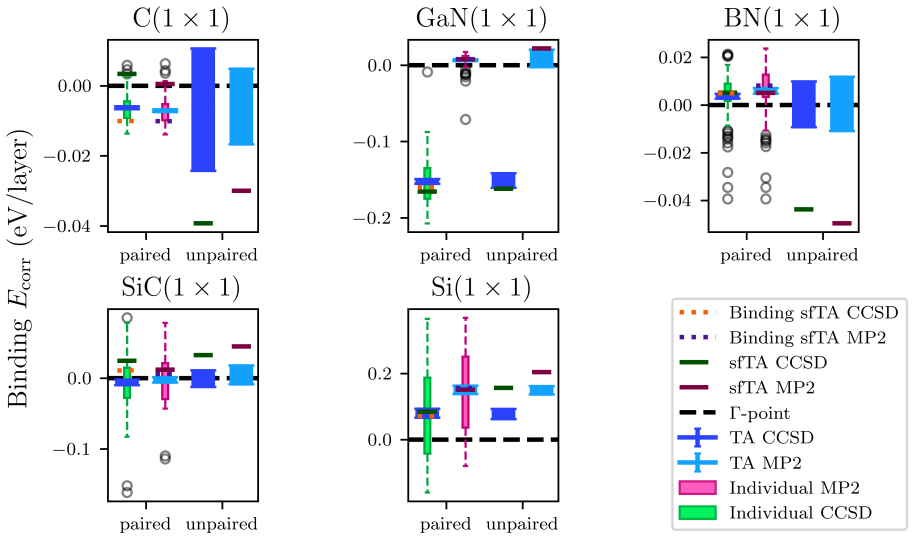
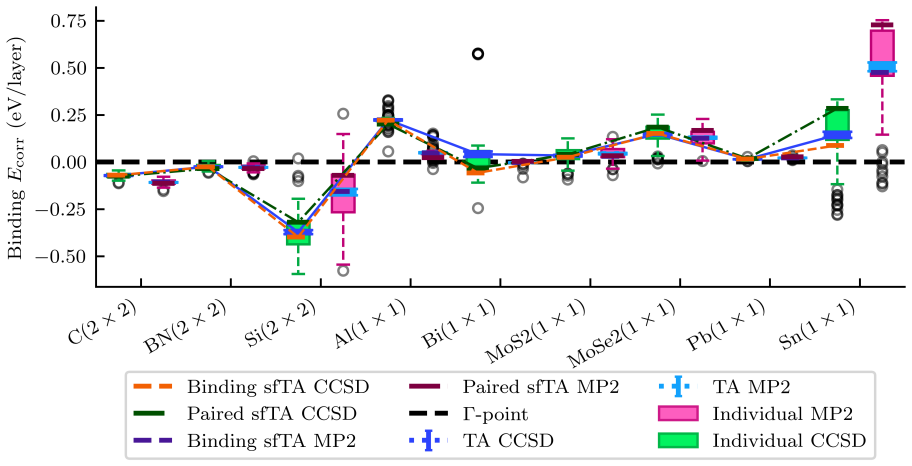
The central discovery is that binding sfTA, by selecting the special twist angle according to the binding structure factor, produces binding correlation energies for bilayer materials that approach the accuracy of twist-averaged calculations, with the improvement most likely due to a cancellation of errors as visualized in contour plots of the test systems.
What carries the argument
The binding structure factor, used to select the special twist angle in the sfTA protocol, which incorporates the interlayer binding interaction into the twist-angle choice for bilayer electronic structure calculations.
If this is right
- Binding sfTA achieves energies approaching those from full TA for various bilayer systems.
- Binding sfTA outperforms both standard sfTA and the paired sfTA variant in accuracy.
- Contour plots of the systems indicate that accuracy improvements stem from error cancellation.
- The method enables accurate results for low-dimensional materials at reduced computational expense compared to full TA.
Where Pith is reading between the lines
- The technique could extend to other van der Waals layered systems or heterostructures where interlayer interactions dominate.
- Similar structure-factor based selections might apply to other methods or to systems with different periodicities.
- Error cancellation mechanisms like this could be exploited in other approximations for periodic quantum calculations.
- Further tests on larger or more complex bilayers would confirm the generality of the approach.
Load-bearing premise
The binding structure factor correctly encodes the interlayer binding interaction for the purpose of twist angle selection, and the accuracy improvements arise primarily from cancellation of errors.
What would settle it
A direct numerical comparison between binding sfTA and full twist-averaged CCSD binding energies for one of the tested bilayer systems, or against experimental binding energies, would confirm or refute the claimed accuracy.
Figures



read the original abstract
Structure factor twist averaging (sfTA) is a newer method that has been shown to reproduce twist-averaged (TA) CCSD energies for bulk systems at a low computational cost. In this work, we extend this method for the treatment of low-dimensional materials in the form of two variants: paired sfTA and binding sfTA. These variants affect which twist angles are used in the sfTA protocol, as well as how the special twist angle is selected, namely by using the binding structure factor. These changes are meant to incorporate the binding interaction into the twist-angle selection algorithm within sfTA. Both variants are tested on a variety of bilayer systems, and the resulting binding correlation energies are compared to original sfTA results. We show that the variants are able to produce results approaching TA, with binding sfTA producing the most accurate energies. We also use contour plots of the test systems to show that these improvements are most likely caused by a cancellation of errors.
Editorial analysis
A structured set of objections, weighed in public.
Referee Report
Summary. The manuscript extends structure factor twist averaging (sfTA) to bilayer materials via two variants—paired sfTA and binding sfTA—that modify twist-angle selection by incorporating the binding structure factor to account for interlayer interactions. These are benchmarked against full twist-averaged (TA) CCSD on various bilayer systems for binding correlation energies, with the claim that binding sfTA yields results closest to TA and that observed gains arise from error cancellation, as illustrated by contour plots of the test systems.
Significance. If the quantitative claims and error-cancellation interpretation hold, the work would provide a low-cost single-twist-angle protocol for approximating TA-CCSD binding energies in low-dimensional materials, extending prior sfTA results from bulk systems. This could be useful for systems where full twist averaging is prohibitive, provided the method's transferability and mechanistic basis are established.
major comments (2)
- [Abstract] Abstract: The central claim that 'binding sfTA producing the most accurate energies' and that 'these improvements are most likely caused by a cancellation of errors' lacks supporting quantitative data. No specific bilayer systems, numerical energy values, error bars, or statistical comparisons to TA-CCSD are provided, leaving the performance advantage and its attribution only partially supported.
- [Results] Results/Discussion (contour plots): The interpretation that accuracy gains stem from error cancellation due to binding-structure-factor selection is not quantitatively demonstrated. Contour plots show correlation between the binding structure factor and accuracy but provide no decomposition of errors into intra- versus inter-layer contributions, no comparison of the selected twist angles against the full TA distribution, and no cross-checks (e.g., against larger supercells) to isolate the cancellation mechanism from other factors such as Brillouin-zone sampling.
minor comments (2)
- [Abstract] The abstract mentions 'a variety of bilayer systems' without listing them or exclusion criteria; this should be made explicit in the main text for reproducibility.
- [Methods] Notation for the binding structure factor and how it differs from the standard structure factor in the original sfTA should be clarified with an equation in the Methods section.
Simulated Author's Rebuttal
We thank the referee for their thoughtful and constructive report. We address each major comment below and have revised the manuscript to improve the quantitative support and clarity of our claims where feasible.
read point-by-point responses
-
Referee: [Abstract] The central claim that 'binding sfTA producing the most accurate energies' and that 'these improvements are most likely caused by a cancellation of errors' lacks supporting quantitative data. No specific bilayer systems, numerical energy values, error bars, or statistical comparisons to TA-CCSD are provided, leaving the performance advantage and its attribution only partially supported.
Authors: The abstract serves as a concise overview, with the detailed numerical comparisons for specific bilayer systems (including energy values and deviations from TA-CCSD) provided in the Results section and figures. To strengthen the abstract's support for the claims, we will revise it to reference the key systems studied and the magnitude of accuracy improvements. We will also add a summary table in the revised manuscript tabulating binding correlation energies, absolute errors relative to TA-CCSD, and any available error bars or statistics across the tested systems. revision: yes
-
Referee: [Results] The interpretation that accuracy gains stem from error cancellation due to binding-structure-factor selection is not quantitatively demonstrated. Contour plots show correlation between the binding structure factor and accuracy but provide no decomposition of errors into intra- versus inter-layer contributions, no comparison of the selected twist angles against the full TA distribution, and no cross-checks (e.g., against larger supercells) to isolate the cancellation mechanism from other factors such as Brillouin-zone sampling.
Authors: The contour plots demonstrate that twist angles selected via the binding structure factor yield binding energies in closer agreement with full TA-CCSD than standard sfTA, which we interpret as arising from error cancellation between intra- and interlayer contributions. We agree that an explicit decomposition of errors or direct mapping of selected twists onto the full TA distribution would provide more rigorous mechanistic insight. In the revised manuscript, we have clarified the discussion to frame the error-cancellation interpretation as supported by the observed correlations and improved numerical agreement, while noting its correlative rather than fully decomposed basis. Direct comparisons of selected twist angles to the TA distribution have been added where data permit. revision: partial
- A full quantitative decomposition of intra- versus inter-layer error contributions and additional cross-checks against larger supercells would require new, computationally intensive calculations that exceed the scope of the present study.
Circularity Check
No significant circularity: empirical validation against independent TA CCSD benchmarks
full rationale
The paper extends sfTA to bilayers via two variants (paired and binding sfTA) that modify twist-angle selection using the binding structure factor, then empirically compares resulting binding correlation energies to full twist-averaged CCSD results on test systems. Contour plots are used only for post-hoc interpretation of error cancellation. No derivation chain reduces a claimed prediction to a fitted parameter or self-referential definition by construction; the accuracy claims rest on direct numerical comparison to an external reference (TA CCSD) rather than internal consistency alone. No load-bearing self-citation of the authors' prior work is present in the provided text, and the method choice is presented as an ansatz motivated by physical incorporation of interlayer effects rather than derived from the target result.
Axiom & Free-Parameter Ledger
axioms (2)
- domain assumption CCSD energies serve as a reliable reference for binding correlation in bilayer systems
- domain assumption Structure-factor-based twist selection can be adapted to incorporate binding interactions without additional fitted parameters
Reference graph
Works this paper leans on
-
[1]
author author B. X. \ Shi , author A. Zen , author V. Kapil , author P. R. \ Nagy , author A. Gr\" u neis , \ and\ author A. Michaelides ,\ 10.1021/jacs.3c09616 journal journal Journal of the American Chemical Society \ volume 145 ,\ pages 25372 ( year 2023 ) NoStop
-
[2]
author author N. D. \ Drummond , author R. J. \ Needs , author A. Sorouri , \ and\ author W. M. C. \ Foulkes ,\ 10.1103/PhysRevB.78.125106 journal journal Physical Review B \ volume 78 ,\ pages 125106 ( year 2008 ) NoStop
-
[3]
author author T. Gruber \ and\ author A. Gr\" u neis ,\ 10.1103/PhysRevB.98.134108 journal journal Physical Review B \ volume 98 ,\ pages 134108 ( year 2018 ) NoStop
-
[4]
author author K. Liao \ and\ author A. Gr\" u neis ,\ 10.1063/1.4964307 journal journal The Journal of Chemical Physics \ volume 145 ,\ pages 141102 ( year 2016 ) NoStop
-
[5]
author author M. Marsman , author A. Gr\" u neis , author J. Paier , \ and\ author G. Kresse ,\ 10.1063/1.3126249 journal journal The Journal of Chemical Physics \ volume 130 ,\ pages 184103 ( year 2009 ) NoStop
-
[6]
author author G. H. \ Booth , author A. Gr\" u neis , author G. Kresse , \ and\ author A. Alavi ,\ 10.1038/nature11770 journal journal Nature \ volume 493 ,\ pages 365 ( year 2013 ) NoStop
-
[7]
author author T. N. \ Mihm , author B. Yang , \ and\ author J. J. \ Shepherd ,\ 10.1021/acs.jctc.0c01171 journal journal Journal of Chemical Theory and Computation \ volume 17 ,\ pages 2752 ( year 2021 a ) NoStop
-
[8]
author author I. Y. \ Zhang \ and\ author A. Gr\" u neis ,\ 10.3389/fmats.2019.00123 journal journal Frontiers in Materials \ volume 6 ( year 2019 ),\ 10.3389/fmats.2019.00123 NoStop
-
[9]
author author C. Lin , author F. H. \ Zong , \ and\ author D. M. \ Ceperley ,\ 10.1103/PhysRevE.64.016702 journal journal Physical Review E \ volume 64 ,\ pages 016702 ( year 2001 ) NoStop
-
[10]
a fer , author S. K. \ Ramadugu , author L. Weiler , author A. Gr\
author author T. N. \ Mihm , author T. Sch\" a fer , author S. K. \ Ramadugu , author L. Weiler , author A. Gr\" u neis , \ and\ author J. J. \ Shepherd ,\ 10.1038/s43588-021-00165-1 journal journal Nature Computational Science \ volume 1 ,\ pages 801 ( year 2021 b ) NoStop
-
[11]
author author A. Gr\" u neis , author G. H. \ Booth , author M. Marsman , author J. Spencer , author A. Alavi , \ and\ author G. Kresse ,\ 10.1021/ct200263g journal journal Journal of Chemical Theory and Computation \ volume 7 ,\ pages 2780 ( year 2011 ) NoStop
-
[12]
author author K. S. \ Novoselov , author A. Mishchenko , author A. Carvalho , \ and\ author A. H. \ Castro Neto ,\ 10.1126/science.aac9439 journal journal Science \ volume 353 ,\ pages aac9439 ( year 2016 ) NoStop
-
[13]
author author A. Yadav , author C. M. \ Acosta , author G. M. \ Dalpian , \ and\ author O. I. \ Malyi ,\ 10.1016/j.matt.2023.05.019 journal journal Matter \ volume 6 ,\ pages 2711 ( year 2023 ) NoStop
-
[14]
The Journal of Chemical Physics , author =
author author J. Klime s \ and\ author A. Michaelides ,\ 10.1063/1.4754130 journal journal The Journal of Chemical Physics \ volume 137 ,\ pages 120901 ( year 2012 ) NoStop
-
[15]
author author P. L. \ Silvestrelli ,\ 10.1103/PhysRevLett.100.053002 journal journal Physical Review Letters \ volume 100 ,\ pages 053002 ( year 2008 ) NoStop
-
[16]
author author E. Mostaani , author N. Drummond , \ and\ author V. Falâko ,\ 10.1103/PhysRevLett.115.115501 journal journal Physical Review Letters \ volume 115 ,\ pages 115501 ( year 2015 ) NoStop
-
[17]
author author V. Fock ,\ 10.1007/BF01340294 journal journal Zeitschrift f\" u r Physik \ volume 61 ,\ pages 126 ( year 1930 ) NoStop
-
[18]
author author J. F. \ Stanton ,\ 10.1016/S0009-2614(97)01144-5 journal journal Chemical Physics Letters \ volume 281 ,\ pages 130 ( year 1997 ) NoStop
-
[19]
author author Attila Szabo \ and\ author Neil S. Ostlund ,\ @noop title Modern Quantum Chemistry : Introduction to Advanced Electronic Structure Theory ,\ edition 1st \ ed.\ ( publisher McGraw-Hill ,\ address New York ,\ year 1989 ) NoStop
1989
-
[20]
author author J. J. \ Shepherd \ and\ author A. Gr\" u neis ,\ 10.1103/PhysRevLett.110.226401 journal journal Physical Review Letters \ volume 110 ,\ pages 226401 ( year 2013 ) NoStop
-
[21]
The Journal of Chemical Physics , author =
author author T. Sch\" a fer , author W. Z. \ Van Benschoten , author J. J. \ Shepherd , \ and\ author A. Gr\" u neis ,\ 10.1063/5.0182729 journal journal The Journal of Chemical Physics \ volume 160 ,\ pages 051101 ( year 2024 ) NoStop
-
[22]
author author I. M. \ Sobol' ,\ 10.1016/0041-5553(67)90144-9 journal journal USSR Computational Mathematics and Mathematical Physics \ volume 7 ,\ pages 86 ( year 1967 ) NoStop
-
[23]
author author J. E. \ Padilha \ and\ author R. B. \ Pontes ,\ 10.1021/jp512489m journal journal The Journal of Physical Chemistry C \ volume 119 ,\ pages 3818 ( year 2015 ) NoStop
-
[24]
author author M. Willander , author M. Friesel , author Q.-u. \ Wahab , \ and\ author B. Straumal ,\ 10.1007/s10854-005-5137-4 journal journal Journal of Materials Science: Materials in Electronics \ volume 17 ,\ pages 1 ( year 2006 ) NoStop
-
[25]
author author A. Jain , author S. P. \ Ong , author G. Hautier , author W. Chen , author W. D. \ Richards , author S. Dacek , author S. Cholia , author D. Gunter , author D. Skinner , author G. Ceder , \ and\ author K. A. \ Persson ,\ 10.1063/1.4812323 journal journal APL Materials \ volume 1 ,\ pages 011002 ( year 2013 ) NoStop
-
[26]
author author M. Scheidgen , author L. Himanen , author A. N. \ Ladines , author D. Sikter , author M. Nakhaee , author \' a . Fekete , author T. Chang , author A. Golparvar , author J. A. \ M\' a rquez , author S. Brockhauser , author S. Br\" u ckner , author L. M. \ Ghiringhelli , author F. Dietrich , author D. Lehmberg , author T. Denell , author A. Al...
-
[27]
author author H.-C. \ Wang , author J. Schmidt , author M. A. L. \ Marques , author L. Wirtz , \ and\ author A. H. \ Romero ,\ 10.1088/2053-1583/accc43 journal journal 2D Materials \ volume 10 ,\ pages 035007 ( year 2023 ) NoStop
-
[28]
author author S. Kirklin , author J. E. \ Saal , author B. Meredig , author A. Thompson , author J. W. \ Doak , author M. Aykol , author S. R\" u hl , \ and\ author C. Wolverton ,\ 10.1038/npjcompumats.2015.10 journal journal npj Computational Materials \ volume 1 ,\ pages 15010 ( year 2015 ) NoStop
-
[29]
Physical Review B47, 558–561 (1993)
author author G. Kresse \ and\ author J. Hafner ,\ 10.1103/PhysRevB.47.558 journal journal Physical Review B \ volume 47 ,\ pages 558 ( year 1993 ) NoStop
-
[30]
author author G. Kresse \ and\ author J. Furthm\" u ller ,\ 10.1016/0927-0256(96)00008-0 journal journal Computational Materials Science \ volume 6 ,\ pages 15 ( year 1996 a ) NoStop
-
[31]
author author G. Kresse \ and\ author J. Furthm\" u ller ,\ 10.1103/PhysRevB.54.11169 journal journal Physical Review B \ volume 54 ,\ pages 11169 ( year 1996 b ) NoStop
-
[32]
author author P. E. \ Bl\" o chl ,\ 10.1103/PhysRevB.50.17953 journal journal Physical Review B \ volume 50 ,\ pages 17953 ( year 1994 ) NoStop
-
[33]
VESTA3 for three-dimensional visualization of crystal, volumetric and morphology data
author author K. Momma \ and\ author F. Izumi ,\ 10.1107/S0021889811038970 journal journal Journal of Applied Crystallography \ volume 44 ,\ pages 1272 ( year 2011 ) NoStop
-
[34]
author author J. P. \ Perdew , author K. Burke , \ and\ author M. Ernzerhof ,\ 10.1103/PhysRevLett.77.3865 journal journal Physical Review Letters \ volume 77 ,\ pages 3865 ( year 1996 ) NoStop
-
[35]
author author L. Hedin ,\ 10.1103/PhysRev.139.A796 journal journal Physical Review \ volume 139 ,\ pages A796 ( year 1965 ) NoStop
-
[36]
author author T. N. \ Mihm , author W. Z. \ Van Benschoten , \ and\ author J. J. \ Shepherd ,\ 10.1063/5.0033408 journal journal The Journal of Chemical Physics \ volume 154 ,\ pages 024113 ( year 2021 c ) NoStop
-
[37]
author author T. N. \ Mihm , author A. R. \ McIsaac , \ and\ author J. J. \ Shepherd ,\ 10.1063/1.5091445 journal journal The Journal of Chemical Physics \ volume 150 ,\ pages 191101 ( year 2019 ) NoStop
discussion (0)
Sign in with ORCID, Apple, or X to comment. Anyone can read and Pith papers without signing in.