Recognition: unknown
From Independent to Joint: Enhancing Quantum Phase and Correlation Factor Estimation by Squeezed Reservoir Engineering
Pith reviewed 2026-05-08 06:33 UTC · model grok-4.3
The pith
A correlated squeezed-thermal reservoir with optimized squeezing phase enhances precision for separate and joint estimation of quantum phase and correlation factor.
A machine-rendered reading of the paper's core claim, the machinery that carries it, and where it could break.
Core claim
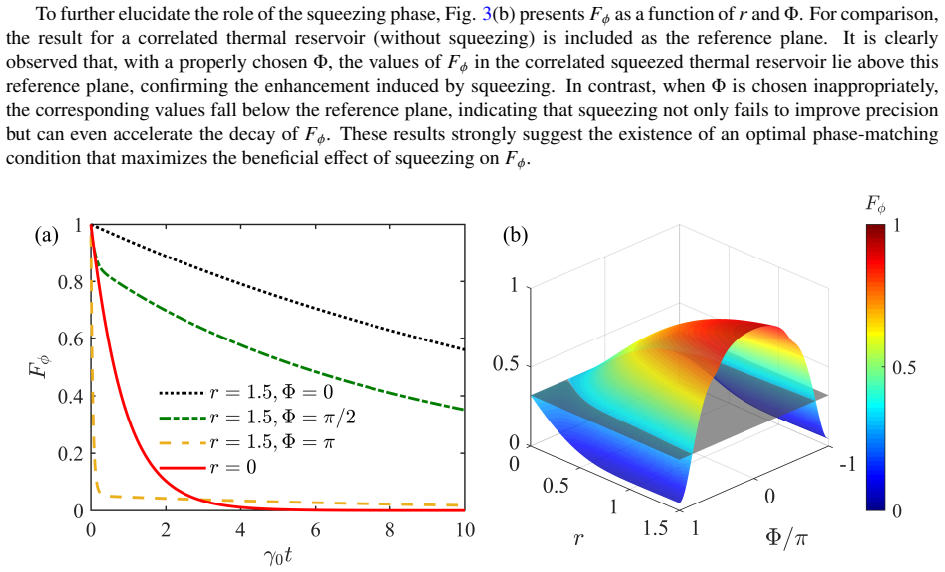
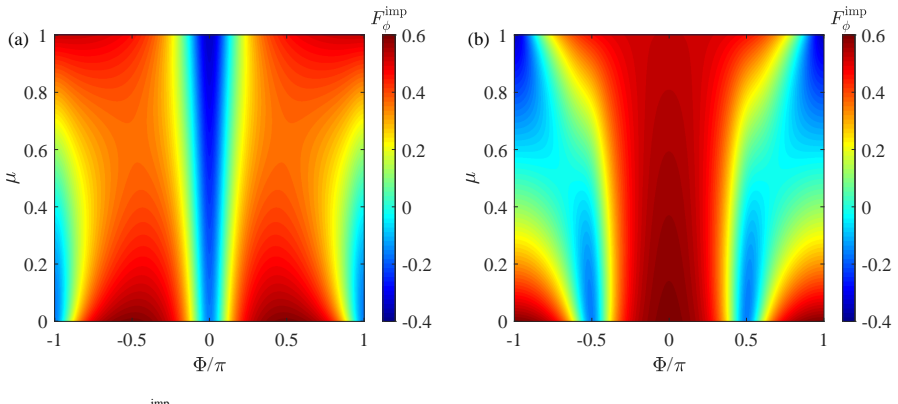
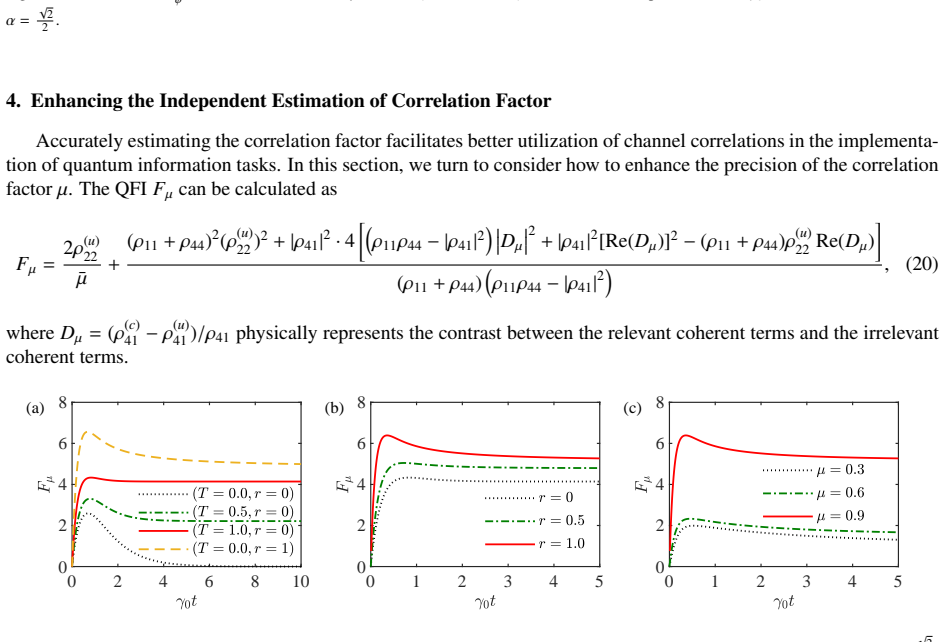
We derive the near-optimal phase-matching relations aimed at maximizing the quantum Fisher information (QFI) for both φ and μ, as well as minimizing the total variance Δ_sim in joint estimation. Furthermore, we show that the joint estimation variance is dominated by F_φ, which motivates our search for the phase-matching conditions that minimize Δ_sim. Through the ratio R of variances, we demonstrate that joint estimation conserves quantum resources and maintains high precision when the squeezing phase is optimized for F_φ, despite the inherent incompatibility of the parameters.
What carries the argument
The correlated squeezed-thermal reservoir with controllable squeezing phase Φ, whose phase-matching conditions are extracted from the QFI expressions to raise estimation precision for φ and μ.
Load-bearing premise
The approach assumes that a correlated squeezed-thermal reservoir with controllable squeezing phase Φ can be realized and that the derived phase-matching conditions remain valid under realistic noise and decoherence.
What would settle it
Prepare the squeezed reservoir in an experiment, apply the derived phase-matching conditions for several values of μ, and check whether the observed estimation variances reach the predicted QFI bounds for both individual and joint estimation.
Figures





read the original abstract
High-precision quantum parameter estimation is fundamental to the advancement of quantum metrology. Although reservoir engineering provides a powerful approach to improve estimation by tailoring system-environment interactions, the role of the squeezing phase and correlations arising from the sequential utilization of the same squeezed reservoir remains inadequately explored. In this work, we employ a correlated squeezed-thermal reservoir to enhance the precision of estimating the phase parameter $\phi$ and the correlation factor $\mu$, both individually and simultaneously. We show that the squeezing phase $\Phi$ is crucial for achieving quantum-enhanced precision, with optimal phase-matching conditions that depend strongly on $\mu$. Specifically, we derive the near-optimal phase-matching relations aimed at maximizing the quantum Fisher information (QFI) for both $\phi$ and $\mu$, as well as minimizing the total variance $\Delta_{\rm sim}$ in joint estimation. Furthermore, we show that the joint estimation variance is dominated by $F_{\phi}$, which motivates our search for the phase-matching conditions that minimize $\Delta_{\text{sim}}$. Through the ratio $R$ of variances, we demonstrate that joint estimation conserves quantum resources and maintains high precision when the squeezing phase is optimized for $F_{\phi}$, despite the inherent incompatibility of the parameters. These findings provide practical insights into reservoir engineering strategies for high-precision quantum sensing and information processing.
Editorial analysis
A structured set of objections, weighed in public.
Referee Report
Summary. The manuscript investigates the use of a correlated squeezed-thermal reservoir to improve the precision of estimating a phase parameter φ and a correlation factor μ, both individually and in joint estimation. It derives phase-matching conditions on the squeezing phase Φ that maximize the quantum Fisher information (QFI) for each parameter and minimize the joint variance Δ_sim, showing that the joint variance is dominated by F_φ and that resource-efficient joint estimation is possible when Φ is optimized for F_φ despite parameter incompatibility.
Significance. If the analytical derivations hold, the work offers concrete, μ-dependent phase-matching relations that can guide reservoir engineering in quantum metrology. The parameter-free character of the optimal conditions and the explicit demonstration that joint estimation conserves resources when tuned to the dominant QFI term constitute useful, falsifiable guidance for multi-parameter sensing protocols.
minor comments (3)
- The abstract refers to 'near-optimal' phase-matching relations without indicating the approximation criterion or the deviation from the exact QFI maximum; a brief statement in the introduction or §3 would clarify the scope of the optimality claim.
- Notation for the total variance Δ_sim and the ratio R is introduced in the abstract but not defined until later; an early inline definition or a small notation table would improve readability for readers outside the immediate subfield.
- The manuscript would benefit from a short paragraph discussing the experimental feasibility of realizing the assumed correlated squeezed-thermal reservoir with controllable Φ, even if only at the level of existing cavity-QED or circuit-QED platforms.
Simulated Author's Rebuttal
We thank the referee for their positive summary of our manuscript, recognition of its significance for reservoir engineering in quantum metrology, and recommendation for minor revision. No specific major comments were raised in the report.
Circularity Check
No significant circularity; derivations are self-contained analytical constructions
full rationale
The paper derives near-optimal phase-matching relations for the squeezing phase Φ directly from the quantum Fisher information (QFI) expressions for parameters φ and μ in a correlated squeezed-thermal reservoir model. These relations are obtained via standard quantum-metrology calculations for open systems, with no fitted inputs renamed as predictions, no self-definitional loops, and no load-bearing self-citations. The joint variance minimization and resource conservation claims follow from the same QFI framework without reducing to the target results by construction. The work is parameter-free and rests on external quantum-optics benchmarks.
Axiom & Free-Parameter Ledger
axioms (2)
- standard math Quantum Fisher information provides the ultimate precision bound for unbiased estimators of the parameters φ and μ.
- domain assumption The system-reservoir interaction can be engineered to produce a correlated squeezed-thermal state with controllable squeezing phase Φ.
Reference graph
Works this paper leans on
-
[1]
L. Pezzè, A. Smerzi, M.K. Oberthaler, R. Schmied, P. Treutlein, Quantum metrology with nonclassical states of atomic ensembles, Rev. Mod. Phys. 90 (2018) 035005. http://dx.doi.org/10.1103/RevModPhys.90.035005
-
[2]
D. Braun, G. Adesso, F. Benatti, R. Floreanini, U. Marzolino, M.W. Mitchell, S. Pirandola, Quantum-enhanced measurements without entanglement, Rev. Mod. Phys. 90 (2018) 035006. http://dx.doi.org/10.1103/RevModPhys.90.035006
-
[3]
, year = 1981, month = apr, volume =
C.M. Caves, Quantum-mechanical noise in an interferometer, Phys. Rev. D. 23 (1981) 1693. http://dx.doi.org/10.1103/PhysRevD.23.1693 15
-
[4]
J.W. Gardner, T. Gefen, S.A. Haine, J.J. Hope, Y . Chen, Achieving the fundamental quantum limit of linear waveform estimation, Phys. Rev. Lett. 132 (2024) 130801. http://dx.doi.org/10.1103/physrevlett.132.130801
-
[5]
An elementary quantum network of entangled optical atomic clocks
B.C. Nichol, R. Srinivas, D.P. Nadlinger, P. Drmota, D. Main, G. Araneda, C.J. Ballance, D.M. Lu- cas, An elementary quantum network of entangled optical atomic clocks, Nature 609 (2022) 689. http://dx.doi.org/10.1038/s41586-022-05088-z
-
[6]
M.H. Zaheer, N.J. Matjelo, D.B. Hume, M.S. Safronova, D.R. Leibrandt, Quantum metrol- ogy algorithms for dark matter searches with clocks, Phys. Rev. A. 111 (2025) 012601. http://dx.doi.org/10.1103/PhysRevA.111.012601
-
[7]
Tsang, Quantum imaging beyond the diffraction limit by optical centroid measurements, Phys
M. Tsang, Quantum imaging beyond the diffraction limit by optical centroid measurements, Phys. Rev. Lett. 102 (2009) 253601. http://dx.doi.org/10.1103/PhysRevLett.102.253601
-
[8]
F. Albarelli, M. Barbieri, M.G. Genoni, I. Gianani, A perspective on multiparameter quantum metrol- ogy: from theoretical tools to applications in quantum imaging, Phys. Lett. A. 384 (2020) 126311. http://dx.doi.org/10.1016/j.physleta.2020.126311
-
[9]
B.M. Escher, R.L. de Matos Filho, L. Davidovich, General framework for estimating the ultimate precision limit in noisy quantum-enhanced metrology, Nat. Phys. 7 (2011) 406. http://dx.doi.org/10.1038/nphys1958
-
[10]
J. Kołody´nski, R. Demkowicz-Dobrza´nski, Efficient tools for quantum metrology with uncorrelated noise, New J. Phys. 15 (2013) 073043. http://dx.doi.org/10.1088/1367-2630/15/7/073043
-
[11]
A. Streltsov, G. Adesso, M.B. Plenio, Quantum coherence as a resource, Rev. Mod. Phys. 89 (2017) 041003. http://dx.doi.org/10.1103/RevModPhys.89.041003
-
[12]
M. Zwierz, C.A. Pérez-Delgado, P. Kok, Ultimate limits to quantum metrology and the meaning of the Heisen- berg limit, Phys. Rev. A. 85 (2012) 042112. http://dx.doi.org/10.1103/PhysRevA.85.042112
-
[13]
Braunstein, C.M
S.L. Braunstein, C.M. Caves, Statistical distance and the geometry of quantum states, Phys. Rev. Lett. 72 (1994)
1994
-
[14]
http://dx.doi.org/10.1103/PhysRevLett.72.3439
-
[15]
G. Tóth, I. Apellaniz, Quantum metrology from a quantum information science perspective, J. Phys. A: Math. Theor. 47 (2014) 424006. http://dx.doi.org/10.1088/1751-8113/47/42/424006
-
[16]
E. Bagan, M. Baig, R. Muñoz-Tapia, Aligning reference frames with quantum states, Phys. Rev. Lett. 87 (2001) 257903. http://dx.doi.org/10.1103/PhysRevLett.87.257903
-
[17]
P.J.D. Crowley, A. Datta, M. Barbieri, I.A. Walmsley, Tradeoffin simultaneous quantum-limited phase and loss estimation in interferometry, Phys. Rev. A. 89 (2014) 023845. http://dx.doi.org/10.1103/PhysRevA.89.023845
-
[18]
A. Monras, F. Illuminati, Measurement of damping and temperature: Precision bounds in Gaussian dissipative channels, Phys. Rev. A. 83 (2011) 012315. http://dx.doi.org/10.1103/PhysRevA.83.012315
-
[19]
M. Szczykulska, T. Baumgratz, A. Datta, Multi-parameter quantum metrology, Adv. Phys.: X 1 (2016) 621. http://dx.doi.org/10.1080/23746149.2016.1230476
-
[20]
Multi- parameter estimation beyond quantum Fisher information.J
R. Demkowicz-Dobrza ´nski, W. Górecki, M. Gu¸ tˇa, Multi-parameter estimation beyond quantum Fisher informa- tion, J. Phys. A 53 (2020) 363001. http://dx.doi.org/10.1088/1751-8121/ab8ef3
-
[21]
Helstrom, Quantum detection and estimation theory, J
C.W. Helstrom, Quantum detection and estimation theory, J. Stat. Phys. 1 (1969) 231. http://dx.doi.org/10.1007/BF01007479
-
[22]
C.L. Degen, F. Reinhard, P. Cappellaro, Quantum sensing, Rev. Mod. Phys. 89 (2017) 035002. http://dx.doi.org/10.1103/RevModPhys.89.035002 16
-
[23]
Nielsen, I.L
M.A. Nielsen, I.L. Chuang, Quantum Computation and Quantum Information, Cambridge: Cambridge Univer- sity Press, 2019
2019
-
[24]
Dynamical Decoupling of Open Quantum Systems
L. Viola, E. Knill, S. Lloyd, Dynamical decoupling of open quantum systems, Phys. Rev. Lett. 82 (1999) 2417. http://dx.doi.org/10.1103/PhysRevLett.82.2417
-
[25]
G. de Lange, Z.H. Wang, D. Ristè, V .V . Dobrovitski, R. Hanson, Universal dynamical decoupling of a single solid state spin from a spin bath, Science 330 (2010) 6000. http://dx.doi.org/10.1126/science.1192739
-
[26]
J. Chiaverini, D. Leibfried, T. Schaetz, M.D. Barrett, R.B. Blakestad, J. Britton, W.M. Itano, J.D. Jost, E. Knill, C. Langer, R. Ozeri, D.J. Wineland, Realization of quantum error correction, Nature 432 (2004) 602. http://dx.doi.org/10.1038/nature03074
-
[27]
E.M. Kessler, I. Lovchinsky, A.O. Sushkov, M.D. Lukin, Quantum error correction for metrology, Phys. Rev. Lett. 112 (2014) 150802. http://dx.doi.org/10.1103/PhysRevLett.112.150802
-
[28]
Q. Sun, M. Al-Amri, L. Davidovich, M.S. Zubairy, Reversing entanglement change by a weak measurement, Phys. Rev. A. 82 (2010) 052323. http://dx.doi.org/10.1103/physreva.82.052323
-
[29]
Y .S. Kim, J.C. Lee, O. Kwon, Y .H. Kim, Protecting entanglement from decoherence using weak measurement and quantum measurement reversal, Nat. Phys. 8 (2012) 117. http://dx.doi.org/10.1038/nphys2178
-
[30]
Y .L. Li, C.H. Liao, L. Yao, X. Xiao, Enhancing the teleportation of quantum Fisher infor- mation under correlated generalized amplitude damping noise, Results Phys. 53 (2023) 107010. http://dx.doi.org/10.1016/j.rinp.2023.107010
-
[31]
G. Goldstein, P. Cappellaro, J.R. Maze, J.S. Hodges, L. Jiang, A.S. Sørensen, M.D. Lukin, Environment-assisted precision measurement, Phys. Rev. Lett. 106 (2011) 140502. http://dx.doi.org/10.1103/physrevlett.106.140502
-
[32]
X. Zhao, S.R. Hedemann, T. Yu, Restoration of a quantum state in a dephasing channel via environment-assisted error correction, Phys. Rev. A. 88 (2013) 022321. http://dx.doi.org/10.1103/physreva.88.022321
-
[33]
W. Muessel, H. Strobel, D. Linnemann, D.B. Hume, M.K. Oberthaler , Scalable spin squeezing for quantum-enhanced magnetometry with Bose-Einstein condensates, Phys. Rev. Lett. 113 (2014) 103004. http://dx.doi.org/10.1103/PhysRevLett.113.103004
-
[34]
G. Adesso, T.R. Bromley, M. Cianciaruso, Measures and applications of quantum correlations, J. Phys. A: Math. Theor. 49 (2016) 473001. http://dx.doi.org/10.1088/1751-8113/49/47/473001
-
[35]
Y . Jeong, H. Shin, Quantum correlation in squeezed generalized amplitude damping channels with memory, Sci. Rep. 9 (2019) 4035. http://dx.doi.org/10.1038/s41598-019-40652-0
-
[36]
C. Xu, L. Zhang, S. Huang, T. Ma, F. Liu, H. Yonezawa, Y . Zhang, M. Xiao, Sensing and tracking enhanced by quantum squeezing, Photon. Res. 7 (2019) A14. http://dx.doi.org/10.1364/prj.7.000a14
-
[37]
M. Gessner, A. Smerzi, L. Pezzè, Multiparameter squeezing for optimal quantum enhancements in sensor net- works, Nat. Commun. 11 (2020) 3817. http://dx.doi.org/10.1038/s41467-020-17471-3
-
[38]
S. Wang, X.H. Han, W.C. Li, T. Qian, X. Fan, Y . Xiao, Y .J. Gu, Protecting nonlocal quantum cor- relations in correlated squeezed generalized amplitude damping channel, Sci. Rep. 12 (2022) 20481. http://dx.doi.org/10.1038/s41598-022-24789-z
-
[39]
Y .T. Lan, M.L. Hu, Protecting steered coherence in squeezed generalized amplitude damping channel with mem- ory, Results Phys. 54 (2023) 107050. http://dx.doi.org/10.1016/j.rinp.2023.107050
-
[40]
M.J. Woolley, A.A. Clerk, Two-mode squeezed states in cavity optomechanics via engineering of a single reser- voir, Phys. Rev. A. 89 (2014) 063805. http://dx.doi.org/10.1103/PhysRevA.89.063805 17
-
[41]
D. Kienzler, H.Y . Lo, B. Keitch, L. de Clercq, F. Leupold, F. Lindenfelser, M. Marinelli, V . Negnevitsky, J. P. Home, Quantum harmonic oscillator state synthesis by reservoir engineering, Science 347 (2015) 53. http://dx.doi.org/10.1126/science.1261033
-
[42]
C.J. Yang, J.H. An, W. Yang, Y . Li, Generation of stable entanglement between two cavity mirrors by squeezed- reservoir engineering, Phys. Rev. A. 92 (2015) 062311. http://dx.doi.org/10.1103/physreva.92.062311
-
[43]
N. Didier, J. Guillaud, S. Shankar, M. Mirrahimi, Remote entanglement stabilization and concentration by quan- tum reservoir engineering, Phys. Rev. A. 98 (2018) 012329. http://dx.doi.org/10.1103/physreva.98.012329
-
[44]
Q.Z. Hou, J.B. You, W.L. Yang, J.H. An, C.Y . Chen, M. Feng, Generation of multiqubit steady-state quantum correlation by squeezed-reservoir engineering, Opt. Express 26 (2018) 20459. http://dx.doi.org/10.1364/oe.26.020459
-
[45]
Q.Z. Hou, C.J. Yang, C.Y . Chen, J.H. An, W.L. Yang, M. Feng, Preservation of quantum correlation be- tween nitrogen-vacancy-center ensembles by squeezed-reservoir engineering, Phys. Rev. A. 100 (2019) 032302. http://dx.doi.org/10.1103/physreva.100.032302
-
[46]
S.Y . Bai, J.H. An, Generating stable spin squeezing by squeezed-reservoir engineering, Phys. Rev. Lett. 127 (2021) 083602. http://dx.doi.org/10.1103/physrevlett.127.083602
-
[47]
P. Groszkowski, M. Koppenhöfer, H.K. Lau, A.A. Clerk, Reservoir-engineered spin squeezing: Macro- scopic even-odd effects and hybrid-systems implementations, Phys. Rev. X. 12 (2022) 011015. http://dx.doi.org/10.1103/physrevx.12.011015
-
[48]
Y . Li, X. Cheng, L.N. Wang, X. Zhao, W. Hou, Y . Li, K. Rehan, M. Zhu, L. Yan, X. Qin, X. Peng, H. Yuan, Y . Lin, J. Du, Multi-parameter quantum metrology with stabilized multi-mode squeezed state, arXiv 2312 (2023) 10379. http://dx.doi.org/10.48550/arXiv.2312.10379
-
[49]
J. Liu, X. Jing, X. Wang, Phase-matching condition for enhancement of phase sensitivity in quantum metrology, Phys. Rev. A. 88 (2013) 042316. http://dx.doi.org/10.1103/physreva.88.042316
-
[50]
Q.A. Turchette, N.Ph. Georgiades, C.J. Hood, H.J. Kimble, A.S. Parkins, Squeezed excitation in cavity QED: Experiment and theory, Phys. Rev. A. 58 (1998) 4056. http://dx.doi.org/10.1103/PhysRevA.58.4056
-
[51]
R. Srikanth, S. Banerjee, Squeezed generalized amplitude damping channel, Phys. Rev. A. 77 (2008) 012318. http://dx.doi.org/10.1103/PhysRevA.77.012318
-
[52]
Y . Yeo, A. Skeen, Time-correlated quantum amplitude-damping channel, Phys. Rev. A. 67 (2003) 064301. http://dx.doi.org/10.1103/PhysRevA.67.064301
-
[53]
A. Blais, A.L. Grimsmo, S.M. Girvin, A. Wallraff, Circuit quantum electrodynamics, Rev. Mod. Phys. 93 (2021) 025005. http://dx.doi.org/10.1103/RevModPhys.93.025005
-
[54]
Barends et al., Nature 508, 500 (2014) https://doi.org/10.1038/nature13171
R. Barends, J. Kelly, A. Megrant, A. Veitia, D. Sank, E. Jeffrey, T.C. White, J. Mutus, A.G. Fowler, B. Campbell, Y . Chen, Z. Chen, B. Chiaro, A. Dunsworth, C. Neill, P. O’Malley, P. Roushan, A. Vainsencher, J. Wenner, A.N. Korotkov, A.N. Cleland, J.M. Martinis, Superconducting quantum circuits at the surface code threshold for fault tolerance, Nature 50...
-
[55]
Trapped-ion quantum computing: Progress and challenges,
C.D. Bruzewicz, J. Chiaverini, R. McConnell, J.M. Sage, Trapped-ion quantum computing: Progress and chal- lenges, Appl. Phys. Rev. 6 (2019) 021314. http://dx.doi.org/10.1063/1.5088164
-
[56]
C.J. Ballance, T.P. Harty, N.M. Linke, M.A. Sepiol, D.M. Lucas, High-fidelity quan- tum logic gates using trapped-ion hyperfine qubits, Phys. Rev. Lett. 117 (2016) 060504. http://dx.doi.org/10.1103/PhysRevLett.117.060504
-
[57]
J. Liu, H. Yuan, X.M. Lu, X. Wang, Quantum Fisher information matrix and multiparameter estimation, J. Phys. A 53 (2020) 023001. http://dx.doi.org/10.1088/1751-8121/ab5d4d 18
-
[58]
R. Yousefjani, R. Nichols, S. Salimi, G. Adesso, Estimating phase with a random generator: Strategies and resources in multiparameter quantum metrology, Phys. Rev. A. 95 (2017) 062307. http://dx.doi.org/10.1103/PhysRevA.95.062307
-
[59]
S. Ragy, M. Jarzyna, R. Demkowicz-Dobrza ´nski, Compatibility in multiparameter quantum metrology, Phys. Rev. A. 94 (2016) 052108. http://dx.doi.org/10.1103/physreva.94.052108 19
discussion (0)
Sign in with ORCID, Apple, or X to comment. Anyone can read and Pith papers without signing in.