Recognition: unknown
The open-Universe signal: A model artifact rather than genuine curvature
Pith reviewed 2026-05-08 05:34 UTC · model grok-4.3
The pith
Late-universe data prefer an open cosmos only when models stay too simple.
A machine-rendered reading of the paper's core claim, the machinery that carries it, and where it could break.
Core claim
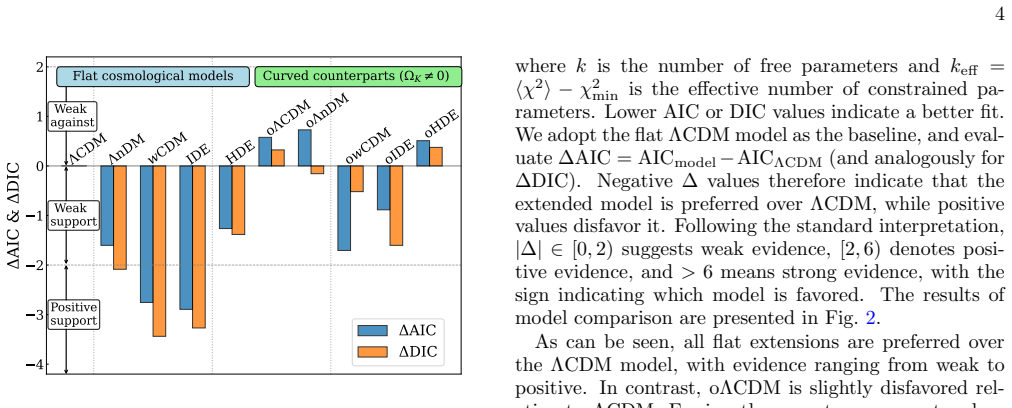
Within the standard ΛCDM model the combined DESI DR2 baryon acoustic oscillation, Type Ia supernova, strong-lensing time-delay, and cosmic-chronometer data prefer Ω_K = 0.049 ± 0.037. This preference vanishes in extensions that allow additional parameters for the expansion history, with the data instead favoring flat geometry. Bayesian evidence shows that introducing new physics is preferred over permitting spatial curvature.
What carries the argument
The limited parameter space of baseline ΛCDM, which forces any mismatch between predicted and observed expansion rates to be absorbed into a nonzero curvature term.
If this is right
- The universe remains spatially flat, consistent with standard inflation.
- No revision to the long-term fate of the cosmos is required by these late-universe data.
- Analyses should prioritize flexible expansion histories rather than curvature to avoid spurious signals.
- The apparent open-universe preference arises from model mismatch in the assumed expansion rate.
Where Pith is reading between the lines
- Similar mild anomalies in other cosmological datasets may also disappear once models are given comparable extra freedom.
- The same modeling strategy could be applied to other tensions, such as the Hubble-constant discrepancy, to test whether they are likewise artifacts of rigidity.
- Observers could design future surveys to separate curvature from evolving dark energy more cleanly than current data allow.
Load-bearing premise
The specific extensions to ΛCDM that were tested are complete enough to capture any additional physics that could mimic or mask curvature.
What would settle it
High-precision future measurements of the expansion history that still favor nonzero curvature even after the dark-energy equation of state is allowed to vary freely with time.
Figures

read the original abstract
Recent late-Universe observations suggest an open Universe. If confirmed, such a departure from spatial flatness would carry profound implications for our understanding of cosmic inflation and the ultimate fate of the Universe. Motivated by this intriguing result and the release of new data, we revisit the question using baryon acoustic oscillation measurements from DESI DR2, multiple Type Ia supernova samples, refined strong gravitational lensing time-delay analyses, and the most up-to-date cosmic chronometer data. We find that within the $\Lambda$ cold dark matter ($\Lambda$CDM) paradigm, the combined data still prefer an open Universe with $\Omega_K=0.049\pm0.037$. However, this preference vanishes in extensions to $\Lambda$CDM, where the data instead favor a flat Universe. The model comparison shows that for $\Lambda$CDM, introducing new physics is preferred over merely allowing spatial curvature, and flat $\Lambda$CDM extensions perform better than their curved counterparts. We therefore argue that the mild open-Universe signal is an artifact of limited model flexibility, rather than a genuine feature of late-Universe observations.
Editorial analysis
A structured set of objections, weighed in public.
Referee Report
Summary. The manuscript analyzes late-Universe data from DESI DR2 BAO, multiple Type Ia supernova samples, strong gravitational lensing time-delay measurements, and cosmic chronometers. Within the standard flat ΛCDM model the combined dataset yields a mild preference for positive spatial curvature (Ω_K = 0.049 ± 0.037). When the model is extended by additional parameters, this preference disappears; model-comparison statistics then favor flat extensions over their curved counterparts. The authors conclude that the apparent open-Universe signal is an artifact of insufficient model flexibility rather than a genuine feature of the observations.
Significance. If the central result is robust, the work would indicate that recent hints of non-flat geometry in late-Universe probes are largely absorbed by modest extensions to ΛCDM, thereby reducing the need to invoke spatial curvature. This has direct implications for the interpretation of cosmological tensions and for the priors adopted in inflation model-building. The multi-probe data combination is a strength provided the statistical methodology is fully documented.
major comments (3)
- [Abstract] Abstract: the exact extensions to ΛCDM that are tested (e.g., wCDM, w0waCDM, or other parameterizations), the priors placed on the new parameters, and the model-selection metric (Bayes factor, AIC, BIC, etc.) are not enumerated. These details are load-bearing for the claim that flat extensions outperform curved ones and that new physics is preferred over curvature.
- [§3] §3 (Data and Methodology): the joint likelihood construction, covariance handling between DESI BAO, supernova, lensing, and chronometer datasets, and the precise prior on Ω_K are not specified. Without this information the reported Ω_K = 0.049 ± 0.037 and the subsequent model-comparison results cannot be independently verified.
- [§5] §5 (Discussion and Conclusions): the assertion that the tested extensions are sufficient to absorb any genuine curvature signal lacks a demonstration that more general models (e.g., curvature allowed simultaneously with early-dark-energy or full late-time freedom) would not revive the Ω_K > 0 preference. This test is required to support the claim that the signal is purely a model-flexibility artifact.
minor comments (2)
- [Abstract] The uncertainty quoted on Ω_K should be explicitly identified as 1σ (or other interval) and cross-checked for consistency with the text and any tables.
- [References] Ensure that all references to DESI DR2, recent supernova compilations, and lensing analyses are complete and up to date.
Simulated Author's Rebuttal
We thank the referee for their careful and constructive review of our manuscript. We address each major comment below, providing the requested clarifications and indicating where revisions will be made to improve the paper.
read point-by-point responses
-
Referee: [Abstract] Abstract: the exact extensions to ΛCDM that are tested (e.g., wCDM, w0waCDM, or other parameterizations), the priors placed on the new parameters, and the model-selection metric (Bayes factor, AIC, BIC, etc.) are not enumerated. These details are load-bearing for the claim that flat extensions outperform curved ones and that new physics is preferred over curvature.
Authors: We agree these details are essential for the claims. The tested extensions are wCDM (with constant w) and w0waCDM (CPL parameterization). Priors on the new parameters are flat: w ∈ [-2, 0] for wCDM; w0 ∈ [-2, 0] and wa ∈ [-3, 3] for w0waCDM. Model comparison uses AIC, BIC, and Bayes factors via nested sampling. We will revise the abstract to briefly enumerate the extensions and metrics, and add a dedicated paragraph in the methods section of the revised manuscript. revision: yes
-
Referee: [§3] §3 (Data and Methodology): the joint likelihood construction, covariance handling between DESI BAO, supernova, lensing, and chronometer datasets, and the precise prior on Ω_K are not specified. Without this information the reported Ω_K = 0.049 ± 0.037 and the subsequent model-comparison results cannot be independently verified.
Authors: We apologize for the lack of explicit detail. The joint likelihood is the product of the individual probe likelihoods (assuming statistical independence), using the full covariance matrices supplied by each survey: DESI DR2 BAO covariance, supernova covariances (including systematics from Pantheon+ or DES), time-delay lensing covariance, and chronometer covariance. The prior on Ω_K is uniform over [-0.3, 0.3]. We will expand §3 in the revised manuscript with a subsection detailing the likelihood construction, all covariances, and priors to enable independent verification. revision: yes
-
Referee: [§5] §5 (Discussion and Conclusions): the assertion that the tested extensions are sufficient to absorb any genuine curvature signal lacks a demonstration that more general models (e.g., curvature allowed simultaneously with early-dark-energy or full late-time freedom) would not revive the Ω_K > 0 preference. This test is required to support the claim that the signal is purely a model-flexibility artifact.
Authors: We acknowledge that our conclusions are scoped to the late-time extensions tested (wCDM and w0waCDM). More general models combining curvature with early dark energy lie beyond the scope of this work, which focuses on late-Universe probes that do not directly constrain early-universe physics. We will revise the discussion to explicitly delimit the claim, note this limitation, and suggest such combined models as a direction for future investigation. revision: partial
Circularity Check
No circularity: model comparisons driven by external data fits
full rationale
The paper reports standard Bayesian fits and evidence ratios on independent late-Universe datasets (DESI DR2 BAO, multiple SNIa samples, time-delay lensing, cosmic chronometers). The stated preference for Ω_K > 0 inside flat ΛCDM, its disappearance inside extensions, and the ranking of flat versus curved extensions are direct outputs of those likelihoods and model-selection metrics; no equation, parameter definition, or self-citation is shown that reduces any of these quantities to the authors' modeling choices by construction. The conclusion that the open-Universe signal is a flexibility artifact therefore rests on the external data and conventional statistics rather than on any of the enumerated circular patterns.
Axiom & Free-Parameter Ledger
free parameters (1)
- Ω_K
axioms (1)
- domain assumption ΛCDM and its extensions provide adequate descriptions of late-universe expansion and structure formation.
Reference graph
Works this paper leans on
-
[1]
Planck 2018 results. VI. Cosmological parameters
N. Aghanimet al.(Planck), “Planck 2018 results. VI. Cosmological parameters,” Astron. Astrophys.641, A6 (2020), arXiv:1807.06209 [astro-ph.CO]
work page internal anchor Pith review arXiv 2018
-
[2]
Chan-Gyung Park and Bharat Ratra, “Using the tilted flat-ΛCDM and the untilted non-flat ΛCDM inflation models to measure cosmological parameters from a com- pilation of observational data,” Astrophys. J.882, 158 (2019), arXiv:1801.00213 [astro-ph.CO]
-
[3]
Handley, Curvature tension: evidence for a closed universe, Phys
Will Handley, “Curvature tension: evidence for a closed universe,” Phys. Rev. D103, L041301 (2021), arXiv:1908.09139 [astro-ph.CO]
-
[4]
Eleonora Di Valentino, Alessandro Melchiorri, and Joseph Silk, “Planck evidence for a closed Universe and a possible crisis for cosmology,” Nature Astron.4, 196–203 (2019), arXiv:1911.02087 [astro-ph.CO]
-
[5]
George Efstathiou and Steven Gratton, “The evidence for a spatially flat Universe,” Mon. Not. Roy. Astron. Soc. 496, L91–L95 (2020), arXiv:2002.06892 [astro-ph.CO]
-
[6]
Erik Rosenberg, Steven Gratton, and George Efstathiou, “CMB power spectra and cosmological parameters from Planck PR4 with CamSpec,” Mon. Not. Roy. Astron. Soc.517, 4620–4636 (2022), arXiv:2205.10869 [astro- ph.CO]
- [7]
-
[8]
Microwave background constraints on cosmological pa- rameters,
Matias Zaldarriaga, David N. Spergel, and Uros Seljak, “Microwave background constraints on cosmological pa- rameters,” Astrophys. J.488, 1–13 (1997), arXiv:astro- ph/9702157
-
[9]
G. Efstathiou and J. R. Bond, “Cosmic confusion: De- generacies among cosmological parameters derived from measurements of microwave background anisotropies,” Mon. Not. Roy. Astron. Soc.304, 75–97 (1999), arXiv:astro-ph/9807103
-
[10]
Forecast- ing cosmic parameter errors from microwave background anisotropy experiments,
J. R. Bond, G. Efstathiou, and M. Tegmark, “Forecast- ing cosmic parameter errors from microwave background anisotropy experiments,” Mon. Not. Roy. Astron. Soc. 291, L33–L41 (1997), arXiv:astro-ph/9702100
-
[11]
The galaxy power spectrum take on spatial cur- vature and cosmic concordance,
Sunny Vagnozzi, Eleonora Di Valentino, Stefano Gari- azzo, Alessandro Melchiorri, Olga Mena, and Joseph Silk, “The galaxy power spectrum take on spatial cur- vature and cosmic concordance,” Phys. Dark Univ.33, 100851 (2021), arXiv:2010.02230 [astro-ph.CO]
-
[12]
Eppur ` e piatto? The Cosmic Chronometers Take on Spatial Curvature and Cosmic Concordance,
Sunny Vagnozzi, Abraham Loeb, and Michele Moresco, “Eppur ` e piatto? The Cosmic Chronometers Take on Spatial Curvature and Cosmic Concordance,” Astrophys. J.908, 84 (2021), arXiv:2011.11645 [astro-ph.CO]
-
[13]
Non-parametric spatial curvature inference using late- Universe cosmological probes,
Suhail Dhawan, Justin Alsing, and Sunny Vagnozzi, “Non-parametric spatial curvature inference using late- Universe cosmological probes,” Mon. Not. Roy. Astron. Soc.506, L1–L5 (2021), arXiv:2104.02485 [astro-ph.CO]
-
[14]
DESI 2024 VI: Cosmological Constraints from the Measurements of Baryon Acoustic Oscillations
A. G. Adameet al.(DESI), “DESI 2024 VI: cosmologi- cal constraints from the measurements of baryon acous- tic oscillations,” JCAP02, 021 (2025), arXiv:2404.03002 [astro-ph.CO]
work page internal anchor Pith review arXiv 2024
-
[15]
Measuring cosmic curva- ture with non-CMB observations,
Peng-Ju Wu and Xin Zhang, “Measuring cosmic curva- ture with non-CMB observations,” Phys. Rev. D112, 063514 (2025), arXiv:2411.06356 [astro-ph.CO]
- [16]
-
[17]
Ji-Yu Song, Jing-Zhao Qi, Jing-Fei Zhang, and Xin Zhang, “Model-independent H 0 within FLRW: Joint Constraints from GWTC-3 Standard Sirens and Strong Lensing Time Delays,” Astrophys. J. Lett.985, L44 (2025), arXiv:2503.10346 [astro-ph.CO]
- [18]
-
[19]
Probing departures from $\Lambda$CDM by late-time datasets
Himanshu Chaudhary, Vipin Kumar Sharma, Salvatore Capozziello, and G. Mustafa, “Probing Departures from ΛCDM by Late-time Datasets,” Astrophys. J. Suppl. 283, 73 (2026), arXiv:2510.08339 [astro-ph.CO]
work page internal anchor Pith review Pith/arXiv arXiv 2026
-
[20]
Leonardo Comini, Sunny Vagnozzi, and Abraham Loeb, “Dark energy, spatial curvature, and star formation efficiency from JWST photometric and spectroscopic high-redshift galaxies,” (2026), arXiv:2604.13866 [astro- ph.CO]
work page internal anchor Pith review Pith/arXiv arXiv 2026
- [21]
-
[22]
Tonghua Liu, Shengjia Wang, Hengyu Wu, Shuo Cao, and Jieci Wang, “Newest Measurements of Cosmic Cur- vature with BOSS/eBOSS and DESI DR1 Baryon Acous- tic Oscillation Observations,” Astrophys. J. Lett.981, L24 (2025), arXiv:2411.14154 [astro-ph.CO]. 6
-
[23]
Probing cosmic curvature with fast radio bursts and DESI DR2 data,
J´ eferson A. S. Fortunato, Wiliam S. Hip´ olito-Ricaldi, and Gustavo E. Romero, “Probing cosmic curvature with fast radio bursts and DESI DR2 data,” Phys. Rev. D113, 023537 (2026), arXiv:2506.01504 [astro-ph.CO]
-
[24]
Quintessence and phantoms in light of DESI 2025,
Ioannis D. Gialamas, Gert H¨ utsi, Martti Raidal, Juan Urrutia, Martin Vasar, and Hardi Veerm¨ ae, “Quintessence and phantoms in light of DESI 2025,” Phys. Rev. D112, 063551 (2025), arXiv:2506.21542 [astro-ph.CO]
-
[25]
Scalar-field dark energy models: Current and forecast constraints,
Anowar J. Shajib and Joshua A. Frieman, “Scalar-field dark energy models: Current and forecast constraints,” Phys. Rev. D112, 063508 (2025), arXiv:2502.06929 [astro-ph.CO]
-
[26]
William Giar` e, Miguel A. Sabogal, Rafael C. Nunes, and Eleonora Di Valentino, “Interacting Dark Energy after DESI Baryon Acoustic Oscillation Measurements,” Phys. Rev. Lett.133, 251003 (2024), arXiv:2404.15232 [astro- ph.CO]
- [27]
-
[28]
In- teracting Dark Sectors in light of DESI DR2,
Rahul Shah, Purba Mukherjee, and Supratik Pal, “In- teracting Dark Sectors in light of DESI DR2,” Mon. Not. Roy. Astron. Soc.542, 2936 (2025), arXiv:2503.21652 [astro-ph.CO]
-
[29]
Interacting dark energy after DESI DR2: A challenge for the ΛCDM paradigm?
Supriya Pan, Sivasish Paul, Emmanuel N. Saridakis, and Weiqiang Yang, “Interacting dark energy after DESI DR2: A challenge for the ΛCDM paradigm?” Phys. Rev. D113, 023515 (2026), arXiv:2504.00994 [astro-ph.CO]
-
[30]
Tian-Nuo Li, Peng-Ju Wu, Guo-Hong Du, Shang-Jie Jin, Hai-Li Li, Jing-Fei Zhang, and Xin Zhang, “Con- straints on Interacting Dark Energy Models from the DESI Baryon Acoustic Oscillation and DES Supernovae Data,” Astrophys. J.976, 1 (2024), arXiv:2407.14934 [astro-ph.CO]
-
[31]
Updated cosmological con- straints on axion dark energy with DESI,
L. A. Ure˜ na-L´ opezet al., “Updated cosmological con- straints on axion dark energy with DESI,” Phys. Rev. D 112, 103505 (2025), arXiv:2503.20178 [astro-ph.CO]
-
[32]
Sta- tus of neutrino cosmology: Standard ΛCDM, exten- sions, and tensions,
Helena Garc´ ıa Escudero and Kevork N. Abazajian, “Sta- tus of neutrino cosmology: Standard ΛCDM, exten- sions, and tensions,” Phys. Rev. D111, 043520 (2025), arXiv:2412.05451 [astro-ph.CO]
- [33]
- [34]
-
[35]
Xingang Chen and Abraham Loeb, “Evolving dark en- ergy or dark matter with an evolving equation-of-state?” JCAP07, 059 (2025), arXiv:2505.02645 [astro-ph.CO]
-
[36]
Evidence for Dynamical Dark Matter,
Deng Wang, “Evidence for Dynamical Dark Matter,” (2025), arXiv:2504.21481 [astro-ph.CO]
- [37]
-
[38]
Modified Gravity Realiza- tions of Quintom Dark Energy after DESI DR2,
Yuhang Yang, Qingqing Wang, Xin Ren, Emmanuel N. Saridakis, and Yi-Fu Cai, “Modified Gravity Realiza- tions of Quintom Dark Energy after DESI DR2,” As- trophys. J.988, 123 (2025), arXiv:2504.06784 [astro- ph.CO]
-
[39]
Sergei D. Odintsov, Diego S´ aez-Chill´ on G´ omez, and Ger- man S. Sharov, “Modified gravity/dynamical dark energy vs ΛCDM: is the game over?” Eur. Phys. J. C85, 298 (2025), arXiv:2412.09409 [gr-qc]
-
[40]
Anton Chudaykin and Martin Kunz, “Modified grav- ity interpretation of the evolving dark energy in light of DESI data,” Phys. Rev. D110, 123524 (2024), arXiv:2407.02558 [astro-ph.CO]
-
[41]
Quintom cosmology and modified gravity after DESI 2024,
Yuhang Yang, Xin Ren, Qingqing Wang, Zhiyu Lu, Dongdong Zhang, Yi-Fu Cai, and Emmanuel N. Saridakis, “Quintom cosmology and modified gravity after DESI 2024,” Sci. Bull.69, 2698–2704 (2024), arXiv:2404.19437 [astro-ph.CO]
-
[42]
How Dark Sector Equations of State Govern Interaction Sig- natures,
Peng-Ju Wu, Ming Zhang, and Shang-Jie Jin, “How dark sector equations of state govern interaction signatures,” Phys. Rev. D113, L081302 (2026), arXiv:2512.05548 [astro-ph.CO]
-
[43]
Interactions in Scalar Field Cosmology
Andrew P. Billyard and Alan A. Coley, “Interactions in scalar field cosmology,” Phys. Rev. D61, 083503 (2000), arXiv:astro-ph/9908224
work page Pith review arXiv 2000
-
[44]
Scaling solutions in general non-minimal coupling theories
Luca Amendola, “Scaling solutions in general nonmini- mal coupling theories,” Phys. Rev. D60, 043501 (1999), arXiv:astro-ph/9904120
work page Pith review arXiv 1999
-
[45]
Effective Field Theory, Black Holes, and the Cosmological Constant
Andrew G. Cohen, David B. Kaplan, and Ann E. Nel- son, “Effective field theory, black holes, and the cosmo- logical constant,” Phys. Rev. Lett.82, 4971–4974 (1999), arXiv:hep-th/9803132
work page Pith review arXiv 1999
-
[46]
A Model of Holographic Dark Energy
Miao Li, “A Model of holographic dark energy,” Phys. Lett. B603, 1 (2004), arXiv:hep-th/0403127
work page Pith review arXiv 2004
-
[47]
DESI DR2 Results II: Measurements of Baryon Acoustic Oscillations and Cosmological Constraints
M. Abdul Karimet al.(DESI), “DESI DR2 results. II. Measurements of baryon acoustic oscillations and cosmo- logical constraints,” Phys. Rev. D112, 083515 (2025), arXiv:2503.14738 [astro-ph.CO]
work page internal anchor Pith review arXiv 2025
-
[48]
B. Popovicet al.(DES), “The Dark Energy Survey Supernova Program: A Reanalysis Of Cosmology Re- sults And Evidence For Evolving Dark Energy With An Updated Type Ia Supernova Calibration,” (2025), arXiv:2511.07517 [astro-ph.CO]
work page internal anchor Pith review Pith/arXiv arXiv 2025
-
[49]
The Pantheon+ Analysis: Cosmological Constraints
Dillon Broutet al., “The Pantheon+ Analysis: Cos- mological Constraints,” Astrophys. J.938, 110 (2022), arXiv:2202.04077 [astro-ph.CO]
work page internal anchor Pith review arXiv 2022
-
[50]
David Rubinet al., “Union Through UNITY: Cosmology with 2,000 SNe Using a Unified Bayesian Framework,” Astrophys. J.986, 231 (2025), arXiv:2311.12098 [astro- ph.CO]
-
[51]
Michele Morescoet al., “Unveiling the Universe with emerging cosmological probes,” Living Rev. Rel.25, 6 (2022), arXiv:2201.07241 [astro-ph.CO]
-
[52]
Measuring the expansion history of the Universe with DESI Cosmic Chronometers,
S. I. Loubser, “Measuring the expansion history of the Universe with DESI Cosmic Chronometers,” (2025), arXiv:2511.02730 [astro-ph.CO]
-
[53]
Simon Birreret al.(TDCOSMO), “TDCOSMO 2025: Cosmological constraints from strong lensing time delays,” Astron. Astrophys.704, A63 (2025), arXiv:2506.03023 [astro-ph.CO]
-
[54]
S. Birreret al., “TDCOSMO - IV. Hierarchical time- delay cosmography – joint inference of the Hubble con- stant and galaxy density profiles,” Astron. Astrophys. 643, A165 (2020), arXiv:2007.02941 [astro-ph.CO]. 7
-
[55]
Constraints on dark energy from TD- COSMO & SLACS lenses,
Natalie B. Hogg, “Constraints on dark energy from TD- COSMO & SLACS lenses,” Monthly Notices of the Royal Astronomical Society: Letters528, L95–L100 (2024), arXiv:2310.11977 [astro-ph.CO]
- [56]
- [57]
- [58]
discussion (0)
Sign in with ORCID, Apple, or X to comment. Anyone can read and Pith papers without signing in.