Recognition: unknown
A Fully Quantum Algorithm for Image Edge Detection
Pith reviewed 2026-05-08 06:25 UTC · model grok-4.3
The pith
A quantum circuit computes image edges using superposed pixel shifts and exact arithmetic without classical post-processing.
A machine-rendered reading of the paper's core claim, the machinery that carries it, and where it could break.
Core claim
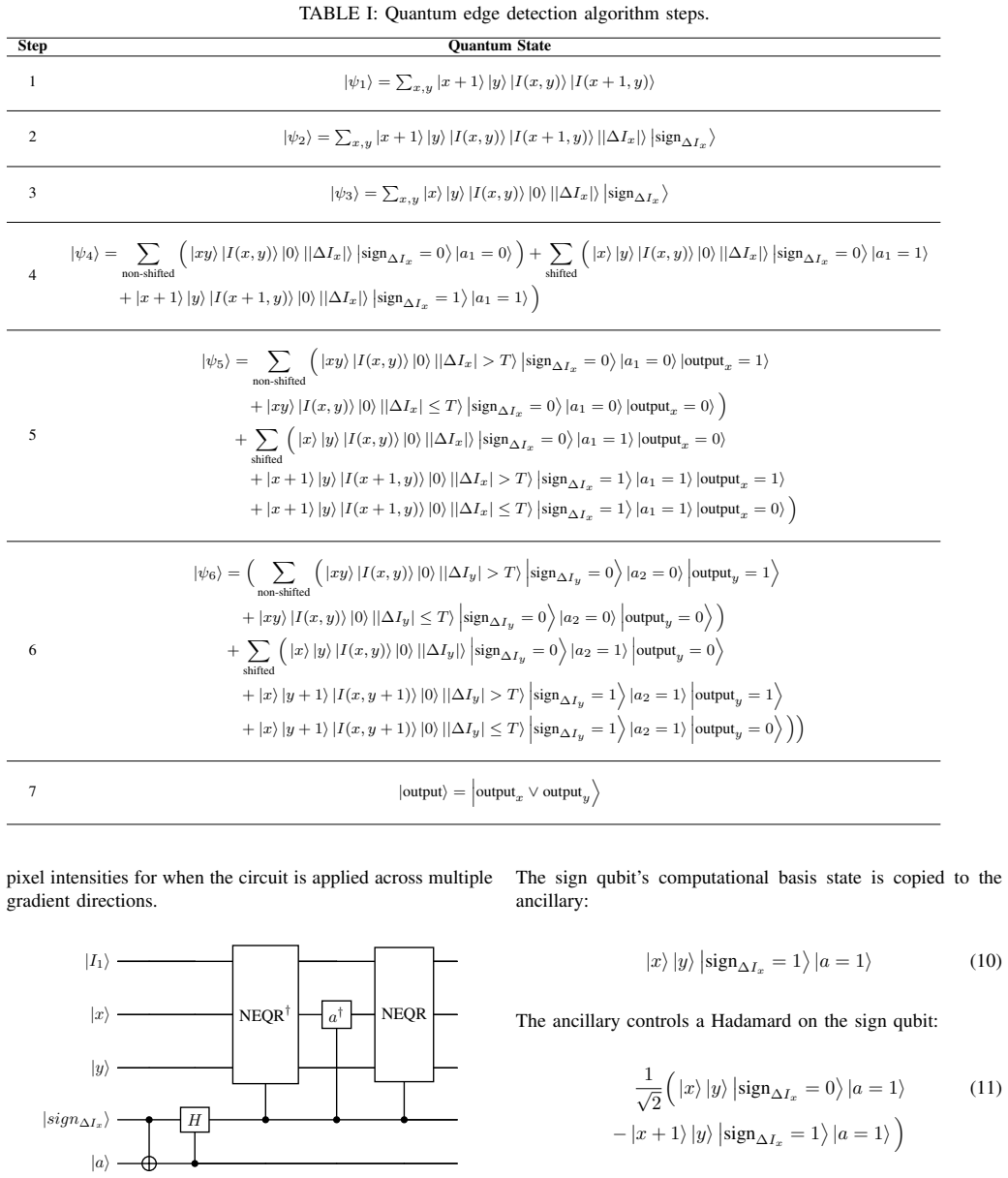
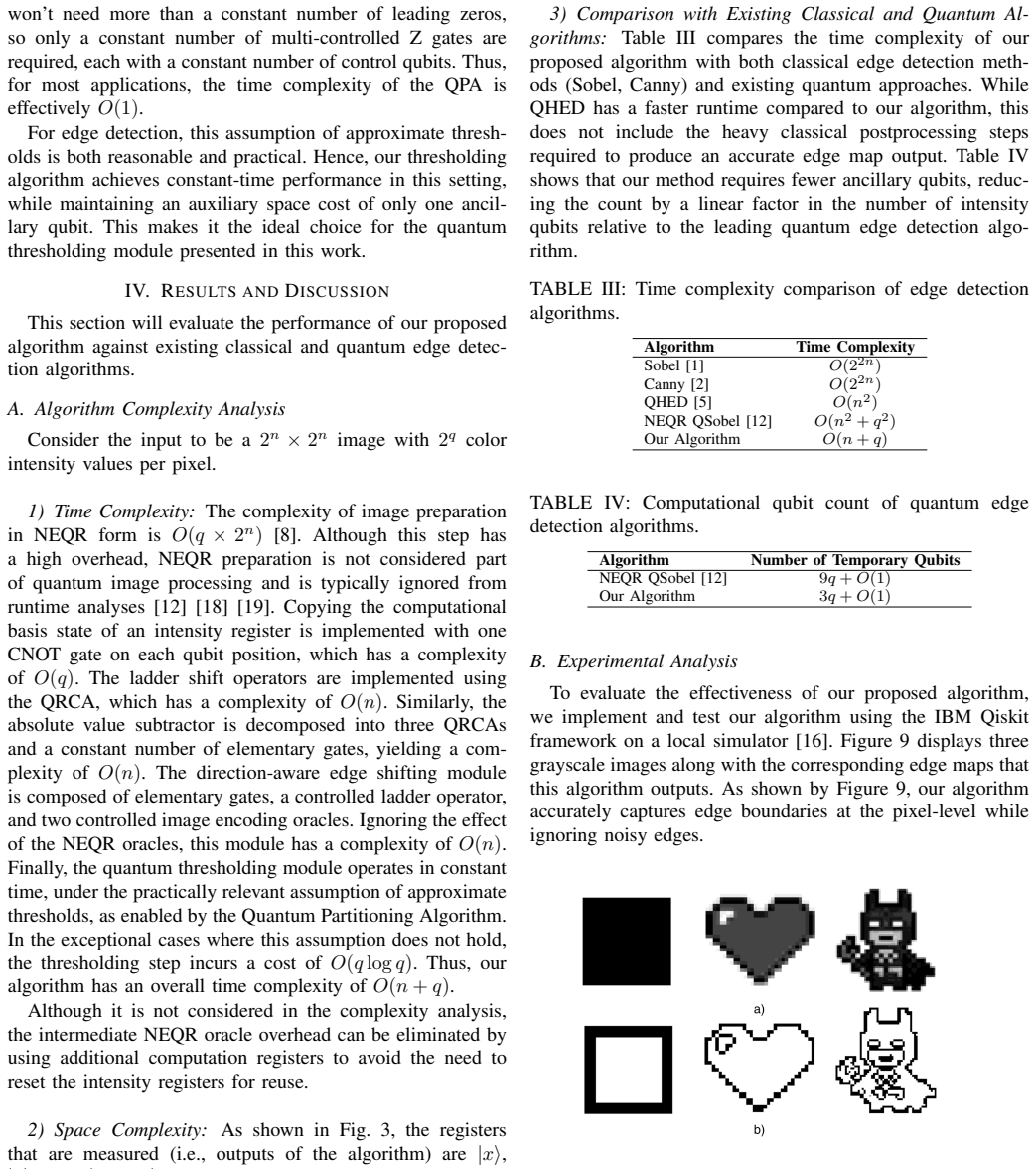
This work introduces a novel quantum algorithm for gradient-based edge detection that operates entirely within the quantum circuit model. Grayscale images are encoded using the Novel Enhanced Quantum Representation (NEQR), allowing exact arithmetic on pixel intensities. Directional gradients are computed by generating superpositions of neighboring pixels via cyclic shift operations and performing subtraction with an exact quantum arithmetic circuit. To refine accuracy, we introduce a direction-aware shifting mechanism that aligns edges with the darker side of intensity transitions. Our novel Quantum Partitioning Algorithm enables efficient in-place thresholding of edge candidates. This work
What carries the argument
The Quantum Partitioning Algorithm together with direction-aware cyclic shifts and exact quantum subtraction circuits on NEQR-encoded states, which compute gradients and threshold results while staying inside the quantum circuit model.
If this is right
- The algorithm reduces ancilla qubit requirements compared to prior NEQR edge detection methods.
- It achieves polynomial improvements in computational time for gradient-based edge detection.
- All steps including thresholding remain inside the quantum circuit model with no classical post-processing.
- The approach demonstrates a practical quantum advantage for image processing tasks on quantum hardware.
Where Pith is reading between the lines
- The shifting and partitioning techniques could be adapted to other quantum image filters such as sharpening or noise reduction.
- Resource savings might compound when this edge detector is used as a subroutine inside larger quantum vision or machine learning circuits.
- Testing on small images with current simulators would directly verify whether the claimed qubit and time bounds hold in practice.
- Generalization to color or multi-channel images would require extending the NEQR encoding and shift operations accordingly.
Load-bearing premise
The direction-aware shifting mechanism and Quantum Partitioning Algorithm can be realized with exact quantum arithmetic circuits on superposed states while maintaining accuracy and achieving the claimed ancilla and time improvements without hidden classical overhead or post-processing.
What would settle it
Run the full quantum circuit on a small image in a simulator, measure the total ancilla qubits and gate count needed to produce an edge map that matches a classical gradient detector, and check whether any classical post-processing is required to reach the claimed accuracy.
Figures




read the original abstract
This work introduces a novel quantum algorithm for gradient-based edge detection that operates entirely within the quantum circuit model. Grayscale images are encoded using the Novel Enhanced Quantum Representation (NEQR), allowing exact arithmetic on pixel intensities. Directional gradients are computed by generating superpositions of neighboring pixels via cyclic shift operations and performing subtraction with an exact quantum arithmetic circuit. To refine accuracy, we introduce a direction-aware shifting mechanism that aligns edges with the darker side of intensity transitions. Our novel Quantum Partitioning Algorithm enables efficient in-place thresholding of edge candidates. This work exhibits polynomial-time improvements and optimizes the ancilla count compared to previous NEQR-based quantum edge detection algorithms. These results demonstrate a resource-efficient and fully quantum approach to edge detection, highlighting a practical quantum advantage in image processing.
Editorial analysis
A structured set of objections, weighed in public.
Referee Report
Summary. The paper proposes a fully quantum algorithm for gradient-based edge detection on grayscale images encoded in NEQR format. It computes directional gradients using cyclic shifts to create superpositions of neighboring pixels followed by exact quantum subtraction, introduces a direction-aware shifting mechanism to align intensity transitions, and presents a Quantum Partitioning Algorithm for in-place thresholding of edge candidates. The work claims polynomial-time and ancilla-count improvements over prior NEQR edge detectors while remaining entirely within the quantum circuit model.
Significance. If the direction-aware shifting and Quantum Partitioning Algorithm are shown to be exact unitary operations on superposed states with the stated resource bounds, the result would provide a concrete resource-efficient quantum method for a core image-processing primitive. This could support downstream quantum computer-vision pipelines and strengthen the case for practical quantum advantage in near-term image tasks.
major comments (2)
- [Abstract and §3] Abstract and §3 (algorithm description): the central claim that the algorithm is 'fully quantum' with polynomial improvements and optimized ancilla count rests on the direction-aware shifting mechanism and Quantum Partitioning Algorithm being realizable as coherent, exact unitary circuits on the superposed |y,x,p> NEQR state. No gate counts, circuit diagrams, or reduction to standard quantum arithmetic primitives are supplied to confirm that these steps avoid conditional measurement, classical feedback for shift direction, or hidden ancilla registers.
- [§4] §4 (complexity analysis): the asserted polynomial-time and ancilla-count advantages are stated without explicit comparison tables or derivations against the specific prior NEQR edge-detection circuits referenced; it is therefore unclear whether the new mechanisms actually reduce total qubits or Toffoli depth once all arithmetic and partitioning subroutines are expanded.
minor comments (2)
- [§2] The NEQR state notation |y,x,p> is used without an early explicit definition of the register sizes or the precise mapping from classical pixel values to quantum amplitudes.
- [Figures] Figure captions for any circuit diagrams should include gate counts or depth annotations to allow direct verification of the claimed optimizations.
Simulated Author's Rebuttal
We thank the referee for the constructive feedback on our manuscript. The comments highlight important areas for clarification regarding the implementation details and complexity analysis. We address each major comment below and will revise the manuscript to incorporate the requested information.
read point-by-point responses
-
Referee: [Abstract and §3] Abstract and §3 (algorithm description): the central claim that the algorithm is 'fully quantum' with polynomial improvements and optimized ancilla count rests on the direction-aware shifting mechanism and Quantum Partitioning Algorithm being realizable as coherent, exact unitary circuits on the superposed |y,x,p> NEQR state. No gate counts, circuit diagrams, or reduction to standard quantum arithmetic primitives are supplied to confirm that these steps avoid conditional measurement, classical feedback for shift direction, or hidden ancilla registers.
Authors: We agree that explicit verification of unitarity and coherence is essential. The direction-aware shifting is realized by a quantum circuit that first computes intensity differences in superposition using controlled subtractions on the NEQR pixel register, then applies direction-dependent cyclic shifts controlled by the sign of those differences; all controls are uncomputed at the end, leaving no persistent ancilla or classical feedback. The Quantum Partitioning Algorithm similarly uses a coherent quantum comparison network followed by in-place conditional swaps, again fully unitary. In the revised manuscript we will add a dedicated subsection in §3 containing the circuit diagrams, their decomposition into standard arithmetic primitives (e.g., controlled-adders and comparators), and explicit gate counts to substantiate that both mechanisms operate exactly on the superposed state without measurements. revision: yes
-
Referee: [§4] §4 (complexity analysis): the asserted polynomial-time and ancilla-count advantages are stated without explicit comparison tables or derivations against the specific prior NEQR edge-detection circuits referenced; it is therefore unclear whether the new mechanisms actually reduce total qubits or Toffoli depth once all arithmetic and partitioning subroutines are expanded.
Authors: We accept that the current presentation of complexity claims is insufficiently detailed. The claimed improvements arise because the superposition-based neighbor generation and the in-place Quantum Partitioning Algorithm eliminate the need for separate measurement-and-re-encoding steps used in earlier NEQR detectors, thereby lowering both ancilla overhead and Toffoli depth. In the revision we will insert a new table in §4 that tabulates total qubits, Toffoli count, and circuit depth for our algorithm against each referenced prior work, together with step-by-step derivations that expand every arithmetic and partitioning subroutine to the level of elementary gates. revision: yes
Circularity Check
No circularity; abstract asserts novel mechanisms without equations or self-referential reductions
full rationale
The provided abstract introduces NEQR encoding, cyclic shift operations for neighboring pixels, subtraction via quantum arithmetic, a direction-aware shifting mechanism, and a Quantum Partitioning Algorithm for thresholding. No equations, circuit constructions, or derivation steps appear that reduce any claimed prediction or result to a fitted input or prior self-citation by construction. The polynomial-time and ancilla optimizations are stated as outcomes but not shown to be equivalent to inputs via any load-bearing step. Per hard rules, circularity requires explicit quotes exhibiting reduction (e.g., Eq. X = Eq. Y); none exist here, so the derivation chain is treated as self-contained.
Axiom & Free-Parameter Ledger
axioms (2)
- domain assumption NEQR encoding permits exact arithmetic on pixel intensities within quantum states.
- standard math Cyclic shift operations and exact quantum subtraction circuits can be applied to superpositions of neighboring pixels without decoherence or approximation.
invented entities (2)
-
Direction-aware shifting mechanism
no independent evidence
-
Quantum Partitioning Algorithm
no independent evidence
Reference graph
Works this paper leans on
-
[1]
A 3×3 isotropic gradient operator for image processing,
I. Sobel and G. Feldman, “A 3×3 isotropic gradient operator for image processing,”Pattern Classification and Scene Analysis, pp. 271–272, 1973
1973
-
[2]
A computational approach to edge detection,
J. Canny, “A computational approach to edge detection,”IEEE Trans. Pattern Anal. Mach. Intell., vol. PAMI-8, pp. 679–698, 1986
1986
-
[3]
A survey of quantum image representations,
F. Yan, A. Iliyasu, and S. Venegas-Andraca, “A survey of quantum image representations,”Quantum Inf. Process., vol. 15, 2016
2016
-
[4]
A flexible representation of quantum images for polynomial preparation, image compression and processing operations,
P. Q. Le, A. Iliyasu, F. Dong, and K. Hirota, “A flexible representation of quantum images for polynomial preparation, image compression and processing operations,”Quantum Inf. Process., vol. 10, pp. 63–84, 2011
2011
-
[5]
Quantum image processing and its application to edge detection: Theory and experiment,
X.-W. Yaoet al., “Quantum image processing and its application to edge detection: Theory and experiment,”Phys. Rev. X, vol. 7, 2017
2017
-
[6]
NEQR: A novel enhanced quantum representation of digital images,
Y . Zhang, K. Lu, Y . Gao, and M. Wang, “NEQR: A novel enhanced quantum representation of digital images,”Quantum Inf. Process., vol. 12, no. 8, pp. 2833–2860, 2013
2013
-
[7]
Edge detection quantumized: A novel quantum algorithm for image processing,
S. E. U. Shubhaet al., “Edge detection quantumized: A novel quantum algorithm for image processing,” arXiv:2404.06889, 2024
-
[8]
Quantum pixel representations and compres- sion for N-dimensional images,
M. G. Amankwahet al., “Quantum pixel representations and compres- sion for N-dimensional images,”Sci. Rep., vol. 12, no. 1, 2022
2022
-
[9]
Addition on a quantum computer,
T. G. Draper, “Addition on a quantum computer,” arXiv:quant- ph/0008033, 2000
-
[10]
M. A. Nielsen and I. L. Chuang,Quantum Computation and Quantum Information. Cambridge Univ. Press, 2011
2011
-
[11]
A new quantum ripple-carry addition circuit
S. A. Cuccaro, T. G. Draper, S. A. Kutin, and D. P. Moulton, “A new quantum ripple-carry addition circuit,” arXiv:quant-ph/0410184, 2004
work page Pith review arXiv 2004
-
[12]
Quantum image edge detection based on eight- direction Sobel operator for NEQR,
W. Liu and L. Wang, “Quantum image edge detection based on eight- direction Sobel operator for NEQR,”Quantum Inf. Process., vol. 21, no. 5, 2022
2022
-
[13]
Quantum arithmetic operations based on quantum Fourier transform on signed integers,
E. S ¸ahin, “Quantum arithmetic operations based on quantum Fourier transform on signed integers,”Int. J. Quantum Inf., vol. 18, no. 6, 2020
2020
-
[14]
M. M. Mano,Digital Logic and Computer Design. Pearson, 2017
2017
-
[15]
A fast quantum mechanical algorithm for database search,
L. K. Grover, “A fast quantum mechanical algorithm for database search,”Proc. STOC, pp. 212–219, 1996
1996
-
[16]
A. Javadi-Abhariet al., “Quantum computing with Qiskit,” arXiv:2405.08810, 2024
work page internal anchor Pith review arXiv 2024
-
[17]
Systematic construction of multi-controlled Pauli gate decompositions with optimalT-count,
K. M. Nakanishi and S. Todo, “Systematic construction of multi-controlled Pauli gate decompositions with optimalT-count,” arXiv:2410.00910, 2024
-
[18]
Quantum image edge detection using improved Sobel mask based on NEQR,
R. Chetia, S. M. B. Boruah, and P. P. Sahu, “Quantum image edge detection using improved Sobel mask based on NEQR,”Quantum Inf. Process., vol. 20, no. 1, 2021
2021
-
[19]
Quantum image edge extraction based on classical Sobel operator for NEQR,
P. Fan, R.-G. Zhou, W. Hu, and N. Jing, “Quantum image edge extraction based on classical Sobel operator for NEQR,”Quantum Inf. Process., vol. 18, no. 1, 2019
2019
-
[20]
Quantum circuit for multi-qubit Toffoli gate with optimal resource,
J. Nie, W. Zi, and X. Sun, “Quantum circuit for multi-qubit Toffoli gate with optimal resource,” arXiv:2402.05053, 2024
discussion (0)
Sign in with ORCID, Apple, or X to comment. Anyone can read and Pith papers without signing in.