Recognition: unknown
Plug-and-Play Consistency Models for MIMO Channel Estimation
Pith reviewed 2026-05-08 05:34 UTC · model grok-4.3
The pith
Plug-and-play consistency models recover angular-domain MIMO channel vectors from limited pilots in few iterations
A machine-rendered reading of the paper's core claim, the machinery that carries it, and where it could break.
Core claim
The PnP-CM inference procedure enforces the pilot observation model in the data-consistency update and invokes a pretrained CM denoiser in the prior update, thereby recovering the angular-domain channel vector within a small number of outer iterations.
What carries the argument
The PnP-CM inference procedure that alternates enforcement of the explicit linear pilot measurement model with application of a pretrained consistency model denoiser as the prior.
Load-bearing premise
A pretrained consistency model supplies an effective prior for the distribution of angular-domain MIMO channel vectors under the given pilot measurement model.
What would settle it
If simulations with standard MIMO setups and limited pilot overhead produce channel estimates whose error remains large relative to ground-truth angular-domain vectors, the claim that the procedure reliably recovers the channels would be falsified.
Figures


read the original abstract
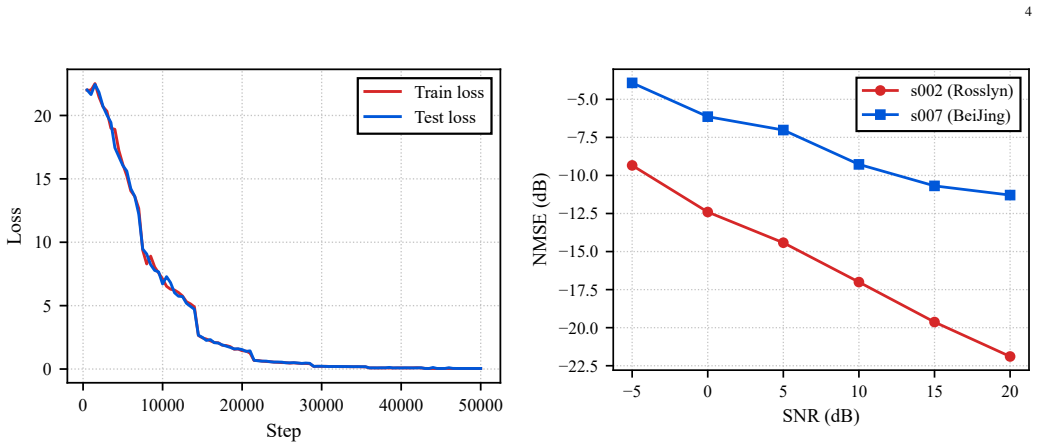
Consistency models (CMs) learn a consistent mapping from multiple noise levels to the data endpoint and can therefore perform generative inference in one or a few steps. This property makes them attractive as learned priors for low-latency inverse problems. Multiple-input multiple-output (MIMO) channel estimation under limited pilot overhead can be formulated as a high-dimensional linear inverse problem with an explicit measurement matrix, where data consistency alone is often insufficient for stable angular-domain channel recovery. This paper applies the plug-and-play consistency model (PnP-CM) framework to pilot-aided MIMO channel estimation. The PnP-CM inference procedure enforces the pilot observation model in the data-consistency update and invokes a pretrained CM denoiser in the prior update, thereby recovering the angular-domain channel vector within a small number of outer iterations. Preliminary experiments validate the feasibility of using CMs as low-latency channel-estimation priors and show that adaptive parameter scheduling and cross-scenario robustness remain important directions for further improvement.
Editorial analysis
A structured set of objections, weighed in public.
Referee Report
Summary. The paper proposes a plug-and-play consistency model (PnP-CM) framework for pilot-aided MIMO channel estimation formulated as a high-dimensional linear inverse problem. The inference alternates a data-consistency step that enforces the explicit pilot observation model with a prior step that applies a pretrained consistency-model denoiser, claiming recovery of the angular-domain channel vector in a small number of outer iterations. Preliminary experiments are cited to validate feasibility, with notes that adaptive parameter scheduling and cross-scenario robustness require further work.
Significance. If the central claim holds, the work offers a promising route to low-latency generative priors for inverse problems in wireless communications by exploiting the one- or few-step inference property of consistency models. The explicit separation of the linear measurement model from the pretrained denoiser avoids circularity and is a methodological strength. However, the preliminary character of the reported experiments limits immediate significance; quantitative gains over standard estimators (e.g., MMSE or other PnP methods) would be needed to establish practical impact.
major comments (2)
- [Abstract / Experimental Results] Abstract and Experimental Results section: the claim that 'preliminary experiments validate the feasibility' is unsupported by any reported quantitative results, baselines, NMSE or MSE metrics, training-data description, model architecture details, or ablation studies. This directly undermines assessment of whether the PnP-CM procedure recovers the angular-domain channel vector effectively under realistic pilot overhead.
- [§3] §3 (PnP-CM inference procedure): no convergence analysis, iteration count bounds, or stability conditions are provided for the alternation between the data-consistency update and the pretrained-CM prior update. Without these, the assertion of recovery 'within a small number of outer iterations' remains an empirical observation rather than a substantiated property.
minor comments (2)
- Notation for the angular-domain channel vector, measurement matrix, and noise model should be introduced consistently with standard MIMO literature (e.g., explicit definition of the DFT-based angular transform) to improve readability.
- [Abstract] The abstract mentions 'adaptive parameter scheduling' as an open direction; a brief description of the current scheduling rule used in the preliminary experiments would help readers reproduce the reported behavior.
Simulated Author's Rebuttal
We thank the referee for the constructive comments on our manuscript. We address each major comment point-by-point below and outline the revisions we will make to strengthen the support for our claims while preserving the preliminary nature of the work.
read point-by-point responses
-
Referee: [Abstract / Experimental Results] Abstract and Experimental Results section: the claim that 'preliminary experiments validate the feasibility' is unsupported by any reported quantitative results, baselines, NMSE or MSE metrics, training-data description, model architecture details, or ablation studies. This directly undermines assessment of whether the PnP-CM procedure recovers the angular-domain channel vector effectively under realistic pilot overhead.
Authors: We acknowledge that the current version reports only high-level feasibility without detailed quantitative metrics, baselines, or implementation specifics. This was intentional to keep the initial submission concise, but we agree it limits evaluation. In the revised manuscript we will expand the Experimental Results section to report NMSE and MSE values, include comparisons against MMSE, least-squares, and other PnP baselines, describe the training dataset and channel model, specify the consistency-model architecture, and add ablation studies on iteration count and parameter scheduling. The abstract claim will be retained as 'preliminary' but will be better supported by these additions. revision: yes
-
Referee: [§3] §3 (PnP-CM inference procedure): no convergence analysis, iteration count bounds, or stability conditions are provided for the alternation between the data-consistency update and the pretrained-CM prior update. Without these, the assertion of recovery 'within a small number of outer iterations' remains an empirical observation rather than a substantiated property.
Authors: We agree that a formal convergence analysis would strengthen the presentation. The current manuscript presents the 'small number of outer iterations' strictly as an empirical observation from our preliminary runs. In revision we will add iteration-wise NMSE curves, empirical stability observations under the MIMO pilot model, and a brief discussion of related PnP convergence results from the literature. A complete theoretical analysis with iteration bounds is beyond the scope of this work and would require additional assumptions on the consistency model that we do not currently possess. revision: partial
Circularity Check
No significant circularity detected in derivation chain
full rationale
The paper presents PnP-CM as a standard plug-and-play alternation: one step enforces the explicit linear pilot measurement model for data consistency, while the other invokes a separately pretrained consistency model as a learned prior. No equations or steps in the provided description reduce the recovery claim to a self-definition, a fitted parameter renamed as prediction, or a load-bearing self-citation chain. The central procedure is an application of existing PnP principles to MIMO estimation with preliminary validation; the pretrained CM is treated as an external input rather than derived from the target result. This is self-contained against external benchmarks.
Axiom & Free-Parameter Ledger
axioms (1)
- domain assumption A pretrained consistency model denoiser serves as an effective prior for angular-domain MIMO channel vectors
Reference graph
Works this paper leans on
-
[1]
An asymptotically MSE- optimal estimator based on gaussian mixture models,
M. Koller, B. Fesl, N. Turan, and W. Utschick, “An asymptotically MSE- optimal estimator based on gaussian mixture models,”IEEE Transac- tions on Signal Processing, vol. 70, pp. 4109–4123, 2021
2021
-
[2]
Low-rank structured MMSE channel estimation with mixtures of factor analyzers,
B. Fesl, N. Turan, and W. Utschick, “Low-rank structured MMSE channel estimation with mixtures of factor analyzers,” in2023 57th Asilomar Conference on Signals, Systems, and Computers, 2023, pp. 375–380
2023
-
[3]
High dimensional channel estimation using deep generative networks,
E. Balevi, A. Doshi, A. Jalal, A. Dimakis, and J. G. Andrews, “High dimensional channel estimation using deep generative networks,”IEEE Journal on Selected Areas in Communications, vol. 39, no. 1, pp. 18–30, 2021
2021
-
[4]
Leveraging variational autoencoders for parameterized MMSE estimation,
M. Baur, B. Fesl, and W. Utschick, “Leveraging variational autoencoders for parameterized MMSE estimation,”IEEE Transactions on Signal Processing, vol. 72, pp. 3731–3744, 2024
2024
-
[5]
MIMO channel estimation using score-based generative models,
M. Arvinte and J. I. Tamir, “MIMO channel estimation using score-based generative models,”IEEE Transactions on Wireless Communications, vol. 22, no. 6, pp. 3698–3713, 2023
2023
-
[6]
Generative diffusion models for high dimensional channel estimation,
X. Zhou, L. Liang, J. Zhang, P. Jiang, Y . Li, and S. Jin, “Generative diffusion models for high dimensional channel estimation,”IEEE Trans- actions on Wireless Communications, vol. 24, pp. 5840–5854, 2024
2024
-
[7]
Diffusion- based generative prior for low-complexity MIMO channel estimation,
B. Fesl, M. Baur, F. Strasser, M. Joham, and W. Utschick, “Diffusion- based generative prior for low-complexity MIMO channel estimation,” IEEE Wireless Communications Letters, vol. 13, no. 12, pp. 3493–3497, 2024
2024
-
[8]
Diff- Pace: Diffusion-based plug-and-play augmented channel estimation in mmwave and terahertz ultra-massive MIMO systems,
Z.-Y . Hu, C. Han, W. H. Gerstacker, and R. Schober, “Diff- Pace: Diffusion-based plug-and-play augmented channel estimation in mmwave and terahertz ultra-massive MIMO systems,”IEEE Journal on Selected Areas in Communications, vol. 44, pp. 2559–2573, 2025
2025
-
[9]
Diffusion Posterior Sampling for General Noisy Inverse Problems
H. Chung, J. Kim, M. T. McCann, M. L. Klasky, and J. C. Ye, “Diffusion posterior sampling for general noisy inverse problems,”arXiv preprint arXiv:2209.14687, 2022
work page internal anchor Pith review arXiv 2022
-
[10]
Consistency mod- els,
Y . Song, P. Dhariwal, M. Chen, and I. Sutskever, “Consistency mod- els,” inProceedings of the 40th International Conference on Machine Learning, 2023, pp. 32 211–32 252
2023
-
[11]
Plug-and-play ADMM for image restoration: Fixed-point convergence and applications,
S. H. Chan, X. Wang, and O. A. Elgendy, “Plug-and-play ADMM for image restoration: Fixed-point convergence and applications,”IEEE Transactions on Computational Imaging, vol. 3, no. 1, pp. 84–98, 2017
2017
-
[12]
PnP-CM: Consistency Models as Plug-and-Play Priors for Inverse Problems
M. G ¨ulle, J. Yun, Y . U. Alc ¸alar, and M. Akc ¸akaya, “Consistency models as plug-and-play priors for inverse problems,”arXiv preprint arXiv:2509.22736, 2025
work page internal anchor Pith review Pith/arXiv arXiv 2025
-
[13]
5G MIMO data for machine learning: Application to beam-selection using deep learning,
A. Klautau, P. Batista, N. Gonz ´alez-Prelcic, Y . Wang, and R. W. Heath, “5G MIMO data for machine learning: Application to beam-selection using deep learning,” in2018 Information Theory and Applications Workshop, 2018, pp. 1–9
2018
-
[14]
Improved techniques for training consistency models,
Y . Song and P. Dhariwal, “Improved techniques for training consistency models,” inInternational Conference on Learning Representations, 2024
2024
discussion (0)
Sign in with ORCID, Apple, or X to comment. Anyone can read and Pith papers without signing in.