Recognition: unknown
Physics informed operator learning of parameter dependent spectra
Pith reviewed 2026-05-08 05:34 UTC · model grok-4.3
The pith
One trained network learns the full spin-dependent quasinormal mode spectrum of Kerr black holes.
A machine-rendered reading of the paper's core claim, the machinery that carries it, and where it could break.
Core claim
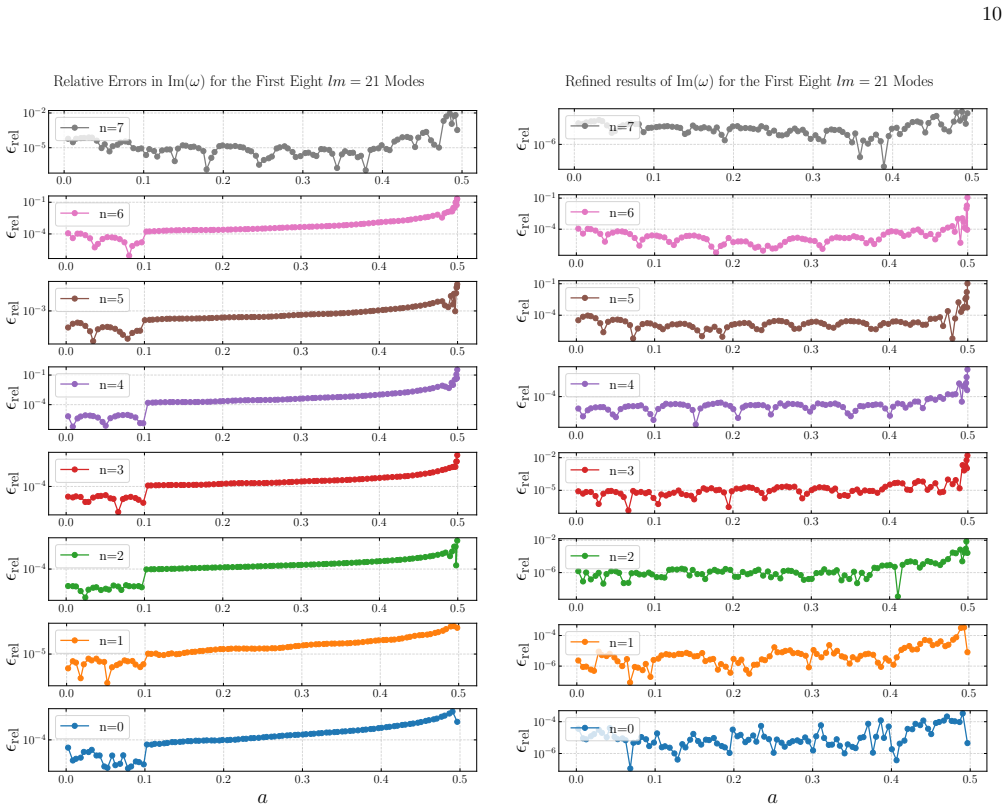
DeepOPiraKAN combines operator learning with physics-informed loss terms to learn the parameter-to-spectrum mapping for Kerr quasinormal modes. A single trained network resolves modes with (ℓ,m) in {(2,0),(2,1)} and overtones up to n=7 over the full spin range, achieving relative errors of O(10^{-6}) for the fundamental mode that rise gradually to O(10^{-4}) for higher overtones when benchmarked against Leaver's method.
What carries the argument
The DeepOPiraKAN neural architecture, which performs operator learning on the parameter-dependent spectral operator while enforcing the differential equation and boundary conditions through the loss function.
If this is right
- Quasinormal mode frequencies and damping times become available for any spin value after a single training run.
- Black hole spectroscopy and ringdown waveform modeling gain practical speed for parameter scans needed by observatories.
- The same framework applies to other parameter-dependent spectral problems without repeated numerical solves at isolated points.
- Accuracy holds across the full spin domain for the tested angular modes and overtones.
Where Pith is reading between the lines
- The trained model could speed up real-time parameter estimation from observed gravitational-wave ringdown signals.
- Extension to higher overtones, different angular indices, or non-Kerr spacetimes would test the generality of the operator-learning step.
- Embedding the network inside waveform templates might reduce the cost of generating large template banks for matched filtering.
- The approach could transfer to eigenvalue problems in other wave equations that depend continuously on system parameters.
Load-bearing premise
The neural architecture and physics-informed training procedure can faithfully represent the continuous and sometimes sensitive dependence of the quasinormal mode frequencies on black hole spin without losing accuracy for higher overtones.
What would settle it
A direct comparison at an intermediate spin value where the network prediction for a low-overtone mode deviates from Leaver's method by more than the stated error tolerance.
Figures


read the original abstract
Spectral problems governed by differential operators underpin a wide range of physical systems, yet remain computationally challenging because their spectra depend sensitively on continuous parameters and often demand repeated evaluations across parameter space. Here we present $\texttt{DeepOPiraKAN}$, an open source physics informed neural network architecture for spectral analysis. By combining operator learning with enhanced optimization stability, it captures the underlying parameter-to-spectrum mapping in a single model, avoiding repeated spectral solutions at isolated points in parameter space. As a representative and stringent benchmark, we apply this framework to the computation of quasinormal modes of Kerr black holes. A single trained network accurately resolves modes with $(\ell,m)\in \{(2,0),(2,1)\}$ and overtones up to $n=7$ across the full spin range, achieving relative errors of $\mathcal{O}(10^{-6})$ for the fundamental mode and gradually increasing to $\mathcal{O}(10^{-4})$ for higher overtones, benchmarked against the Leaver's method. This level of accuracy is already significant for black hole spectroscopy and practical ringdown modelling for current and future observatories. More broadly, these results highlight the potential of $\texttt{DeepOPiraKAN}$ as a general and scalable framework for parameter dependent spectral problems across complex physical systems.
Editorial analysis
A structured set of objections, weighed in public.
Referee Report
Summary. The paper introduces DeepOPiraKAN, an open-source physics-informed neural network architecture for operator learning of parameter-dependent spectra. As a benchmark application, it applies the framework to Kerr black hole quasinormal modes, claiming that a single trained network accurately resolves modes for (ℓ,m)∈{(2,0),(2,1)} and overtones up to n=7 across the full spin range a∈[0,1), with relative errors of O(10^{-6}) for the fundamental mode increasing to O(10^{-4}) for higher overtones when benchmarked against Leaver's method.
Significance. If the accuracy claims hold under rigorous validation, the work offers a potentially useful surrogate model for efficient computation of QNM spectra over continuous parameter ranges, which could benefit black hole spectroscopy and ringdown modeling for gravitational-wave observations. The combination of operator learning with physics-informed losses addresses a genuine computational challenge in spectral problems, and the open-source release supports reproducibility.
major comments (2)
- Abstract: The central claim of uniform O(10^{-4}) relative accuracy for n=7 overtones across a∈[0,1) is load-bearing. Kerr QNMs for high overtones exhibit increasingly steep dependence on a near extremality, so the training protocol must resolve this; without explicit confirmation that collocation points and loss weighting are sufficient near a=1, local errors could exceed the reported bound even if average errors are small.
- Methods/Results sections: The physics-informed loss enforcing the Teukolsky radial equation and outgoing boundary conditions must be specified in detail (including any adaptive weighting for stiff higher-n modes) to verify that the network faithfully captures the continuous parameter dependence without introducing spurious solutions or degradation for n=7.
minor comments (3)
- Introduction: Expand the acronym DeepOPiraKAN on first use and clarify the role of KANs versus standard PINNs in the operator-learning component.
- Results: Include error maps or tables showing maximum relative error versus a for each overtone n, particularly highlighting behavior near a=1, to make the accuracy claims more transparent.
- Notation: Ensure consistent use of symbols for the complex frequency ω(ℓ,m,n,a) and relative error definition throughout.
Simulated Author's Rebuttal
We thank the referee for their constructive feedback and positive assessment of the potential utility of DeepOPiraKAN. We have revised the manuscript to provide the requested details on training and loss formulation, strengthening the validation of accuracy claims. Our point-by-point responses follow.
read point-by-point responses
-
Referee: Abstract: The central claim of uniform O(10^{-4}) relative accuracy for n=7 overtones across a∈[0,1) is load-bearing. Kerr QNMs for high overtones exhibit increasingly steep dependence on a near extremality, so the training protocol must resolve this; without explicit confirmation that collocation points and loss weighting are sufficient near a=1, local errors could exceed the reported bound even if average errors are small.
Authors: We agree that near-extremal accuracy for high overtones is a stringent test. The training protocol in the original manuscript already incorporated a non-uniform distribution of collocation points with increased density for a > 0.95, combined with the physics-informed loss that directly penalizes deviations from the Teukolsky equation. To make this explicit and address the concern about local errors, we have added a new figure in the revised Results section plotting relative error versus a for the n=7, (ℓ,m)=(2,1) mode, confirming that the error remains bounded by O(10^{-4}) across the full range, including a → 1^-. We have also updated the Methods section with the precise sampling strategy. revision: yes
-
Referee: Methods/Results sections: The physics-informed loss enforcing the Teukolsky radial equation and outgoing boundary conditions must be specified in detail (including any adaptive weighting for stiff higher-n modes) to verify that the network faithfully captures the continuous parameter dependence without introducing spurious solutions or degradation for n=7.
Authors: We appreciate the request for greater specificity. The original manuscript outlined the composite loss in Section 3, but we acknowledge it omitted explicit weighting details. In the revised version we have expanded the Methods section to provide the full mathematical form of the loss terms (interior residual of the Teukolsky radial operator plus outgoing boundary conditions at the horizon and infinity). We now also describe the adaptive weighting procedure, in which per-mode weights are dynamically scaled by the running residual norm to mitigate stiffness for n ≥ 5. Additional cross-validation against Leaver’s method at 200 randomly sampled points (including n=7) shows no spurious modes and confirms the reported error bounds. revision: yes
Circularity Check
No significant circularity; accuracy claims benchmarked against independent solver
full rationale
The paper introduces DeepOPiraKAN as a physics-informed operator-learning network that maps black-hole spin to quasinormal-mode frequencies by enforcing the underlying differential operator via a loss function. The reported relative errors (O(10^{-6}) to O(10^{-4})) are obtained by direct numerical comparison to Leaver's method, an established, independent spectral solver. No equation in the abstract or described workflow defines the target spectrum in terms of the network's own fitted weights, nor does any load-bearing step rely on a self-citation chain that would render the result tautological. The central claim therefore remains an externally falsifiable numerical surrogate rather than a self-referential re-expression of its training inputs.
Axiom & Free-Parameter Ledger
free parameters (1)
- Neural network weights and hyperparameters
axioms (1)
- domain assumption The physics-informed loss function is sufficient to embed the differential operator governing the spectrum
Reference graph
Works this paper leans on
-
[1]
Hern´ andez, J
V. Hern´ andez, J. E. Rom´ an, V. Vidal, Slepc: Scalable library for eigenvalue problem computations, in: Inter- national Conference on High Performance Computing for Computational Science, Springer, 2002, pp. 377–391
2002
-
[2]
J. E. Roman, C. Campos, E. Romero, A. Tom´ as, Slepc users manual, Departamento di Sistemas Informaticos y Computaci´ on, Universitat Politecnica de Valencia, TR DSIC-II/24/02, Rev 3 (2016)
2016
-
[3]
K. D. Kokkotas, B. G. Schmidt, Quasinormal modes of stars and black holes, Living Rev. Rel. 2 (1999) 2.arXiv: gr-qc/9909058,doi:10.12942/lrr-1999-2
-
[4]
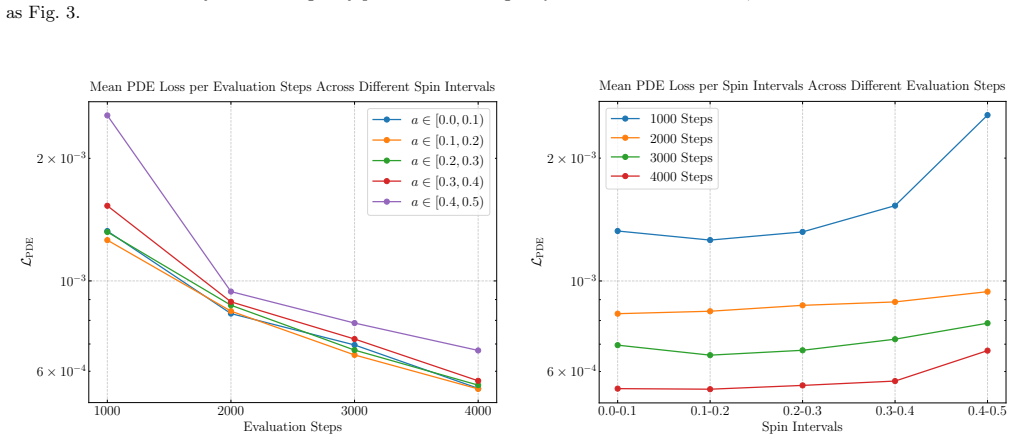
R. A. Konoplya, A. Zhidenko, Quasinormal modes of 10 0.0 0.1 0.2 0.3 0.4 0.5 10−5 10−2 ϵrel n=7 0.0 0.1 0.2 0.3 0.4 0.5 10−4 10−1 ϵrel n=6 0.0 0.1 0.2 0.3 0.4 0.5 10−3 ϵrel n=5 0.0 0.1 0.2 0.3 0.4 0.5 10−4 10−1 ϵrel n=4 0.0 0.1 0.2 0.3 0.4 0.5 10−4 ϵrel n=3 0.0 0.1 0.2 0.3 0.4 0.5 10−4 ϵrel n=2 0.0 0.1 0.2 0.3 0.4 0.5 10−5 ϵrel n=1 0.0 0.1 0.2 0.3 0.4 0.5...
-
[5]
Quasinormal modes of black holes and black branes
E. Berti, V. Cardoso, A. O. Starinets, Quasinormal modes of black holes and black branes, Class. Quant. Grav. 26 (2009) 163001.arXiv:0905.2975,doi:10. 1088/0264-9381/26/16/163001
work page internal anchor Pith review arXiv 2009
-
[6]
doi:10.1103/PhysRevD.89.104059, https://arxiv.org/abs/1404.7149 arXiv:1404.7149 [gr-qc]
E. Barausse, V. Cardoso, P. Pani, Can environmental effects spoil precision gravitational-wave astrophysics?, Phys. Rev. D 89 (10) (2014) 104059.arXiv:1404.7149, doi:10.1103/PhysRevD.89.104059
-
[7]
N. Franchini, S. H. V¨ olkel, Testing General Relativity with Black Hole Quasi-normal Modes, 2024.arXiv: 2305.01696,doi:10.1007/978-981-97-2871-8_9
-
[8]
Black hole spectroscopy: from theory to experiment
J. Abedi, et al., Black hole spectroscopy: from theory to experiment (5 2025).arXiv:2505.23895
work page internal anchor Pith review arXiv 2025
-
[9]
B. P. Abbott, et al., Observation of Gravitational Waves from a Binary Black Hole Merger, Phys. Rev. Lett. 116 (6) (2016) 061102.arXiv:1602.03837,doi:10.1103/ PhysRevLett.116.061102
work page internal anchor Pith review arXiv 2016
-
[10]
Laser Interferometer Space Antenna
P. Amaro-Seoane, et al., Laser Interferometer Space An- tenna, e-prints (2 2017).arXiv:1702.00786
work page internal anchor Pith review arXiv 2017
-
[11]
Combinatorial optimization enhanced by shallow quantum circuits with 104 superconduct- ing qubits
W.-R. Hu, Y.-L. Wu, The Taiji Program in Space for gravitational wave physics and the nature of gravity, Natl. Sci. Rev. 4 (5) (2017) 685–686.doi:10.1093/nsr/ nwx116
-
[12]
M. Du, et al., Towards realistic detection pipelines of Taiji: New challenges in data analysis and high-fidelity simulations of space-based gravitational wave antenna, Sci. China Phys. Mech. Astron. 69 (4) (2026) 249501. arXiv:2505.16500,doi:10.1007/s11433-025-2870-8
-
[13]
Quasinormal modes of black holes and black branes
J. Luo, et al., TianQin: a space-borne gravitational wave detector, Class. Quant. Grav. 33 (3) (2016) 035010.arXiv:1512.02076,doi:10.1088/0264-9381/ 33/3/035010
-
[14]
M. Raissi, P. Perdikaris, G. E. Karniadakis, Physics- informed neural networks: A deep learning framework for solving forward and inverse problems involving non- linear partial differential equations, J. Comput. Phys. 378 (2019) 686–707.arXiv:1711.10561,doi:10.1016/ j.jcp.2018.10.045
work page Pith review arXiv 2019
-
[15]
Anitescu, B
C. Anitescu, B. ˙Ismail Ate¸ s, T. Rabczuk, Physics- informed neural networks: Theory and applications, in: Machine Learning in Modeling and Simulation: Methods and Applications, Springer, 2023, pp. 179–218
2023
-
[16]
DOI 10.1140/epjc/ s10052-022-10942-5
D. Tseneklidou, A. Torres-Forne, P. Cerda-Duran, To- wards asteroseismology of neutron stars with physics- informed neural networks, Eur. Phys. J. C 85 (10) (2025) 1218.arXiv:2504.12183,doi:10.1140/epjc/ s10052-025-14942-z
-
[17]
A. S. Cornell, A. Ncube, G. Harmsen, Using physics- informed neural networks to compute quasinormal modes, Phys. Rev. D 106 (12) (2022) 124047.arXiv: 2205.08284,doi:10.1103/PhysRevD.106.124047
- [18]
- [19]
- [20]
- [21]
-
[22]
R. Luna, D. D. Doneva, J. A. Font, J.-H. Lien, S. S. Yazadjiev, Quasinormal modes in modified gravity us- ing physics-informed neural networks, Phys. Rev. D 109 (12) (2024) 124064.arXiv:2404.11583,doi:10. 1103/PhysRevD.109.124064. [23]https://github.com/PaddlePaddle/PaddleScience/ tree/develop/examples/qnm(2025)
-
[23]
L. Lu, P. Jin, G. Pang, Z. Zhang, G. E. Karni- adakis, Learning nonlinear operators via deeponet based on the universal approximation theorem of operators, Nature Machine Intelligence 3 (3) (2021). doi:10.1038/s42256-021-00302-5. URLhttp://dx.doi.org/10.1038/ s42256-021-00302-5
- [24]
-
[25]
S. Wang, H. Wang, P. Perdikaris, On the eigenvector bias of fourier feature networks: From regression to solv- ing multi-scale pdes with physics-informed neural net- works, Computer Methods in Applied Mechanics and En- gineering 384 (2021) 113938.doi:10.1016/j.cma.2021. 113938. URLhttp://dx.doi.org/10.1016/j.cma.2021.113938
- [26]
-
[27]
A. Daw, J. Bu, S. Wang, P. Perdikaris, A. Karpatne, Mitigating propagation failures in physics-informed neu- ral networks using retain-resample-release (R3) sampling, in: A. Krause, E. Brunskill, K. Cho, B. Engelhardt, S. Sabato, J. Scarlett (Eds.), Proceedings of the 40th International Conference on Machine Learning, Vol. 202 of Proceedings of Machine Le...
2023
-
[28]
V. Gopakumar, S. Pamela, D. Samaddar, Loss land- scape engineering via data regulation on pinns, Machine Learning with Applications 12 (2023) 100464. doi:https://doi.org/10.1016/j.mlwa.2023.100464. URLhttps://www.sciencedirect.com/science/ article/pii/S2666827023000178
-
[29]
P. Rathore, W. Lei, Z. Frangella, L. Lu, M. Udell, Chal- lenges in training pinns: A loss landscape perspective (2024).arXiv:2402.01868. URLhttps://arxiv.org/abs/2402.01868
-
[30]
Z. Liu, Y. Wang, S. Vaidya, F. Ruehle, J. Halverson, M. Soljaˇ ci´ c, T. Y. Hou, M. Tegmark, Kan: Kolmogorov- arnold networks (2025).arXiv:2404.19756. URLhttps://arxiv.org/abs/2404.19756
work page internal anchor Pith review arXiv 2025
-
[31]
Y. Wang, J. Sun, J. Bai, C. Anitescu, M. S. Eshaghi, X. Zhuang, T. Rabczuk, Y. Liu, Kolmogorov–arnold- informed neural network: A physics-informed deep learn- ing framework for solving forward and inverse problems based on kolmogorov–arnold networks, Computer Meth- ods in Applied Mechanics and Engineering 433 (2025) 12 117518.doi:10.1016/j.cma.2024.117518...
- [32]
-
[33]
In: Advances in Neural Information Processing Systems, vol
M. Tancik, P. P. Srinivasan, B. Mildenhall, S. Fridovich- Keil, N. Raghavan, U. Singhal, R. Ramamoorthi, J. T. Barron, R. Ng, Fourier features let networks learn high frequency functions in low dimensional domains (2020). arXiv:2006.10739. URLhttps://arxiv.org/abs/2006.10739
- [34]
- [35]
-
[36]
Kolmogorov-Arnold Fou rier networks,
J. Zhang, Y. Fan, K. Cai, K. Wang, Kolmogorov-arnold fourier networks (2025).arXiv:2502.06018. URLhttps://arxiv.org/abs/2502.06018
- [37]
-
[38]
S. Wang, H. Wang, P. Perdikaris, Learning the solution operator of parametric partial differential equations with physics-informed deeponets, Science Advances 7 (40) (2021) eabi8605.arXiv:https:// www.science.org/doi/pdf/10.1126/sciadv.abi8605, doi:10.1126/sciadv.abi8605. URLhttps://www.science.org/doi/abs/10.1126/ sciadv.abi8605
-
[39]
B. P. Abbott, et al., Tests of general relativity with GW150914, Phys. Rev. Lett. 116 (22) (2016) 221101, [Erratum: Phys.Rev.Lett. 121, 129902 (2018)].arXiv: 1602.03841,doi:10.1103/PhysRevLett.116.221101
- [40]
- [41]
-
[42]
Reitze, et al., Cosmic Explorer: The U.S
D. Reitze, et al., Cosmic Explorer: The U.S. Contri- bution to Gravitational-Wave Astronomy beyond LIGO, Bull. Am. Astron. Soc. 51 (7) (2019) 035.arXiv:1907. 04833
2019
-
[43]
Punturo, et al., The Einstein Telescope: A third- generation gravitational wave observatory, Class
M. Punturo, et al., The Einstein Telescope: A third- generation gravitational wave observatory, Class. Quant. Grav. 27 (2010) 194002.doi:10.1088/0264-9381/27/ 19/194002
-
[46]
S. A. Teukolsky, Rotating black holes - separable wave equations for gravitational and electromagnetic pertur- bations, Phys. Rev. Lett. 29 (1972) 1114–1118.doi: 10.1103/PhysRevLett.29.1114
-
[47]
S. A. Teukolsky, Perturbations of a rotating black hole
-
[48]
Fundamental equations for gravitational electromag- netic and neutrino field perturbations, Astrophys. J. 185 (1973) 635–647.doi:10.1086/152444
-
[49]
E. W. Leaver, An Analytic representation for the quasi normal modes of Kerr black holes, Proc. Roy. Soc. Lond. A 402 (1985) 285–298.doi:10.1098/rspa.1985.0119
-
[50]
C. V. Vishveshwara, Scattering of Gravitational Radia- tion by a Schwarzschild Black-hole, Nature 227 (1970) 936–938.doi:10.1038/227936a0
-
[51]
S. Chandrasekhar, S. L. Detweiler, The quasi-normal modes of the Schwarzschild black hole, Proc. Roy. Soc. Lond. A 344 (1975) 441–452.doi:10.1098/rspa.1975. 0112
-
[52]
B. F. Schutz, C. M. Will, BLACK HOLE NORMAL MODES: A SEMIANALYTIC APPROACH, Astrophys. J. Lett. 291 (1985) L33–L36.doi:10.1086/184453
-
[53]
S. Iyer, C. M. Will, Black Hole Normal Modes: A WKB Approach. 1. Foundations and Application of a Higher Order WKB Analysis of Potential Barrier Scattering, Phys. Rev. D 35 (1987) 3621.doi:10.1103/PhysRevD. 35.3621
-
[54]
New approach to the quasinormal modes of a black hole.Phys
V. Ferrari, B. Mashhoon, New approach to the quasi- normal modes of a black hole, Phys. Rev. D 30 (1984) 295–304.doi:10.1103/PhysRevD.30.295
- [55]
-
[56]
O’Toole, R
C. O’Toole, R. Macedo, T. Stratton, B. Wardell, Quasi- normalmodes: A black hole perturbation toolkit package, https://github.com/BlackHolePerturbationToolkit/ QuasiNormalModes, a package for computing quasi- normal modes of Schwarzschild and Kerr black holes (2025)
2025
-
[57]
Inc,https://www.paddlepaddle.org.cn/en(2025)
B. Inc,https://www.paddlepaddle.org.cn/en(2025)
2025
-
[58]
V. Baibhav, E. Berti, Multimode black hole spectroscopy, Phys. Rev. D 99 (2) (2019) 024005.arXiv:1809.03500, doi:10.1103/PhysRevD.99.024005
- [59]
-
[60]
Carullo, Black hole spectroscopy: status report, Gen
G. Carullo, Black hole spectroscopy: status report, Gen. Rel. Grav. 57 (5) (2025) 76.doi:10.1007/ s10714-025-03408-y
2025
-
[61]
K. D. Kokkotas, B. F. Schutz, W-modes: A New family of normal modes of pulsating relativistic stars, Mon. Not. Roy. Astron. Soc. 225 (1992) 119
1992
- [62]
discussion (0)
Sign in with ORCID, Apple, or X to comment. Anyone can read and Pith papers without signing in.