Recognition: unknown
CLASH-VLT: The Fifth Force in Chameleon Gravity from Joint Lensing and Kinematics Cluster Mass Profiles
Pith reviewed 2026-05-08 05:23 UTC · model grok-4.3
The pith
Joint lensing and kinematic data from nine galaxy clusters are consistent with general relativity in chameleon gravity when cuspy mass profiles are used.
A machine-rendered reading of the paper's core claim, the machinery that carries it, and where it could break.
Core claim
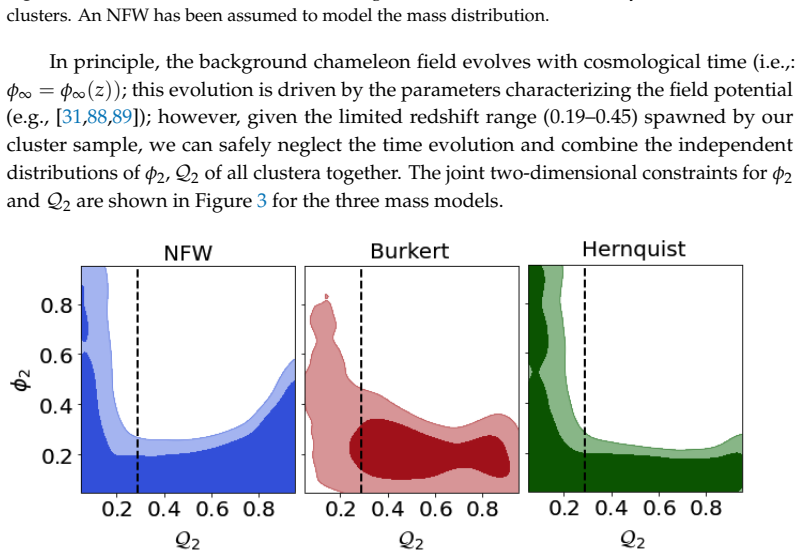
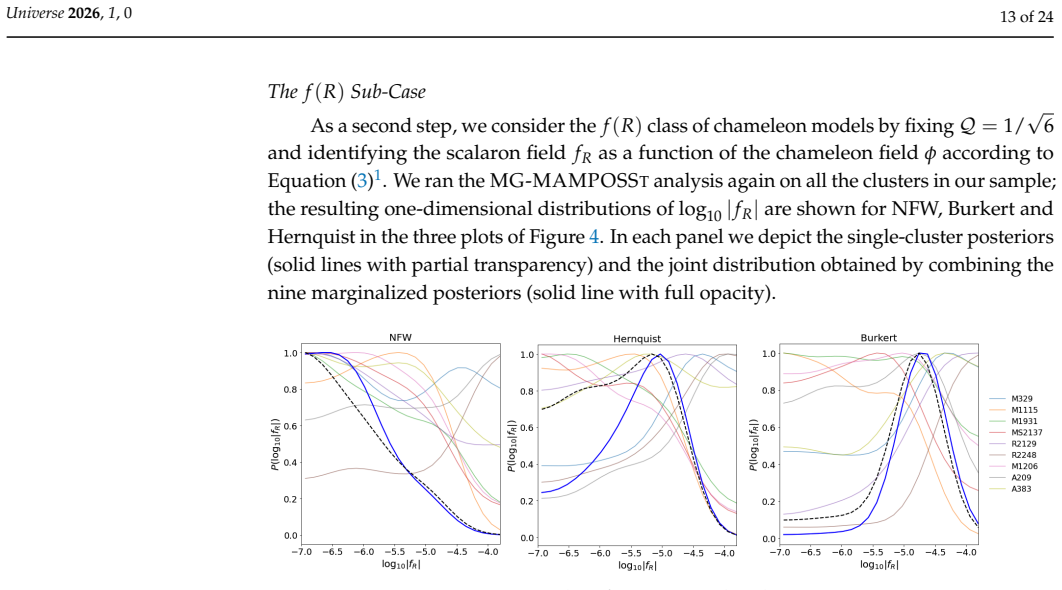
In the general chameleon framework with cuspy mass models (NFW or Hernquist), the joint constraints from the nine massive galaxy clusters are fully consistent with general relativity, excluding large regions of the modified-gravity parameter space defined by the coupling constant Q and the background chameleon field phi_infty. This provides one of the tightest bounds on general chameleon models derived from cluster data. For the f(R) sub-case, the bound on the background scalaron field is |f_R| ≲ 2-5 × 10^{-5} at 95% confidence level.
What carries the argument
The joint gravitational-lensing and kinematic analysis inside the chameleon gravity framework, applied to three alternative parametric total-mass profiles (NFW, Hernquist, Burkert) that describe the cluster mass distribution.
If this is right
- Cuspy mass profiles rule out large regions of the (Q, phi_infty) parameter space in favor of general relativity.
- The f(R) subclass is limited to background scalaron values |f_R| below a few times 10^{-5} at 95 percent .
- The Burkert profile produces a mild deviation from general relativity but is disfavored by lensing data alone.
- Removing clusters that show clear dynamical disturbance reduces any residual tension with general relativity.
Where Pith is reading between the lines
- If future observations establish that cluster mass profiles are predominantly cored, the mild deviation seen with Burkert models could become a signal of modified gravity rather than a modeling artifact.
- Independent mass-profile reconstructions that do not assume any of the three parametric forms could provide a direct test of whether the current consistency with general relativity holds.
- The strong dependence on mass-profile choice indicates that similar joint analyses on larger samples will need robust, profile-independent mass measurements to deliver decisive constraints.
Load-bearing premise
One of the three parametric forms (NFW, Hernquist or Burkert) accurately represents the true total mass distribution in these galaxy clusters.
What would settle it
A high-resolution mass profile measurement for any of the clusters that cannot be described by NFW, Hernquist or Burkert shapes even after allowing chameleon modifications would falsify the derived parameter bounds.
Figures



read the original abstract
We present a high-precision joint gravitational-lensing and kinematic analysis of nine massive galaxy clusters from the CLASH and CLASH-VLT surveys to test chameleon screening gravity and its $f(R)$ sub-class at Mpc scales. We investigate the dependence on the assumed parametrization of the total cluster mass profile by adopting three models, namely Navarro--Frenk--White (NFW), Burkert, and Hernquist. When cuspy models (NFW or Hernquist) are assumed in the general chameleon framework, the combined constraints from the nine clusters are fully consistent with General Relativity (GR), excluding large regions of the modified-gravity parameter space (the coupling constant $\mathcal{Q}$ and the background chameleon field $ \phi_\infty$), providing one of the tightest bounds on general chameleon models with clusters to date. In contrast, adopting a Burkert profile -- disfavored by lensing data -- leads to a mild ($\sim 2\sigma$) departure from the GR expectation in joint analysis. When considering the $f(R)$ sub-case, we obtain a bound on the background scalaron field of $|f_R| \lesssim \mathrm{2-5}\times 10^{-5}$ (95\% C.L.) for NFW and Hernquist models, in agreement with current constraints at cosmological scales, and an apparent deviation from standard gravity of $\log_{10}|f_R| = -4.7 \pm 1.2$ for the Burkert case. We investigate the impact of systematics in the kinematical analysis, showing that the tension is mitigated when clusters exhibiting clear dynamical disturbance are excluded from the sample. [...[ The upcoming generation of wide-field lensing surveys and spectroscopic follow-up programs will enable similar analyses on substantially larger samples, offering the prospect of tightening cluster-based constraints on gravity and the dark sector.
Editorial analysis
A structured set of objections, weighed in public.
Referee Report
Summary. The paper performs a joint gravitational lensing and kinematic analysis of nine massive clusters from CLASH/CLASH-VLT to constrain chameleon gravity (and its f(R) subclass) at Mpc scales. Three parametric mass profiles (NFW, Burkert, Hernquist) are adopted; for cuspy profiles the combined constraints are reported as fully consistent with GR, excluding large regions of the (Q, phi_infty) space and yielding |f_R| ≲ 2-5×10^{-5} (95% C.L.), while Burkert produces mild (~2σ) tension but is stated to be disfavored by lensing data. The impact of dynamical disturbance is examined by excluding affected clusters.
Significance. If the central assumptions hold, the work supplies one of the tightest cluster-based bounds on general chameleon models to date and demonstrates the value of joint lensing+kinematics on a homogeneous sample. Credit is due for explicitly mapping the dependence on mass-profile choice, for showing that the Burkert tension is mitigated by removing dynamically disturbed systems, and for providing falsifiable forecasts for upcoming wide-field surveys.
major comments (2)
- [Abstract and results section] Abstract and results section: the assertion that the Burkert profile is 'disfavored by lensing data' (leading to the preference for cuspy models and the GR-consistent bounds) must be shown to be independent of the chameleon parameters. Lensing observables depend on the scalar-field configuration and therefore on Q and phi_infty; if the lensing likelihood was evaluated under GR (or with phi_infty fixed to zero), the reported profile ranking is not guaranteed to survive when those parameters are free, which would undermine the claim that cuspy models alone yield robust bounds.
- [Joint-analysis section] Joint-analysis section (presumably §5): the combined nine-cluster constraints for NFW/Hernquist are presented as the primary result, yet the manuscript does not quantify how the posterior on (Q, phi_infty) changes when the profile choice is treated as a discrete nuisance parameter or when a profile-selection criterion (e.g., Bayesian evidence) is computed jointly with the modified-gravity parameters.
minor comments (2)
- [Methods] The notation for the coupling constant Q and background field phi_infty should be defined explicitly in the methods (with reference to the governing equations) rather than assumed from prior literature.
- [Figures and tables] Figure captions and Table 1 should state the exact priors adopted for Q, phi_infty and the mass-profile parameters so that the reported 95% C.L. bounds can be reproduced.
Simulated Author's Rebuttal
We thank the referee for the positive evaluation of our work and for the detailed, constructive comments. We address each major comment point by point below, providing clarifications based on the analysis performed and indicating the revisions we will make to strengthen the manuscript.
read point-by-point responses
-
Referee: [Abstract and results section] Abstract and results section: the assertion that the Burkert profile is 'disfavored by lensing data' (leading to the preference for cuspy models and the GR-consistent bounds) must be shown to be independent of the chameleon parameters. Lensing observables depend on the scalar-field configuration and therefore on Q and phi_infty; if the lensing likelihood was evaluated under GR (or with phi_infty fixed to zero), the reported profile ranking is not guaranteed to survive when those parameters are free, which would undermine the claim that cuspy models alone yield robust bounds.
Authors: We appreciate the referee drawing attention to this potential dependence. In the chameleon framework used here, the lensing observables (convergence and shear) are computed with the standard GR lensing kernel. This is because the scalar field does not couple directly to photons, so light deflection follows null geodesics determined by the metric potentials in a manner consistent with GR at the level relevant for our analysis; the chameleon modifications primarily affect the motion of massive tracers (kinematics). Consequently, the lensing-based ranking of mass profiles is independent of Q and phi_infty. We will revise the abstract and results section to explicitly state this justification and confirm that the disfavoring of the Burkert profile by lensing data holds in the modified-gravity context. revision: yes
-
Referee: [Joint-analysis section] Joint-analysis section (presumably §5): the combined nine-cluster constraints for NFW/Hernquist are presented as the primary result, yet the manuscript does not quantify how the posterior on (Q, phi_infty) changes when the profile choice is treated as a discrete nuisance parameter or when a profile-selection criterion (e.g., Bayesian evidence) is computed jointly with the modified-gravity parameters.
Authors: We agree that marginalizing over the discrete mass-profile choice or reporting joint Bayesian evidences would offer a more unified view. Because the three profiles are distinct functional forms and the lensing data independently and strongly disfavors Burkert (as clarified above), we presented separate constraints to transparently illustrate the sensitivity to this modeling assumption. A full re-computation of evidences within the chameleon parameter space is computationally intensive and was not performed in the original analysis. We will add a dedicated paragraph in the joint-analysis section discussing model selection, including approximate evidence ratios based on the existing likelihoods, and will note that the cuspy profiles are preferred at high significance. revision: partial
Circularity Check
No significant circularity in the derivation chain
full rationale
The paper conducts a joint likelihood analysis of external lensing and kinematic observations from the CLASH surveys, fitting them to three parametric mass profiles (NFW, Hernquist, Burkert) inside the chameleon gravity model with free parameters Q and phi_infty. The central result—GR consistency and bounds on the modified-gravity parameters for cuspy profiles—is the direct posterior outcome of this fit to independent data. Results are reported separately for each profile choice, with explicit discussion of how the Burkert case differs. No equation or step reduces by construction to a fitted quantity, self-citation, or ansatz imported from prior work by the same authors. The analysis is self-contained against external benchmarks and does not rely on internal redefinitions.
Axiom & Free-Parameter Ledger
free parameters (3)
- Q
- phi_infty
- f_R
axioms (2)
- domain assumption Clusters are in dynamical equilibrium so that kinematic velocity dispersion traces the gravitational potential.
- domain assumption One of the three analytic mass profiles (NFW, Hernquist, Burkert) adequately represents the true total mass distribution.
Reference graph
Works this paper leans on
-
[1]
2016, , 833, L30, 10.3847/2041-8213/833/2/L30
Rubin, D.; Hayden, B. Is the Expansion of the Universe Accelerating? All Signs Point to Yes.Astrophys. J. Lett.2016,833, L30. https://doi.org/10.3847/2041-8213/833/2/L30
-
[2]
Astier, P .; Pain, R. Observational evidence of the accelerated expansion of the universe.Comptes Rendus Phys.2012,13, 521–538. https://doi.org/10.1016/j.crhy.2012.04.009
-
[3]
Martin, J. Everything you always wanted to know about the cosmological constant problem (but were afraid to ask).Comptes Rendus Phys.2012,13, 566–665. https://doi.org/10.1016/j.crhy.2012.04.008
-
[4]
Lectures on the Cosmological Constant Problem.arXiv2015, arXiv:1502.05296
Padilla, A. Lectures on the Cosmological Constant Problem.arXiv2015, arXiv:1502.05296. https://doi.org/10.48550/arXiv.1502.0 5296
-
[5]
Aghanim, N. et al. [Planck Collaboration] Planck 2018 results. I. Overview and the cosmological legacy of Planck.Astron. Astrophys.2020,641, A1. https://doi.org/10.1051/0004-6361/201833880
-
[6]
https://doi.org/10.1007/978-3-031-61187-2
New Frontiers in Science in the Era of AI; Springer Nature: Cham, Switzerland, 2024. https://doi.org/10.1007/978-3-031-61187-2. https://doi.org/10.3390/universe1010000 Universe2026,1, 0 20 of 24
-
[7]
Perivolaropoulos, L.; Skara, F. Challenges for ΛCDM: An update.New Astron. Rev.2022,95, 101659. https://doi.org/10.1016/j. newar.2022.101659
work page doi:10.1016/j 2022
-
[8]
Abbott, T. et al. [DES Collaboration] Dark Energy Survey Year 3 results: Cosmological constraints from galaxy clustering and weak lensing.Phys. Rev. D2022,105, 023520. https://doi.org/10.1103/physrevd.105.023520
-
[9]
Wang, D. The Self-Consistency of DESI Analysis and Comment on ”Does DESI 2024 Confirm ΛCDM?”.arXiv2024, arXiv:2404.13833. https://doi.org/10.48550/arXiv.2404.13833
-
[10]
Ong, D.D.Y.; Yallup, D.; Handley, W. The Bayesian view of DESI DR2: Evidence and tension in a combined analysis with CMB and supernovae across cosmological models.arXiv2026, arXiv:2603.05472. https://doi.org/10.48550/arXiv.2603.05472
-
[11]
Experimental Tests of General Relativity: Past, Present and Future
Everitt, C.W.F. Experimental Tests of General Relativity: Past, Present and Future. InPhysics and Contemporary Needs: Volume 4; Riazuddin, Ed.; Springer: Boston, MA, USA, 1980; pp. 529–555. https://doi.org/10.1007/978-1-4684-7624-8_16
-
[12]
Tests of general relativity: A review.arXiv preprint arXiv:1705.04397, 2017
Asmodelle, E. Tests of General Relativity: A Review.arXiv2017, arXiv:1705.04397. https://doi.org/10.48550/arXiv.1705.04397
-
[13]
The General Theory of Relativity and Its Tests in the Solar System
Ciufolini, I. The General Theory of Relativity and Its Tests in the Solar System. InRecent Progress on Gravity Tests: Challenges and Future Perspectives; Bambi, C., Cárdenas-Avendaño, A., Eds.; Springer Nature: Singapore, 2024; pp. 27–59. https://doi.org/10.100 7/978-981-97-2871-8_2
2024
-
[14]
Astrophysical Probes of the Vainshtein Mechanism: Stars and Galaxies.Phys
Koyama, K.; Sakstein, J. Astrophysical Probes of the Vainshtein Mechanism: Stars and Galaxies.Phys. Rev. D2015,D91, 124066. https://doi.org/10.1103/PhysRevD.91.124066
-
[15]
2021, Modified Gravity and Cosmology
Saridakis, E.N.; Lazkoz, R.; Salzano, V .; Moniz, P .V .; Capozziello, S.; Jiménez, J.B.; De Laurentis, M.; Olmo, G.J.Modified Gravity and Cosmology. An Update by the CANTATA Network; Springer: Cham, Switzerland, 2021. https://doi.org/10.1007/978-3-030-83715-0
-
[16]
Constraining Cosmological Parameters Using the Splashback Radius of Galaxy Clusters.Astrophys
Haggar, R.; Amoura, Y.; Mpetha, C.T.; Taylor, J.E.; Walker, K.; Power, C. Constraining Cosmological Parameters Using the Splashback Radius of Galaxy Clusters.Astrophys. J.2024,972, 28. https://doi.org/10.3847/1538-4357/ad5cee
-
[17]
Testing Gravity Using Dwarf Stars.Phys
Sakstein, J. Testing Gravity Using Dwarf Stars.Phys. Rev. D2015,D92, 124045. https://doi.org/10.1103/PhysRevD.92.124045
-
[18]
Pizzuti, L.; Sartoris, B.; Amendola, L.; Borgani, S.; Biviano, A.; Umetsu, K.; Mercurio, A.; Rosati, P .; Balestra, I.; Caminha, G.B.; et al. CLASH-VLT: Constraints on f(R) gravity models with galaxy clusters using lensing and kinematic analyses.J. Cosmol. Astropart. Phys.2017,7, 023. https://doi.org/10.1088/1475-7516/2017/07/023
-
[19]
Artis, E.; Bulbul, E.; Grandis, S.; Ghirardini, V .; Clerc, N.; Seppi, R.; Comparat, J.; Cataneo, M.; von der Linden, A.; Bahar, Y.E.; et al. The SRG/eROSITA All-Sky Survey: Constraints on the structure growth from cluster number counts.Astron. Astrophys. 2025,696, A5. https://doi.org/10.1051/0004-6361/202452584
-
[20]
Formation of Galaxy Clusters.Annu
Kravtsov, A.V .; Borgani, S. Formation of Galaxy Clusters.Annu. Rev. Astron. Astrophys.2012,50, 353–409. https://doi.org/10.1 146/annurev-astro-081811-125502
2012
-
[21]
Halo velocity profiles in screened modified gravity theories.Mon
Gronke, M.; Llinares, C.; Mota, D.F.; Winther, H.A. Halo velocity profiles in screened modified gravity theories.Mon. Not. R. Astron. Soc.2015,449, 2837–2844. https://doi.org/10.1093/mnras/stv496
-
[22]
Bílek, M. Peculiar dark matter halos inferred from gravitational lensing as a manifestation of modified gravity.Astron. Astrophys. 2024,690, A364. https://doi.org/10.1051/0004-6361/202450154
-
[23]
2013, SSRv, 177, 75, doi: 10.1007/s11214-013-9978-5
Hoekstra, H.; Bartelmann, M.; Dahle, H.; Israel, H.; Limousin, M.; Meneghetti, M. Masses of Galaxy Clusters from Gravitational Lensing.Space Sci. Rev.2013,177, 75–118. https://doi.org/10.1007/s11214-013-9978-5
-
[24]
Biviano, A.; Rosati, P .; Balestra, I.; Mercurio, A.; Girardi, M.; Nonino, M.; Grillo, C.; Scodeggio, M.; Lemze, D.; Kelson, D.; et al. CLASH-VLT: The mass, velocity-anisotropy, and pseudo-phase-space density profiles of the z = 0.44 galaxy cluster MACS J1206.2-0847.Astron. Astrophys.2013,558, A1. https://doi.org/10.1051/0004-6361/201321955
-
[25]
Primordial black hole formation in the early universe: critical behaviour and self- similarity.Class
Brax, P . Screening mechanisms in modified gravity.Class. Quantum Gravity2013,30, 214005. https://doi.org/10.1088/0264-938 1/30/21/214005
-
[26]
Cosmological tests of modified gravity.Rep
Koyama, K. Cosmological tests of modified gravity.Rep. Prog. Phys.2016,79, 046902. https://doi.org/10.1088/0034-4885/79/4 /046902
-
[27]
Testing Screened Modified Gravity.Universe2021,8, 11
Brax, P .; Casas, S.; Desmond, H.; Elder, B. Testing Screened Modified Gravity.Universe2021,8, 11. https://doi.org/10.3390/ universe8010011
-
[28]
Testing Screening Mechanisms with Mass Profiles of Galaxy Clusters.Universe2022,8, 157
Pizzuti, L. Testing Screening Mechanisms with Mass Profiles of Galaxy Clusters.Universe2022,8, 157. https://doi.org/10.3390/ universe8030157
-
[29]
Chameleon Fields: Awaiting Surprises for Tests of Gravity in Space.Phys
Khoury, J.; Weltman, A. Chameleon Fields: Awaiting Surprises for Tests of Gravity in Space.Phys. Rev. Lett.2004,93, 171104. https://doi.org/10.1103/ physrevlett.93.171104
2004
-
[30]
Dilaton and modified gravity.Phys
Brax, P .; van de Bruck, C.; Davis, A.C.; Shaw, D. Dilaton and modified gravity.Phys. Rev. D2010,82, 063519. https: //doi.org/10.1103/physrevd.82.063519
-
[31]
The shape dependence of chameleon screening.J
Burrage, C.; Copeland, E.J.; Moss, A.; Stevenson, J.A. The shape dependence of chameleon screening.J. Cosmol. Astropart. Phys. 2018,1, 056. https://doi.org/10.1088/1475-7516/2018/01/056
-
[32]
Extra force in f(R) modified theories of gravity.Phys
Bertolami, O.; Böhmer, C.G.; Harko, T.; Lobo, F.S.N. Extra force in f(R) modified theories of gravity.Phys. Rev. D2007,75, 104016. https://doi.org/10.1103/PhysRevD.75.104016. https://doi.org/10.3390/universe1010000 Universe2026,1, 0 21 of 24
-
[33]
Can f(R) modified gravity theories mimic a ΛCDM cosmology?Phys
Fay, S.; Nesseris, S.; Perivolaropoulos, L. Can f(R) modified gravity theories mimic a ΛCDM cosmology?Phys. Rev. D2007, 76, 063504. https://doi.org/10.1103/PhysRevD.76.063504
-
[34]
A compendium of chameleon constraints.J
Burrage, C.; Sakstein, J. A compendium of chameleon constraints.J. Cosmol. Astropart. Phys.2016,2016, 045. https: //doi.org/10.1088/1475-7516/2016/11/045
-
[35]
Tests of chameleon gravity.Living Rev
Burrage, C.; Sakstein, J. Tests of chameleon gravity.Living Rev. Relativ.2018,21, 1. https://doi.org/10.1007/s41114-018-0011-x
-
[36]
Galaxy morphology rules out astrophysically relevant Hu-Sawicki f (R ) gravity.Phys
Desmond, H.; Ferreira, P .G. Galaxy morphology rules out astrophysically relevant Hu-Sawicki f (R ) gravity.Phys. Rev. D2020, 102, 104060. https://doi.org/10.1103/PhysRevD.102.104060
-
[37]
Stringent pulsar timing bounds on light scalar couplings to matter.Phys
Benisty, D.; Brax, P .; Davis, A.C. Stringent pulsar timing bounds on light scalar couplings to matter.Phys. Rev. D2023,107, 064049. https://doi.org/10.1103/physrevd.107.064049
-
[38]
The XMM Cluster Survey: Testing chameleon gravity using the profiles of clusters.Mon
Wilcox, H.; Bacon, D.; Nichol, R.C.; Rooney, P .J.; Terukina, A.; Romer, A.K.; Koyama, K.; Zhao, Go.; Hood, R.; Mann, R.G.; et al. The XMM Cluster Survey: Testing chameleon gravity using the profiles of clusters.Mon. Not. Roy. Astron. Soc.2015, 452, 1171–1183. https://doi.org/10.1093/mnras/stv1366
-
[39]
Cluster abundance in chameleonf(R) gravity I: Toward an accurate halo mass function prediction.J
Cataneo, M.; Rapetti, D.; Lombriser, L.; Li, B. Cluster abundance in chameleonf(R) gravity I: Toward an accurate halo mass function prediction.J. Cosmol. Astropart. Phys.2016,2016, 024. https://doi.org/10.1088/1475-7516/2016/12/024
-
[40]
Chameleon screening depends on the shape and structure of NFW halos.J
Tamosiunas, A.; Briddon, C.; Burrage, C.; Cui, W.; Moss, A. Chameleon screening depends on the shape and structure of NFW halos.J. Cosmol. Astropart. Phys.2022,2022, 047. https://doi.org/10.1088/1475-7516/2022/04/047
-
[41]
Cosmic time slip: Testing gravity on supergalactic scales with strong-lensing time delays.Phys
Jyoti, D.; Muñoz, J.B.; Caldwell, R.R.; Kamionkowski, M. Cosmic time slip: Testing gravity on supergalactic scales with strong-lensing time delays.Phys. Rev. D2019,100, 043031. https://doi.org/10.1103/PhysRevD.100.043031
-
[42]
Lian, Y.; Cao, S.; Liu, T.; Biesiada, M.; Zhu, Z.H. Direct Tests of General Relativity under Screening Effect with Galaxy-scale Strong Lensing Systems.Astrophys. J.2022,941, 16. https://doi.org/10.3847/1538-4357/ac9d36
-
[43]
Mu, C.; Cao, S.; Tian, S.; Jiang, X.; Zheng, C.; Cheng, D. Testing Screened Modified Gravity with Strongly Lensed Gravitational Waves.arXiv2026, arXiv:2603.09340. https://doi.org/10.48550/arXiv.2603.09340
-
[44]
2012, , 199, 25, 10.1088/0067-0049/199/2/25
Postman, M.; Coe, D.; Benítez, N.; Bradley, L.; Broadhurst, T.; Donahue, M.; Ford, H.; Graur, O.; Graves, G.; Jouvel, S.; et al. The Cluster Lensing and Supernova Survey with Hubble: An Overview.Astrophys. J. Suppl. Ser.2012,199, 25. https://doi.org/10.1088/0067-0049/199/2/25
-
[45]
Rosati, P . et al. [Clash-VLT Team] CLASH-VLT: A VIMOS Large Programme to Map the Dark Matter Mass Distribution in Galaxy Clusters and Probe Distant Lensed Galaxies.Messenger2014,158, 48–53
-
[46]
Pizzuti, L.; Saltas, I.D.; Amendola, L. MG-MAMPOSST: A code to test modifications of gravity with internal kinematics and lensing analyses of galaxy clusters.Mon. Not. R. Astron. Soc.2021,506, 595–612. https://doi.org/10.1093/mnras/stab1727
-
[47]
Mass Modeling and Kinematics of Galaxy Clusters in Modified Gravity.arXiv2024, arXiv:2407.08778
Pizzuti, L.; Boumechta, Y.; Haridasu, S.; Pombo, A.M.; Dossena, S.; Butt, M.A.; Benetti, F.; Baccigalupi, C.; Lapi, A. Mass Modeling and Kinematics of Galaxy Clusters in Modified Gravity.arXiv2024, arXiv:2407.08778. https://doi.org/10.48550/arXiv.2407.08778
-
[48]
Caustic and hydrostatic mass bias: Implications for modified gravity.arXiv2024, arXiv:2401.04698
Butt, M.A.; Haridasu, B.S.; Boumechta, Y.; Benetti, F.; Pizzuti, L.; Baccigalupi, C.; Lapi, A. Caustic and hydrostatic mass bias: Implications for modified gravity.arXiv2024, arXiv:2401.04698. https://doi.org/10.48550/arXiv.2401.04698
-
[49]
Disappearing cosmological constant in f (R) gravity.JETP Lett.2007,86, 157–163
Starobinsky, A.A. Disappearing cosmological constant in f (R) gravity.JETP Lett.2007,86, 157–163
2007
-
[50]
Nonlinear evolution of f (R) cosmologies
Oyaizu, H.; Lima, M.; Hu, W. Nonlinear evolution of f (R) cosmologies. II. Power spectrum.Phys. Rev. D2008,78, 123524
-
[51]
f(R) gravity and chameleon theories.Phys
Brax, P .; van de Bruck, C.; Davis, A.C.; Shaw, D.J. f(R) gravity and chameleon theories.Phys. Rev. D2008,78, 104021. https://doi.org/10.1103/PhysRevD.78.104021
-
[52]
Probing dark energy with atom interferometry.J
Burrage, C.; Copeland, E.J.; Hinds, E. Probing dark energy with atom interferometry.J. Cosmol. Astropart. Phys.2015,2015, 042. https://doi.org/10.1088/1475-7516/2015/03/042
-
[53]
Zhang, X.; Niu, R.; Zhao, W. Constraining the scalar-tensor gravity theories with and without screening mechanisms by combined observations.Phys. Rev. D2019,100, 024038. https://doi.org/10.1103/PhysRevD.100.024038
-
[54]
Constraining chameleon screening using galaxy cluster dynamics.Phys
Boumechta, Y.; Haridasu, B.S.; Pizzuti, L.; Butt, M.A.; Baccigalupi, C.; Lapi, A. Constraining chameleon screening using galaxy cluster dynamics.Phys. Rev. D2023,108, 044007. https://doi.org/10.1103/PhysRevD.108.044007
-
[55]
Gas Density Profile in Dark Matter Halo in Chameleon Cosmology.Phys
Terukina, A.; Yamamoto, K. Gas Density Profile in Dark Matter Halo in Chameleon Cosmology.Phys. Rev. D2012,86, 103503. https://doi.org/10.1103/PhysRevD.86.103503
-
[56]
Physical properties of the X-ray gas as a dynamical diagnosis for galaxy clusters.Mon
Laganá, T.F.; Durret, F.; Lopes, P .A.A. Physical properties of the X-ray gas as a dynamical diagnosis for galaxy clusters.Mon. Not. R. Astron. Soc.2019,484, 2807–2830. https://doi.org/10.1093/mnras/stz148
-
[57]
CLASH-VLT: The Inner Slope of the MACS J1206.2-0847 Dark Matter Density Profile.Astrophys
Biviano, A.; Pizzuti, L.; Mercurio, A.; Sartoris, B.; Rosati, P .; Ettori, S.; Girardi, M.; Grillo, C.; Caminha, G.B.; Nonino, M. CLASH-VLT: The Inner Slope of the MACS J1206.2-0847 Dark Matter Density Profile.Astrophys. J.2023,958, 148. https: //doi.org/10.3847/1538-4357/acf832
-
[58]
Testing chameleon gravity with the Coma cluster,
Terukina, A.; Lombriser, L.; Yamamoto, K.; Bacon, D.; Koyama, K.; Nichol, R.C. Testing chameleon gravity with the Coma cluster. J. Cosmol. Astropart. Phys.2014,4, 013. https://doi.org/10.1088/1475-7516/2014/04/013
-
[59]
Simulation tests of galaxy cluster constraints on chameleon gravity.Mon
Wilcox, H.; Nichol, R.C.; Zhao, G.B.; Bacon, D.; Koyama, K.; Romer, A.K. Simulation tests of galaxy cluster constraints on chameleon gravity.Mon. Not. Roy. Astron. Soc.2016,462, 715–725. https://doi.org/10.1093/mnras/stw1617. https://doi.org/10.3390/universe1010000 Universe2026,1, 0 22 of 24
-
[60]
Pizzuti, L.; Amatori, V .; Pombo, A.M.; Haridasu, S. The Shape of the Chameleon Fifth-Force on the Mass Components of Galaxy Clusters.Universe2024,10, 443. https://doi.org/10.3390/universe10120443
-
[61]
Pizzuti, L.; Biviano, A.; Umetsu, K.; Agostoni, E.; Autorino, A.; Pombo, A.M.; Mercurio, A.; D’Addona, M. CLASH-VLT: Constraining deviation from GR with the mass profiles of nine massive galaxy clusters.arXiv2025, arXiv:2509.16317. https: //doi.org/10.48550/arXiv.2509.16317
-
[62]
Umetsu, K.; Zitrin, A.; Gruen, D.; Merten, J.; Donahue, M.; Postman, M. CLASH: Joint Analysis of Strong-Lensing, Weak-Lensing Shear and Magnification Data for 20 Galaxy Clusters.Astrophys. J.2016,821, 116. https://doi.org/10.3847/0004-637X/821/2/116
-
[63]
Navarro, J.F.; Frenk, C.S.; White, S.D.M. The Structure of cold dark matter halos.Astrophys. J.1996,462, 563–575. https: //doi.org/10.1086/177173
-
[64]
The Structure and evolution of weakly selfinteracting cold dark matter halos.Astrophys
Burkert, A. The Structure and evolution of weakly selfinteracting cold dark matter halos.Astrophys. J. Lett.2000,534, L143–L146. https://doi.org/10.1086/312674
-
[65]
An Analytical Model for Spherical Galaxies and Bulges.Astrophys
Hernquist, L. An Analytical Model for Spherical Galaxies and Bulges.Astrophys. J.1990,356, 359. https://doi.org/10.1086/1688 45
-
[66]
Sartoris, B.; Biviano, A.; Rosati, P .; Mercurio, A.; Grillo, C.; Ettori, S.; Nonino, M.; Umetsu, K.; Bergamini, P .; Caminha, G.B.; et al. CLASH-VLT: A full dynamical reconstruction of the mass profile of Abell S1063 from 1 kpc out to the virial radius.Astron. Astrophys.2020,637, A34. https://doi.org/10.1051/0004-6361/202037521
-
[67]
Bergamini, P .; Grillo, C.; Rosati, P .; Vanzella, E.; Meštri´ c, U.; Mercurio, A.; Acebron, A.; Caminha, G.B.; Granata, G.; Meneghetti, M.; et al. A state-of-the-art strong-lensing model of MACS J0416.1-2403 with the largest sample of spectroscopic multiple images. Astron. Astrophys.2023,674, A79. https://doi.org/10.1051/0004-6361/202244834
-
[68]
Girardi, M.; Mercurio, A.; Balestra, I.; Nonino, M.; Biviano, A.; Grillo, C.; Rosati, P .; Annunziatella, M.; Demarco, R.; Fritz, A.; et al. CLASH-VLT: Substructure in the galaxy cluster MACS J1206.2-0847 from kinematics of galaxy populations.Astron. Astrophys. 2015,579, A4. https://doi.org/10.1051/0004-6361/201425599
-
[69]
Donahue, M.; Ettori, S.; Rasia, E.; Sayers, J.; Zitrin, A.; Meneghetti, M.; Voit, G.M.; Golwala, S.; Czakon, N.; Yepes, G.; et al. The Morphologies and Alignments of Gas, Mass, and the Central Galaxies of Clash Clusters Of Galaxies.Astrophys. J.2016,819, 36. https://doi.org/10.3847/0004-637x/819/1/36
-
[70]
Unveiling the Dynamical State of Massive Clusters through the ICL Fraction.Astrophys
Jiménez-Teja, Y.; Dupke, R.; Benítez, N.; Koekemoer, A.M.; Zitrin, A.; Umetsu, K.; Ziegler, B.L.; Frye, B.L.; Ford, H.; Bouwens, R.J.; et al. Unveiling the Dynamical State of Massive Clusters through the ICL Fraction.Astrophys. J.2018,857, 79. https: //doi.org/10.3847/1538-4357/aab70f
-
[71]
The Projected Dark and Baryonic Ellipsoidal Structure of 20 CLASH Galaxy Clusters.Astrophys
Umetsu, K.; Sereno, M.; Tam, S.I.; Chiu, I.N.; Fan, Z.; Ettori, S.; Gruen, D.; Okumura, T.; Medezinski, E.; Donahue, M.; et al. The Projected Dark and Baryonic Ellipsoidal Structure of 20 CLASH Galaxy Clusters.Astrophys. J.2018,860, 104. https://doi.org/10.3847/1538-4357/aac3d9
-
[72]
CLASH-VLT: Abell S1063: Cluster assembly history and spectroscopic catalogue.Astron
Mercurio, A.; Rosati, P .; Biviano, A.; Annunziatella, M.; Girardi, M.; Sartoris, B.; Nonino, M.; Brescia, M.; Riccio, G.; Grillo, C.; et al. CLASH-VLT: Abell S1063: Cluster assembly history and spectroscopic catalogue.Astron. Astrophys.2021,656, A147. https://doi.org/10.1051/0004-6361/202142168
-
[73]
Girardi, M.; Boschin, W.; Mercurio, A.; Nocerino, N.; Nonino, M.; Rosati, P .; Biviano, A.; Demarco, R.; Grillo, C.; Sartoris, B.; et al. CLASH-VLT: Galaxy cluster MACS J0329–0211 and its surroundings using galaxies as kinematic tracers.Astron. Astrophys.2024, 692, A175. https://doi.org/10.1051/0004-6361/202451286
-
[74]
CLASH-VLT: The variance in the velocity anisotropy profiles of galaxy clusters.Astron
Biviano, A.; Maraboli, E.A.; Pizzuti, L.; Rosati, P .; Mercurio, A.; De Lucia, G.; Ragone-Figueroa, C.; Grillo, C.; Granato, G.L.; Girardi, M.; et al. CLASH-VLT: The variance in the velocity anisotropy profiles of galaxy clusters.Astron. Astrophys.2026, 707, A153. https://doi.org/10.1051/0004-6361/202555439
-
[75]
CLASH-VLT velocity anisotropy profiles in a stack of massive galaxy clusters
Maraboli, E.; Biviano, A.; Grillo, C.; Mercurio, A.; Pizzuti, L.; Rosati, P .; D’Addona, M. CLASH-VLT velocity anisotropy profiles in a stack of massive galaxy clusters.arXiv2026, arXiv:2602.15934. https://doi.org/10.48550/arXiv.2602.15934
work page internal anchor Pith review Pith/arXiv arXiv doi:10.48550/arxiv.2602.15934
-
[76]
2011, ApJ, 729, 127, doi: 10.1088/0004-637X/729/2/127
Umetsu, K.; Broadhurst, T.; Zitrin, A.; Medezinski, E.; Hsu, L.Y. Cluster Mass Profiles from a Bayesian Analysis of Weak- lensing Distortion and Magnification Measurements: Applications to Subaru Data.Astrophys. J.2011,729, 127. https: //doi.org/10.1088/0004-637X/729/2/127
-
[77]
Model-free Multi-probe Lensing Reconstruction of Cluster Mass Profiles.Astrophys
Umetsu, K. Model-free Multi-probe Lensing Reconstruction of Cluster Mass Profiles.Astrophys. J.2013,769, 13. https: //doi.org/10.1088/0004-637X/769/1/13
-
[78]
2015, ApJ, 801, 44, doi: 10.1088/0004-637X/801/1/44
Zitrin, A.; Fabris, A.; Merten, J.; Melchior, P .; Meneghetti, M.; Koekemoer, A.; Coe, D.; Maturi, M.; Bartelmann, M.; Postman, M.; et al. Hubble Space Telescope Combined Strong and Weak Lensing Analysis of the CLASH Sample: Mass and Magnification Models and Systematic Uncertainties.Astrophys. J.2015,801, 44. https://doi.org/10.1088/0004-637X/801/1/44
-
[79]
CLASH: Weak-lensing Shear-and-magnification Analysis of 20 Galaxy Clusters.Astrophys
Umetsu, K.; Medezinski, E.; Nonino, M.; Merten, J.; Postman, M.; Meneghetti, M.; Donahue, M.; Czakon, N.; Molino, A.; Seitz, S.; et al. CLASH: Weak-lensing Shear-and-magnification Analysis of 20 Galaxy Clusters.Astrophys. J.2014,795, 163. https://doi.org/10.1088/0004-637X/795/2/163. https://doi.org/10.3390/universe1010000 Universe2026,1, 0 23 of 24
-
[80]
The GOGREEN survey: Internal dynamics of clusters of galaxies at redshift 0.9–1.4.Astron
Biviano, A.; van der Burg, R.F.J.; Balogh, M.L.; Munari, E.; Cooper, M.C.; De Lucia, G.; Demarco, R.; Jablonka, P .; Muzzin, A.; Nantais, J.; et al. The GOGREEN survey: Internal dynamics of clusters of galaxies at redshift 0.9–1.4.Astron. Astrophys.2021, 650, A105. https://doi.org/10.1051/0004-6361/202140564
discussion (0)
Sign in with ORCID, Apple, or X to comment. Anyone can read and Pith papers without signing in.