Recognition: unknown
Entanglement (1+2) QED in a double layer of Dirac Materials
Pith reviewed 2026-05-08 06:09 UTC · model grok-4.3
The pith
Phenomenological self-energy dressing enhances entanglement entropy between Dirac quasiparticles in a double-layer cavity system when coherence time exceeds photon travel time.
A machine-rendered reading of the paper's core claim, the machinery that carries it, and where it could break.
Core claim
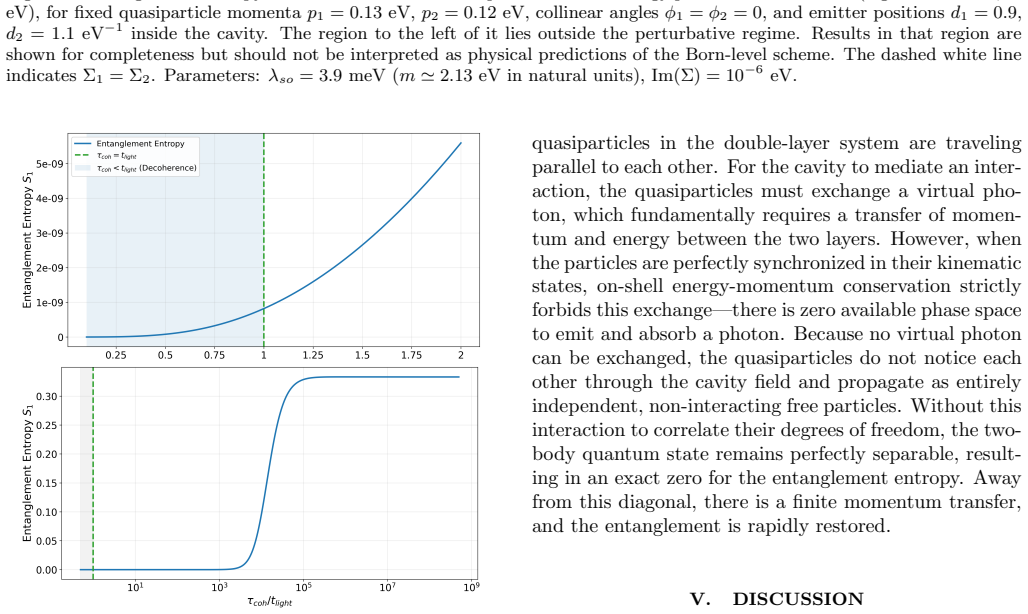
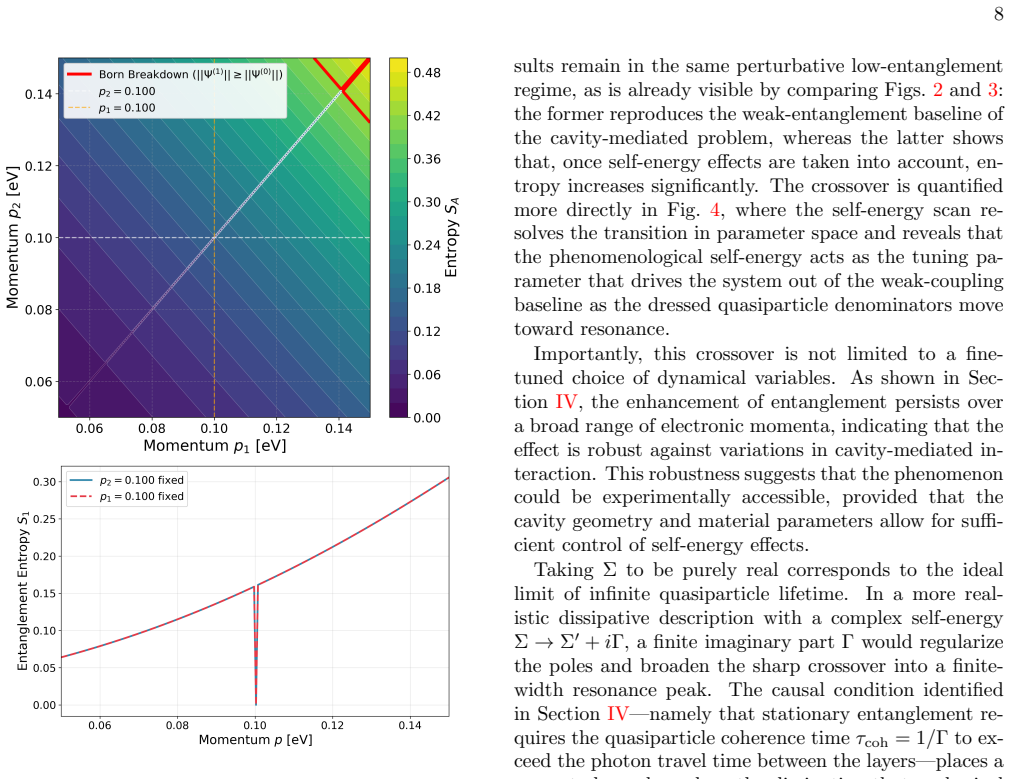
Within the perturbatively controlled regime the entropy remains small, while phenomenological self-energy dressing drives a crossover to strong enhancement of the entanglement entropy. Stationary entanglement is obtained only when the quasiparticle coherence time exceeds the photon propagation time between the layers.
What carries the argument
Ladder-approximated Bethe-Salpeter equation for the two-body state of massive Dirac fermions, from which the reduced sublattice density matrix is formed to yield the momentum-resolved von Neumann entropy.
If this is right
- Within the perturbatively controlled regime the entanglement entropy remains small.
- Phenomenological self-energy dressing produces a crossover to strong enhancement of the entanglement entropy.
- Stationary entanglement appears only when quasiparticle coherence time exceeds photon propagation time between the layers.
- The maximum-entropy regime supplies a viable route to Bell-like states.
Where Pith is reading between the lines
- Engineering longer coherence times in layered Dirac structures could make stationary entanglement experimentally accessible.
- The same combination of virtual photon exchange and spinor geometry may affect entanglement in other two-dimensional materials with similar cavity coupling.
- Layer separation could serve as a tunable parameter that controls the crossover between weak and strong entanglement regimes.
Load-bearing premise
The ladder approximation together with a Born-level treatment around a free two-body state remains valid after a phenomenological self-energy dressing is added without a self-consistent recalculation.
What would settle it
A measurement showing that the momentum-resolved von Neumann entropy fails to increase under self-energy dressing, or that stationary entanglement disappears whenever the measured coherence time is shorter than the calculated inter-layer photon travel time.
Figures


read the original abstract
We investigate the momentum-space entanglement between two Dirac quasiparticles in a double-layer honeycomb lattice coupled via a planar electromagnetic cavity. We model the low-energy excitations as massive Dirac fermions in $(1+2)$ dimensions and derive the Bethe-Salpeter equation using the ladder approximation. We use a Born-level approximation around a free two-body quasiparticle state, where the interaction is mediated by the cavity photon propagator. From the reduced sublattice density matrix, we compute a momentum-resolved von Neumann entropy. Within the perturbatively controlled regime, the entropy remains small, while phenomenological self-energy dressing drives a crossover to strong enhancement of the entanglement entropy. Stationary entanglement is obtained only when the quasiparticle coherence time exceeds the photon propagation time between the layers. The maximum-entropy regime appears to be a viable method for achieving Bell-like states. These results demonstrate how self-energy renormalization, virtual particle exchange, and spinor geometry combine to reshape the entanglement landscape of Dirac materials.
Editorial analysis
A structured set of objections, weighed in public.
Referee Report
Summary. The manuscript investigates momentum-space entanglement between two Dirac quasiparticles in a double-layer honeycomb lattice coupled via a planar electromagnetic cavity. Low-energy excitations are modeled as massive Dirac fermions in (1+2) dimensions. The Bethe-Salpeter equation is derived in the ladder approximation, with a Born-level treatment around a free two-body quasiparticle state where the interaction is mediated by the cavity photon propagator. From the reduced sublattice density matrix, a momentum-resolved von Neumann entropy is computed. The central results are that the entropy remains small within the perturbatively controlled regime, while phenomenological self-energy dressing induces a crossover to strong enhancement; stationary entanglement occurs only when the quasiparticle coherence time exceeds the photon propagation time between layers, and the maximum-entropy regime is proposed as a route to Bell-like states.
Significance. If the results hold under controlled approximations, the work illustrates how self-energy renormalization, virtual particle exchange, and Dirac spinor geometry can reshape entanglement in cavity-coupled Dirac materials. This could inform strategies for generating stationary entangled states in 2D material platforms, bridging cavity QED techniques with quantum information measures in condensed-matter systems.
major comments (1)
- [Abstract] The abstract states that 'phenomenological self-energy dressing drives a crossover to strong enhancement of the entanglement entropy' while 'within the perturbatively controlled regime, the entropy remains small.' However, the ladder approximation plus Born-level treatment around a free two-body state is perturbative by construction. No derivation is provided showing that the dressing can be introduced self-consistently from the Bethe-Salpeter equation or that it preserves the small-coupling expansion without effectively resumming higher-order terms, which directly affects the reliability of the reported entropy crossover and stationary-entanglement condition.
minor comments (2)
- The notation '(1+2) QED' in the title and abstract could be clarified for consistency with standard (2+1)-dimensional QED terminology used in the literature on Dirac materials.
- The manuscript would benefit from explicit statements of the parameter regime (e.g., coupling strength, layer separation) where the Born approximation around the free two-body state is expected to hold, including any estimates of neglected diagrams.
Simulated Author's Rebuttal
We thank the referee for their careful reading and insightful comments on our manuscript. We appreciate the opportunity to clarify the scope and limitations of our perturbative treatment and the phenomenological aspects of the self-energy dressing. We address the major comment below.
read point-by-point responses
-
Referee: [Abstract] The abstract states that 'phenomenological self-energy dressing drives a crossover to strong enhancement of the entanglement entropy' while 'within the perturbatively controlled regime, the entropy remains small.' However, the ladder approximation plus Born-level treatment around a free two-body state is perturbative by construction. No derivation is provided showing that the dressing can be introduced self-consistently from the Bethe-Salpeter equation or that it preserves the small-coupling expansion without effectively resumming higher-order terms, which directly affects the reliability of the reported entropy crossover and stationary-entanglement condition.
Authors: We agree that the ladder approximation combined with the Born-level treatment around a free two-body state is perturbative by construction, and the manuscript does not provide a self-consistent derivation of the self-energy dressing from the Bethe-Salpeter equation. The dressing is introduced phenomenologically to model quasiparticle renormalization and finite coherence effects arising from interactions outside the strict ladder approximation, as is common in exploratory studies of cavity-coupled Dirac systems. We do not claim that this preserves the small-coupling expansion or avoids resummation; the crossover to enhanced entropy is presented as an illustrative result within this extended model. The stationary-entanglement condition (coherence time exceeding interlayer photon propagation time) follows directly from the photon propagator and reduced density matrix construction and remains valid within the stated regime. To address the concern, we will revise the abstract to more explicitly qualify the dressing as phenomenological and add a paragraph in the discussion section outlining the limitations and the need for future non-perturbative treatments. This clarification will better frame the reliability of the reported crossover without altering the core calculations. revision: partial
Circularity Check
Phenomenological self-energy dressing drives the crossover to strong entanglement enhancement, reducing the central result to an inserted input rather than a derivation from the ladder/Bethe-Salpeter setup.
specific steps
-
fitted input called prediction
[Abstract]
"Within the perturbatively controlled regime, the entropy remains small, while phenomenological self-energy dressing drives a crossover to strong enhancement of the entanglement entropy. Stationary entanglement is obtained only when the quasiparticle coherence time exceeds the photon propagation time between the layers."
The small-entropy result follows from the ladder + Born setup, but the reported strong enhancement and stationary regime are not outputs of that setup; they are produced by inserting the phenomenological dressing as an external driver. The crossover magnitude is therefore chosen rather than computed from the cavity propagator or free-state assumptions, rendering the headline claim dependent on the input parameter.
full rationale
The paper derives the Bethe-Salpeter equation in the ladder approximation with Born-level treatment around a free two-body state using the cavity photon propagator, yielding small entropy in the perturbatively controlled regime. However, the headline claims of strong enhancement, crossover, and stationary entanglement (when coherence time exceeds propagation time) are explicitly attributed to an additional phenomenological self-energy dressing whose magnitude and form are not derived self-consistently from the same equations or shown to preserve perturbative control. This makes the key prediction equivalent to the choice of that dressing term.
Axiom & Free-Parameter Ledger
free parameters (1)
- phenomenological self-energy dressing strength
axioms (2)
- domain assumption Ladder approximation is sufficient for the Bethe-Salpeter kernel
- domain assumption Born-level treatment around the free two-body quasiparticle state
Reference graph
Works this paper leans on
-
[1]
=−ζ 2X n sin nπd1 L sin nπd2 L × Z d3q (2π)3 e−iq·(x1−x′
-
[2]
The cavity con- finement enters through the discrete transverse momen- tumq z =nπ/L, which shifts the photon denominator by (nπ/L)2
gµν q2 − nπ L 2 + iϵ ,(11) where we integrate over the off-shell three-momentum qµ = (q 0,q) withq 2 ≡(q 0)2 − |q| 2. The cavity con- finement enters through the discrete transverse momen- tumq z =nπ/L, which shifts the photon denominator by (nπ/L)2. III. TWO-BODY QED FRAMEWORK To investigate the momentum-space entanglement properties of the two-body quas...
-
[3]
The eigenvalues are computed and renormalized by their sum to restore the unit-trace condition
to remove floating-point asymmetry. The eigenvalues are computed and renormalized by their sum to restore the unit-trace condition. This procedure yields the entanglement pro- fileS 1(p1, p2, ϕ1, ϕ2) over the full momentum grid, form- ing the basis of the analysis presented in Sec. IV; the full numerical pipeline is summarized in Appendix B. A momentum-in...
-
[4]
Reznik, Entanglement from the vacuum, Found
B. Reznik, Entanglement from the vacuum, Found. Phys. 33, 167 (2003), quant-ph/0212044
-
[5]
C. H. Bennett, G. Brassard, C. Cr´ epeau, R. Jozsa, A. Peres, and W. K. Wootters, Teleporting an unknown quantum state via dual classical and einstein-podolsky- rosen channels, Phys. Rev. Lett.70, 1895 (1993)
1993
-
[6]
A. K. Ekert, Quantum cryptography based on bell’s the- orem, Phys. Rev. Lett.67, 661 (1991)
1991
-
[7]
Jozsa and N
R. Jozsa and N. Linden, On the role of entanglement in quantum-computational speed-up, Proceedings of the Royal Society of London. Series A: Mathematical, Phys- ical and Engineering Sciences459, 2011 (2003)
2011
- [8]
-
[9]
Valentini, Non-local correlations in quantum electro- dynamics, Phys
A. Valentini, Non-local correlations in quantum electro- dynamics, Phys. Lett. A153, 321 (1991)
1991
-
[10]
R. Horodecki, P. Horodecki, M. Horodecki, and K. Horodecki, Quantum entanglement, Rev. Mod. Phys. 81, 865 (2009), quant-ph/0702225
- [11]
-
[12]
A. Pozas-Kerstjens and E. Mart´ ın-Mart´ ınez, Harvesting correlations from the quantum vacuum, Phys. Rev. D92, 064042 (2015), 1506.03081. 10
-
[13]
Dragoman and M
D. Dragoman and M. Dragoman, Quantum logic gates based on ballistic transport in graphene, J. Appl. Phys. 119, 094902 (2016)
2016
-
[14]
Asjad, M
M. Asjad, M. Qasymeh, and H. Eleuch, Continuous- variable quantum teleportation using a microwave- enabled plasmonic graphene waveguide, Phys. Rev. Ap- plied16, 034046 (2021)
2021
-
[15]
Asjad, M
M. Asjad, M. Qasymeh, and H. Eleuch, A local area quantum teleportation communication network based on an array of electrically activated graphene plasmonic waveguides, Opt. Express30, 21016 (2022)
2022
-
[16]
G. Y. Wu and N.-Y. Lue, Graphene-based qubits in quan- tum communications, Phys. Rev. B86, 045456 (2012)
2012
-
[17]
A.-B. A. Mohamed, A.-H. Abdel-Aty, M. Qasymeh, and H. Eleuch, Non-local correlation dynamics in two- dimensional graphene, Sci. Rep.12, 3581 (2022)
2022
-
[18]
Cayssol, Introduction to Dirac materials and topologi- cal insulators, Comptes Rendus
J. Cayssol, Introduction to Dirac materials and topologi- cal insulators, Comptes Rendus. Physique14, 760 (2013)
2013
-
[19]
Alonso Calafell, J
I. Alonso Calafell, J. D. Cox, M. Radonji´ c, J. R. M. Saavedra, F. J. Garc´ ıa de Abajo, L. A. Rozema, and P. Walther, Quantum computing with graphene plas- mons, npj Quantum Information5, 37 (2019)
2019
-
[20]
A. H. C. Neto, F. Guinea, N. M. R. Peres, K. S. Novoselov, and A. K. Geim, The electronic properties of graphene, Rev. Mod. Phys.81, 109 (2009)
2009
-
[21]
M. E. Peskin and D. V. Schroeder,An Introduction to Quantum Field Theory(CRC Press, Boca Raton, FL,
-
[22]
E. C. Marino, L. O. Nascimento, V. S. Alves, and C. M. Smith, Interaction induced quantum valley hall effect in graphene, Phys. Rev. X5, 011040 (2015)
2015
-
[23]
Lamata, J
L. Lamata, J. Le´ on, and E. Solano, Entanglement be- tween two interacting atoms in a one-dimensional har- monic trap, Phys. Rev. A73, 012335 (2006)
2006
- [24]
-
[25]
C. L. Kane and E. J. Mele, Quantum spin hall effect in graphene, Phys. Rev. Lett.95, 226801 (2005)
2005
-
[26]
T. C. H. Liew, I. A. Shelykh, and G. Malpuech, Polari- tonic devices, Physica E43, 1543 (2011)
2011
-
[27]
Keller, G
J. Keller, G. Scalari, M. Gasparinetti, D. Hagenm¨ uller, M. Beck, and J. Faist, Few-electron ultrastrong light- matter coupling at 300 ghz with nanogap hybrid lc mi- crocavities, Nano Lett.17, 7410 (2017)
2017
-
[28]
Byrnes, N
T. Byrnes, N. Y. Kim, and Y. Yamamoto, Exciton- polariton condensates, Nat. Phys.10, 803 (2014)
2014
-
[29]
Y. Sun, Y. Yoon, M. Steger, G. Liu, L. N. Pfeiffer, K. West, D. W. Snoke, and K. A. Nelson, Direct measure- ment of polariton–polariton interaction strength, Nat. Phys.13, 870 (2017)
2017
-
[30]
Arreyes, F
F. Arreyes, F. Escudero, and J. S. Ardenghi, Correla- tions in twisted double-layer graphene with virtual pho- tons in a microcavity, J. Phys.: Condens. Matter34, 115602 (2022)
2022
-
[31]
Arreyes, F
F. Arreyes, F. Escudero, J. S. Ardenghi, and A. Juan, Entanglement harvesting in buckled honeycomb lattices by vacuum fluctuations in a microcavity, J. Phys.: Con- dens. Matter36, 505501 (2024)
2024
-
[32]
M. J. Spencer and T. Morishita,Silicene: Structure, Properties and Applications(Springer, Cham, 2016)
2016
-
[33]
Zhang, J
Y.-Y. Zhang, J. Pan, S. Du, and H.-J. Gao, Two- dimensional crystals: Graphene, silicene, germanene, and stanene, inSpringer Handbook of Surface Science, edited by M. Rocca, T. S. Rahman, and L. Vattuone (Springer International Publishing, Cham, 2020) pp. 243–266
2020
-
[34]
Bianco, S
E. Bianco, S. Butler, S. Jiang, O. D. Restrepo, W. Windl, and J. E. Goldberger, Stability and exfoliation of ger- manane: A germanium graphane analogue, ACS Nano 7, 4414 (2013)
2013
-
[35]
Rold´ an, L
R. Rold´ an, L. Chirolli, E. Prada, J. A. Silva-Guill´ en, P. S. Jos´ e, and F. Guinea, Theory of 2d crystals: graphene and beyond, Chem. Soc. Rev.46, 4387 (2017)
2017
- [36]
- [37]
-
[38]
J. S. Ardenghi, Entanglement entropy between virtual and real excitations in quantum electrodynamics, Int. J. Mod. Phys. A33, 1850081 (2018)
2018
-
[39]
C.-C. Liu, H. Jiang, and Y. Yao, Low-energy effective hamiltonian involving spin–orbit coupling in silicene and two-dimensional germanium and tin, Phys. Rev. B84, 195430 (2011)
2011
-
[40]
Y. Yao, F. Ye, X.-L. Qi, S.-C. Zhang, and Z. Fang, Spin–orbit gap of graphene: First-principles calculations, Phys. Rev. B75, 041401(R) (2007)
2007
-
[41]
Ezawa, Topological insulator and helical zero mode in silicene under inhomogeneous electric field, New J
M. Ezawa, Topological insulator and helical zero mode in silicene under inhomogeneous electric field, New J. Phys. 14, 033003 (2012)
2012
-
[42]
Greiner and J
W. Greiner and J. Reinhardt,Quantum Electrodynamics (Springer, Berlin, 2009) chap. 11
2009
-
[43]
von Neumann,Mathematical Foundations of Quantum Mechanics(Princeton University Press, Princeton, NJ,
J. von Neumann,Mathematical Foundations of Quantum Mechanics(Princeton University Press, Princeton, NJ,
- [44]
-
[45]
Kulig, T
M. Kulig, T. Mas lowski, K. A. Kouzakov, V. K. Dugaev, P. Kurashvili, S. Wolski, M. Inglot, C. Jasiukiewicz, and L. Chotorlishvili, Fermionic entanglement in altermag- nets, Phys. Rev. B111, 184427 (2025)
2025
-
[46]
Kristinsson, O
K. Kristinsson, O. V. Kibis, S. Morina, and I. A. She- lykh, Control of electronic transport in graphene by elec- tromagnetic dressing, Sci. Rep.6, 20082 (2016)
2016
-
[47]
Parhizgar, H
F. Parhizgar, H. Rostami, and R. Asgari, Indirect ex- change interaction between magnetic adatoms in a mono- layer mos2, Phys. Rev. B87, 125401 (2013)
2013
-
[48]
Zare, Thermoelectric transport properties of boro- phane, Phys
M. Zare, Thermoelectric transport properties of boro- phane, Phys. Rev. B99, 235413 (2019)
2019
-
[49]
O. V. Kibis, Metal-insulator transition in graphene in- duced by circularly polarized photons, Phys. Rev. B81, 165433 (2010)
2010
-
[50]
A. V. Kotikov and S. Teber, Two-loop fermion self-energy in reduced quantum electrodynamics and application to the ultrarelativistic limit of graphene, Phys. Rev. D89, 065038 (2014). 11 Appendix A: Bethe–Salpeter Kernel Derivation In Appendix A1, we derive the effective Bethe-Salpeter kernel in momentum space; in Appendices A3 and A4, we perform the frequ...
2014
discussion (0)
Sign in with ORCID, Apple, or X to comment. Anyone can read and Pith papers without signing in.