Recognition: unknown
Beyond coauthorship: semantic structure and phantom collaborators in transportation research, 1967--2025
Pith reviewed 2026-05-08 04:58 UTC · model grok-4.3
The pith
Authors close in semantic space but far in the coauthorship graph become real collaborators at rates 16 to 33 times above baseline.
A machine-rendered reading of the paper's core claim, the machinery that carries it, and where it could break.
Core claim
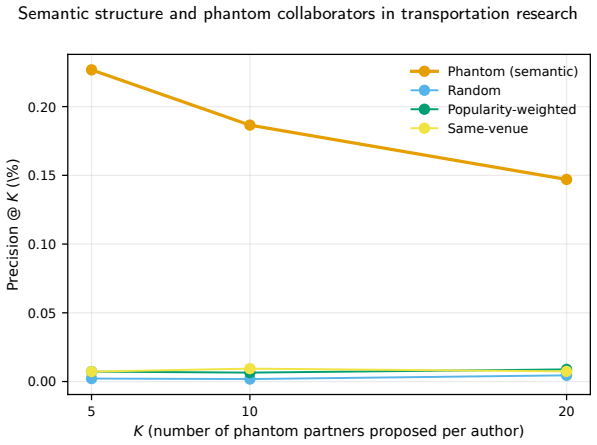
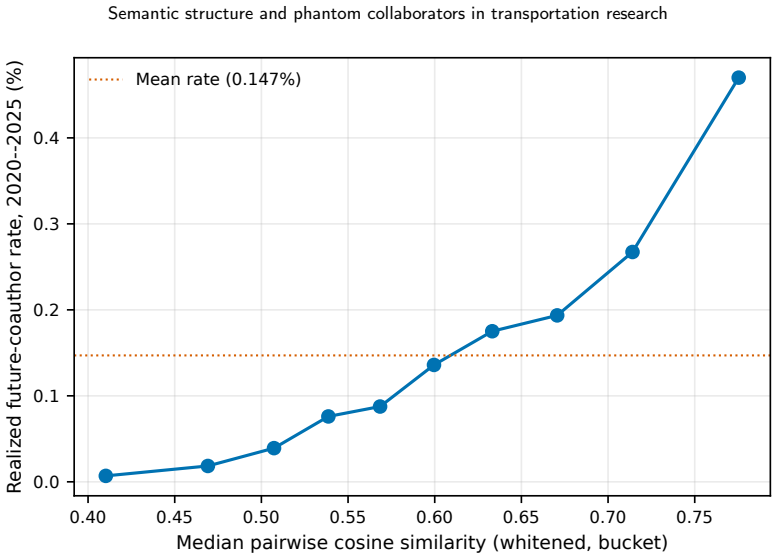
Phantom collaborators are pairs of authors who are top-K semantic neighbors based on combined paper embeddings, TF-IDF, and venue projections, yet remain at least three hops apart in the coauthor graph. When trained on data through 2019, these pairs coauthor new work in 2020-2025 at 16 to 33 times the rate of random, popularity-weighted, and same-venue baselines, with conversion rates rising monotonically by a factor of 68 from the lowest- to highest-similarity buckets.
What carries the argument
Phantom collaborator: an author pair that is nearest-neighbor in semantic embedding space of their papers but separated by three or more steps in the coauthorship graph.
Load-bearing premise
The embeddings and projections measure collaboration-relevant similarity without being driven by unmeasured factors such as shared geography, career stage, or external events.
What would settle it
Repeating the hold-out test on publications after 2025 and finding that phantom pairs no longer show elevated coauthorship rates compared with the same baselines.
Figures





read the original abstract
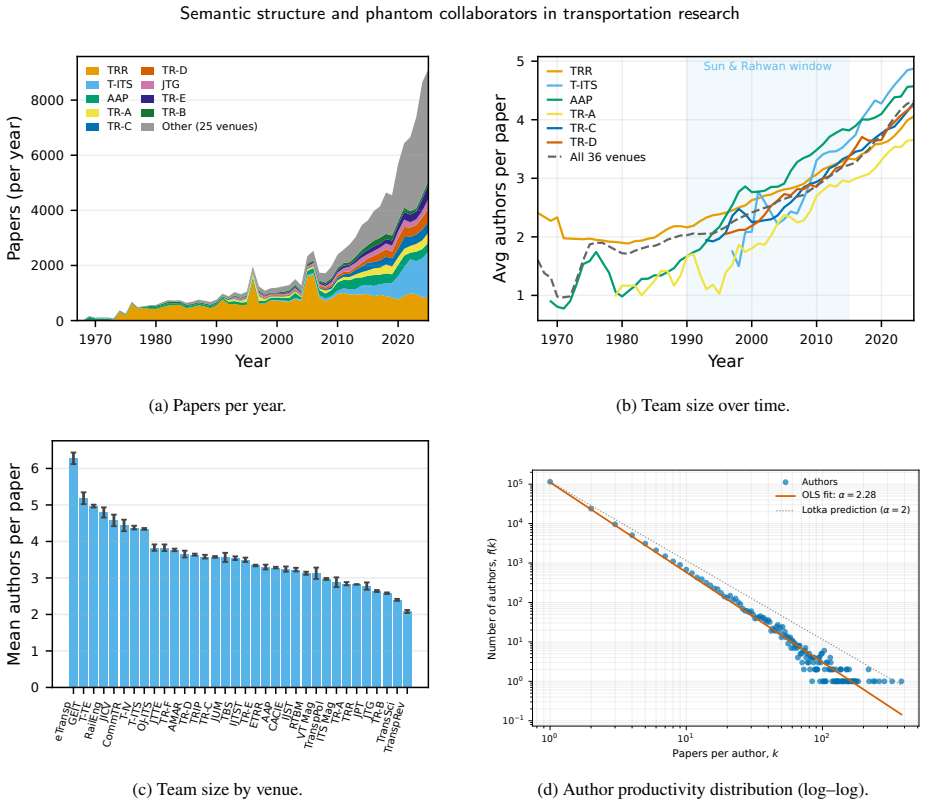
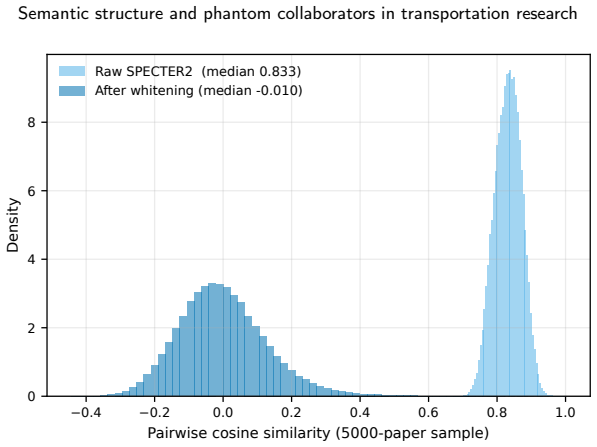
We present a semantic-structural atlas of transportation research built from 120{,}323 papers across 34 peer-reviewed journals published between 1967 and 2025, roughly an order of magnitude larger than and a decade beyond Sun and Rahwan's~(2017) coauthorship study. We use OpenAlex and Crossref as open, CC0-licensed data sources, resolve author identity through OpenAlex author IDs, ORCID records, and manual alias resolution, and embed every paper with SPECTER2 with Arora-style whitening concatenated with concept TF--IDF and venue linear-discriminant projections. On this substrate we report three findings. First, Leiden on the author-level semantic k-nearest-neighbor graph yields 23 topic communities that agree only weakly with the 172 coauthor communities (normalized mutual information $0.23$), opening room for a predictive layer that neither source encodes alone. Second, a multiplex Leiden partition combining both edge types recovers 181 communities and localizes where collaboration and topic structure decouple. Third -- the paper's core methodological contribution -- we define \emph{phantom collaborators}, pairs of authors who are top-$K$ semantic neighbors yet $\geq 3$ hops apart in the coauthor graph, and show via a temporal hold-out (training cutoff 2019) that phantom pairs become real coauthors in 2020--2025 at a rate $16$ to $33$ times above random, popularity-weighted, and same-venue baselines, with a $68$-fold monotone gradient between the highest- and lowest-similarity buckets. All artifacts are released as a live, reproducible web atlas at https://choi-seongjin.github.io/transport-atlas/.
Editorial analysis
A structured set of objections, weighed in public.
Referee Report
Summary. The paper builds a large-scale atlas of transportation research (120k papers, 1967-2025) using SPECTER2 embeddings concatenated with TF-IDF and venue projections. It reports weak alignment (NMI 0.23) between 23 semantic topic communities and 172 coauthorship communities from Leiden clustering, a multiplex partition, and introduces 'phantom collaborators' (top-K semantic neighbors at least 3 hops apart in the pre-2019 coauthor graph). Via temporal hold-out, these pairs show 16-33x higher rates of becoming real coauthors in 2020-2025 than random, popularity-weighted, and same-venue baselines, with a 68-fold similarity gradient; all artifacts are released as a live atlas.
Significance. If the semantic signal can be isolated, the work provides a scalable, predictive approach to latent collaboration potential that neither coauthorship nor topic structure captures alone, with clear strengths in dataset scale, open CC0 sources (OpenAlex/Crossref), author disambiguation, temporal validation that avoids forward leakage, and the public reproducible atlas. These elements support falsifiable claims and reproducibility.
major comments (2)
- [phantom collaborators analysis (third finding)] The temporal hold-out evaluation of phantom collaborators (third finding) compares against random, popularity-weighted, and same-venue baselines but does not condition on institutional or geographic co-location. Since co-location is a documented strong predictor of future collaboration and is plausibly correlated with SPECTER2 embeddings, the reported 16-33x lift and 68-fold gradient may be partly attributable to non-semantic factors rather than the claimed semantic signal alone.
- [semantic graph construction and Leiden partitions] The author-level semantic k-nearest-neighbor graph construction (used for both community detection and phantom definition) leaves free parameters (top-K, hop cutoff) and the exact whitening procedure unspecified, with no sensitivity analysis; this affects robustness of the NMI=0.23 result and the phantom rates.
minor comments (2)
- The multiplex Leiden partition recovering 181 communities is presented without details on edge weighting or resolution parameter choices.
- Clarify how venue linear-discriminant projections are concatenated with SPECTER2 and TF-IDF, and whether they are normalized before kNN construction.
Simulated Author's Rebuttal
We thank the referee for the constructive and detailed comments, which help clarify the robustness of our findings. We address each major comment below and outline the revisions we will incorporate.
read point-by-point responses
-
Referee: [phantom collaborators analysis (third finding)] The temporal hold-out evaluation of phantom collaborators (third finding) compares against random, popularity-weighted, and same-venue baselines but does not condition on institutional or geographic co-location. Since co-location is a documented strong predictor of future collaboration and is plausibly correlated with SPECTER2 embeddings, the reported 16-33x lift and 68-fold gradient may be partly attributable to non-semantic factors rather than the claimed semantic signal alone.
Authors: We agree that institutional and geographic co-location represents a plausible confound not fully isolated by the same-venue baseline. Although venue overlap provides a partial proxy (as many transportation journals are regionally concentrated), direct controls would strengthen the isolation of the semantic signal. In the revised manuscript we will add an institutional co-location baseline using OpenAlex affiliation strings (matched at the organization level for authors active pre-2019) and report the phantom collaboration rates after conditioning on this factor. We will also discuss the residual lift as evidence that semantic similarity contributes beyond co-location. revision: partial
-
Referee: [semantic graph construction and Leiden partitions] The author-level semantic k-nearest-neighbor graph construction (used for both community detection and phantom definition) leaves free parameters (top-K, hop cutoff) and the exact whitening procedure unspecified, with no sensitivity analysis; this affects robustness of the NMI=0.23 result and the phantom rates.
Authors: We acknowledge that the manuscript should have explicitly stated the parameter choices and included sensitivity checks. The reported results use K=10 nearest neighbors, a minimum hop distance of 3, and Arora-style whitening applied to the concatenated SPECTER2+TF-IDF+venue vectors. In the revision we will add a dedicated methods subsection and appendix that (i) fully specifies the whitening implementation and (ii) presents sensitivity tables varying K from 5 to 20 and hop cutoffs from 2 to 4, demonstrating that both the NMI value and the phantom collaboration multipliers remain qualitatively stable (within 10-15% relative change). revision: yes
Circularity Check
No circularity: temporal hold-out makes phantom transition rates independent of input definitions
full rationale
The paper defines phantom collaborators from pre-2019 semantic kNN (SPECTER2 + TF-IDF + venue projections) and coauthor graph distance, then evaluates their 2020-2025 coauthorship rates against independent baselines on held-out future data. This out-of-sample test means the 16-33x multipliers and 68-fold gradient are empirical observations, not tautological by construction. No self-citations are load-bearing, no parameters are fitted then renamed as predictions, and the embeddings are externally pre-trained. The derivation chain remains self-contained and falsifiable.
Axiom & Free-Parameter Ledger
free parameters (2)
- top-K semantic neighbors
- hop distance cutoff
axioms (1)
- domain assumption SPECTER2 embeddings with Arora whitening plus concept TF-IDF and venue LDA projections capture topic similarity relevant to collaboration
invented entities (1)
-
phantom collaborators
independent evidence
Reference graph
Works this paper leans on
-
[1]
doi:10.18653/v1/2020.acl-main.207. van Eck, N.J., Waltman, L.,
-
[2]
Software survey: VOSviewer, a computer program for bibliometric mapping. Scientometrics 84, 523–538. doi:10.1007/s11192-009-0146-3. Fortunato, S., Hric, D.,
-
[3]
Community detection in networks: A user guide. Physics Reports 659, 1–44. doi:10.1016/j.physrep.2016.09
-
[4]
Quantitative Science Studies , _month = feb, publisher =
Crossref: the sustainable source of community-owned scholarly metadata. Quantitative Science Studies 1, 414–427. doi:10.1162/qss_a_00022. Jacomy, M., Venturini, T., Heymann, S., Bastian, M.,
-
[5]
ForceAtlas2, a continuous graph layout algorithm for handy network visualization designed for the Gephi software. PLOS ONE 9, e98679. doi:10.1371/journal.pone.0098679. Jiang, C., Bhat, C.R., Lam, W.H.,
-
[6]
Transportation Research Part B: Methodological 138, 268–291
A bibliometric overview of transportation research part b: Methodological in the past forty years (1979– 2019). Transportation Research Part B: Methodological 138, 268–291. doi:10.1016/j.trb.2020.05.016. Liben-Nowell, D., Kleinberg, J.,
-
[7]
Journal of the American Society for Information Science and Technology , volume =
The link-prediction problem for social networks. Journal of the American Society for Information Science and Technology 58, 1019–1031. doi:10.1002/asi.20591. Lotka, A.J.,
-
[8]
doi:10.21105/joss.00861. Modak, N.M., Merigó, J.M., Weber, R., Manzor, F., Ortúzar, J.d.D.,
-
[9]
Transportation Research Part A: Policy and Practice 120, 188–223
Fifty years of transportation research journals: A bibliometric overview. Transportation Research Part A: Policy and Practice 120, 188–223. doi:10.1016/j.tra.2018.11.015. Mucha, P.J., Richardson, T., Macon, K., Porter, M.A., Onnela, J.P.,
-
[10]
Community structure in time-dependent, multiscale, and multiplex networks. Science 328, 876–878. doi:10.1126/science.1184819. Newman, M.,
-
[11]
Proceedings of the National Academy of Sciences 98, 404–409
The structure of scientific collaboration networks. Proceedings of the National Academy of Sciences 98, 404–409. doi:10.1073/pnas.98.2.404. Priem, J., Piwowar, H., Orr, R.,
-
[12]
OpenAlex: A fully-open index of scholarly works, authors, venues, institutions, and concepts. arXiv:2205.01833. Singh,A.,D’Arcy,M.,Cohan,A.,Downey,D.,Feldman,S.,2023. SciRepEval:Amulti-formatbenchmarkforscientificdocumentrepresentations, in: Proceedings of EMNLP
-
[13]
doi:10.18653/v1/2023.emnlp-main.338. Sun, L., Rahwan, I.,
-
[14]
Transportation Research Part A: Policy and Practice 100, 135–151
Coauthorship network in transportation research. Transportation Research Part A: Policy and Practice 100, 135–151. doi:10.1016/j.tra.2017.04.011. Traag, V., Waltman, L., van Eck, N.,
-
[15]
doi:10.1038/s41598-019-41695-z. S. Choi:Preprint submitted to ElsevierPage 24 of 38 Semantic structure and phantom collaborators in transportation research A. Venue ISSNs and coverage Table 9 The 34 venues indexed by the atlas. Coverage is the observed year span in OpenAlex for papers of typejournal-article orconference-paper. Venue Abbr. ISSN (print / on...
-
[16]
Venues contributing fewer than100papers at fit time are folded into an “other” class, which is why the realized dimension is28rather than33
= 28 components. Venues contributing fewer than100papers at fit time are folded into an “other” class, which is why the realized dimension is28rather than33. Hybrid concatenation.The three𝐿 2-normalized blocks are concatenated with square-root-weighted scaling: whitened SPECTER2 at √ 0.55(768dim), concept TF–IDF at √ 0.30(128dim), and venue LDA at √ 0.15(...
2017
-
[17]
different
Five-yearbins,minimumtwonon-emptybinsperauthorforclassificationeligibility,restrictedtoauthorswith≥3 bins(≥10-yearpublicationwindow,twotrajectorysegments)fortheheadlinefour-classpartition.Centroidtrajectories aresmoothedonlythroughbinaggregation;notemporalregulariserorkernelsmootherisapplied.Classcutoffs:stayer cutoff𝜏 stay = 15, drifter cutoff𝜏𝜂 = 0.60, ...
2021
discussion (0)
Sign in with ORCID, Apple, or X to comment. Anyone can read and Pith papers without signing in.