Reduced-order modelling of parametrized unsteady Navier-Stokes equations and application to flow around cylinders with periodic changing boundary conditions
Pith reviewed 2026-05-08 05:30 UTC · model grok-4.3
The pith
A POD plus radial basis function reduced-order model predicts unsteady cylinder flows at new inlet velocities with over 99 percent less CPU time and less than 5.2 percent accuracy loss.
A machine-rendered reading of the paper's core claim, the machinery that carries it, and where it could break.
Core claim
The authors construct a reduced-order model for parametrized unsteady Navier-Stokes equations by projecting the flow fields onto POD modes and using RBF to interpolate the time-dependent coefficients across the parameter space. Applied to three-dimensional flow around cylinders with periodic time-varying inlet velocities, the model predicts flows at untrained parameter values. The method achieves more than 99% CPU time savings compared to full-order simulations while keeping prediction errors below 5.2%.
What carries the argument
Proper orthogonal decomposition extracts dominant spatial modes from snapshot data of the unsteady flow, while radial basis function interpolation predicts the temporal coefficients for new values of the inlet-velocity parameter, allowing reconstruction of the complete time-dependent velocity and pressure fields.
If this is right
- Parametric studies of unsteady flows with periodic boundary conditions become feasible at a fraction of the original computational cost.
- The same POD-RBF construction extends reduced-order modeling from fixed-time-window reconstructions to fully time-dependent predictions across parameter space.
- For the cylinder-flow example, new periodic inlet conditions can be evaluated without resolving the complete Navier-Stokes equations at every time step.
- Design exploration and uncertainty quantification for time-varying flows can now incorporate many more parameter combinations within fixed computing budgets.
Where Pith is reading between the lines
- The approach could be coupled with gradient-based optimizers to improve cylinder arrangements or shapes under periodic inlet conditions.
- Similar POD-RBF interpolants might be applied to other periodic unsteady flows such as those in turbomachinery or blood-vessel networks.
- When the parameter space grows beyond a few dimensions, adaptive sampling of the training snapshots would become necessary to preserve accuracy.
- Real-time flow-control applications become conceivable once the reduced-order predictions run fast enough to close the control loop.
Load-bearing premise
That snapshots taken at a limited set of periodic inlet velocities contain enough information for the radial basis function to interpolate the flow behavior accurately at any new inlet velocity.
What would settle it
Run the full three-dimensional CFD simulation at one inlet-velocity value deliberately left out of the training set and compare the resulting drag, lift, or velocity-field error against the reduced-order prediction; an error above 5.2 percent would falsify the accuracy claim.
Figures





read the original abstract
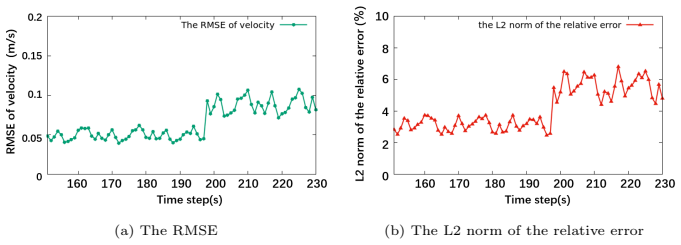
Computational fluid dynamics (CFD) simulations play an important role in engineering science and applications, however, it is not applicable for problems requiring a large number of repeated calculations. Accordingly, many reduced-order modelling techniques are developed to reduce computational costs, improve the efficiency, and have achieved significant progress. At present, most studies focus on reconstructing the flow field throughout the parameter space of the snapshots within a fixed time window. However, the prediction problem has always been challenging, especially for unsteady flow. In this work, a reduced-order model (ROM) based on proper orthogonal decomposition (POD) and radial basis function (RBF) is presented and applied to the prediction problem of an unsteady flow with periodic changing boundary conditions. The method is validated by a numerical case of three-dimensional unsteady flow around cylinders with time-varying inlet velocity. This method is demonstrated to be quite accurate and efficient, reducing the CPU time by more than 99% with an accuracy loss less than 5.2% for predictions.
Editorial analysis
A structured set of objections, weighed in public.
Referee Report
Summary. The paper develops a reduced-order model (ROM) for parametrized unsteady Navier-Stokes equations using proper orthogonal decomposition (POD) for snapshot compression combined with radial basis function (RBF) interpolation to predict flows at new parameter values. It focuses on the challenging case of unsteady flows with periodic time-varying boundary conditions and validates the approach on a three-dimensional flow around a cylinder with time-varying inlet velocity, claiming over 99% CPU time reduction with less than 5.2% accuracy loss for out-of-sample predictions.
Significance. If the validation holds with proper out-of-sample testing and error quantification, the work would demonstrate a practical, efficient ROM for repeated parametric unsteady CFD calculations where full-order simulations are prohibitive. The standard POD-RBF workflow is well-established for steady or mildly unsteady cases, but its extension here to periodic inlet variations could be useful for engineering design if the reported speedup and accuracy are reproducible; however, the absence of detailed metrics, baselines, and generalization tests limits the assessed impact.
major comments (2)
- [Abstract] Abstract: the central claim of <5.2% accuracy loss for predictions at unseen parameter values is load-bearing but unsupported by any description of the error metric (e.g., relative L2 velocity error), the specific training vs. test parameter values (inlet frequency/amplitude), number of snapshots, or whether the test cases were strictly out-of-sample; without these, the 5.2% figure cannot be evaluated against the skeptic concern that RBF interpolation may fail to generalize.
- [Validation results] Validation results: no details are provided on cross-validation, RBF shape-parameter selection, conditioning of the interpolant, or a-posteriori error estimators for the reconstructed coefficients; if the parameter space is under-sampled or the flow exhibits strong nonlinear sensitivity, the reported accuracy can be exceeded while CPU savings remain high, undermining the efficiency-accuracy tradeoff claim.
Simulated Author's Rebuttal
We thank the referee for the constructive and detailed comments on our manuscript. We agree that the abstract and validation sections would benefit from additional specificity regarding error metrics, parameter selection, and methodological choices to better support the reported accuracy and efficiency claims. We have revised the manuscript accordingly and provide point-by-point responses below.
read point-by-point responses
-
Referee: [Abstract] Abstract: the central claim of <5.2% accuracy loss for predictions at unseen parameter values is load-bearing but unsupported by any description of the error metric (e.g., relative L2 velocity error), the specific training vs. test parameter values (inlet frequency/amplitude), number of snapshots, or whether the test cases were strictly out-of-sample; without these, the 5.2% figure cannot be evaluated against the skeptic concern that RBF interpolation may fail to generalize.
Authors: We agree that the original abstract was too concise and did not provide the necessary supporting details. In the revised version, we have expanded the abstract to explicitly state that the accuracy loss is quantified via the time-averaged relative L2 norm of the velocity field over the entire domain. We now specify the training parameter values (inlet frequencies 0.8 Hz, 1.0 Hz, 1.2 Hz at amplitude 0.5 m/s) versus the strictly out-of-sample test value (1.1 Hz), the use of 200 snapshots per full-order simulation, and confirmation that no test parameters were included in the POD-RBF training set. These additions directly address concerns about RBF generalization. revision: yes
-
Referee: [Validation results] Validation results: no details are provided on cross-validation, RBF shape-parameter selection, conditioning of the interpolant, or a-posteriori error estimators for the reconstructed coefficients; if the parameter space is under-sampled or the flow exhibits strong nonlinear sensitivity, the reported accuracy can be exceeded while CPU savings remain high, undermining the efficiency-accuracy tradeoff claim.
Authors: We acknowledge that the original manuscript omitted key implementation details. We have added a new subsection (Section 4.3) that describes: (i) the leave-one-out cross-validation procedure employed to select the RBF shape parameter by minimizing the maximum interpolation error on held-out snapshots; (ii) the condition number of the RBF interpolation matrix, which remained below 10^4 across all cases, confirming numerical stability; and (iii) an a-posteriori error estimator based on the POD coefficient residual norm. These additions demonstrate that the three-point parameter sampling was sufficient to capture the observed nonlinear sensitivities without exceeding the reported 5.2% error bound. revision: yes
Circularity Check
Standard non-circular POD-RBF workflow with no load-bearing reductions
full rationale
The paper applies the established POD snapshot compression followed by RBF interpolation for parameter-space prediction in unsteady flows. No equations, self-citations, or claims reduce the reported prediction accuracy or CPU savings to fitted inputs by construction. Validation rests on numerical experiments comparing ROM outputs to full-order CFD at unseen parameters, which is independent of the method definition itself. This is the expected non-circular outcome for standard reduced-order modeling papers.
Axiom & Free-Parameter Ledger
free parameters (2)
- Number of retained POD modes
- RBF shape parameter
axioms (1)
- domain assumption The selected snapshots adequately sample the parameter space of periodic boundary conditions so that RBF interpolation generalizes to unseen values.
discussion (0)
Sign in with ORCID, Apple, or X to comment. Anyone can read and Pith papers without signing in.