Recognition: unknown
WISE-FM:Operation-Aware, Engineering-Informed Foundation Model for Multi-Task Well Design
Pith reviewed 2026-05-08 06:17 UTC · model grok-4.3
The pith
A design-aware and physics-informed foundation model reduces virtual flow metering errors by up to 13 times and speeds up well design optimization by over 1000 times.
A machine-rendered reading of the paper's core claim, the machinery that carries it, and where it could break.
Core claim
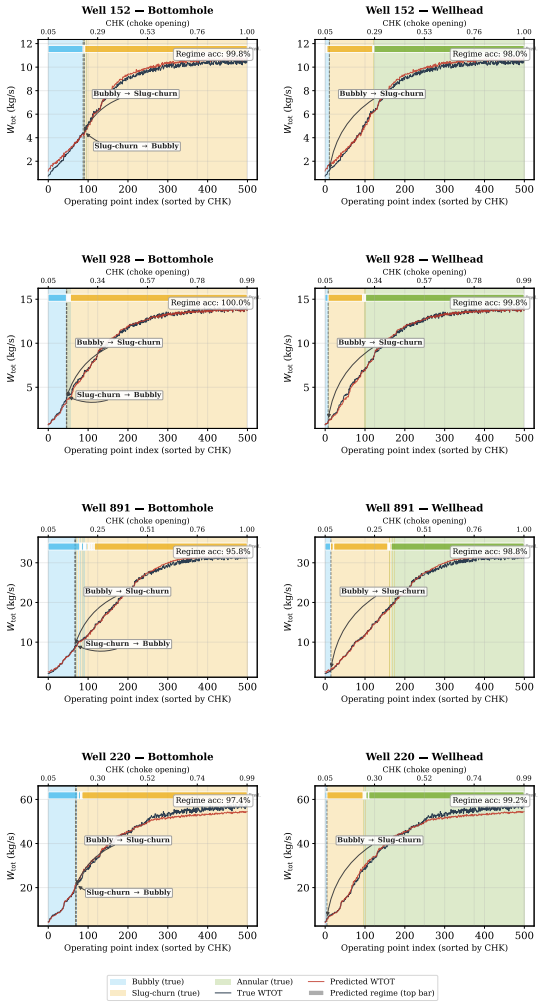
WISE-FM integrates design conditioning via FiLM and attention, multi-task learning for flow rates, bottomhole conditions, and flow regime classification, and soft physics constraints derived from mass conservation. On the ManyWells benchmark of 2000 simulated wells and one million points, design awareness cuts virtual flow metering error by up to 13 times compared with design-unaware baselines, physics constraints cut negative flow predictions by 65 percent, and flow regime accuracy reaches 97.7 percent. The same model transfers to real data from five Equinor Volve producers with R-squared values of 0.89 for oil rate, 0.98 for bottomhole pressure, and 0.97 for water rate. It also serves as a
What carries the argument
The WISE-FM model that uses Feature-wise Linear Modulation (FiLM) and cross-modal attention to condition operational embeddings on well design parameters, together with multi-task prediction heads and soft physics constraints enforcing mass conservation.
If this is right
- Design conditioning enables accurate predictions for wells whose design parameters were never seen during training.
- Soft physics constraints reduce physically invalid outputs such as negative flow rates by 65 percent without extra sensors.
- Multi-task learning produces simultaneous forecasts of flow rates, bottomhole conditions, and flow regimes from one model.
- The trained model replaces drift-flux simulations for optimization over a 24-dimensional design space at more than 1000 times the speed.
- High transfer accuracy on real Equinor data shows the approach works on operational measurements beyond simulation.
Where Pith is reading between the lines
- The same conditioning on design parameters and soft constraints could apply to other engineered systems whose geometry affects physical behavior, such as pipelines or reactors.
- The 1000-fold speedup opens the possibility of embedding the model inside real-time control loops for adaptive well operations.
- Extending the model with uncertainty estimates on its multi-task outputs would let operators decide which wells still need physical sensors for verification.
Load-bearing premise
The ManyWells simulated dataset from 2000 wells and one million points sufficiently represents the range and distribution of real-world well designs and operations, and the chosen soft physics constraints are correctly formulated and weighted.
What would settle it
Evaluating the model on a fresh set of real wells whose design parameters fall outside the ManyWells distribution and finding that error reductions disappear or that the physics constraints raise overall error.
Figures




read the original abstract
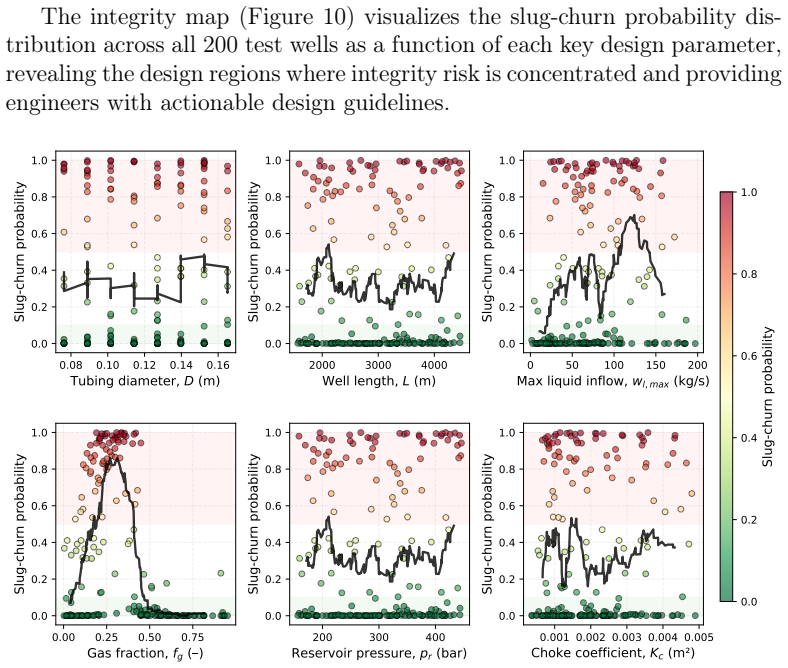
Deploying machine learning models across diverse well portfolios requires generalisation to wells with design parameters outside the training distribution. Current data-driven approaches to virtual flow metering (VFM) and bottomhole estimation typically treat each well independently or ignore the influence of well design on operational behaviour. We present WISE (Well Intelligence and Systems Engineering Foundation Model), a design-aware, physics-informed multi-task model that integrates three complementary mechanisms: Feature-wise Linear Modulation (FiLM) and cross-modal attention to condition operational embeddings on well design parameters; multi-task learning for simultaneous prediction of flow rates, bottomhole conditions, and flow regime classification; and structural mass conservation with soft physics constraints derived from well engineering principles. Evaluation on the ManyWells benchmark (2000 simulated wells, $10^6$ data points) demonstrates that design-aware models reduce VFM prediction error by up to $13\times$ compared to design-unaware baselines, and that physics constraints reduce negative flow predictions by 65%. Flow regime classification achieves 97.7% bottomhole accuracy, providing continuous well integrity monitoring without additional sensors. The methodology transfers to real operational data from five Equinor Volve producers (oil rate $R^2 = 0.89$, bottomhole pressure $R^2 = 0.98$, water rate $R^2 = 0.97$). The trained model additionally serves as a fast surrogate for integrity-aware well design optimisation over a 24-dimensional design space, with more than $1000\times$ speedup over drift-flux simulations. These results demonstrate that design awareness, physics enforcement, and multi-task learning are essential and complementary ingredients for foundation models intended to operate across large well portfolios.
Editorial analysis
A structured set of objections, weighed in public.
Referee Report
Summary. The paper presents WISE-FM, a design-aware, physics-informed multi-task foundation model for virtual flow metering (VFM) and well design. It integrates FiLM conditioning and cross-modal attention to incorporate well design parameters into operational embeddings, multi-task learning to predict flow rates, bottomhole conditions, and flow regimes simultaneously, and soft physics constraints enforcing mass conservation from well engineering principles. On the ManyWells simulated benchmark (2000 wells, 10^6 points), it claims up to 13× VFM error reduction versus design-unaware baselines and 65% fewer negative flow predictions with physics constraints; flow regime classification reaches 97.7% accuracy. The model transfers to real Equinor Volve data (five producers) with R² values of 0.89 (oil rate), 0.98 (bottomhole pressure), and 0.97 (water rate), and serves as a surrogate enabling >1000× faster integrity-aware optimization over a 24-dimensional design space compared to drift-flux simulations.
Significance. If the quantitative claims and generalization hold, this represents a meaningful advance in applying foundation models to petroleum engineering by addressing design dependence and physical consistency in VFM and well optimization. The large-scale simulated benchmark, multi-task formulation, and attempt at real-data transfer are strengths that could influence surrogate modeling practices. The 1000× speedup potential for design optimization is notable if surrogate fidelity is maintained.
major comments (4)
- [§4.2 (ManyWells evaluation)] §4.2 (ManyWells evaluation): The central 13× VFM error reduction and 65% negative-flow reduction claims lack specification of the precise error metric (MAE/RMSE/etc.), the exact design-unaware baseline architectures, data splits or cross-validation procedure, and any error bars or statistical tests across the 2000 wells. These omissions are load-bearing because they prevent independent verification of whether design awareness and physics constraints deliver the reported gains.
- [§4.3 (real-data transfer)] §4.3 (real-data transfer): Performance on the five Volve producers is reported solely as R² values with no baseline comparisons, no ablations removing FiLM conditioning or the physics constraints, and no additional metrics (e.g., MAE or negative-flow counts). This is load-bearing for the generalization claim, especially given potential distribution shifts (sensor noise, unmodeled transients) between the drift-flux simulator and real wells.
- [Methods (physics-constraint formulation)] Methods (physics-constraint formulation): The exact mathematical form of the soft mass-conservation constraints, their derivation from engineering principles, the weighting coefficients in the multi-task loss, and the enforcement mechanism are insufficiently specified. This detail is required to assess whether the 65% reduction in negative flows is achieved without introducing bias or limiting generalization.
- [Optimization surrogate section] Optimization surrogate section: The >1000× speedup claim for 24-dimensional integrity-aware design optimization depends on surrogate accuracy outside the simulated training distribution; additional quantitative comparison of optimized designs against full drift-flux simulations (e.g., constraint violation rates or objective values) is needed to substantiate this application.
minor comments (2)
- [Abstract] Abstract: The phrase 'structural mass conservation with soft physics constraints' would benefit from a one-sentence definition or equation reference to improve immediate clarity for readers unfamiliar with the domain.
- [Notation and figures] Notation and figures: Ensure consistent symbol usage for flow rates (q_o, q_w, etc.) and that all result figures include explicit captions distinguishing design-aware versus unaware models and with/without physics constraints.
Simulated Author's Rebuttal
We thank the referee for their constructive feedback on our manuscript. We have carefully considered each major comment and made revisions to enhance the clarity, reproducibility, and substantiation of our claims. Our point-by-point responses are provided below.
read point-by-point responses
-
Referee: [§4.2 (ManyWells evaluation)] The central 13× VFM error reduction and 65% negative-flow reduction claims lack specification of the precise error metric (MAE/RMSE/etc.), the exact design-unaware baseline architectures, data splits or cross-validation procedure, and any error bars or statistical tests across the 2000 wells. These omissions are load-bearing because they prevent independent verification of whether design awareness and physics constraints deliver the reported gains.
Authors: We agree these details are essential for verification. We have revised §4.2 to specify the precise error metric, the exact design-unaware baseline architectures, the data splits and cross-validation procedure, and to include error bars and statistical tests across the 2000 wells. revision: yes
-
Referee: [§4.3 (real-data transfer)] Performance on the five Volve producers is reported solely as R² values with no baseline comparisons, no ablations removing FiLM conditioning or the physics constraints, and no additional metrics (e.g., MAE or negative-flow counts). This is load-bearing for the generalization claim, especially given potential distribution shifts (sensor noise, unmodeled transients) between the drift-flux simulator and real wells.
Authors: We acknowledge this limitation in the original presentation. We have revised §4.3 to include baseline comparisons, ablations removing FiLM conditioning and the physics constraints, and additional metrics such as MAE and negative-flow counts to better support the generalization claim. revision: yes
-
Referee: [Methods (physics-constraint formulation)] The exact mathematical form of the soft mass-conservation constraints, their derivation from engineering principles, the weighting coefficients in the multi-task loss, and the enforcement mechanism are insufficiently specified. This detail is required to assess whether the 65% reduction in negative flows is achieved without introducing bias or limiting generalization.
Authors: We agree that more detail is needed. The revised Methods section now includes the exact mathematical form of the soft mass-conservation constraints, their derivation from engineering principles, the weighting coefficients in the multi-task loss, and the enforcement mechanism. revision: yes
-
Referee: [Optimization surrogate section] The >1000× speedup claim for 24-dimensional integrity-aware design optimization depends on surrogate accuracy outside the simulated training distribution; additional quantitative comparison of optimized designs against full drift-flux simulations (e.g., constraint violation rates or objective values) is needed to substantiate this application.
Authors: We recognize the need for further validation of the surrogate. We have added quantitative comparisons of optimized designs against full drift-flux simulations, including constraint violation rates and objective values, in the optimization section. revision: yes
Circularity Check
No significant circularity in derivation chain
full rationale
The paper presents an empirical ML model (FiLM conditioning + multi-task heads + soft mass-conservation penalties) whose performance claims are tied to held-out evaluation on the ManyWells simulated benchmark and separate R² reporting on Volve real wells. No equation reduces a claimed prediction to a fitted parameter by construction, no self-citation supplies a load-bearing uniqueness theorem, and no ansatz is smuggled via prior work. The derivation therefore remains self-contained against external benchmarks rather than tautological.
Axiom & Free-Parameter Ledger
free parameters (3)
- FiLM modulation parameters
- Physics constraint weights
- Multi-task loss balancing weights
axioms (2)
- domain assumption Well design parameters influence operational flow behavior
- domain assumption Mass conservation holds in wellbore flow
Reference graph
Works this paper leans on
-
[1]
Virtual multiphase flow metering using diverse neural network ensemble and adaptive simulated annealing
Al-Qutami, T.A., Ibrahim, R., Ismail, I., Ishak, M.A., 2018. Virtual multiphase flow metering using diverse neural network ensemble and adaptive simulated annealing. Expert Systems with Applications 93, 304–316
2018
-
[2]
Evaluation of commercially available virtual flow me- ters
Amin, A., 2015. Evaluation of commercially available virtual flow me- ters. Offshore Technology Conference, OTC-25764-MS
2015
-
[3]
Bot- tomhole pressure estimation using evolved neural networks
Ashena, R., Rabiei, M., Rasouli, V., Mohammadi, A.H., 2021. Bot- tomhole pressure estimation using evolved neural networks. Journal of Petroleum Science and Engineering 196, 108013
2021
-
[4]
Ba, J.L., Kiros, J.R., Hinton, G.E., 2016. Layer normalization. arXiv preprint arXiv:1607.06450
work page internal anchor Pith review arXiv 2016
-
[5]
Multiphase flow in wells
Bai, Y., Bai, Q., Wang, X., 2022. Multiphase flow in wells. In: Subsea Engineering Handbook, 2nd ed. Gulf Professional Publishing
2022
-
[6]
Physics-informed neural networks for well test interpretation
Bao, J., Li, H., Gao, X., 2022. Physics-informed neural networks for well test interpretation. Journal of Petroleum Science and Engineering 208, 109644
2022
-
[7]
Oil production monitoring us- ing gradient boosting machine learning algorithm
Bikmukhametov, T., Jaschke, J., 2019. Oil production monitoring us- ing gradient boosting machine learning algorithm. IFAC-PapersOnLine 52(1), 514–519. 41
2019
-
[8]
First principles and machine learning virtual flow metering: A literature review
Bikmukhametov, T., Jaschke, J., 2020. First principles and machine learning virtual flow metering: A literature review. Journal of Petroleum Science and Engineering 184, 106487
2020
-
[9]
Modulating early visual processing by language
De Vries, H., Strub, F., Mary, J., Larochelle, H., Pietquin, O., Courville, A.C., 2017. Modulating early visual processing by language. In: Ad- vances in Neural Information Processing Systems (NeurIPS)
2017
-
[10]
A learned representation for artistic style
Dumoulin, V., Shlens, J., Kudlur, M., 2018. A learned representation for artistic style. In: International Conference on Learning Representations (ICLR)
2018
-
[11]
A simple approach to virtual flow metering us- ing hybrid mechanistic-data-driven models
Grimstad, B., Gunnerud, V., Sandnes, A.J., Sharika, S., Therrien, J., Ungredda, J., 2021. A simple approach to virtual flow metering us- ing hybrid mechanistic-data-driven models. IFAC-PapersOnLine 54(3), 490–495
2021
-
[12]
ManyWells: Simulation of multiphase flow in thousands of wells
Grimstad, B., et al., 2026. ManyWells: Simulation of multiphase flow in thousands of wells. Geoenergy Science and Engineering (in press)
2026
-
[13]
Gaussian Error Linear Units (GELUs)
Hendrycks, D., Gimpel, K., 2016. Gaussian error linear units (GELUs). arXiv preprint arXiv:1606.08415
work page internal anchor Pith review arXiv 2016
-
[14]
Developing a hy- brid data-driven, mechanistic virtual flow meter—a case study
Hotvedt, M., Grimstad, B., Imsland, L., 2020. Developing a hy- brid data-driven, mechanistic virtual flow meter—a case study. IFAC- PapersOnLine 53(2), 11692–11697
2020
-
[15]
On the integration of physics-based and data-driven models for virtual flow metering
Hotvedt, M., Grimstad, B., Imsland, L., 2024. On the integration of physics-based and data-driven models for virtual flow metering. Applied Soft Computing, 111168
2024
-
[16]
Physics-informed machine learning
Karniadakis, G.E., Kevrekidis, I.G., Lu, L., Perdikaris, P., Wang, S., Yang, L., 2021. Physics-informed machine learning. Nature Reviews Physics 3(6), 422–440
2021
-
[17]
Characterizing possible failure modes in physics-informed neural networks
Krishnapriyan, A.S., Gholami, A., Zhe, S., Kirby, R.M., Mahoney, M.W., 2021. Characterizing possible failure modes in physics-informed neural networks. In: Advances in Neural Information Processing Sys- tems (NeurIPS). 42
2021
-
[18]
Focal loss for dense object detection
Lin, T.Y., Goyal, P., Girshick, R., He, K., Dollár, P., 2017. Focal loss for dense object detection. In: IEEE International Conference on Computer Vision (ICCV)
2017
-
[19]
Decoupled weight decay regularization
Loshchilov, I., Hutter, F., 2019. Decoupled weight decay regularization. In: International Conference on Learning Representations (ICLR)
2019
-
[20]
A machine learning approach for detecting slugging in vertical gas wells
Mask, G., Wu, X., Ling, K., 2019. A machine learning approach for detecting slugging in vertical gas wells. SPE Western Regional Meeting, SPE-195418-MS
2019
-
[21]
Multimodal anomaly detection for batch distillation using temporal convolutional networks
Nogueira, I.B.R., et al., 2024. Multimodal anomaly detection for batch distillation using temporal convolutional networks. Computers & Chem- ical Engineering, 108830
2024
-
[22]
Identification of gas-liquid flow regimes using a non-intrusive Doppler ultrasonic sensor and virtual flow regime maps
Nnabuife, S.G., Pilario, K.E.S., Lao, L., Cao, Y., Shafiee, M., 2019. Identification of gas-liquid flow regimes using a non-intrusive Doppler ultrasonic sensor and virtual flow regime maps. Flow Measurement and Instrumentation 68, 101568
2019
-
[23]
FiLM: Visual reasoning with a general conditioning layer
Perez, E., Strub, F., De Vries, H., Dumoulin, V., Courville, A., 2018. FiLM: Visual reasoning with a general conditioning layer. In: AAAI Conference on Artificial Intelligence
2018
-
[24]
Physics-informed neural networks: A deep learning framework for solving forward and in- verse problems involving nonlinear partial differential equations
Raissi, M., Perdikaris, P., Karniadakis, G.E., 2019. Physics-informed neural networks: A deep learning framework for solving forward and in- verse problems involving nonlinear partial differential equations. Journal of Computational Physics 378, 686–707
2019
-
[25]
Neural conservation laws: A divergence-free perspective
Richter-Powell, J., Lorraine, J., Amos, B., 2022. Neural conservation laws: A divergence-free perspective. In: Advances in Neural Information Processing Systems (NeurIPS)
2022
-
[26]
Drift- flux parameters for three-phase steady-state flow in wellbores
Shi, H., Holmes, J.A., Diaz, L.R., Durlofsky, L.J., Aziz, K., 2005. Drift- flux parameters for three-phase steady-state flow in wellbores. SPE Journal 10(2), 130–137
2005
-
[27]
Physics-informed machine learn- ing for production forecasting
Zhong, Z., Sun, A.Y., Jeong, H., 2023. Physics-informed machine learn- ing for production forecasting. SPE Journal 28(5), 2700–2717. 43
2023
-
[28]
Volve field data (2008–2016): Well, reservoir, and pro- duction data from the North Sea
Equinor, 2018. Volve field data (2008–2016): Well, reservoir, and pro- duction data from the North Sea. Available at:https://www.equinor. com/energy/volve-data-sharing. Equinor Open Data Licence
2018
-
[29]
Norne field reservoir simulation model
OPM Project, 2015. Norne field reservoir simulation model. Available at:https://github.com/OPM/opm-data/tree/master/norne. Open Database License
2015
-
[30]
Mechanistic Modeling of Gas-Liquid Two-Phase Flow in Pipes
Shoham, O., 2006. Mechanistic Modeling of Gas-Liquid Two-Phase Flow in Pipes. Society of Petroleum Engineers, Richardson, TX
2006
-
[31]
The elimination of severe slugging—experiments and modeling
Jansen, F.E., Shoham, O., Taitel, Y., 1996. The elimination of severe slugging—experiments and modeling. International Journal of Multi- phase Flow 22(6), 1055–1072
1996
-
[32]
A multi- task learning approach to virtual flow metering and bottomhole pressure estimation
Sandnes, M., Hotvedt, M., Grimstad, B., Imsland, L., 2021. A multi- task learning approach to virtual flow metering and bottomhole pressure estimation. Knowledge-Based Systems 232, 107458
2021
-
[33]
When is gray-box model- ing advantageous for virtual flow metering? IFAC-PapersOnLine 55(7), 520–525
Hotvedt, M., Grimstad, B., Imsland, L., 2022. When is gray-box model- ing advantageous for virtual flow metering? IFAC-PapersOnLine 55(7), 520–525
2022
-
[34]
Inte- grating scientific knowledge with machine learning for engineering and environmental systems
Willard, J., Jia, X., Xu, S., Steinbach, M., Kumar, V., 2022. Inte- grating scientific knowledge with machine learning for engineering and environmental systems. ACM Computing Surveys 55(4), 66:1–66:37
2022
-
[35]
Scientific machine learning through physics-informed neural networks: where we are and what’s next
Cuomo, S., Di Cola, V.S., Giampaolo, F., Rozza, G., Raissi, M., Pic- cialli, F., 2022. Scientific machine learning through physics-informed neural networks: where we are and what’s next. Journal of Scientific Computing 92, 88
2022
-
[36]
An Empirical Evaluation of Generic Convolutional and Recurrent Networks for Sequence Modeling
Bai, S., Kolter, J.Z., Koltun, V., 2018. An empirical evaluation of generic convolutional and recurrent networks for sequence modeling. arXiv:1803.01271
work page internal anchor Pith review arXiv 2018
-
[37]
Attention is all you need
Vaswani, A., Shazeer, N., Parmar, N., Uszkoreit, J., Jones, L., Gomez, A.N., Kaiser, Ł., Polosukhin, I., 2017. Attention is all you need. In: Ad- vances in Neural Information Processing Systems (NeurIPS), pp. 5998– 6008. 44
2017
-
[38]
Modellingflowpatterntransi- tions for steady upward gas-liquid flow in vertical tubes
Taitel, Y., Bornea, D., Dukler, A.E., 1980. Modellingflowpatterntransi- tions for steady upward gas-liquid flow in vertical tubes. AIChE Journal 26(3), 345–354
1980
-
[39]
On the Opportunities and Risks of Foundation Models
Bommasani, R., Hudson, D.A., Aditi, E., et al., 2021. On the opportu- nities and risks of foundation models. arXiv:2108.07258
work page internal anchor Pith review arXiv 2021
-
[40]
Stability of stratified gas-liquid flow
Shoham, O., Taitel, Y., 1982. Stability of stratified gas-liquid flow. International Journal of Multiphase Flow 8(3), 217–225. Appendix A. ManyWells Dataset Feature Description Table A.7 lists the operational inputs and well design parameters used in WISE-FM. Appendix B. Hyperparameter Settings 45 Table A.7: Feature descriptions for the ManyWells dataset....
1982
discussion (0)
Sign in with ORCID, Apple, or X to comment. Anyone can read and Pith papers without signing in.