Recognition: unknown
Core-Hole Excitation Dynamics of One-Dimensional Ultracold Trapped Fermions
Pith reviewed 2026-05-08 04:57 UTC · model grok-4.3
The pith
Deep core holes in one-dimensional ultracold fermions resist refilling more than bulk or edge vacancies.
A machine-rendered reading of the paper's core claim, the machinery that carries it, and where it could break.
Core claim
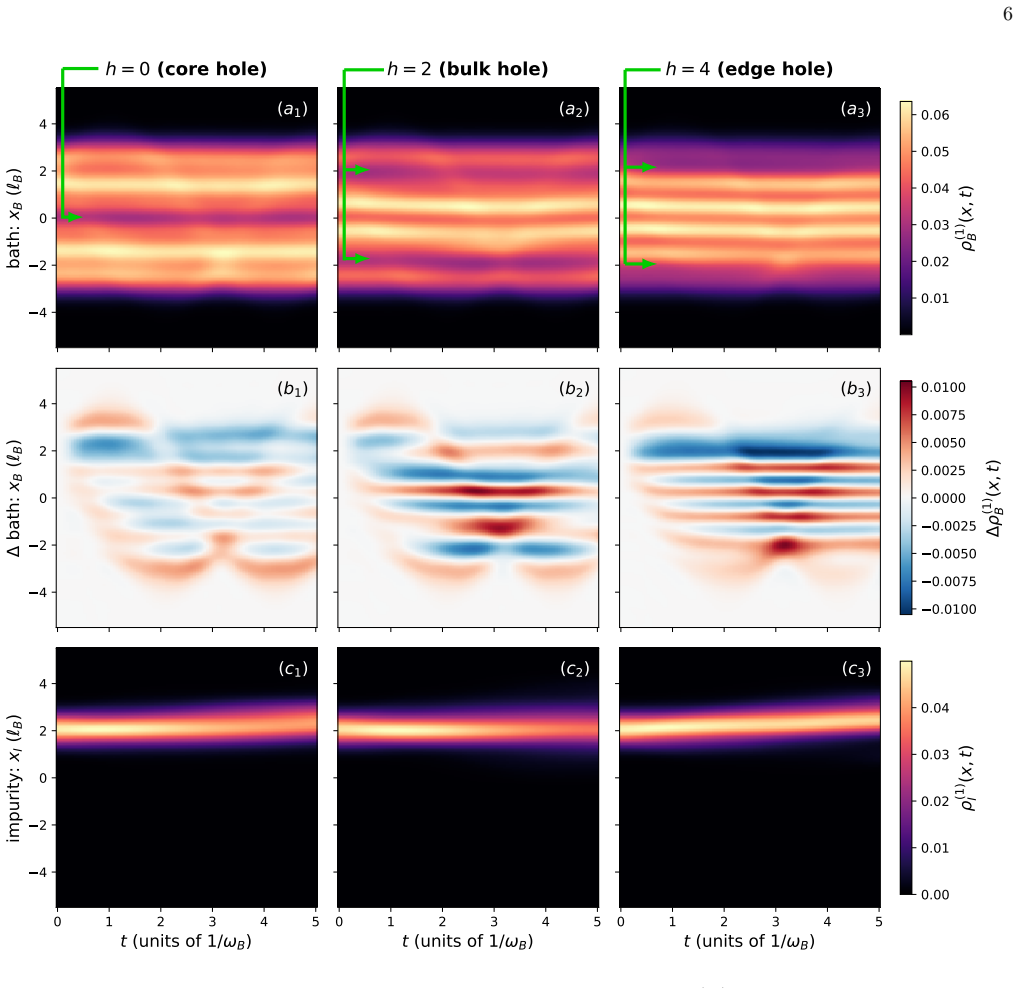
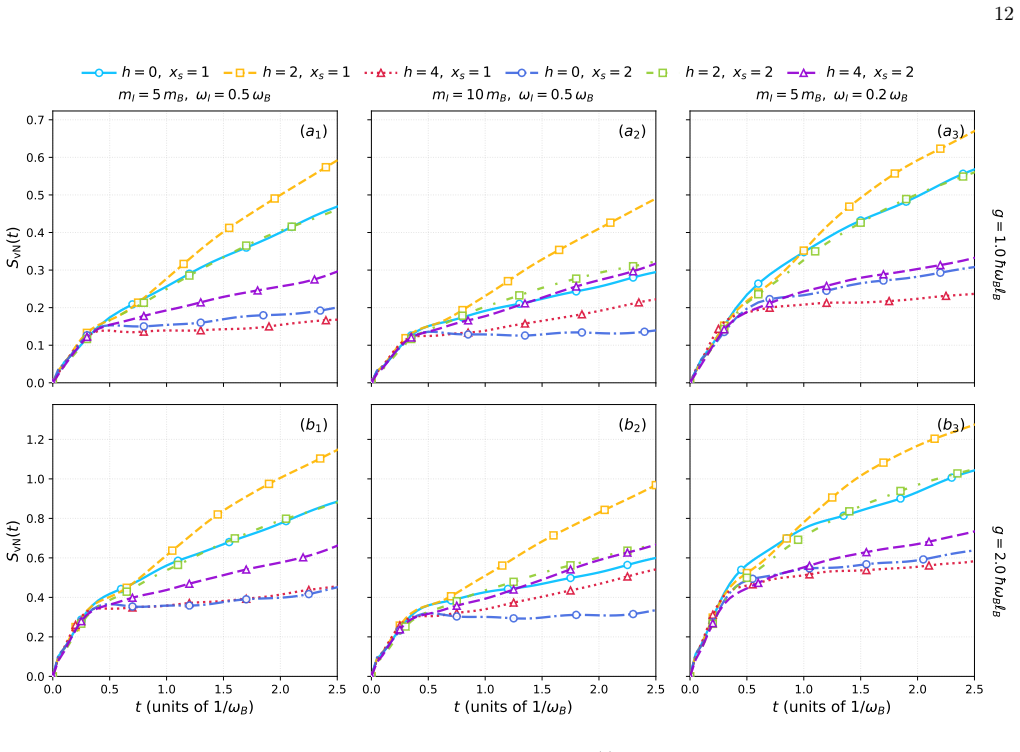
We show that the postquench response is governed by the interaction strength, impurity confinement, mass imbalance, and the location of the initially prepared hole within the Fermi sea. The density evolution and impurity center-of-mass motion reveal a competition between mixing and demixing of impurity and bath, while the von Neumann entropy demonstrates the buildup of pronounced many-body correlations. Most importantly, the occupation dynamics of the initially emptied orbital identifies deep core holes as substantially more robust against refilling than bulk or edge vacancies.
What carries the argument
The time-dependent occupation of the initially emptied single-particle orbital, which directly measures the rate at which the core hole refills after the interaction quench.
If this is right
- The postquench response depends on interaction strength, impurity confinement, mass imbalance, and initial hole position inside the Fermi sea.
- Impurity and bath densities exhibit a competition between mixing and demixing after the quench.
- Many-body correlations grow steadily, as tracked by the von Neumann entropy.
- Core-hole excitations remain robust dynamical features rather than rapidly filling in.
Where Pith is reading between the lines
- The slower refilling of deep holes could enable time-resolved observation of the orthogonality response in ultracold-atom setups.
- Similar robustness may appear when the system size is increased or the trapping potential is changed, offering a testable extension.
- The same hole-tracking approach could be applied to bosonic baths or multi-impurity configurations to compare correlation buildup across statistics.
Load-bearing premise
The two numerical methods capture the full many-body quantum dynamics for the chosen few-body parameters without important truncation or convergence errors.
What would settle it
A measurement of the time-dependent occupation number of the initially empty orbital in an ultracold one-dimensional Fermi gas experiment, showing whether deep holes refill more slowly than shallow ones.
Figures






read the original abstract
We investigate the nonequilibrium dynamics of core-hole excitations in a one-dimensional fermionic few-body system consisting of a spin-polarized Fermi bath coupled to a single heavy mobile impurity. The bath is initially prepared in a particle-hole configuration by emptying a selected bath single-particle orbital, while the impurity is displaced with respect to the center of the bath confinement potential. The quench dynamics are initialized by suddenly switching on the impurity-bath interaction. To resolve the resulting dynamics, we combine two complementary \textit{ab initio} approaches, namely the Multi-Layer Multi-Configuration Time-Dependent Hartree method for mixtures and a multi-channel Born-Oppenheimer framework. We show that the postquench response is governed by the interaction strength, impurity confinement, mass imbalance, and the location of the initially prepared hole within the Fermi sea. The density evolution and impurity center-of-mass motion reveal a competition between mixing and demixing of impurity and bath, while the von Neumann entropy demonstrates the buildup of pronounced many-body correlations. Most importantly, the occupation dynamics of the initially emptied orbital identifies deep core holes as substantially more robust against refilling than bulk or edge vacancies. Our results establish core-hole excitations as robust dynamical many-body features in trapped ultracold fermions and provide a controlled route towards probing orthogonality response, correlation buildup, and hole refilling in real time.
Editorial analysis
A structured set of objections, weighed in public.
Referee Report
Summary. The manuscript investigates the nonequilibrium dynamics of core-hole excitations in a one-dimensional ultracold fermionic few-body system consisting of a spin-polarized Fermi bath coupled to a single heavy mobile impurity. The bath is prepared in a particle-hole configuration by emptying a selected single-particle orbital, with the impurity displaced from the trap center. Upon suddenly switching on the impurity-bath interaction, the quench dynamics are simulated using two complementary ab initio methods: the Multi-Layer Multi-Configuration Time-Dependent Hartree method for mixtures (ML-MCTDH-X) and a multi-channel Born-Oppenheimer framework. The analysis covers density evolution, impurity center-of-mass motion, von Neumann entropy buildup, and occupation dynamics of the initially emptied orbital, with the central result that deep core holes are substantially more robust against refilling than bulk or edge vacancies, depending on interaction strength, impurity confinement, mass imbalance, and hole location within the Fermi sea.
Significance. If the numerical findings are reliable, the work provides a controlled theoretical route to probing real-time orthogonality response, many-body correlation buildup, and hole refilling in trapped ultracold fermions. The dual ab initio approach is a strength for few-body systems, and the identification of robust core-hole features could inform experimental designs in quantum gases. The results are internally consistent with direct numerical solution of the time-dependent many-body problem and avoid circular reasoning.
major comments (1)
- [Numerical Methods and Occupation Dynamics] The central claim that deep core holes are substantially more robust against refilling (abstract and occupation dynamics section) rests on the post-quench occupation of the initially emptied orbital. The manuscript does not report explicit convergence tests for the ML-MCTDH-X expansion (number of layers and single-particle functions) or the multi-channel Born-Oppenheimer expansion (number of channels) with respect to this observable for different hole positions. Different hole locations couple to different parts of the single-particle spectrum and impurity-induced mixing, so truncation errors could distort refilling rates in a position-dependent manner; doubling the basis size and monitoring long-time occupation would be required to confirm the robustness distinction.
minor comments (1)
- [Abstract] The abstract refers to the methods as 'complementary ab initio approaches' without any mention of basis sizes, truncation parameters, or error estimates, which would improve clarity for readers assessing the reliability of the reported dynamics.
Simulated Author's Rebuttal
We thank the referee for the careful reading of our manuscript and the constructive comment on numerical convergence. We address the point below and will revise the manuscript accordingly.
read point-by-point responses
-
Referee: [Numerical Methods and Occupation Dynamics] The central claim that deep core holes are substantially more robust against refilling (abstract and occupation dynamics section) rests on the post-quench occupation of the initially emptied orbital. The manuscript does not report explicit convergence tests for the ML-MCTDH-X expansion (number of layers and single-particle functions) or the multi-channel Born-Oppenheimer expansion (number of channels) with respect to this observable for different hole positions. Different hole locations couple to different parts of the single-particle spectrum and impurity-induced mixing, so truncation errors could distort refilling rates in a position-dependent manner; doubling the basis size and monitoring long-time occupation would be required to confirm the robustness distinction.
Authors: We agree that explicit convergence tests with respect to the occupation dynamics are necessary to fully substantiate the position-dependent robustness claim. While the manuscript relies on the quantitative agreement between the two independent ab initio methods (ML-MCTDH-X and multi-channel Born-Oppenheimer) as a cross-validation, we acknowledge that dedicated basis-size scans for the long-time occupation of the emptied orbital at different hole locations were not reported. We have performed additional calculations in which the number of single-particle functions in ML-MCTDH-X was doubled and the number of channels in the Born-Oppenheimer expansion was increased, monitoring the occupation up to long times for representative deep, bulk, and edge holes. These tests show that the reported distinction in refilling rates remains stable, with relative changes in the long-time occupations below 8 %. We will add a new appendix containing these convergence tests, including tables and figures of occupation versus basis size for each hole position, in the revised manuscript. revision: yes
Circularity Check
No circularity: results from direct numerical solution of TD many-body Schrödinger equation
full rationale
The paper computes post-quench occupation dynamics by numerically solving the time-dependent many-body problem for a specified Hamiltonian and initial particle-hole state using two independent ab initio methods (ML-MCTDH-X and multi-channel Born-Oppenheimer). No parameters are fitted to data and then relabeled as predictions; no self-definitional relations appear in the equations; no load-bearing self-citations or uniqueness theorems imported from prior author work are invoked to force the central claim. The reported robustness of deep core holes is an output of the simulation, not an input by construction. The derivation chain is self-contained.
Axiom & Free-Parameter Ledger
axioms (1)
- standard math The time-dependent many-body Schrödinger equation governs the quantum dynamics of the impurity-bath system.
Reference graph
Works this paper leans on
-
[1]
(B5) This shows that the one-body density matrix con- tains contributions from overlaps between bath states ⟨Ψj,B(x1)|Ψk,B(x2)⟩, weighted by the corresponding im- purity amplitudes
Impurity one-body density matrix In this formalism, the one-body density matrix of the impurity is defined as ρ(1) I (x1, x2;t) =⟨Ψ(t)| ˆΨ† I(x1) ˆΨI(x2)|Ψ(t)⟩,(B4) 16 which after some straightforward fermionic anti- commutation algebra reads ρ(1) I (x1, x2;t) = MX j,k=1 Ψ∗ j,I(x1;t)Ψ k,I(x2;t) × ⟨Ψj,B(x1)|Ψk,B(x2)⟩. (B5) This shows that the one-body dens...
-
[2]
Projectors onto Born-Oppenheimer channels To derive the probability of occupying a certain PEC curvej, we introduce the projector ˆPj = Z dxI |Ψj(xI)⟩⟨Ψj(xI)|,(B7) where|Ψ j(xI)⟩are defined as |Ψj(xI)⟩= ˆΨ† I(xI)|0I ⟩ ⊗ |Ψj,B(xI)⟩.(B8) This projector resolves the many-body state onto the j-th Born-Oppenheimer channel, integrated over all impurity position...
-
[3]
Auger, J
P. Auger, J. Phys. Radium6, 65 (1925)
1925
-
[4]
Feifel and M
R. Feifel and M. N. Piancastelli, J. Electron Spectrosc. Relat. Phenom.183, 10 (2011)
2011
-
[5]
Tashiro, K
M. Tashiro, K. Ueda, and M. Ehara, J. Chem. Phys.135, 154307 (2011)
2011
-
[6]
J. H. D. Eland, M. Tashiro, P. Linusson, M. Ehara, K. Ueda, and R. Feifel, Phys. Rev. Lett.105, 213005 (2010)
2010
-
[7]
L. S. Cederbaum, J. Zobeley, and F. Tarantelli, Phys. Rev. Lett.79, 4778 (1997)
1997
-
[8]
Hergenhahn, J
U. Hergenhahn, J. Electron Spectrosc. Relat. Phenom. 184, 78 (2011)
2011
-
[9]
Jahnke, U
T. Jahnke, U. Hergenhahn, B. Winter, R. Dörner, U. Frühling, P. V. Demekhin, K. Gokhberg, L. S. Ceder- baum, A. Ehresmann, A. Knie, and A. Dreuw, Chem. Rev.120, 11295 (2020)
2020
-
[10]
G. D. Mahan, Phys. Rev.163, 612 (1967)
1967
-
[11]
P. W. Anderson, Phys. Rev. Lett.18, 1049 (1967)
1967
-
[12]
Nozières and C
P. Nozières and C. T. De Dominicis, Phys. Rev.178, 1097 (1969)
1969
-
[13]
Ohtaka and Y
K. Ohtaka and Y. Tanabe, Rev. Mod. Phys.62, 929 (1990)
1990
-
[14]
Goold, T
J. Goold, T. Fogarty, N. Lo Gullo, M. Paternostro, and T. Busch, Phys. Rev. A84, 063632 (2011)
2011
-
[15]
M. Knap, A. Shashi, Y. Nishida, A. Imambekov, D. A. Abanin, and E. Demler, Phys. Rev. X2, 041020 (2012)
2012
-
[16]
Sindona, J
A. Sindona, J. Goold, N. Lo Gullo, S. Lorenzo, and F. Plastina, Phys. Rev. Lett.111, 165303 (2013)
2013
-
[17]
Cetina, M
M. Cetina, M. Jag, R. S. Lous, J. T. M. Walraven, R. Grimm, R. S. Christensen, and G. M. Bruun, Phys. Rev. Lett.115, 135302 (2015)
2015
-
[18]
Cetina, M
M. Cetina, M. Jag, R. S. Lous, I. Fritsche, J. T. M. Wal- raven, R. Grimm, J. Levinsen, M. M. Parish, R. Schmidt, M. Knap, and E. Demler, Science354, 96 (2016)
2016
-
[19]
Massignan, M
P. Massignan, M. Zaccanti, and G. M. Bruun, Rep. Prog. Phys.77, 034401 (2014)
2014
-
[20]
Demler, Rep
R.Schmidt, M.Knap, D.A.Ivanov, J.-S.You, M.Cetina, and E. Demler, Rep. Prog. Phys.81, 024401 (2018)
2018
-
[21]
Sowiński and M
T. Sowiński and M. Á. García-March, Rep. Prog. Phys. 82, 104401 (2019)
2019
-
[22]
Taglieber, A.-C
M. Taglieber, A.-C. Voigt, T. Aoki, T. W. Hänsch, and K. Dieckmann, Phys. Rev. Lett.100, 010401 (2008)
2008
-
[23]
T. G. Tiecke, M. R. Goosen, A. Ludewig, S. D. Gense- mer, S. Kraft, S. J. J. M. F. Kokkelmans, and J. T. M. Walraven, Phys. Rev. Lett.104, 053202 (2010)
2010
-
[24]
Ciamei, S
A. Ciamei, S. Finelli, A. Trenkwalder, M. Inguscio, A. Si- moni, and M. Zaccanti, Phys. Rev. Lett.129, 093402 (2022)
2022
-
[25]
Ciamei, S
A. Ciamei, S. Finelli, A. Cosco, M. Inguscio, A. Trenkwalder, and M. Zaccanti, Phys. Rev. A106, 053318 (2022)
2022
-
[26]
Silber, S
C. Silber, S. Günther, C. Marzok, B. Deh, P. W. 18 Courteille, and C. Zimmermann, Phys. Rev. Lett.95, 170408 (2005)
2005
-
[27]
B. Deh, C. Marzok, C. Zimmermann, and P. W. Courteille, Phys. Rev. A77, 010701 (2008)
2008
-
[28]
Ye, L.-Y
Z.-X. Ye, L.-Y. Xie, Z. Guo, X.-B. Ma, G.-R. Wang, L. You, and M. K. Tey, Phys. Rev. A102, 033307 (2020)
2020
-
[29]
Weitenberg, M
C. Weitenberg, M. Endres, J. F. Sherson, M. Cheneau, P. Schauß, T. Fukuhara, I. Bloch, and S. Kuhr, Nature 471, 319 (2011)
2011
-
[30]
Haller, J
E. Haller, J. Hudson, A. Kelly, D. A. Cotta, B. Peaude- cerf, G.D.Bruce,andS.Kuhr,Nat.Phys.11,738(2015)
2015
-
[31]
L. W. Cheuk, M. A. Nichols, K. R. Lawrence, M. Okan, H. Zhang, E. Khatami, N. Trivedi, T. Paiva, M. Rigol, and M. W. Zwierlein, Phys. Rev. Lett.114, 193001 (2015)
2015
-
[32]
Endres, H
M. Endres, H. Bernien, A. Keesling, H. Levine, E. R. Anschuetz, A. Krajenbrink, C. Senko, V. Vuletić, M. Greiner, and M. D. Lukin, Science354, 1024 (2016)
2016
-
[33]
Olshanii, Phys
M. Olshanii, Phys. Rev. Lett.81, 938 (1998)
1998
-
[34]
Bergeman, M
T. Bergeman, M. G. Moore, and M. Olshanii, Phys. Rev. Lett.91, 163201 (2003)
2003
-
[35]
C. Chin, R. Grimm, P. Julienne, and E. Tiesinga, Rev. Mod. Phys.82, 1225 (2010)
2010
-
[36]
Becker, G
A. Becker, G. M. Koutentakis, and P. Schmelcher, Phys. Rev. Res.6, 013257 (2024)
2024
-
[37]
Becker, G
A. Becker, G. M. Koutentakis, and P. Schmelcher, Phys. Rev. Res.7, 033088 (2025)
2025
-
[38]
Krönke, L
S. Krönke, L. Cao, O. Vendrell, and P. Schmelcher, New J. Phys.15, 063018 (2013)
2013
-
[39]
L. Cao, S. Krönke, O. Vendrell, and P. Schmelcher, J. Chem. Phys.139, 134103 (2013)
2013
-
[40]
L. Cao, V. Bolsinger, S. I. Mistakidis, G. M. Koutentakis, S. Krönke, J. M. Schurer, and P. Schmelcher, J. Chem. Phys.147, 044106 (2017)
2017
-
[41]
Born and R
M. Born and R. Oppenheimer, Ann. Phys.389, 457 (1927)
1927
-
[42]
P. A. M. Dirac, Proc. Cambridge Philos. Soc.26, 361 (1930)
1930
-
[43]
Frenkel,Wave Mechanics, Advanced General Theory, Vol
J. Frenkel,Wave Mechanics, Advanced General Theory, Vol. 1 (Oxford University Press, 1934)
1934
discussion (0)
Sign in with ORCID, Apple, or X to comment. Anyone can read and Pith papers without signing in.