Recognition: unknown
Weyl anomaly induced transport in hydrodynamics
Pith reviewed 2026-05-08 05:40 UTC · model grok-4.3
The pith
The Weyl trace anomaly produces a new non-dissipative vector current in accelerated relativistic fluids by fixing a second-order transport coefficient for electromagnetic coupling to acceleration.
A machine-rendered reading of the paper's core claim, the machinery that carries it, and where it could break.
Core claim
The Weyl (trace) anomaly gives rise to a new non-dissipative vector current in accelerated relativistic fluids. The anomaly uniquely fixes the second-order transport coefficient governing the coupling between the electromagnetic field and the fluid acceleration. This is derived by extending hydrodynamic anomaly matching to include the trace anomaly and reproduced by treating the Rindler horizon of an accelerated observer as an effective boundary, where the electric- and magnetic-field sectors correspond to screening and vacuum magnetization effects near the boundary.
What carries the argument
The extension of hydrodynamic anomaly matching to the trace anomaly, which determines the transport coefficient for the coupling of electromagnetic fields to fluid acceleration.
If this is right
- In the local rest frame the electric-field contribution induces an additional charge density.
- The magnetic-field contribution generates a transverse current with a Nernst-like, more generally thermomagnetic Hall-like, tensor structure.
- The transport is non-dissipative and belongs to a new class of anomaly-induced effects governed by the trace anomaly.
- The coefficient is uniquely determined with no free parameters at second order.
Where Pith is reading between the lines
- The boundary calculation implies that horizon-like effects can constrain flat-space transport coefficients even when curvature is absent.
- The result provides a consistency check for hydrodynamic descriptions of systems where acceleration and electromagnetic fields coexist.
- Extensions to non-conformal fluids would require additional coefficients that the pure trace anomaly cannot fix.
Load-bearing premise
The standard hydrodynamic anomaly-matching procedure can be extended to the trace anomaly without introducing new undetermined coefficients or violating consistency conditions, and the Rindler-horizon boundary treatment faithfully reproduces the local transport in flat-space accelerated frames.
What would settle it
A measurement or numerical simulation of the induced charge density from an electric field or the transverse current from a magnetic field in an accelerated relativistic fluid, checking whether the magnitude matches the coefficient fixed solely by the Weyl anomaly.
Figures

read the original abstract
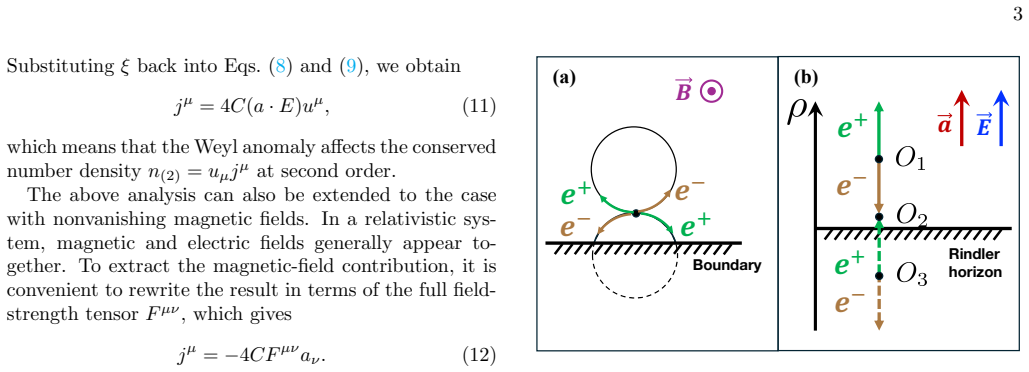
We show that the Weyl (trace) anomaly gives rise to a new non-dissipative vector current in accelerated relativistic fluids. The anomaly uniquely fixes the second-order transport coefficient governing the coupling between the electromagnetic field and the fluid acceleration. We derive this result by extending hydrodynamic anomaly matching to include the trace anomaly, and independently reproduce it in boundary quantum field theory by treating the Rindler horizon of an accelerated observer as an effective boundary. From the boundary perspective, the electric- and magnetic-field sectors correspond to screening and vacuum magnetization effects near the boundary. In the local rest frame, the electric-field contribution induces an additional charge density, while the magnetic-field contribution generates a transverse current with a Nernst-like, more generally thermomagnetic Hall-like, tensor structure. Our results reveal a new class of anomaly-induced transport governed by the trace anomaly.
Editorial analysis
A structured set of objections, weighed in public.
Referee Report
Summary. The paper claims that the Weyl (trace) anomaly induces a new non-dissipative vector current in accelerated relativistic fluids. The anomaly uniquely fixes the second-order transport coefficient for the coupling between the electromagnetic field and fluid acceleration. This is obtained by extending hydrodynamic anomaly matching to the trace anomaly and independently reproduced in a boundary QFT calculation by treating the Rindler horizon as an effective boundary. In the local rest frame, the electric-field sector induces additional charge density while the magnetic-field sector generates a transverse current with Nernst-like (thermomagnetic Hall) tensor structure.
Significance. If the result holds, the work identifies a new class of anomaly-induced transport governed by the trace anomaly (rather than chiral anomalies), with possible relevance to accelerated relativistic fluids in heavy-ion collisions or astrophysical settings. The dual derivation via anomaly matching and boundary QFT is a strength, as is the claim that the coefficient is fixed without new free parameters. The physical interpretation in terms of screening and vacuum magnetization near the boundary is useful.
major comments (2)
- [§3] §3 (hydrodynamic anomaly matching): The central claim that the trace-anomaly extension fixes the second-order coefficient without new undetermined parameters or consistency violations requires the explicit constitutive relation for the vector current and the precise matching condition (e.g., the relevant Ward identity or conservation equation) that determines the coefficient. Without this, the uniqueness cannot be verified from the text.
- [§4] §4 (Rindler boundary QFT): The boundary construction reproduces the same local coefficient. The manuscript must explicitly demonstrate that non-local horizon contributions (Unruh temperature, redshift factors, entanglement entropy) decouple in the local hydrodynamic limit of flat-space accelerated frames; otherwise the agreement with the anomaly-matching result does not establish that the coefficient is purely local and trace-anomaly fixed.
minor comments (1)
- [Abstract and §2] The abstract and introduction refer to a 'Nernst-like, more generally thermomagnetic Hall-like, tensor structure' without giving the explicit tensor form of the current; this should be stated with indices in the main text near the constitutive relations.
Simulated Author's Rebuttal
We thank the referee for their careful reading of our manuscript and for the constructive comments. We appreciate the positive assessment of the potential significance of the Weyl anomaly-induced transport and the dual derivation approach. We address each major comment below and will incorporate clarifications in the revised version.
read point-by-point responses
-
Referee: [§3] §3 (hydrodynamic anomaly matching): The central claim that the trace-anomaly extension fixes the second-order coefficient without new undetermined parameters or consistency violations requires the explicit constitutive relation for the vector current and the precise matching condition (e.g., the relevant Ward identity or conservation equation) that determines the coefficient. Without this, the uniqueness cannot be verified from the text.
Authors: We agree that greater explicitness will aid verification. In the revised manuscript we will insert the explicit constitutive relation for the vector current, J^μ = (σ_E a^μ F_ν^λ u_λ + σ_B ε^μνρσ u_ν a_ρ B_σ) + O(∂^3), obtained by extending the hydrodynamic anomaly matching to the trace anomaly. The matching condition follows directly from the Ward identity ∇_μ T^μν = (anomaly term involving the Weyl tensor and electromagnetic invariants), which fixes the two second-order coefficients σ_E and σ_B without introducing new free parameters or violating conservation. This step-by-step derivation will be added to §3 to make the uniqueness manifest. revision: yes
-
Referee: [§4] §4 (Rindler boundary QFT): The boundary construction reproduces the same local coefficient. The manuscript must explicitly demonstrate that non-local horizon contributions (Unruh temperature, redshift factors, entanglement entropy) decouple in the local hydrodynamic limit of flat-space accelerated frames; otherwise the agreement with the anomaly-matching result does not establish that the coefficient is purely local and trace-anomaly fixed.
Authors: We thank the referee for highlighting this subtlety. In the revised §4 we will add an explicit decoupling argument: in the local hydrodynamic limit (wavelengths much shorter than the acceleration scale), the Unruh temperature is absorbed into the local fluid temperature T, redshift factors are removed by the choice of local inertial coordinates, and entanglement-entropy contributions appear only at non-local orders that vanish upon taking the flat-space limit while keeping the acceleration finite. With these terms shown to decouple, the boundary calculation reduces to a purely local, trace-anomaly-determined coefficient that matches the hydrodynamic result. revision: yes
Circularity Check
No circularity: derivation relies on independent standard methods
full rationale
The paper extends the established hydrodynamic anomaly-matching procedure to incorporate the trace anomaly and independently reproduces the result via boundary QFT treating the Rindler horizon as an effective boundary. Both steps are presented as applications of external, pre-existing techniques without self-definitional equations, fitted inputs renamed as predictions, or load-bearing self-citations that reduce the central coefficient to the paper's own inputs by construction. The abstract and description give no indication that the uniqueness or value of the transport coefficient is forced by prior author work or internal fitting; the result is therefore self-contained against external benchmarks.
Axiom & Free-Parameter Ledger
axioms (2)
- domain assumption Hydrodynamic anomaly matching extends consistently to the trace anomaly
- domain assumption Rindler horizon of an accelerated observer functions as an effective boundary in QFT
Reference graph
Works this paper leans on
-
[1]
Vilenkin, Phys
A. Vilenkin, Phys. Rev.D22, 3080 (1980)
1980
-
[2]
K. Fukushima, D. E. Kharzeev, and H. J. Warringa, Phys. Rev.D78, 074033 (2008), arXiv:0808.3382 [hep- ph]
work page Pith review arXiv 2008
- [3]
-
[4]
Kharzeev, K
D. Kharzeev, K. Landsteiner, A. Schmitt, and H.-U. Yee, Lect. Notes Phys.871, pp.1 (2013)
2013
-
[5]
Vilenkin, Phys
A. Vilenkin, Phys. Rev.D21, 2260 (1980)
1980
- [6]
-
[7]
K. Landsteiner, E. Megias, and F. Pena-Benitez, Phys. Rev. Lett.107, 021601 (2011), arXiv:1103.5006 [hep-ph]
- [8]
- [9]
- [10]
- [11]
- [12]
- [13]
-
[14]
M. Stone and J. Kim, Phys. Rev.D98, 025012 (2018), arXiv:1804.08668 [cond-mat.mes-hall]
-
[15]
S.-Z. Yang, J.-H. Gao, and Z.-T. Liang, Symmetry14, 948 (2022), arXiv:2203.14023 [hep-ph]
- [16]
-
[17]
S. Golkar and D. T. Son, JHEP02, 169 (2015), arXiv:1207.5806 [hep-th]
- [18]
- [19]
- [20]
- [21]
-
[22]
C.-S. Chu and R.-X. Miao, Phys. Rev. Lett.121, 251602 (2018), arXiv:1803.03068 [hep-th]
- [23]
- [24]
- [25]
- [26]
-
[27]
C.-S. Chu and R.-X. Miao, JHEP07, 005 (2018), arXiv:1804.01648 [hep-th]
-
[28]
C.-S. Chu, Fortsch. Phys.67, 1910005 (2019), arXiv:1903.02817 [hep-th]
-
[29]
S. R. De Groot,Relativistic Kinetic Theory. Principles and Applications, edited by W. A. Van Leeuwen and C. G. Van Weert (1980)
1980
-
[30]
Local thermodynamical equilibrium and the beta frame for a quantum relativistic fluid
F. Becattini, L. Bucciantini, E. Grossi, and L. Tinti, Eur. Phys. J. C75, 191 (2015), arXiv:1403.6265 [hep-th]
work page Pith review arXiv 2015
-
[31]
S.-Z. Yang, J.-H. Gao, and S. Pu, Phys. Rev. D111, 036013 (2025), arXiv:2409.00456 [hep-ph]
-
[32]
Israel and J
W. Israel and J. M. Stewart, Annals Phys.118, 341 (1979)
1979
- [33]
-
[34]
Deutsch and P
D. Deutsch and P. Candelas, Phys. Rev. D20, 3063 (1979)
1979
-
[35]
L. C. B. Crispino, A. Higuchi, and G. E. A. Matsas, Rev. Mod. Phys.80, 787 (2008), arXiv:0710.5373 [gr-qc]
work page Pith review arXiv 2008
-
[36]
W. G. Unruh, Phys. Rev.D14, 870 (1976)
1976
-
[37]
M. Parikh and F. Wilczek, Phys. Rev. D58, 064011 (1998), arXiv:gr-qc/9712077
-
[38]
J. S. Dowker, Phys. Rev.D36, 3742 (1987)
1987
-
[39]
Candelas and D
P. Candelas and D. Deutsch, Proc. Roy. Soc. Lond. A 362, 251 (1978)
1978
- [40]
-
[41]
A. V. Kavokin, B. L. Altshuler, S. G. Sharapov, P. S. Grigoryev, and A. A. Varlamov, Proceedings of the Na- 6 tional Academy of Sciences117, 2846 (2020)
2020
-
[42]
Ferreiros, A
Y. Ferreiros, A. A. Zyuzin, and J. H. Bardarson, Phys. Rev. B96, 115202 (2017)
2017
-
[43]
ichi Uchida and J
K. ichi Uchida and J. P. Heremans, Joule6, 2240 (2022)
2022
-
[44]
Sekine and N
A. Sekine and N. Nagaosa, Phys. Rev. B101, 155204 (2020)
2020
-
[45]
Event-by-event fluctuations of magnetic and electric fields in heavy ion collisions
A. Bzdak and V. Skokov, Phys. Lett. B710, 171 (2012), arXiv:1111.1949 [hep-ph]
work page Pith review arXiv 2012
-
[46]
Event-by-event generation of electromagnetic fields in heavy-ion collisions
W.-T. Deng and X.-G. Huang, Phys. Rev. C85, 044907 (2012), arXiv:1201.5108 [nucl-th]
work page Pith review arXiv 2012
- [47]
-
[48]
Global $\Lambda$ hyperon polarization in nuclear collisions: evidence for the most vortical fluid
L. Adamczyket al.(STAR), Nature548, 62 (2017), arXiv:1701.06657 [nucl-ex]
work page Pith review arXiv 2017
-
[49]
W.-T. Deng and X.-G. Huang, Phys. Rev. C93, 064907 (2016), arXiv:1603.06117 [nucl-th]
- [50]
- [51]
-
[52]
I. Karpenko and F. Becattini,Proceedings, 27th In- ternational Conference on Ultrarelativistic Nucleus- Nucleus Collisions (Quark Matter 2018): Venice, Italy, May 14-19, 2018, Nucl. Phys.A982, 519 (2019), arXiv:1811.00322 [nucl-th]. END MA TTER Mapping second-order hydrodynamics to the Weyl anomaly— From energy-momentum conservation, we ob- tain the set o...
discussion (0)
Sign in with ORCID, Apple, or X to comment. Anyone can read and Pith papers without signing in.