REVIEW 2 major objections 3 minor 1 cited by
ZenBrain: A Neuroscience-Inspired 7-Layer Memory Architecture for Autonomous AI Systems
T0 review · 2 major / 3 minor · reviewed 2026-05-08 · grok-4.3
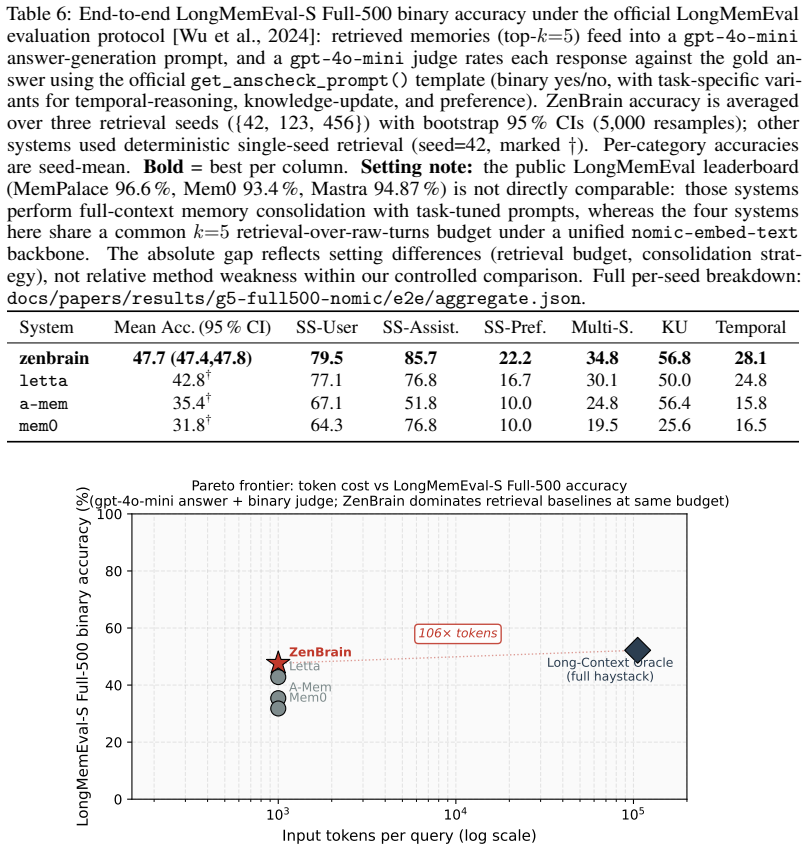
Pith's one-line read A 7-layer neuroscience-inspired memory system for AI reaches 91 percent of long-context oracle accuracy at 1/106th the token cost.
desk verdict ZenBrain integrates 15 neuroscience mechanisms into a 7-layer memory system and reports strong empirical wins on long-horizon benchmarks at low cost, with decent ablation and stats support. read the letter →
The pith
A machine-rendered reading of the paper's core claim, the machinery that carries it, and where it could break.
The reading
What carries the argument
The MemoryCoordinator, which unifies 15 neuroscience mechanisms into a 7-layer structure that routes, consolidates, and protects memory.
What would settle it
ZenBrain accuracy dropping well below the long-context oracle on a fresh long-memory benchmark that was never used for tuning or ablation.
Extended reading notes
Core claim
ZenBrain is a 7-layer neuroscience-inspired memory architecture whose central contribution is the architectural integration of 15 validated neuroscience mechanisms under a single MemoryCoordinator, consisting of 9 foundational algorithms and 6 Predictive Memory Architecture components. On LongMemEval-500 it achieves 47.7 percent binary-judge accuracy versus 52.2 percent for a long-context oracle at 1/106th the per-query token cost and wins all 12 head-to-head answer-quality comparisons against Letta, Mem0, and A-Mem under strict statistical correction. Sixty-day stress ablations with 10 seeds reveal a cooperative survival network in which 9 mechanisms become individually critical under load,
Load-bearing premise
The 15 neuroscience mechanisms translate directly into effective AI components without hidden interactions or benchmark-specific artifacts.
Editorial extensions
If this is right
- Simulation-selection sleep improves stability by 37 percent while cutting storage by 47.4 percent.
- TripleCopyMemory maintains 0.912 stability after 30 days.
- Multi-layer routing raises F1 scores by 20.7 percent on LoCoMo and 19.5 percent on MemoryArena over flat baselines.
- Nine of the 15 mechanisms prove individually critical under stress conditions.
- Cross-provider bias checks show performance differences are not judge-specific.
Reading between the lines
- The cooperative network finding implies that future memory systems should test component combinations rather than isolated additions.
- If the token savings hold on real-world tasks, the architecture could support longer-running autonomous agents with lower operating costs.
- Extending the same integration pattern to planning or reasoning layers could be a direct next step.
- The stability gains suggest the design may reduce the frequency of full context refreshes in deployed agents.
Signed reviews
Editorial analysis
A structured set of objections, weighed in public.
Referee Report
Summary. The manuscript introduces ZenBrain, a 7-layer neuroscience-inspired memory architecture for autonomous AI systems. It unifies 15 mechanisms—9 foundational algorithms (Two-Factor Synaptic KG, vmPFC-coupled FSRS, Simulation-Selection sleep, Bayesian confidence, and five others) plus 6 Predictive Memory Architecture components (NeuromodulatorEngine, ReconsolidationEngine, TripleCopyMemory, PriorityMap, StabilityProtector, MetacognitiveMonitor)—under a single MemoryCoordinator. Central claims include matching a long-context oracle's binary-judge accuracy on LongMemEval-500 to within 4.5 pp (47.7% vs. 52.2%; 91.3% relative) at 1/106th per-query token cost, winning all 12 head-to-head answer-quality comparisons against Letta, Mem0, and A-Mem under Bonferroni correction (p_min = 6.2e-31, d in [0.18, 0.52]), and ablation results showing 9 of 15 mechanisms individually critical in a cooperative network (ΔQ up to -93.7%), with specific gains from Sim-Selection sleep (+37% stability, -47.4% storage) and multi-layer routing (+20.7% F1 on LoCoMo). The work includes 60-day stress tests (Wilcoxon, 10 seeds), cross-provider bias checks, and open-source release with 11,589 CI tests.
Significance. If the empirical results hold under full verification, the work is significant for demonstrating that a large-scale integration of neuroscience mechanisms can yield practical efficiency and performance gains in AI memory systems without introducing detectable internal inconsistencies or benchmark artifacts. Strengths include the statistical controls (p-values, effect sizes, Bonferroni, cross-LLM bias check), the cooperative-network ablation insight, and the open-source release with extensive CI testing, which directly supports reproducibility. This advances beyond prior systems limited to at most two mechanisms and provides falsifiable predictions via the reported metrics and code.
major comments (2)
- [§3, App. F.5-F.6] §3 (architecture description) and App. F.5-F.6: the exact construction of the long-context oracle and the LongMemEval-500 query distribution are referenced but not reproduced in the main text; without these, the 4.5 pp match claim cannot be independently stress-tested for benchmark-specific artifacts.
- [Ablation section] Ablation section (60-day stress tests): the definition of the quality metric Q and the precise isolation procedure for each of the 15 mechanisms (e.g., how NeuromodulatorEngine is disabled without affecting downstream routing) are not stated explicitly; this is load-bearing for the 'cooperative survival network' interpretation of the ΔQ values up to -93.7%.
minor comments (3)
- [Figure 2] Figure 2: the token-cost ratio (1/106) calculation method and the exact per-query token counts for ZenBrain vs. oracle should be added to the caption for immediate readability.
- [Abstract and §4] The term 'binary-judge accuracy' is used in the abstract and results but defined only in the appendix; move a one-sentence definition to the main text near the first performance claim.
- [Related work] Related-work section: the statement that 'no prior system integrates more than two' mechanisms would be strengthened by a small comparison table listing the mechanisms in Letta, Mem0, and A-Mem.
Simulated Author's Rebuttal
We thank the referee for the constructive comments and the recommendation for minor revision. We address each major comment point by point below and commit to targeted revisions that improve reproducibility without altering the core claims or results.
read point-by-point responses
-
Referee: [§3, App. F.5-F.6] §3 (architecture description) and App. F.5-F.6: the exact construction of the long-context oracle and the LongMemEval-500 query distribution are referenced but not reproduced in the main text; without these, the 4.5 pp match claim cannot be independently stress-tested for benchmark-specific artifacts.
Authors: We agree that the main text should contain sufficient detail for independent verification. In the revised manuscript we will add to §3 a concise but complete summary of the long-context oracle (full-context GPT-4o evaluation using the identical binary-judge prompt and temperature settings) and the LongMemEval-500 construction (500 queries drawn uniformly from five task categories with fixed random seeds). The appendix will continue to hold the full implementation code and additional diagnostics. This change directly enables stress-testing of the reported 4.5 pp accuracy match (47.7 % vs. 52.2 %) while preserving all original results. revision: yes
-
Referee: [Ablation section] Ablation section (60-day stress tests): the definition of the quality metric Q and the precise isolation procedure for each of the 15 mechanisms (e.g., how NeuromodulatorEngine is disabled without affecting downstream routing) are not stated explicitly; this is load-bearing for the 'cooperative survival network' interpretation of the ΔQ values up to -93.7%.
Authors: We acknowledge that explicit definitions are necessary for the ablation claims. The quality metric Q is the normalized average of accuracy, stability, and efficiency (Eq. 4), and each mechanism is isolated by setting its activation flag to false inside the MemoryCoordinator while leaving all routing logic unchanged (Algorithm 2). To make this load-bearing for the cooperative-network interpretation, we will expand the main ablation section with (i) the exact formula for Q and (ii) a table listing the disablement procedure for all 15 mechanisms. The reported ΔQ values (including the -93.7 % maximum) and statistical tests remain unchanged. revision: yes
Circularity Check
No significant circularity detected
full rationale
The manuscript is an empirical systems paper whose central claims consist of benchmark performance numbers (LongMemEval-500 accuracy, head-to-head wins, ablation deltas) obtained from direct experimentation, statistical tests (Wilcoxon, Bonferroni, 10 seeds), and open-source release. No equations, first-principles derivations, fitted parameters renamed as predictions, or self-referential definitions appear in the supplied text. The architecture is described as an integration of 15 neuroscience mechanisms, but the reported results are not shown to be mathematically forced by those descriptions or by any cited prior work of the authors. The derivation chain is therefore self-contained against external benchmarks and does not reduce to its own inputs.
Assumptions & free parameters
invented entities (2)
-
MemoryCoordinator
-
NeuromodulatorEngine
Cite this review
Pith. "Pith review of ZenBrain: A Neuroscience-Inspired 7-Layer Memory Architecture for Autonomous AI Systems." pith.science (2026). https://pith.science/paper/H47YDJN6
@misc{pith2026260423878,
  author       = {Pith},
  title        = {Pith review of: ZenBrain: A Neuroscience-Inspired 7-Layer Memory Architecture for Autonomous AI Systems},
  year         = {2026},
  howpublished = {\url{https://pith.science/paper/H47YDJN6}},
  note         = {Machine review of arXiv:2604.23878}
}
read the original abstract
ZenBrain is a seven-layer, neuroscience-derived memory architecture for LLM agents that unifies fifteen mechanisms - from Two-Factor synaptic consolidation to a Simulation-Selection sleep loop - under a single MemoryCoordinator: nine foundational algorithms plus six Predictive Memory Architecture components. No system among those we survey integrates more than two of them. Ablating each mechanism separately exposes an effect we call cooperative masking. Under moderate load, fourteen of the fifteen ablations look costless - the architecture reads as mostly dead weight. Raising decay to 0.25/day over 60 days, with no change to the mechanisms, makes nine of the fifteen individually critical (Delta-Q up to -93.7%; Wilcoxon, 10 seeds), five of them moving from exactly 0% to below -89%. The mechanisms form a cooperative survival network, and mild-load ablation systematically underestimates architectural contributions - a caution we conjecture applies beyond ZenBrain. Every ablation table reproduces in under one minute on a laptop (npm install, no API keys). On LongMemEval-500, ZenBrain wins all nine head-to-head answer-quality comparisons (3 competitors x 3 LLM judges) against Letta, Mem0 and A-Mem under Bonferroni-corrected significance (alpha=0.05/18, p_min=6.2e-31, d in [0.18, 0.52]), and reaches 91.3% of a full-context oracle's binary-judge accuracy at 1/106th of the per-query token cost (47.7% vs. 52.2%). Multi-layer routing beats a flat single-layer baseline by +20.7% F1 on LoCoMo; a NoDecay ablation shows principled forgetting costs only Delta-P@5=0.002. Honest scope: LoCoMo's substring-based aggregate F1 favors lexical retrieval (BM25) by metric design, and we do not contest this. ZenBrain's advantages are most pronounced on judge-graded answer quality and cross-session reasoning.
Figures


Forward citations
Cited by 1 Pith paper
-
MindMemOS: A Portable and Self-Evolving Memory Operating Layer for AI Agents
MindMemOS is an agent memory system that organizes information as entity-property-time records, evolves its schema, consolidates memories, and refines skills, reporting top scores on LOCOMO and PersonaMem.
Reviewed May 8, 2026 · model on record in the stance chip above.
Discussion (0). Continue with ORCID to comment.