Recognition: unknown
Development and Performance Study of Vertical GaN α-Particle Detector with High Energy Resolution
Pith reviewed 2026-05-07 17:37 UTC · model grok-4.3
The pith
Depletion-width nonuniformity causes the low-energy tail in GaN alpha-particle detectors
A machine-rendered reading of the paper's core claim, the machinery that carries it, and where it could break.
Core claim
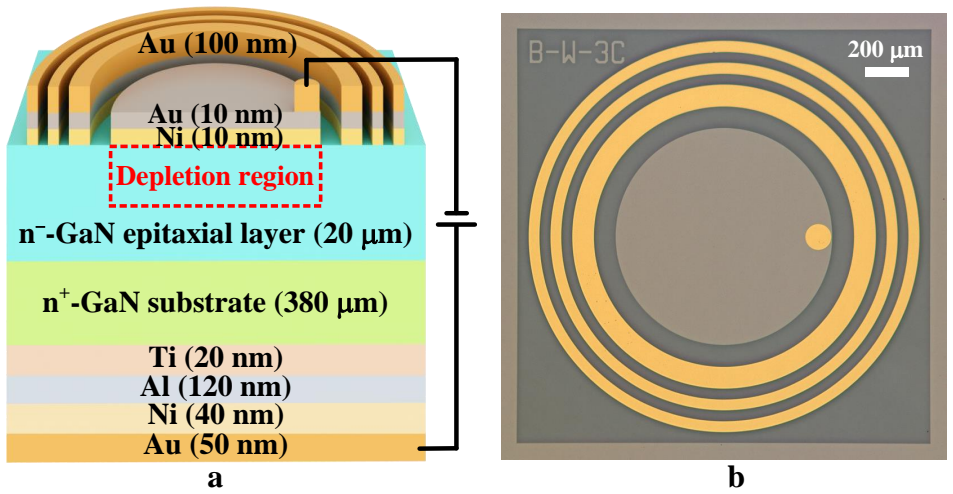
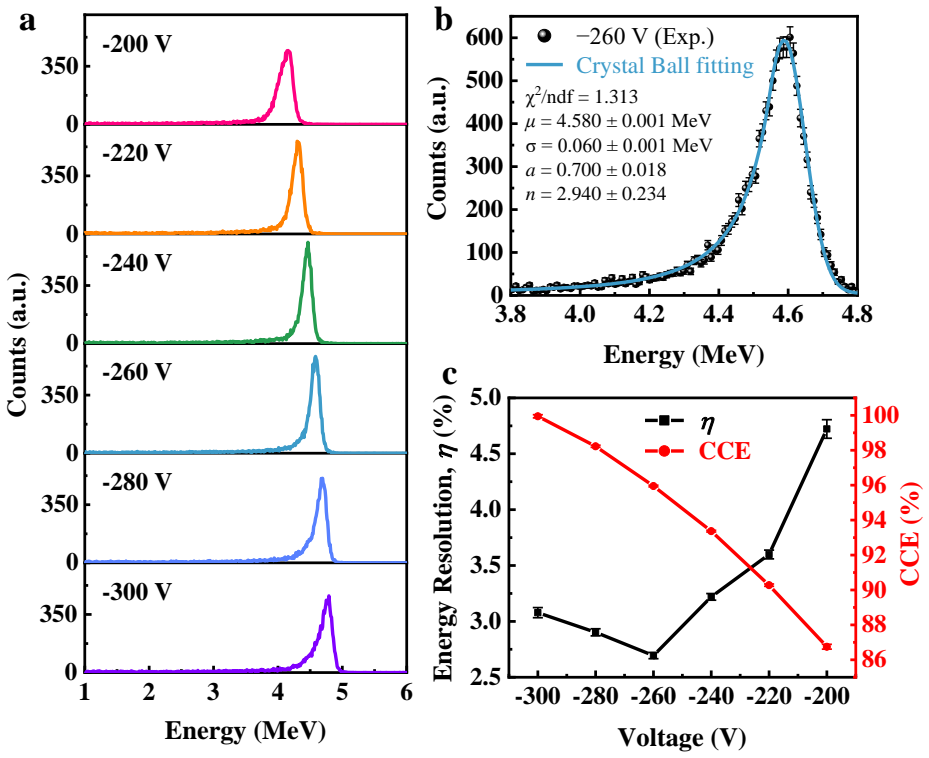
The authors fabricated a vertical homoepitaxial GaN alpha-particle detector with a 20-nm ultrathin dead layer and guard-ring structure. It shows an ultralow leakage current of 2.195 nA at -200 V, an intrinsic energy resolution of 2.69%, and a charge collection efficiency of 95.9% at -260 V. Geant4 simulations reveal that depletion-width nonuniformity is the dominant cause of partial energy leakage responsible for the extended low-energy tail in the energy spectrum. A depletion-width nonuniformity model is established that agrees well with experimental results.
What carries the argument
The depletion-width nonuniformity model built from Geant4 simulations, which shows how local variations in depletion thickness allow alpha particles to experience incomplete energy deposition and produce the low-energy tail.
Load-bearing premise
That the Geant4 simulation accurately reproduces the real electric-field profile inside the device and that depletion-width nonuniformity is the primary cause of the low-energy tail rather than surface effects, trapping, or other unmodeled factors.
What would settle it
Fabricating an otherwise identical GaN detector on a more uniform epitaxial layer and verifying that the low-energy tail disappears or shrinks substantially while resolution improves.
Figures




read the original abstract
High-energy-resolution GaN $\alpha$-particle detectors have significant potential for space radiation, nuclear instrumentation, and harsh-environment applications. However, existing GaN $\alpha$-particle detectors still face several key challenges, including reducing the dead-layer thickness, suppressing leakage current under high reverse bias, improving energy resolution, and clarifying the physical mechanism underlying the low-energy tail phenomenon. This study presents a vertical homoepitaxial GaN $\alpha$-particle detector integrating a 20-nm ultrathin dead layer and a guard-ring structure. The detector exhibits an ultralow leakage current of 2.195 nA at -200 V and an intrinsic energy resolution of 2.69% with a charge collection efficiency (CCE) of 95.9% at -260 V. More importantly, this work demonstrates for the first time through Geant4 simulations that depletion-width nonuniformity is the dominant source of partial energy leakage, leading to an extended low-energy tail in the energy spectrum. We establish a depletion-width nonuniformity model and observe good agreement between simulation and experiment. This finding provides practical guidance for the design and optimization of high-performance GaN-based radiation detectors.
Editorial analysis
A structured set of objections, weighed in public.
Referee Report
Summary. The paper reports fabrication of a vertical homoepitaxial GaN α-particle detector with a 20-nm dead layer and guard-ring structure. It achieves leakage current of 2.195 nA at -200 V, intrinsic energy resolution of 2.69%, and CCE of 95.9% at -260 V. Using Geant4, the authors claim to show for the first time that depletion-width nonuniformity is the dominant cause of the low-energy tail, with a model yielding good simulation-experiment agreement and offering design guidance.
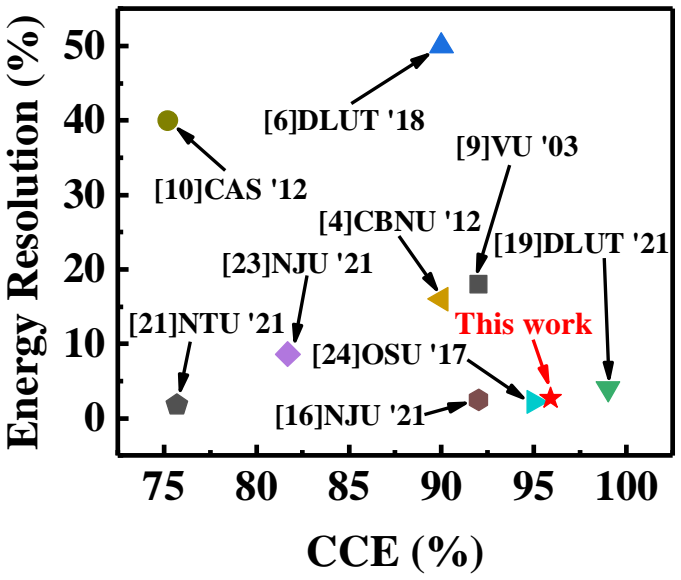
Significance. If the mechanism claim is robustly supported, the work would usefully identify a concrete optimization target for GaN detectors in space and nuclear applications. The reported leakage, resolution, and CCE values are competitive and provide a useful benchmark. The simulation-experiment comparison adds value only if the model parameters are independently constrained.
major comments (2)
- [§4.2] §4.2 (depletion-width nonuniformity model): The parameters are introduced to reproduce the observed low-energy tail and then shown to agree with experiment, but the text does not state that they were fixed a priori by independent measurements (e.g., C-V profiling or electric-field mapping). This creates a moderate circularity risk for the claim that nonuniformity is demonstrated as the dominant mechanism.
- [Results section] Results section: Competing mechanisms (carrier trapping, surface recombination, dead-layer variations) are not quantitatively compared or excluded, so the simulation agreement alone does not establish dominance of depletion-width nonuniformity.
minor comments (1)
- [Abstract] Abstract and §3: 'Intrinsic energy resolution' is stated without an explicit definition or reference to the FWHM calculation method used on the spectra.
Simulated Author's Rebuttal
We thank the referee for the constructive comments and positive evaluation of the work's significance. We address each major comment point by point below, with clear indications of planned revisions.
read point-by-point responses
-
Referee: [§4.2] §4.2 (depletion-width nonuniformity model): The parameters are introduced to reproduce the observed low-energy tail and then shown to agree with experiment, but the text does not state that they were fixed a priori by independent measurements (e.g., C-V profiling or electric-field mapping). This creates a moderate circularity risk for the claim that nonuniformity is demonstrated as the dominant mechanism.
Authors: We agree that the manuscript text should more explicitly describe the basis for the model parameters to avoid any appearance of circularity. The nonuniformity parameters were selected within physically reasonable bounds derived from the known homoepitaxial growth uniformity, device geometry, and supporting C-V measurements on comparable GaN structures. In the revised version, we will expand §4.2 with a new paragraph that states these constraints upfront, references the C-V data, and explains why the chosen values are not arbitrary fits. This clarification will reinforce that the simulation agreement supports the dominance claim without circular reasoning. revision: partial
-
Referee: [Results section] Results section: Competing mechanisms (carrier trapping, surface recombination, dead-layer variations) are not quantitatively compared or excluded, so the simulation agreement alone does not establish dominance of depletion-width nonuniformity.
Authors: The referee is correct that the current manuscript does not provide a quantitative side-by-side comparison of competing mechanisms. While the Geant4 model was constructed specifically around depletion-width nonuniformity and reproduces the observed tail shape and bias dependence, other effects were evaluated only qualitatively. In the revised Results section we will add an explicit discussion subsection that contrasts the expected signatures of carrier trapping (uniform CCE reduction), surface recombination (bias-independent losses), and dead-layer variations (different tail onset) against both the experimental spectra and the nonuniformity simulation. This will demonstrate why nonuniformity provides the superior match while acknowledging that full exclusion of alternatives may require further targeted measurements. revision: yes
Circularity Check
Depletion-width nonuniformity model parameters appear fitted to match observed low-energy tail rather than independently constrained
specific steps
-
fitted input called prediction
[Geant4 simulation and depletion-width nonuniformity model (abstract and results sections)]
"this work demonstrates for the first time through Geant4 simulations that depletion-width nonuniformity is the dominant source of partial energy leakage, leading to an extended low-energy tail in the energy spectrum. We establish a depletion-width nonuniformity model and observe good agreement between simulation and experiment."
The nonuniformity model is introduced to account for the experimentally observed low-energy tail; parameters are adjusted until simulation matches the spectral shape. Without a priori constraints on those parameters from separate measurements (e.g., capacitance-voltage profiling of depletion width variation), the reported agreement is statistically forced by the fitting step and does not constitute an independent validation of the physical mechanism.
full rationale
The paper's central claim is that Geant4 simulations establish depletion-width nonuniformity as the dominant cause of the low-energy tail, with good agreement to experiment. However, the provided abstract and reader's analysis indicate the nonuniformity model is constructed specifically to reproduce the tail, without explicit independent validation of its parameters (e.g., via C-V profiling or direct field mapping). This matches the 'fitted input called prediction' pattern: the simulation reproduces the data by design of the model inputs, reducing the claimed 'demonstration' to a consistency check rather than an independent prediction. No other circular steps (self-citation chains, self-definitional equations, or ansatz smuggling) are evident from the given text. The derivation remains partially self-contained via the experimental spectra and basic device metrics, justifying a moderate score rather than high circularity.
Axiom & Free-Parameter Ledger
free parameters (1)
- depletion-width nonuniformity parameters
axioms (1)
- domain assumption Geant4 Monte Carlo simulation accurately models alpha-particle energy deposition and the device's internal electric field distribution.
Reference graph
Works this paper leans on
-
[1]
merlin.mbs aapmrev4-1.bst 2010-07-25 4.21a (PWD, AO, DPC) hacked
FUNCTION id.bst "merlin.mbs aapmrev4-1.bst 2010-07-25 4.21a (PWD, AO, DPC) hacked" ENTRY address archive archivePrefix author bookaddress booktitle chapter collaboration doi edition editor eid eprint howpublished institution isbn issn journal key language month note number organization pages primaryClass publisher school SLACcitation series title translat...
2010
-
[2]
merlin.mbs aipauth4-1.bst 2010-07-25 4.21a (PWD, AO, DPC) hacked
FUNCTION id.bst "merlin.mbs aipauth4-1.bst 2010-07-25 4.21a (PWD, AO, DPC) hacked" ENTRY address archive archivePrefix author bookaddress booktitle chapter collaboration doi edition editor eid eprint howpublished institution isbn issn journal key language month note number organization pages primaryClass publisher school SLACcitation series title translat...
2010
-
[3]
merlin.mbs aipnum4-1.bst 2010-07-25 4.21a (PWD, AO, DPC) hacked
FUNCTION id.bst "merlin.mbs aipnum4-1.bst 2010-07-25 4.21a (PWD, AO, DPC) hacked" ENTRY address archive archivePrefix author bookaddress booktitle chapter collaboration doi edition editor eid eprint howpublished institution isbn issn journal key language month note number organization pages primaryClass publisher school SLACcitation series title translati...
2010
-
[4]
merlin.mbs apsrev4-1.bst 2010-07-25 4.21a (PWD, AO, DPC) hacked
FUNCTION id.bst "merlin.mbs apsrev4-1.bst 2010-07-25 4.21a (PWD, AO, DPC) hacked" ENTRY address archive archivePrefix author bookaddress booktitle chapter collaboration doi edition editor eid eprint howpublished institution isbn issn journal key language month note number organization pages primaryClass publisher school SLACcitation series title translati...
2010
-
[5]
merlin.mbs apsrmp4-1.bst 2010-07-25 4.21a (PWD, AO, DPC) hacked
FUNCTION id.bst "merlin.mbs apsrmp4-1.bst 2010-07-25 4.21a (PWD, AO, DPC) hacked" ENTRY address archive archivePrefix author bookaddress booktitle chapter collaboration doi edition editor eid eprint howpublished institution isbn issn journal key language month note number organization pages primaryClass publisher school SLACcitation series title translati...
2010
discussion (0)
Sign in with ORCID, Apple, or X to comment. Anyone can read and Pith papers without signing in.