Recognition: unknown
Multi-scale Dynamic Wake Modeling of Floating Offshore Wind Turbines via Fourier Neural Operators and Physics-Informed Neural Networks
Pith reviewed 2026-05-08 01:54 UTC · model grok-4.3
The pith
Fourier neural operators reconstruct multi-scale turbulent wakes of floating offshore wind turbines more accurately and faster than physics-informed neural networks.
A machine-rendered reading of the paper's core claim, the machinery that carries it, and where it could break.
Core claim
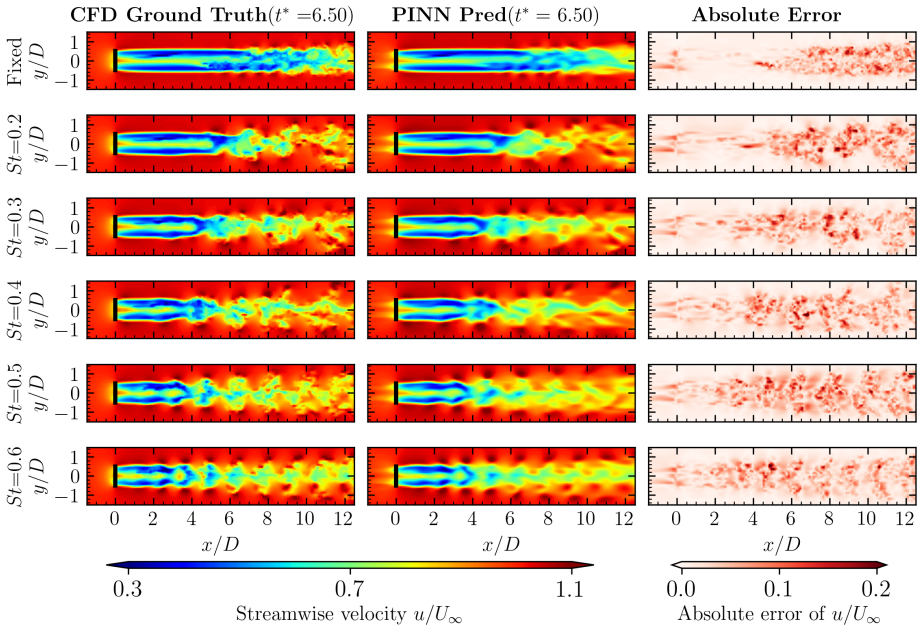
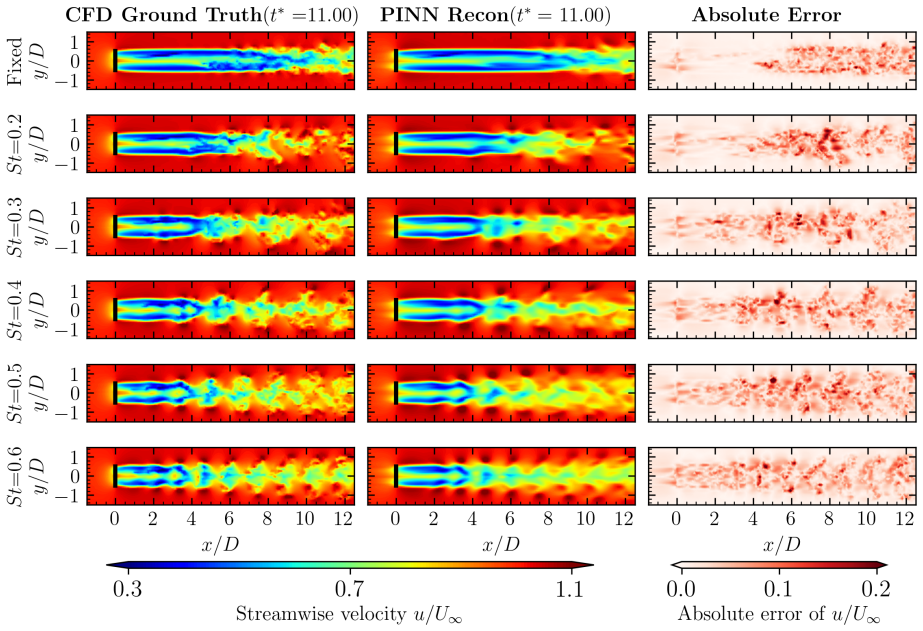
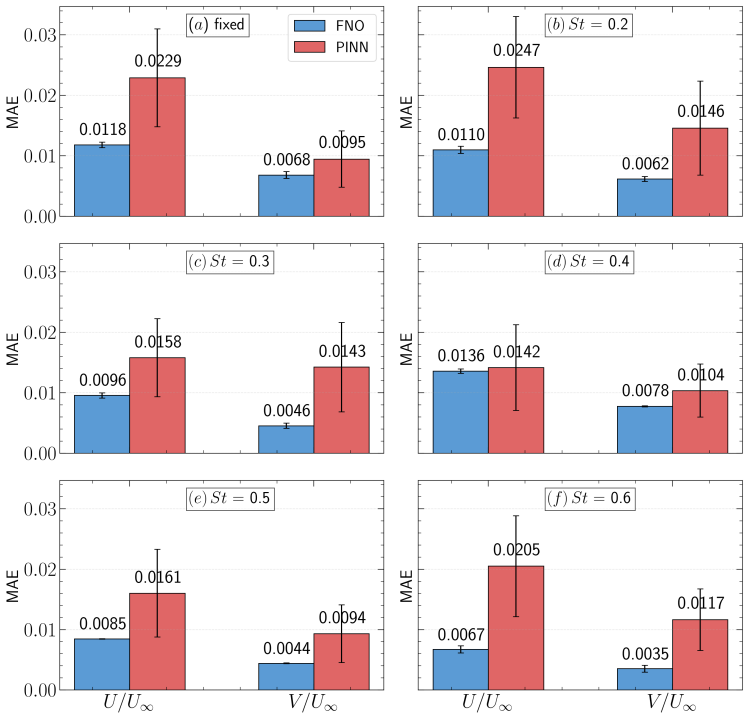
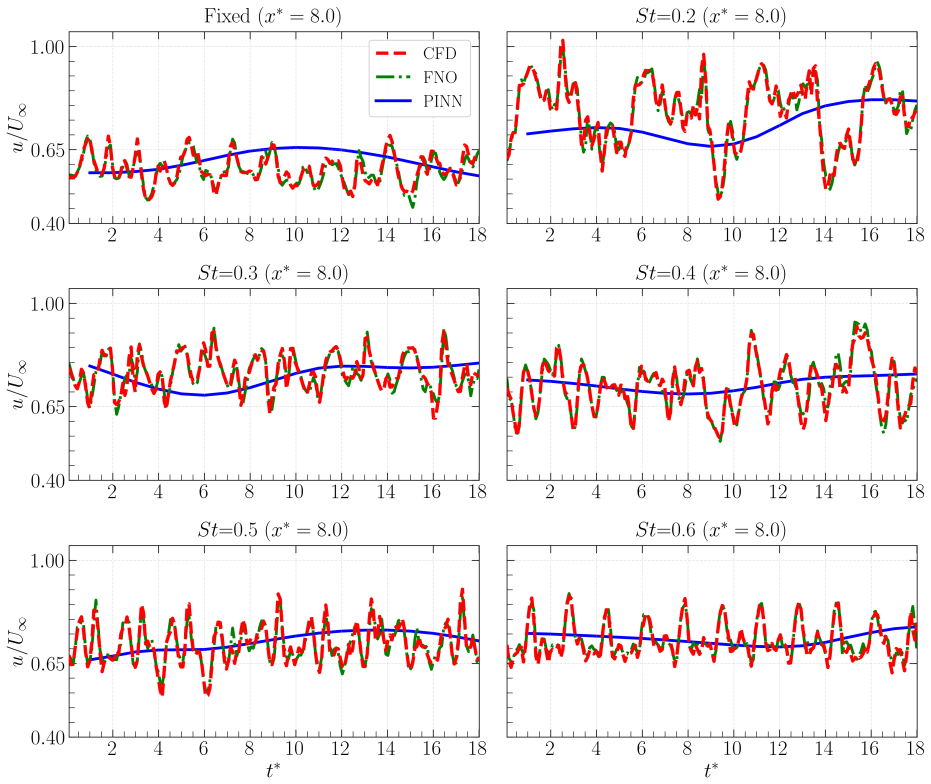
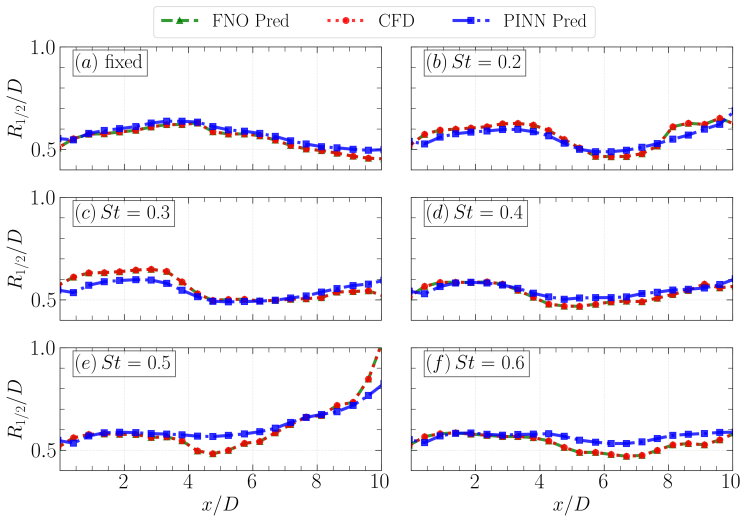
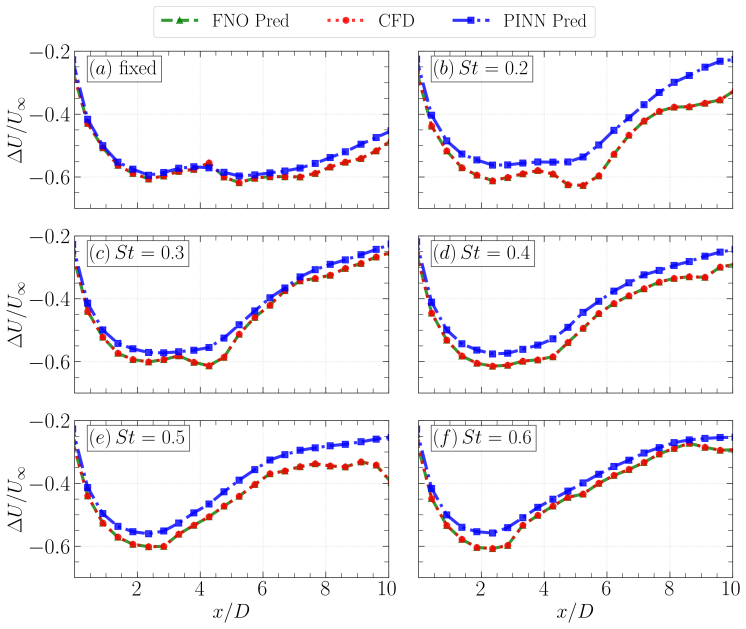
Fourier neural operators successfully reconstruct and predict the complex turbulent wakes of floating offshore wind turbines under coupled surge and pitch motions across Strouhal numbers from 0 to 0.6. They resolve both large-scale wake meandering and small-scale coherent structures with higher fidelity than physics-informed neural networks. Training converges approximately eight times faster. Power spectral density analysis confirms that FNO captures the primary meandering frequencies, their higher-order harmonics such as 2St and 3St, and high-frequency features, while PINNs function as a spatiotemporal low-pass filter that underestimates energy in the high-frequency regime.
What carries the argument
Fourier neural operators, which parameterize mappings in Fourier space to learn multi-scale function-to-function relationships directly from simulation data of fluid flows.
If this is right
- FNO enables higher-fidelity forecasts of wake center position and half-width variations for improved real-time FOWT control.
- Faster convergence allows models to be retrained rapidly on new operational data sets.
- Capture of higher-order harmonics supports more accurate prediction of fluctuating loads on downstream turbines.
- Resolution of small-scale coherent structures reduces underestimation of turbulent kinetic energy in wake regions.
Where Pith is reading between the lines
- FNO wake models could be coupled with existing farm-scale simulators to handle arrays of floating turbines without prohibitive compute cost.
- The observed low-pass filtering property of PINNs might still suit applications focused only on mean-flow statistics rather than dynamic detail.
- Testing the same FNO architecture on wakes from other floating platforms, such as wave-energy devices, would check whether the multi-scale advantage generalizes beyond wind turbines.
Load-bearing premise
The CFD-generated training and test data accurately represent real-world FOWT wake physics across the full range of Strouhal numbers and motion amplitudes encountered in operation.
What would settle it
Field measurements of wake velocity fields from an operating floating turbine during documented surge and pitch motions at known Strouhal numbers, compared directly against the model outputs for both large-scale meandering and high-frequency spectral content.
Figures










read the original abstract
Multi-scale dynamic wake prediction is essential for the real-time control and performance optimization of floating offshore wind turbines (FOWTs). In this study, Fourier neural operators (FNOs) and physics-informed neural networks (PINNs) are utilized for the first time to reconstruct and predict the complex turbulent wakes of the FOWT under coupled surge and pitch motions across a range of Strouhal numbers (St = [0, 0.6]). Results demonstrate that while both models successfully capture dominant dynamic characteristics such as wake meandering, PINN-generated wakes appear relatively smooth, failing to resolve high-frequency coherent structures as well as the intensity of temporal variations in wake center and wake half-width. FNO effectively resolves both large- and small-scale coherent turbulent structures with significantly higher fidelity. Furthermore, FNO achieves a training speed approximately eight times faster than PINN, converging in far fewer epochs. Power spectral density (PSD) analysis reveals that FNO is more effective at capturing not only the primary wake meandering frequencies (St) but also their higher-order harmonics (e.g., 2St and 3St) and small-scale coherent structures. In fact, PINN effectively acts as a spatiotemporal low-pass filter; they resolve only large-scale dynamic features and fail to capture other spectral signatures induced by coupled surge and pitch motions, thereby significantly underestimating the energy in the high-frequency regime. These findings suggest that FNO is a promising approach for FOWT wake prediction.
Editorial analysis
A structured set of objections, weighed in public.
Referee Report
Summary. The manuscript introduces the application of Fourier Neural Operators (FNOs) and Physics-Informed Neural Networks (PINNs) to predict multi-scale dynamic wakes of floating offshore wind turbines (FOWTs) subjected to coupled surge and pitch motions for Strouhal numbers ranging from 0 to 0.6. Based on CFD simulations, it reports that FNO captures both large- and small-scale coherent turbulent structures with higher fidelity than PINN, trains about eight times faster, and better reproduces the power spectral density including higher-order harmonics, whereas PINN functions as a spatiotemporal low-pass filter.
Significance. If the findings are confirmed with rigorous validation, this work has potential significance for advancing surrogate modeling in offshore wind energy, enabling faster and more accurate wake predictions for control and optimization. The direct comparison between FNO and PINN on the same dataset, along with spectral analysis, provides valuable insights into the strengths of operator learning methods for fluid dynamics problems. The use of machine learning on CFD data for FOWT wakes is a timely contribution to the field.
major comments (2)
- [Abstract] Abstract: The central claims that FNO resolves large- and small-scale structures 'with significantly higher fidelity' and that PINN 'significantly underestimating the energy in the high-frequency regime' are load-bearing for the paper's conclusion, yet the abstract provides no quantitative error metrics (e.g., L2 norms, PSD-integrated energy differences, or correlation coefficients on held-out cases) to substantiate the magnitude of improvement or the low-pass filter characterization.
- [Data generation and validation sections] Data generation and validation sections: The interpretation that FNO's superior PSD capture (including harmonics at 2St and 3St) reflects better multi-scale physics rather than data fitting depends on the CFD dataset accurately representing real-world FOWT wakes up to St=0.6. No grid-convergence studies, turbulence model validation, or experimental benchmarks are referenced to rule out numerical dissipation or insufficient resolution for high-frequency content.
minor comments (1)
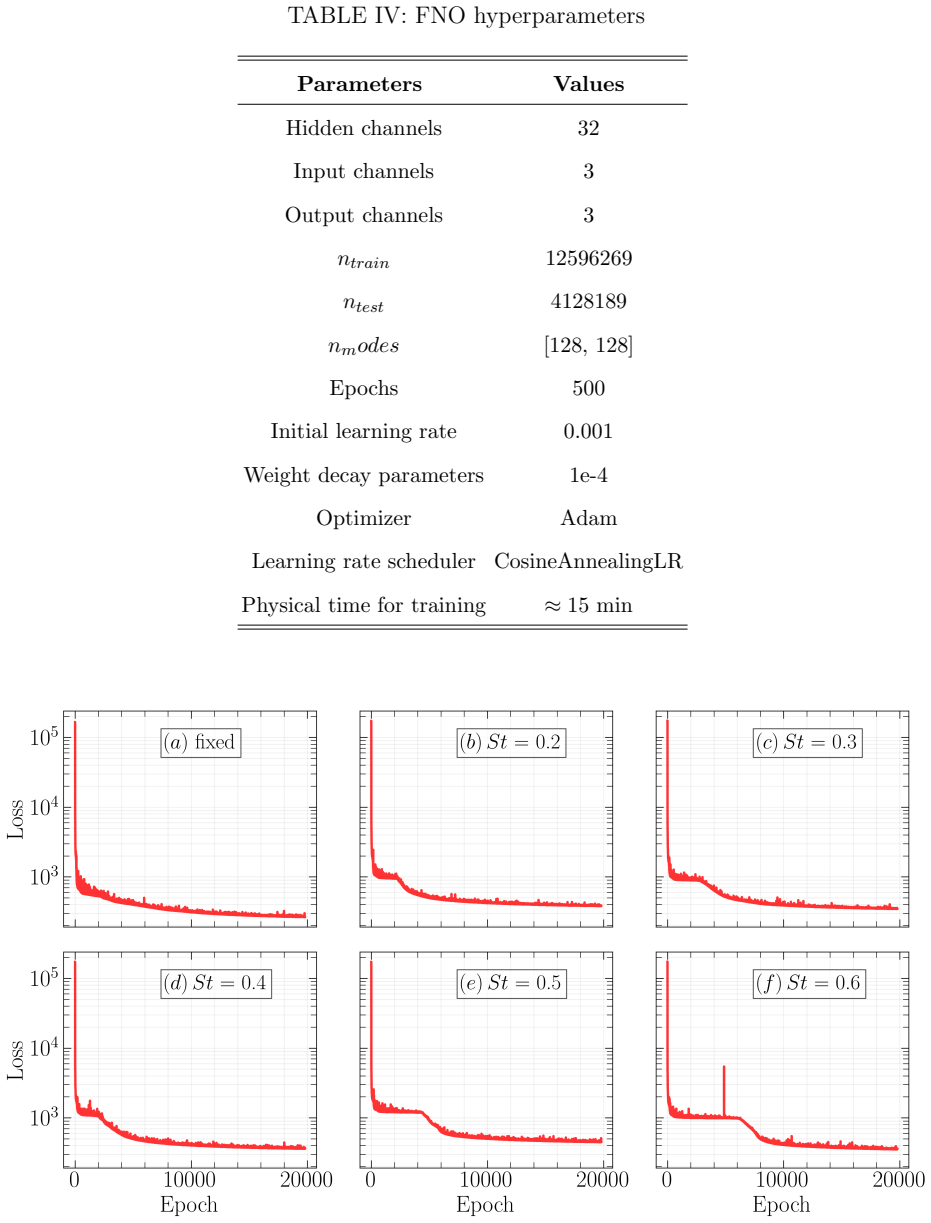
- [Abstract] Abstract: The training-speed claim ('approximately eight times faster') would be strengthened by specifying hardware, optimizer settings, epoch counts, and convergence tolerances to allow direct reproducibility.
Simulated Author's Rebuttal
We thank the referee for the constructive and detailed comments, which have helped us identify areas to strengthen the manuscript. We address each major comment point by point below, with revisions planned for the next version.
read point-by-point responses
-
Referee: [Abstract] Abstract: The central claims that FNO resolves large- and small-scale structures 'with significantly higher fidelity' and that PINN 'significantly underestimating the energy in the high-frequency regime' are load-bearing for the paper's conclusion, yet the abstract provides no quantitative error metrics (e.g., L2 norms, PSD-integrated energy differences, or correlation coefficients on held-out cases) to substantiate the magnitude of improvement or the low-pass filter characterization.
Authors: We agree that quantitative metrics are needed to support the central claims. In the revised manuscript, we will augment the abstract with specific error metrics computed on held-out cases, including relative L2 norms between model predictions and CFD data, integrated PSD energy differences in the high-frequency regime, and correlation coefficients for wake center and half-width time series. These additions will quantify the fidelity improvement and substantiate the low-pass filter characterization of PINN. revision: yes
-
Referee: [Data generation and validation sections] Data generation and validation sections: The interpretation that FNO's superior PSD capture (including harmonics at 2St and 3St) reflects better multi-scale physics rather than data fitting depends on the CFD dataset accurately representing real-world FOWT wakes up to St=0.6. No grid-convergence studies, turbulence model validation, or experimental benchmarks are referenced to rule out numerical dissipation or insufficient resolution for high-frequency content.
Authors: The CFD data are generated from established high-fidelity simulations of FOWT wakes under coupled motions, as described in the methods. We acknowledge that the manuscript does not explicitly reference grid-convergence studies or direct experimental benchmarks for the St range up to 0.6. In the revision, we will add a dedicated paragraph in the data generation section citing prior validation of the CFD setup (including turbulence model choices) against available experimental benchmarks from the literature, along with a brief discussion of resolution limits for high-frequency content. This will clarify that the FNO-PINN comparison is performed on identical data and highlight relative performance while noting potential numerical effects. revision: partial
Circularity Check
No circularity detected; models trained and evaluated on external CFD data
full rationale
The paper trains FNO and PINN models on CFD-generated datasets for FOWT wake reconstruction and prediction under surge/pitch motions, then compares their outputs on held-out test cases using metrics such as wake meandering, PSD harmonics, and training convergence. No derivation chain reduces a claimed prediction to a fitted parameter by construction, nor does any load-bearing step rely on self-citation of an unverified uniqueness theorem or ansatz. The central claims (FNO resolving small-scale structures better than PINN, PINN acting as low-pass filter) are empirical performance differences, not definitional equivalences. The analysis is self-contained against the external CFD benchmark.
Axiom & Free-Parameter Ledger
Reference graph
Works this paper leans on
-
[1]
Net zero by 2050: A roadmap for the global energy sector,
1S. Bouckaert, A. F. Pales, C. McGlade, U. Remme, B. Wanner, L. Varro, D. D’Ambrosio, and T. Spencer, “Net zero by 2050: A roadmap for the global energy sector,” (2021). 2Global Wind Energy Council, “Global wind report 2025,” Global Report (Global Wind Energy Council (GWEC), Bonn, Germany,
2050
-
[2]
Modelling and measuring flow and 33 wind turbine wakes in large wind farms offshore,
council GWE. 3R. J. Barthelmie, K. Hansen, S. T. Frandsen, O. Rathmann, J. Schepers, W. Schlez, J. Phillips, K. Rados, A. Zervos, E. Politis,et al., “Modelling and measuring flow and 33 wind turbine wakes in large wind farms offshore,” Wind Energy: An International Journal for Progress and Applications in Wind Power Conversion Technology12, 431–444 (2009)...
2009
-
[3]
Fourier Neural Operator for Parametric Partial Differential Equations
p. 012049. 6A. Hegazy, F. Blondel, M. Cathelain, and S. Aubrun, “Lidar and scada data processing for interacting wind turbine wakes with comparison to analytical wake models,” Renewable Energy181, 457–471 (2022). 7T. Wang, C. Cai, X. Wang, Z. Wang, Y. Chen, C. Hou, S. Zhou, J. Xu, Y. Zhang, and Q. Li, “Evolution mechanism of wind turbine wake structure in...
work page internal anchor Pith review arXiv 2022
-
[4]
pp. 2415–2423. 47D. Kochkov, J. A. Smith, A. Alieva, Q. Wang, M. P. Brenner, and S. Hoyer, “Machine learning–accelerated computational fluid dynamics,” Proceedings of the National Academy of Sciences118, e2101784118 (2021). 37 48L. Lu, P. Jin, G. Pang, Z. Zhang, and G. E. Karniadakis, “Learning nonlinear operators via deeponet based on the universal appro...
-
[5]
Numerical modeling of wind turbine wakes,
65J. N. Sorensen and W. Z. Shen, “Numerical modeling of wind turbine wakes,” J. Fluids Eng.124, 393–399 (2002). 66L. A. Mart´ ınez-Tossas, M. J. Churchfield, and C. Meneveau, “Optimal smoothing length scale for actuator line models of wind turbine blades based on gaussian body force distri- bution,” Wind Energy20, 1083–1096 (2017). 67J. Jonkman, S. Butter...
2002
discussion (0)
Sign in with ORCID, Apple, or X to comment. Anyone can read and Pith papers without signing in.