Recognition: unknown
Learning subgrid interfacial area in two-phase flows with regime-dependent inductive biases
Pith reviewed 2026-05-07 17:31 UTC · model grok-4.3
The pith
A fractal geometric prior improves machine learning predictions of subgrid interfacial area density only in corrugation-dominated flow regimes.
A machine-rendered reading of the paper's core claim, the machinery that carries it, and where it could break.
Core claim
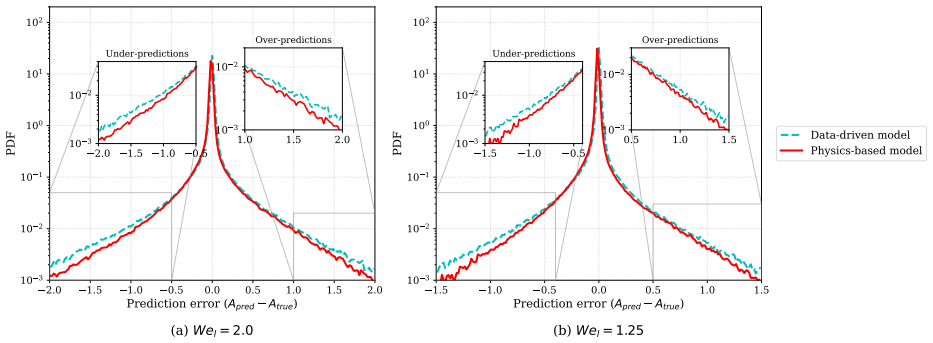
Across Weber numbers the physics-constrained model with fractal regularization outperforms the data-driven encoder-decoder in predictive accuracy and artifact suppression, but the improvement is confined to corrugation-dominated regimes; the same prior becomes ineffective once fragmentation and topology change dominate.
What carries the argument
The fractal geometric prior, introduced as a regularization term in the loss function of the physics-constrained 3D encoder-decoder network, enforces self-similar scaling on the predicted subgrid interfacial area density.
If this is right
- The embedded fractal bias reduces nonphysical artifacts specifically where its scaling assumptions hold.
- Generalization improves in regimes aligned with the prior but degrades when topology changes violate the prior.
- A single fixed inductive bias is insufficient for flows that transition between corrugation and fragmentation.
- Utility of physics-informed models requires explicit alignment between the bias and the governing physical regime.
Where Pith is reading between the lines
- Models could be extended with regime detectors that activate or blend different priors depending on local flow topology.
- The same alignment principle may apply to other subgrid closures where geometric assumptions break at high Reynolds or Weber numbers.
- Testing the approach on additional breakup mechanisms would clarify how broadly the regime-dependence observation holds.
Load-bearing premise
The fractal geometric prior matches the actual geometric structure of the interface only in corrugation-dominated regimes.
What would settle it
A simulation or experiment in which the measured fractal dimension of the interface deviates from the assumed scaling in a fragmentation regime, accompanied by loss of the constrained model's accuracy advantage over the data-driven baseline.
Figures







read the original abstract
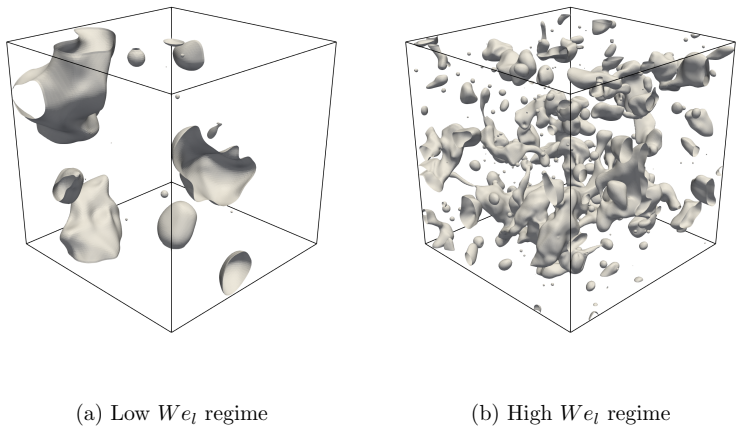
The reliability of machine learning in multiscale physical systems depends on how physical structure is embedded into the learning process. We investigate this in the context of turbulent multiphase flows, focusing on the prediction of subgrid interfacial area density, a key quantity governing interphase transport that remains unresolved in large-eddy simulations. In this work, we develop and evaluate two machine learning subgrid closure models to predict the three-dimensional subgrid interfacial area density: a purely data-driven 3D encoder-decoder network, and a physics-constrained variant regularized by a fractal geometric prior. Across a range of Weber numbers, the physics-based model improves predictive accuracy, reduces error variance, and suppresses nonphysical artifacts relative to purely data-driven approaches. We also show that these gains are regime-dependent: the embedded inductive bias enhances generalization in corrugation-dominated regimes where its underlying assumptions hold, but becomes ineffective in fragmentation-dominated regimes characterized by topology change and droplet breakup. These results reveal a broader principle for scientific machine learning: the utility of physics-informed models depends not only on the presence of inductive bias, but on its alignment with the governing physical regime. This suggests a path toward regime-aware learning frameworks for modeling of complex multiscale systems.
Editorial analysis
A structured set of objections, weighed in public.
Referee Report
Summary. The manuscript develops and compares two machine learning models for predicting three-dimensional subgrid interfacial area density in turbulent two-phase flows: a purely data-driven 3D encoder-decoder network and a physics-constrained variant regularized by a fractal geometric prior. It claims that the physics-based model yields higher predictive accuracy, lower error variance, and fewer nonphysical artifacts across a range of Weber numbers, with these improvements being regime-dependent—stronger in corrugation-dominated regimes where the fractal assumptions hold and ineffective in fragmentation-dominated regimes involving topology change and breakup.
Significance. If the regime-specific gains are robustly shown to arise from alignment of the inductive bias rather than other factors, the work would establish a useful principle for scientific machine learning: that the value of physics-informed constraints depends on their match to the governing physical regime. This could guide development of more reliable subgrid closures for large-eddy simulations of multiphase flows.
major comments (2)
- [Results section (regime-dependence discussion)] Results section (regime-dependence discussion): The central claim that performance gains occur specifically because the fractal prior aligns with interface geometry in corrugation-dominated regimes is not supported by direct validation. No quantitative checks—such as measured fractal dimensions, scaling exponents, or interface roughness statistics extracted from the same DNS fields used for training and testing—are reported to confirm that the prior's assumptions hold in those regimes.
- [Methods section (regime classification)] Methods section (regime classification): Regime labels (corrugation vs. fragmentation) appear to be assigned via Weber-number thresholds or visual inspection rather than an objective metric of topology or fractal character. This leaves open the possibility that observed differences arise from regularization strength or dataset partitioning instead of inductive-bias alignment.
minor comments (2)
- [Abstract and results] The abstract and results lack specific numerical values for error metrics, dataset sizes, training details, and error bars, which are needed to assess the magnitude and statistical significance of the reported improvements.
- [Figures] Figure captions and legends should explicitly indicate which Weber-number cases correspond to corrugation versus fragmentation regimes to aid interpretation of the regime-dependent claims.
Simulated Author's Rebuttal
We thank the referee for the detailed and constructive report. The comments highlight important opportunities to strengthen the evidence for our central claims. We address each major comment below and will incorporate revisions to provide the requested quantitative support.
read point-by-point responses
-
Referee: Results section (regime-dependence discussion): The central claim that performance gains occur specifically because the fractal prior aligns with interface geometry in corrugation-dominated regimes is not supported by direct validation. No quantitative checks—such as measured fractal dimensions, scaling exponents, or interface roughness statistics extracted from the same DNS fields used for training and testing—are reported to confirm that the prior's assumptions hold in those regimes.
Authors: We agree that the manuscript would be strengthened by direct quantitative validation of the fractal assumptions within the specific DNS datasets. While our interpretation draws on established literature characterizing corrugation regimes as fractal and fragmentation regimes as involving topology change, we did not extract fractal dimensions or roughness statistics from the training and test fields. In the revised manuscript we will add a dedicated subsection that computes these quantities (box-counting fractal dimension and interface roughness metrics) directly from the DNS interface geometries for both regimes, thereby providing explicit confirmation that the inductive bias aligns with the data in the corrugation cases. revision: yes
-
Referee: Methods section (regime classification): Regime labels (corrugation vs. fragmentation) appear to be assigned via Weber-number thresholds or visual inspection rather than an objective metric of topology or fractal character. This leaves open the possibility that observed differences arise from regularization strength or dataset partitioning instead of inductive-bias alignment.
Authors: The referee is correct that Weber-number thresholds combined with visual inspection introduce an element of subjectivity. To eliminate this ambiguity we will replace the current classification with an objective, data-driven procedure based on two quantitative metrics computed from the interface: (1) a topological change indicator (change in number of connected components and Euler characteristic) and (2) a fractal-dimension threshold. Regime labels will be assigned only when both metrics satisfy the corresponding criteria, allowing us to demonstrate that performance gains track the presence of fractal character rather than regularization strength or partitioning artifacts. revision: yes
Circularity Check
No circularity: fractal prior is external inductive bias; regime claims rest on model comparisons against DNS, not self-definition or fitted inputs
full rationale
The paper introduces a physics-constrained encoder-decoder regularized by an external fractal geometric prior and compares it to a purely data-driven baseline across Weber-number regimes. No equation or claim reduces a prediction to a fitted parameter by construction, nor does any load-bearing step rely on self-citation chains or ansatz smuggling. Regime labels are assigned via Weber number or visual topology inspection, independent of the model's outputs or the prior itself. The central result (regime-dependent improvement) is therefore an empirical observation against held-out DNS data rather than a tautology. This is the normal case of a self-contained scientific ML study.
Axiom & Free-Parameter Ledger
Reference graph
Works this paper leans on
-
[1]
[12], using the aforementioned procedure. And we have further identified the source of this problem, it arises from the discrepancy in interface thickness ( ϵ) scales from the volume averaged DNS and the resolved LES interfacial area density. For instance, take a 1D interface, defined by ϕ= 1 2 [1+tanh( x 2ϵ)],(A5) which is representative of a zero-curvat...
-
[2]
H. Choi, C. Cho, M. Kim, and J. Park, Perspective on machine-learning-based large-eddy simulation, Phys. Rev. Fluids10, 110701 (2025)
2025
-
[3]
W. H. R. Chan, P. L. Johnson, P. Moin, and J. Urzay, The turbulent bubble break-up cascade. part 2. numerical simulations of breaking waves, Journal of Fluid Mechanics912, A43 (2021)
2021
-
[4]
N. A. Chigier,Energy and Combustion Science(Pergamon, 1979) pp. 183–200
1979
-
[5]
Takamasa, T
T. Takamasa, T. Iguchi, T. Hazuku, T. Hibiki, and M. Ishii, Interfacial area transport of bubbly flow under microgravity environment, International Journal of Multiphase Flow29, 291 (2003)
2003
-
[6]
T. D. Stoffel, M. Viqueira-Moreira, C. Brehm, and S. J. Poovathingal, Application of a diffuse interface multiphase method for high temperature and hypersonic flows with phase change, in AIAA A VIATION 2023 Forum(AIAA AVIATION, 2023)
2023
-
[7]
Smagorinsky, General circulation experiments with the primitive equation i
J. Smagorinsky, General circulation experiments with the primitive equation i. the basic ex- 31 periment, Monthly Weather Review91, 99 (1963)
1963
- [8]
-
[9]
Vallet, A
A. Vallet, A. Burluka, and R. Borghi, Development of a eulerian model for the” atomization” of a liquid jet, Atomization and Sprays11, 619 (2001)
2001
-
[10]
Lebas, T
R. Lebas, T. Menard, P. A. Beau, A. Berlemont, and F. X. Demoulin, Numerical simulation of primary break-up and atomization: Dns and modelling study, International Journal of Multiphase Flow35, 247 (2009)
2009
-
[11]
Chesnel, J
J. Chesnel, J. Reveillon, T. Menard, and F. X. Demoulin, Large eddy simulation of liquid jet atomization, Atomization and Sprays21, 711 (2011)
2011
-
[12]
Granger, J.-C
F. Granger, J.-C. Hoarau, L.-H. Dorey, D. Zuzio, and J.-L. Estival` ezes, Interface area density model for large-eddy simulation of assisted atomization in fiber regime, International Journal of Multiphase Flow179, 104927 (2024)
2024
-
[13]
Hatashita, A
L. Hatashita, A. Elnahhas, and S. S. Jain, A-priori analysis of subgrid interfacial area in two- phase flows, Proceedings of the 35th Annual Conference on Liquid Atomization and Spray Systems (2025)
2025
-
[14]
Bardina, J
J. Bardina, J. H. Ferziger, and W. C. Reynolds, Improved subgrid scale models for large-eddy simulation, Proceedings of the 13th Fluid and Plasmadynamics Conference (AIAA Paper 80-
-
[15]
A. Beck, D. Flad, and C.-D. Munz, Deep neural networks for data-driven les closure models, Journal of Computational Physics398, 108910 (2019)
2019
-
[16]
Z. Wang, K. Luo, D. Li, J. Tan, and J. Fan, Investigations of data-driven closure for subgrid- scale stress in large-eddy simulation, Physics of Fluids30, 125101 (2018)
2018
-
[17]
Wu and S
A. Wu and S. K. Lele, Two neural network unet architecture for subfilter stress modeling, Phys. Rev. Fluids10, 014601 (2025)
2025
-
[18]
Basha, R
N. Basha, R. Arcucci, P. Angeli, C. Anastasiou, T. Abadie, C. Q. Casas, J. Chen, S. Cheng, L. Chagot, F. Galvanin, C. E. Heaney, F. Hossein, J. Hu, N. Kovalchuk, M. Kalli, L. Ka- houadji, M. Kerhouant, A. Lavino, F. Liang, K. Nathanael, L. Magri, P. Lettieri, M. Mat- erazzi, M. Erigo, P. Pico, C. C. Pain, M. Shams, M. Simmons, T. Traverso, J. P. Valdes, Z...
2024
-
[19]
Q. Cao, X. Zhang, S. Lu, J. Wang, S. Guo, G. Tabor, J. Wu, X. Chu, and G. Yang, Integrat- ing data and physics: A review of data-driven methods for computational multiphase flow, Chemical Engineering Journal530, 173311 (2026)
2026
-
[20]
C. E. Heaney, Z. Wolffs, J. A. T´ omasson, L. Kahouadji, P. Salinas, A. Nicolle, I. M. Navon, O. K. Matar, N. Srinil, and C. C. Pain, An ai-based non-intrusive reduced-order model for extended domains applied to multiphase flow in pipes, Physics of Fluids34, 055111 (2022)
2022
-
[21]
Savage, N
T. Savage, N. Basha, J. McDonough, J. Krassowski, O. Matar, and E. A. del Rio Chanona, Machine learning-assisted discovery of flow reactor designs, Nature Chemical Engineering1, 522 (2024)
2024
-
[22]
Y. Qi, J. Lu, R. Scardovelli, S. Zaleski, and G. Tryggvason, Computing curvature for volume of fluid methods using machine learning, Journal of Computational Physics377, 155 (2019)
2019
-
[23]
H. V. Patel, A. Panda, J. A. M. Kuipers, and E. Peters, Computing interface curvature from volume fractions: A machine learning approach, Computers & Fluids (2019)
2019
-
[24]
¨Onder and P
A. ¨Onder and P. L.-F. Liu, Deep learning of interfacial curvature: A symmetry-preserving approach for the volume of fluid method, Journal of Computational Physics485, 112110 (2023)
2023
-
[25]
Zuzio, P
D. Zuzio, P. Trontin, B. Di Pierro, Y. Mezache, L. Richard, and J.-L. Estival` ezes, Prediction of interfacial surface in two-phase flows atomization simulations using a u-net convolutional neural network, AI Thermal Fluids5, 100024 (2026)
2026
-
[26]
Vankova, S
N. Vankova, S. Tcholakova, N. D. Denkov, I. B. Ivanov, V. D. Vulchev, and T. Danner, Emulsification in turbulent flow: 1. mean and maximum drop diameters in inertial and viscous regimes, Journal of Colloid and Interface Science312, 363 (2007)
2007
-
[27]
Ni, Deformation and breakup of bubbles and drops in turbulence, Annual Review of Fluid Mechanics56, 319 (2024)
R. Ni, Deformation and breakup of bubbles and drops in turbulence, Annual Review of Fluid Mechanics56, 319 (2024)
2024
-
[28]
S. B. Pope,Turbulent Flows(Cambridge University Press, 2000)
2000
-
[29]
Kolmogorov, On the breakage of drops in a turbulent flow, inDokl
A. Kolmogorov, On the breakage of drops in a turbulent flow, inDokl. Akad. Navk. SSSR, Vol. 66 (1949) pp. 825–828
1949
-
[30]
J. O. Hinze, Fundamentals of the hydrodynamic mechanism of splitting in dispersion processes, AIChE Journal1, 289 (1955)
1955
-
[31]
Risso and J
F. Risso and J. Fabre, Oscillations and breakup of a bubble immersed in a turbulent field, 33 Journal of Fluid Mechanics372, 323–355 (1998)
1998
-
[32]
D. Qian, J. B. McLaughlin, K. Sankaranarayanan, S. Sundaresan, and K. Kontomaris, Simu- lation of bubble breakup dynamics in homogeneous turbulence, Chemical Engineering Com- munications193, 1038 (2006)
2006
-
[33]
Cannon, G
I. Cannon, G. Soligo, and M. E. Rosti, Morphology of clean and surfactant-laden droplets in homogeneous isotropic turbulence, Journal of Fluid Mechanics987, A31 (2024)
2024
-
[34]
Shinnar, On the behaviour of liquid dispersions in mixing vessels, Journal of Fluid Me- chanics10, 259–275 (1961)
R. Shinnar, On the behaviour of liquid dispersions in mixing vessels, Journal of Fluid Me- chanics10, 259–275 (1961)
1961
-
[35]
S. S. Jain and A. Elnahhas, Stationary states of forced two-phase turbulence, Chemical Engi- neering Journal524, 169077 (2025)
2025
-
[36]
S. S. Jain, Accurate conservative phase-field method for simulation of two-phase flows, Journal of Computational Physics469, 111529 (2022)
2022
-
[37]
W. T. Chung, K. S. Jung, J. H. Chen, and M. Ihme, Blastnet: A call for community-involved big data in combustion machine learning, Applications in Energy and Combustion Science12, 100087 (2022)
2022
-
[38]
Glaws, R
A. Glaws, R. King, and M. Sprague, Deep learning for in situ data compression of large turbulent flow simulations, Phys. Rev. Fluids5, 114602 (2020)
2020
-
[39]
D. P. Kingma, Adam: A method for stochastic optimization, arXiv preprint arXiv:1412.6980 (2014)
work page internal anchor Pith review arXiv 2014
-
[40]
K. R. Sreenivasan and C. Meneveau, The fractal facets of turbulence, Journal of Fluid Me- chanics173, 357–386 (1986)
1986
-
[41]
S. S. Jain and L. H. Hatashita, Length scales and interfacial area in two-phase turbulence, Bulletin of the American Physical Society (2025)
2025
-
[42]
Decoupled Weight Decay Regularization
I. Loshchilov and F. Hutter, Decoupled weight decay regularization (2019), arXiv:1711.05101
work page internal anchor Pith review arXiv 2019
-
[43]
Bhattacharjee, L
A. Bhattacharjee, L. H. Hatashita, and S. S. Jain, A machine learning model for the prediction of sub-grid interfacial area in two-phase turbulent flows, inAIAA SCITECH 2026 Forum
2026
-
[44]
Leoni,A First Course in Sobolev Spaces(American Mathematical Society, 2009)
G. Leoni,A First Course in Sobolev Spaces(American Mathematical Society, 2009). 34
2009
discussion (0)
Sign in with ORCID, Apple, or X to comment. Anyone can read and Pith papers without signing in.