Recognition: unknown
Hard Probes in Ultraperipheral Collisions at LHCb
Pith reviewed 2026-05-07 17:33 UTC · model grok-4.3
The pith
LHCb measures rho and phi vector mesons in ultraperipheral heavy-ion collisions at forward rapidity.
A machine-rendered reading of the paper's core claim, the machinery that carries it, and where it could break.
Core claim
The LHCb experiment has obtained the highest-precision quarkonium measurements to date in ultraperipheral collisions and reports new forward-rapidity cross sections for rho(770) and phi(1020) vector mesons that can be contrasted with existing data and photon-induced production calculations.
What carries the argument
Forward-rapidity vector-meson reconstruction in ultraperipheral heavy-ion events that selects photon-nucleus interactions.
If this is right
- The data constrain nuclear gluon distributions at low momentum fractions.
- Comparisons test the relative importance of different vector-meson photoproduction mechanisms.
- Forward acceptance accesses kinematic regions complementary to central detectors.
- Upgraded detector running will supply higher-statistics samples for the same observables.
Where Pith is reading between the lines
- The measurements could help discriminate between models that include gluon saturation effects in nuclei.
- Similar techniques might be applied to other light vector mesons or to asymmetric collision systems.
- Longer-term data sets could link photoproduction results to low-x QCD behavior seen in deep-inelastic scattering.
Load-bearing premise
The selected events are dominated by photon-induced production with only small contributions from hadronic interactions or detector effects.
What would settle it
Measured rho and phi yields that deviate substantially from photon-nucleus model predictions after all experimental corrections would falsify the interpretation.
Figures
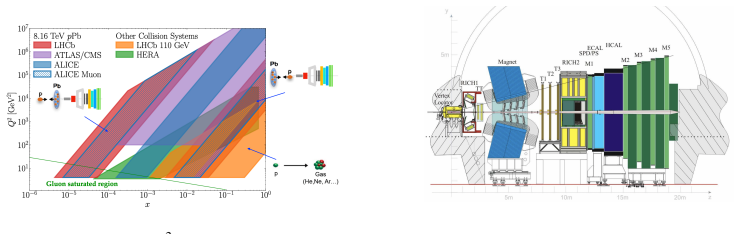


read the original abstract
Measurements of quarkonia production in peripheral and ultraperipheral heavy-ion collisions are sensitive to photon-photon and photon-nucleus interactions, the partonic structure of nuclei, and the mechanisms of vector-meson production. In this contribution, quarkonium measurements with the highest precision currently accessible will be compared with the latest theoretical models. Additionally, new studies of $\rho(770)$ and $\phi(1020)$ vector meson production at forward rapidity will be presented and contrasted with other experimental results. Future UPC measurements with the upgraded LHCb detector in Run 3 will also be discussed.
Editorial analysis
A structured set of objections, weighed in public.
Referee Report
Summary. The manuscript is a conference-style contribution from the LHCb collaboration summarizing measurements of quarkonia production in peripheral and ultraperipheral PbPb collisions. It highlights the sensitivity of these measurements to photon-photon and photon-nucleus interactions, the partonic structure of nuclei, and vector-meson production mechanisms. The text compares high-precision quarkonium results with theoretical models, presents new forward-rapidity studies of ρ(770) and φ(1020) vector meson production, contrasts them with other experimental results, and discusses prospects for Run 3 with the upgraded LHCb detector.
Significance. If the summarized results hold, this work adds value by providing LHCb's forward-rapidity coverage for vector-meson photoproduction in UPCs, which can constrain nuclear PDFs and production models. The new ρ and φ measurements extend the dataset beyond mid-rapidity experiments, and the Run 3 outlook indicates potential for higher-statistics studies of photon-induced processes.
minor comments (2)
- The abstract claims 'highest precision currently accessible' for quarkonium measurements; this should be supported in the main text by explicit references to integrated luminosities, statistical uncertainties, or direct comparisons with prior results from other experiments.
- The discussion of new ρ(770) and φ(1020) studies would benefit from a brief description of the event selection (e.g., rapidity gaps or ZDC requirements) and any preliminary cross-section values or ratios, even if the contribution is concise.
Simulated Author's Rebuttal
We thank the referee for the careful reading and positive assessment of our manuscript. The summary accurately captures the scope of our contribution on quarkonia and vector-meson measurements in ultraperipheral collisions. We are pleased that the forward-rapidity coverage and Run 3 prospects are viewed as adding value. No specific major comments were provided in the report, so we have no points to address individually. We will incorporate any minor editorial suggestions in the revised version.
Circularity Check
No significant circularity: experimental summary only
full rationale
This is a conference-style experimental report summarizing LHCb measurements of vector-meson production in UPC and peripheral collisions. No derivation chain, theoretical model, or quantitative prediction is advanced within the manuscript; results are extracted from detector data using standard event-selection criteria (rapidity gaps, ZDC activity) that are field conventions rather than internally derived. Comparisons to external models are presented but not used to close any loop back to the paper's own inputs. The paper is therefore self-contained against external benchmarks with no load-bearing self-referential steps.
Axiom & Free-Parameter Ledger
axioms (1)
- domain assumption Standard assumptions of quantum chromodynamics and electromagnetic interactions govern photon-nucleus processes in ultraperipheral collisions
Reference graph
Works this paper leans on
-
[1]
The Electron-Ion Collider: Assessing the Energy Dependence of Key Measurements
E.C. Aschenauer et al., Rept. Prog. Phys.82, 024301 (2019),1708.01527
work page Pith review arXiv 2019
- [2]
-
[3]
R. Aaij et al. (LHCb), Phys. Rev. Lett.134, 031902 (2025),2407.14301
-
[4]
R. Aaij et al. (LHCb), Phys. Rev. Lett.118, 022003 (2017),1606.07895
-
[5]
Carvalho Akiba et al., JINST13, P04017 (2018),1801.04281
K. Carvalho Akiba et al., JINST13, P04017 (2018),1801.04281
-
[6]
J. Adam et al. (ALICE), Phys. Rev. Lett.116, 222301 (2016),1509.08802
-
[7]
J. Adam et al. (STAR), Phys. Rev. Lett.123, 132302 (2019),1904.11658
- [8]
- [9]
- [10]
-
[11]
Smith et al
K.L. Smith et al. (LHCb), LHCb-CONF-2024-006 (2025)
2024
- [12]
- [13]
-
[14]
S. Acharya et al. (ALICE), Phys. Rev. Lett.132, 222303 (2024),2311.11792
-
[15]
Aaijet al.,The LHCb Upgrade I, JINST19(2024) P05065, arXiv:2305.10515
R. Aaij et al. (LHCb), JINST19, P05065 (2024),2305.10515
discussion (0)
Sign in with ORCID, Apple, or X to comment. Anyone can read and Pith papers without signing in.