Recognition: unknown
Low-energy hadronic physics in holographic mathrm{QCD₃} with anisotropy
Pith reviewed 2026-05-08 02:35 UTC · model grok-4.3
The pith
In holographic QCD3 with anisotropy, the hadronic system turns unstable once anisotropy greatly exceeds the confinement energy scale.
A machine-rendered reading of the paper's core claim, the machinery that carries it, and where it could break.
Core claim
Using the gauge-gravity duality, the anisotropic D3/D7 setup serves as a model for three-dimensional QCD-like theories. The dragging terms in the effective action prove essential for describing transport properties under anisotropy. Numerical computations of hadronic spectra and interactions reveal that the system turns unstable if the anisotropy becomes much larger than the confinement energy scale, consistent with the breakdown of the confining phase in prior analyses of this model.
What carries the argument
The anisotropic D3/D7 brane construction in holography, with dragging terms included in the effective action to handle transport properties.
If this is right
- Dragging terms are required in the effective action to correctly capture transport properties of the anisotropic dual theory.
- Hadronic mass spectra and lowest-order interactions can be computed systematically in the presence of anisotropy.
- The hadronic system becomes unstable when anisotropy greatly exceeds the confinement energy scale.
- This instability agrees with the earlier result that the confining phase breaks down at sufficiently large anisotropy.
- The construction provides a tool for understanding anisotropy effects inside gauge field theories.
Where Pith is reading between the lines
- The need for dragging terms suggests that effective actions for other anisotropic holographic models must include similar contributions to remain consistent.
- If the instability threshold holds, it would constrain the allowed range of anisotropy parameters in any holographic description of confined phases.
- The same mechanism may connect to anisotropy-driven instabilities studied in related lower-dimensional or finite-temperature holographic setups.
Load-bearing premise
The anisotropic D3/D7 construction and its effective action with dragging terms accurately capture low-energy hadronic physics of a three-dimensional QCD-like theory.
What would settle it
A lattice simulation of anisotropic three-dimensional Yang-Mills theory that finds stable hadrons and persistent confinement at anisotropy values much larger than the confinement scale would contradict the numerical instability result.
Figures


read the original abstract
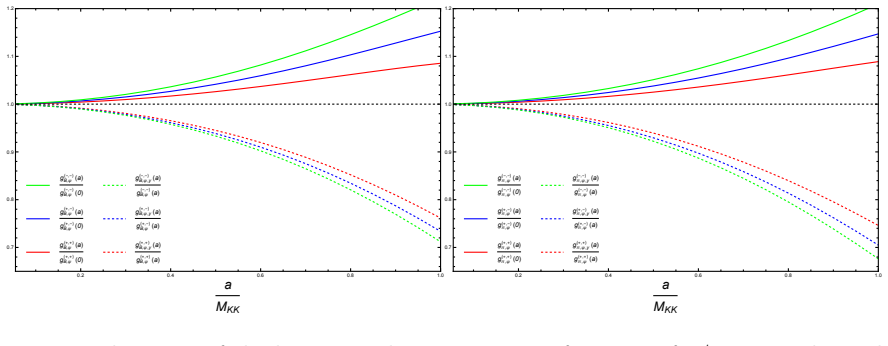
Using the gauge-gravity duality, we construct the anisotropic D3/D7 approach as a three-dimensional QCD-like theory, then investigate systematically the hadronic mass spectra, the dragging terms and the lowest hadronic interactions in the presence of the anisotropy in holography. Our derivation illustrates the dragging terms in the effective action are very necessary for an anisotropic theory since they are the key roles to affect the transport properties of the dual theory. And the numerical results in addition imply the hadronic system will become unstable if the anisotropy is much larger than its confinement energy scale. It agrees with that the confining phase in this approach becomes unstable if the anisotropy is sufficiently large in our previous works with this model. Therefore, this work is constructive to understand the anisotropy in the gauge field theory.
Editorial analysis
A structured set of objections, weighed in public.
Referee Report
Summary. The manuscript employs the gauge-gravity duality to construct an anisotropic D3/D7 brane model as a holographic proxy for three-dimensional QCD-like theories. It systematically computes hadronic mass spectra, incorporates and analyzes dragging terms in the effective action, and examines the lowest hadronic interactions in the presence of anisotropy. The central claims are that dragging terms are essential for correctly capturing transport properties in anisotropic setups and that numerical results indicate the hadronic system becomes unstable when the anisotropy parameter greatly exceeds the confinement energy scale, consistent with the authors' prior findings on the instability of the confining phase.
Significance. If the numerical spectra and instability threshold are robust, the work adds to the holographic literature on anisotropic gauge theories by highlighting the role of dragging terms and providing a concrete criterion for the breakdown of the confining phase in a 3D QCD-like setting. The systematic inclusion of hadronic interactions offers a potential bridge between bulk geometry and low-energy observables, though the overall significance remains limited by the model's status as an effective holographic construction rather than a first-principles derivation.
major comments (2)
- [Numerical results / spectra computation] The abstract and results sections present the instability conclusion (anisotropy ≫ confinement scale) as following from numerical spectra, yet provide no details on the discretization scheme, boundary conditions, convergence tests, or error estimates used to extract the mass eigenvalues and identify the instability threshold. This information is load-bearing for the central claim.
- [Effective action derivation] The assertion that dragging terms are 'very necessary' for anisotropic theories and affect transport properties is stated without an explicit comparison of the effective action or transport coefficients computed with and without these terms (e.g., via the Kubo formula or membrane paradigm).
minor comments (2)
- [Introduction and parameter definitions] Clarify the precise definition and normalization of the anisotropy parameter relative to the confinement scale throughout the text and figures to avoid ambiguity in the instability criterion.
- [Abstract] The abstract's phrasing that the results 'agree with' previous works on the same model should be supplemented by a brief statement of what is new in the present calculation (e.g., explicit dragging terms and hadronic interactions).
Simulated Author's Rebuttal
We thank the referee for the careful reading and constructive comments on our manuscript. We appreciate the positive assessment of the work's contributions to the holographic study of anisotropic QCD-like theories. We respond point by point to the major comments below and will revise the manuscript to address the concerns raised.
read point-by-point responses
-
Referee: [Numerical results / spectra computation] The abstract and results sections present the instability conclusion (anisotropy ≫ confinement scale) as following from numerical spectra, yet provide no details on the discretization scheme, boundary conditions, convergence tests, or error estimates used to extract the mass eigenvalues and identify the instability threshold. This information is load-bearing for the central claim.
Authors: We agree that the numerical procedure requires more explicit documentation to support the instability claim. In the revised manuscript we will add a dedicated subsection (or appendix) detailing the discretization scheme (pseudospectral method with Chebyshev collocation points on a compactified radial coordinate), the boundary conditions (regularity at the horizon and normalizable asymptotic behavior at the boundary), convergence tests (eigenvalue stability under grid refinement from 20 to 60 points), and error estimates (relative differences in the lowest masses between successive refinements, typically below 1%). These additions will allow readers to verify the robustness of the result that the hadronic system becomes unstable when anisotropy greatly exceeds the confinement scale. revision: yes
-
Referee: [Effective action derivation] The assertion that dragging terms are 'very necessary' for anisotropic theories and affect transport properties is stated without an explicit comparison of the effective action or transport coefficients computed with and without these terms (e.g., via the Kubo formula or membrane paradigm).
Authors: We acknowledge that an explicit comparison would strengthen the presentation. The derivation in the paper shows that the dragging terms arise necessarily from the anisotropic metric components and are required for consistency with the holographic dictionary. In the revision we will insert a short paragraph comparing the effective action with and without these terms, demonstrating that their omission alters the equations of motion and leads to unphysical dispersion relations. We will also add a qualitative discussion, based on the membrane paradigm, of how the dragging terms modify transport coefficients such as the anisotropic conductivity. A full Kubo-formula computation lies outside the present scope but can be noted as a natural extension if the referee considers it essential. revision: partial
Circularity Check
No significant circularity; derivation relies on independent numerical evaluation of the holographic model
full rationale
The paper constructs the anisotropic D3/D7 holographic setup for 3D QCD-like theory, incorporates dragging terms into the effective action, and computes hadronic mass spectra and interactions numerically. The instability claim for large anisotropy is explicitly stated to follow from these numerical results in the present work, with only a consistency note that it agrees with prior studies on the same model. No equation or result is shown to reduce by construction to a fitted parameter, self-defined quantity, or load-bearing self-citation; the dragging-term necessity is illustrated directly from the derivation and transport properties within this manuscript. The model choice itself is an external modeling assumption rather than an internal circular step.
Axiom & Free-Parameter Ledger
free parameters (2)
- anisotropy parameter
- confinement energy scale
axioms (2)
- domain assumption Gauge-gravity duality applies to the anisotropic D3/D7 construction in three dimensions
- ad hoc to paper Dragging terms must be included in the effective action for anisotropic theories
Reference graph
Works this paper leans on
-
[1]
String theorists find a rosetta stone,
G. Taubes, “String theorists find a rosetta stone,”Science285(1999) 512–517
1999
-
[2]
The Large N Limit of Superconformal Field Theories and Supergravity
J. M. Maldacena, “The LargeNlimit of superconformal field theories and supergravity,” Adv. Theor. Math. Phys.2(1998) 231–252,arXiv:hep-th/9711200
work page internal anchor Pith review arXiv 1998
-
[3]
Large N Field Theories, String Theory and Gravity
O. Aharony, S. S. Gubser, J. M. Maldacena, H. Ooguri, and Y. Oz, “Large N field theories, string theory and gravity,”Phys. Rept.323(2000) 183–386,arXiv:hep-th/9905111
work page Pith review arXiv 2000
-
[4]
Anti De Sitter Space And Holography
E. Witten, “Anti de Sitter space and holography,”Adv. Theor. Math. Phys.2(1998) 253–291,arXiv:hep-th/9802150
work page internal anchor Pith review arXiv 1998
-
[5]
Why does the quark gluon plasma at RHIC behave as a nearly ideal fluid?,
E. Shuryak, “Why does the quark gluon plasma at RHIC behave as a nearly ideal fluid?,” Prog. Part. Nucl. Phys.53(2004) 273–303,arXiv:hep-ph/0312227
-
[6]
What RHIC experiments and theory tell us about properties of quark-gluon plasma?,
E. V. Shuryak, “What RHIC experiments and theory tell us about properties of quark-gluon plasma?,”Nucl. Phys. A750(2005) 64–83,arXiv:hep-ph/0405066. 35
-
[7]
W. Florkowski and R. Ryblewski, “Highly-anisotropic and strongly-dissipative hydrodynamics for early stages of relativistic heavy-ion collisions,”Phys. Rev. C83 (2011) 034907,arXiv:1007.0130 [nucl-th]
-
[8]
Non-boost-invariant motion of dissipative and highly anisotropic fluid,
R. Ryblewski and W. Florkowski, “Non-boost-invariant motion of dissipative and highly anisotropic fluid,”J. Phys. G38(2011) 015104,arXiv:1007.4662 [nucl-th]
-
[9]
Dissipative Dynamics of Highly Anisotropic Systems,
M. Martinez and M. Strickland, “Dissipative Dynamics of Highly Anisotropic Systems,” Nucl. Phys. A848(2010) 183–197,arXiv:1007.0889 [nucl-th]
-
[10]
Non-boost-invariant anisotropic dynamics,
M. Martinez and M. Strickland, “Non-boost-invariant anisotropic dynamics,”Nucl. Phys. A856(2011) 68–87,arXiv:1011.3056 [nucl-th]
-
[11]
Strongly-coupled anisotropic gauge theories and holography,
D. Giataganas, U. G¨ ursoy, and J. F. Pedraza, “Strongly-coupled anisotropic gauge theories and holography,”Phys. Rev. Lett.121no. 12, (2018) 121601,arXiv:1708.05691 [hep-th]
-
[12]
Phase transitions of an anisotropic N=4 super Yang-Mills plasma via holography,
E. Banks, “Phase transitions of an anisotropic N=4 super Yang-Mills plasma via holography,”JHEP07(2016) 085,arXiv:1604.03552 [hep-th]
-
[13]
Thermodynamics of anisotropic branes,
D. ´Avila, D. Fern´ andez, L. Pati˜ no, and D. Trancanelli, “Thermodynamics of anisotropic branes,”JHEP11(2016) 132,arXiv:1609.02167 [hep-th]
-
[14]
Holographic QCD 3 and Chern-Simons theory from anisotropic supergravity,
S.-w. Li, S.-k. Luo, and Y.-q. Hu, “Holographic QCD 3 and Chern-Simons theory from anisotropic supergravity,”JHEP06(2022) 040,arXiv:2203.14489 [hep-th]
-
[15]
Three-dimensional Yang-Mills-Chern-Simons theory from a D3-brane background with D-instantons,
S.-w. Li, S.-k. Luo, and M.-z. Tan, “Three-dimensional Yang-Mills-Chern-Simons theory from a D3-brane background with D-instantons,”Phys. Rev. D104no. 6, (2021) 066008, arXiv:2106.04038 [hep-th]
-
[16]
Holographic aspects of three dimensional QCD from string theory,
D. K. Hong and H.-U. Yee, “Holographic aspects of three dimensional QCD from string theory,”JHEP05(2010) 036,arXiv:1003.1306 [hep-th]. [Erratum: JHEP 08, 120 (2010)]
-
[17]
R. Argurio, A. Armoni, M. Bertolini, F. Mignosa, and P. Niro, “Vacuum structure of large N QCD 3 from holography,”JHEP07(2020) 134,arXiv:2006.01755 [hep-th]
-
[18]
Worldvolume fermion as baryon with homogeneous instantons in holographic QCD3,
S.-w. Li and X.-t. Zhang, “Worldvolume fermion as baryon with homogeneous instantons in holographic QCD3,”Phys. Rev. D112no. 2, (2025) 026001,arXiv:2503.24173 [hep-th]
-
[19]
Thermodynamics and Instabilities of a Strongly Coupled Anisotropic Plasma,
D. Mateos and D. Trancanelli, “Thermodynamics and Instabilities of a Strongly Coupled Anisotropic Plasma,”JHEP07(2011) 054,arXiv:1106.1637 [hep-th]. 36
-
[20]
Violation of the Holographic Viscosity Bound in a Strongly Coupled Anisotropic Plasma,
A. Rebhan and D. Steineder, “Violation of the Holographic Viscosity Bound in a Strongly Coupled Anisotropic Plasma,”Phys. Rev. Lett.108(2012) 021601,arXiv:1110.6825 [hep-th]
-
[21]
The anisotropic N=4 super Yang-Mills plasma and its instabilities,
D. Mateos and D. Trancanelli, “The anisotropic N=4 super Yang-Mills plasma and its instabilities,”Phys. Rev. Lett.107(2011) 101601,arXiv:1105.3472 [hep-th]
-
[22]
T. Sch¨ afer and E. V. Shuryak, “Instantons in QCD,”Rev. Mod. Phys.70(1998) 323–426, arXiv:hep-ph/9610451
work page Pith review arXiv 1998
-
[23]
QCD and Instantons at Finite Temperature,
D. J. Gross, R. D. Pisarski, and L. G. Yaffe, “QCD and Instantons at Finite Temperature,”Rev. Mod. Phys.53(1981) 43
1981
-
[24]
TASI lectures on solitons: Instantons, monopoles, vortices and kinks,
D. Tong, “TASI lectures on solitons: Instantons, monopoles, vortices and kinks,” in Theoretical Advanced Study Institute in Elementary Particle Physics: Many Dimensions of String Theory. 6, 2005.arXiv:hep-th/0509216
-
[25]
Theta dependence of the deconfinement temperature in Yang-Mills theories
M. D’Elia and F. Negro, “θdependence of the deconfinement temperature in Yang-Mills theories,”Phys. Rev. Lett.109(2012) 072001,arXiv:1205.0538 [hep-lat]
work page Pith review arXiv 2012
-
[26]
Phase diagram of Yang-Mills theories in the presence of a theta term
M. D’Elia and F. Negro, “Phase diagram of Yang-Mills theories in the presence of aθ term,”Phys. Rev. D88no. 3, (2013) 034503,arXiv:1306.2919 [hep-lat]
work page Pith review arXiv 2013
-
[27]
Theta dependence of SU(N) gauge theories in the presence of a topological term,
E. Vicari and H. Panagopoulos, “Theta dependence of SU(N) gauge theories in the presence of a topological term,”Phys. Rept.470(2009) 93–150,arXiv:0803.1593 [hep-th]. [28]HFLA VCollaboration, Y. S. Amhiset al., “Averages of b-hadron, c-hadron, and τ-lepton properties as of 2021,”Phys. Rev. D107no. 5, (2023) 052008, arXiv:2206.07501 [hep-ex]. [29]LHCbCollab...
-
[28]
String Theory and M-Theory: A Modern Introduction,
L. Becker, M. Becker, and J. Schwarz, “String Theory and M-Theory: A Modern Introduction,”Cambridge University Press(2007)
2007
-
[29]
Anti-de Sitter Space, Thermal Phase Transition, And Confinement In Gauge Theories
E. Witten, “Anti-de Sitter space, thermal phase transition, and confinement in gauge theories,”Adv. Theor. Math. Phys.2(1998) 505–532,arXiv:hep-th/9803131
work page Pith review arXiv 1998
-
[30]
Baryons and branes in anti-de Sitter space,
E. Witten, “Baryons and branes in anti-de Sitter space,”JHEP07(1998) 006, arXiv:hep-th/9805112
-
[31]
Correlation function of flavored fermion in holographic QCD,
S.-w. Li, Y.-p. Zhang, and H.-q. Li, “Correlation function of flavored fermion in holographic QCD,”Phys. Rev. D109no. 8, (2024) 086020,arXiv:2307.13357 [hep-th]. 37
-
[32]
Fermions and baryons as open-string states from brane junctions,
T. Nakas and K. S. Rigatos, “Fermions and baryons as open-string states from brane junctions,”JHEP12(2020) 157,arXiv:2010.00025 [hep-th]
-
[33]
Fermions, T duality and effective actions for D-branes in bosonic backgrounds,
D. Marolf, L. Martucci, and P. J. Silva, “Fermions, T duality and effective actions for D-branes in bosonic backgrounds,”JHEP04(2003) 051,arXiv:hep-th/0303209
-
[34]
Actions and Fermionic symmetries for D-branes in bosonic backgrounds,
D. Marolf, L. Martucci, and P. J. Silva, “Actions and Fermionic symmetries for D-branes in bosonic backgrounds,”JHEP07(2003) 019,arXiv:hep-th/0306066
-
[35]
Phenomenological theory of superconductivity and magnetism in ho 1−xdyxni2B2c,
H. Doh, M. Sigrist, B. K. Cho, and S.-I. Lee, “Phenomenological theory of superconductivity and magnetism in ho 1−xdyxni2B2c,”Phys. Rev. Lett.83(Dec, 1999) 5350–5353.https://link.aps.org/doi/10.1103/PhysRevLett.83.5350
-
[36]
Effective ginzburg-landau free energy functional for multi-band isotropic superconductors,
K. V. Grigorishin, “Effective ginzburg-landau free energy functional for multi-band isotropic superconductors,”Physics Letters A380no. 20, (2016) 1781–1787. https://www.sciencedirect.com/science/article/pii/S0375960116300020
2016
-
[37]
Worldvolume fermions as baryons in holographic quantum chromodynamics with instantons,
S.-w. Li, H.-q. Li, and Y.-p. Zhang, “Worldvolume fermions as baryons in holographic quantum chromodynamics with instantons,”Commun. Theor. Phys.77no. 1, (2025) 015203,arXiv:2402.01197 [hep-th]
-
[38]
Gauge/String Duality, Hot QCD and Heavy Ion Collisions
J. Casalderrey-Solana, H. Liu, D. Mateos, K. Rajagopal, and U. Achim Wiedemann, Gauge/String Duality, Hot QCD and Heavy Ion Collisions. Cambridge University Press, 2014.arXiv:1101.0618 [hep-th]
work page Pith review arXiv 2014
-
[39]
M. Kruczenski, D. Mateos, R. C. Myers, and D. J. Winters, “Towards a holographic dual of large N(c) QCD,”JHEP05(2004) 041,arXiv:hep-th/0311270
-
[40]
Low energy hadron physics in holographic QCD
T. Sakai and S. Sugimoto, “Low energy hadron physics in holographic QCD,”Prog. Theor. Phys.113(2005) 843–882,arXiv:hep-th/0412141
work page Pith review arXiv 2005
-
[41]
A. V. Manohar, “Large N QCD,” inLes Houches Summer School in Theoretical Physics, Session 68: Probing the Standard Model of Particle Interactions, pp. 1091–1169. 2, 1998. arXiv:hep-ph/9802419
work page Pith review arXiv 1998
-
[42]
The 1/N(c) expansion for baryons,
R. F. Dashen, E. E. Jenkins, and A. V. Manohar, “The 1/N(c) expansion for baryons,” Phys. Rev. D49(1994) 4713,arXiv:hep-ph/9310379. [Erratum: Phys.Rev.D 51, 2489 (1995)]
-
[43]
Spin polarization of holographic baryon in strongly coupled fluid,
S.-w. Li and S. Lin, “Spin polarization of holographic baryon in strongly coupled fluid,” Phys. Rev. D112no. 7, (2025) 074009,arXiv:2505.21883 [hep-th]
-
[44]
Holographic spectroscopy of fermion with instantons,
S.-w. Li, Y.-p. Zhang, and H.-q. Li, “Holographic spectroscopy of fermion with instantons,”Eur. Phys. J. C85no. 8, (2025) 830,arXiv:2406.11557 [hep-th]. 38
-
[45]
R. Camporesi and A. Higuchi, “On the Eigen functions of the Dirac operator on spheres and real hyperbolic spaces,”J. Geom. Phys.20(1996) 1–18,arXiv:gr-qc/9505009
-
[46]
Drag force in a strongly coupled anisotropic plasma,
M. Chernicoff, D. Fernandez, D. Mateos, and D. Trancanelli, “Drag force in a strongly coupled anisotropic plasma,”JHEP08(2012) 100,arXiv:1202.3696 [hep-th]
-
[47]
Minkowski-space correlators in AdS/CFT correspondence: recipe and applications
D. T. Son and A. O. Starinets, “Minkowski space correlators in AdS / CFT correspondence: Recipe and applications,”JHEP09(2002) 042,arXiv:hep-th/0205051
work page internal anchor Pith review arXiv 2002
-
[48]
D-branes,
C. V. Johnson, “D-branes,”Cambridge University Press(2002) . 39
2002
discussion (0)
Sign in with ORCID, Apple, or X to comment. Anyone can read and Pith papers without signing in.